 Physics
بنك الاسئلة القوى الكهروستاتيكية
|

\[1 \star\]
أحد الشحنات التالية من الممكن أن تكون شحنة جسم

أختر الإجابة الصحيحة
A\[q=3×10^{-19} \;\;c\;\;\;\;\;\;\]
B\[q=5.2×10^{-19} \;\;c\;\;\;\;\;\;\]
C\[q=2×10^{-19} \;\;c\;\;\;\;\;\;\]
D\[q=8×10^{-19} \;\;c\;\;\;\;\;\;\]
 اضغط هنا تظهر طريقة الحل
تم دلك قضيب من الزجاج بقطعة من الصوف فأصبح القضيب مشحون بشحنة موجبة فإن القضيب يكون

أختر الإجابة الصحيحة
Aفقد بروتونات
Bاكتسب بروتونات
Cاكتسب إلكترونات
Dفقد إلكترونات
اضغط هنا تظهر طريقة الحل
أحد الموصلات التالية قد قلت كتلته
مع العلم
(A , B) حدث التقريب في الصورة
(C , D) حدث تلامس في الصورة

أختر الإجابة الصحيحة
AA
BB
CC
DD
اضغط هنا تظهر طريقة الحل
(0.5 g) عدد الالكترونات الموجودة في
من الماء تعادل
(18) علما بأن الكتلة المولية للماء تعادل
العدد الذري للأوكسجين يعادل 8 والعدد الذري للهيدروجين يعادل 1

أختر الإجابة الصحيحة
A\[N=1.67×10^{25}\] إلكترون
B\[N=1.67×10^{24}\] إلكترون
C\[N=1.67×10^{23}\] إلكترون
D\[N=1.67×10^{22}\] إلكترون
اضغط هنا تظهر طريقة الحل
عدد الإلكترونات الموجودة في 2جرام من جزيء الأوكسجين
\[o_2\]
علما بأن الكتلة الذرية للأوكسجين \[M=16\;g\] والعدد الذري يعادل 8

أختر الإجابة الصحيحة
A\[N=6.02×10^{22}\] إلكترون
B\[N=6.02×10^{23}\] إلكترون
C\[N=6.02×10^{24}\] إلكترون
D\[N=6.02×10^{25}\] إلكترون
اضغط هنا تظهر طريقة الحل
كشاف كهربائي متعادل تم تقريب منة موصل مشحون بشحنة موجبة لوحظ أن الكشاف قد انفرجت ورقتاه فإن

أختر الإجابة الصحيحة
Aالمقبض تم شحنه بشحنة موجبة والورقتين بشحنة سالبة
Bالمقبض تم شحنه بشحنة سالبة والورقتين بشحنة موجبة
Cالمقبض والورقتين تم شحنهما بشحنة موجبة
Dالمقبض والورقتين تم شحنهما بشحنة سالبة
اضغط هنا تظهر طريقة الحل
موصلان متشابهان متعادلان تم تقريب جسم مشحون بشحنة موجبة كما في الشكل من الموصلين وتم ابعاد الموصلين عن بعضهما البعض دون ابعاد الجسم المشحون فان شحنة الموصلين

أختر الإجابة الصحيحة
A(سالب الشحنة B) (سالب الشحنة A)
B(موجب الشحنة B) (موجب الشحنة A)
C(موجب الشحنة B) (سالب الشحنة A)
D(سالب الشحنة B) (موجب الشحنة A)
اضغط هنا تظهر طريقة الحل
موصلان متشابهان متعادلان تم تقريب جسم مشحون بشحنة سالبة كما في الشكل من الموصلين ثم تم التوصيل بالأرض ومن بعدها قطع الاتصال بالأرض و تم ابعاد الموصلين عن بعضهما البعض دون ابعاد الجسم المشحون فان شحنة الموصلين

أختر الإجابة الصحيحة
A(سالب الشحنة B) (متعادل A)
B(سالب الشحنة B)( موجب الشحنة A)
C(موجب الشحنة B)( متعادل A)
D(موجب الشحنة B)( موجب الشحنة A)
اضغط هنا تظهر طريقة الحل
موصلان متشابهان متعادلان تم تقريب جسم مشحون بشحنة موجبة كما في الشكل من الموصلين ثم تم التوصيل بالأرض ومن بعدها قطع الاتصال بالأرض و ابعد الجسم المشحون و تم ابعاد الموصلين عن بعضهما البعض فان شحنة الموصلين

أختر الإجابة الصحيحة
A(سالب الشحنة B) (سالب الشحنة A)
B(سالب الشحنة B)( موجب الشحنة A)
C(موجب الشحنة B)(متعادل A)
D(متعادل B)( موجب الشحنة A)
اضغط هنا تظهر طريقة الحل
(A) موصلان كرويان متماثلان تم شحن الموصل
(-3µc) بشحنة مقدارها
(B) تم شحن الموصل
(9µc) بشحنة مقدارها
(A) تم ملامسة الموصلان ببعضهما البعض ثم أبعد الموصلان عن بعضهما البعض فإن عدد الإلكترونات التي فقدها الموصل
تعادل
أختر الإجابة الصحيحة
A\[ 3.75 ×10^{13}\;\;\;\;\;\;-A\] إلكترون
B\[1.87 ×10^{13}\;\;\;\;\;\;-B\] إلكترون
C\[ 4.43 ×10^{13}\;\;\;\;\;\;-C\] إلكترون
D\[5.85 ×10^{13}\;\;\;\;\;\;-D\] إلكترون
اضغط هنا تظهر طريقة الحل
(n) في شبه موصل تم تطعيمه بعناصر من المجموعة 15 فأصبح شبة موصل نمط قادر على توصيل التيار فإن المسؤول عن نقل التيار في شبة الموصل في درجة حرارة الصفر المطلق

أختر الإجابة الصحيحة
Aالفجوات والإلكترونات
Bالفجوات فقط
Cالإلكترونات فقط
Dالشحنات الموجب فقط
اضغط هنا تظهر طريقة الحل
كشاف كهربائي قاعدتة متصلة بالأرض تم تقريب جسم مشحون بشحنة سالبة من الكشاف دون الملامسة أحد الاشكال التالية تبين ماذا يحدث للكشاف

أختر الإجابة الصحيحة
AA
BB
CC
DD
اضغط هنا تظهر طريقة الحل
\[13 \star\]
بأي عامل يتغير البعد بين شحنتين إذا زادت القوة المتبادلة بين شحنتين إلى الضعف مع بقاء باقي العوامل ثابته

أختر الإجابة الصحيحة
A\[r_2=0.7 r\]
B\[r_2=4 r\]
C\[r_2=0.25 r\]
D\[r_2=2 r\]
اضغط هنا تظهر طريقة الحل
إذا أثرت قوة كهربائية من الشحنة الأولى على الثانية
10N
نحو اليمين فإن القوة التي تؤثر بها الشحنة الثانية على الأولى تعادل
اختر الإجابة الصحيحة
Aلا نستطيع أن نحدد لعدم معرفة مقدار الشحنتين
B\[F_{21}=10\;\;N\] نحو اليمين
Cلا نستطيع أن نحدد لعدم معرفة نوع الشحنتين
D\[F_{21}=10\;\;N\] نحو اليسار
اضغط هنا تظهر طريقة الحل
ثلاث شحنات على استقامة واحدة كما في الشكل من نفس النوع ومقاديرها موضحة على الشكل فإن اتجاه و مقدار القوة المؤثرة على الشحنة
q2

أختر الإجابة الصحيحة
A\[F_{net}=0.0\;\;\;\;\;\;\]
B\[F_{net}=\frac{K.q^2}{2r^2}\;\;\;\;\;\;\] نحو اليمين
C\[F_{net}=\frac{K.q^2}{4r^2}\;\;\;\;\;\;\] نحو اليمين
D\[F_{net}=\frac{K.q^2}{2r^2}\;\;\;\;\;\;\] نحو اليسار
\[16 \star \star \star\]
تم حساب القوة المؤثرة على \[q_1\] فكانت 5 نيوتن واتجاهها موضح على الرسم
وكانت القوة المؤثرة من
q3 على q1
تعادل 3 نيوتن فإن الشحنة الثانية مقدارها ونوعها

أختر الإجابة الصحيحة
A\[q_2= 2.2×10^{-6}\;\;c\] موجبة
B\[q_2= 4.4×10^{-6}\;\;c\] موجبة
C\[q_2= 6.6×10^{-6}\;\;c\] سالبة
D\[q_2= 3.3×10^{-6}\;\;c\] سالبة
اضغط هنا تظهر طريقة الحل
شحنتين نقطيتين الأولى مقدارها \[q_1=- 4\;\;𝜇𝑐\] الثانية غير معلومة المقدار والنوع \[q_2= ?\] المسافة بينهما \[r=0.1\;\; m\] تم وضع إلكترون بين الشحنتين كما في الشكل أدناه وعلى بعد \[r_2= 0.02\;\; m\]من الشحنه الثانية لوحظ أن الإلكترون متزن فإن مقدار ونوع الشحنة الثانية تعادل

أختر الإجابة الصحيحة
A\[q_2= 2.5×10^{-5}\;\;c\] سالبة
B\[q_2= 5.3×10^{-5}\;\;c\] موجبة
C\[q_2= 6.5×10^{-5}\;\;c\] موجبة
D\[q_2= 3.5×10^{-5}\;\;c\] سالبة
اضغط هنا تظهر طريقة الحل
يوضح الشكل أدناه رسوم ثلاث شحنات نقطية على استقامة واحدة، موجبة الشحنة. إذا كانت القوة الكهربائية الكلية المؤثرة على الشحنة الثانية معدومة فإن النسبة \[\frac{𝑟_1}{𝑟_2}\] تعادل

أختر الإجابة الصحيحة
A\[\frac{𝑟_1}{𝑟_2}=0.81\]
B\[\frac{𝑟_1}{𝑟_2}=1.22\]
C\[\frac{𝑟_1}{𝑟_2}=0.57\]
D\[\frac{𝑟_1}{𝑟_2}=1.41\]
اضغط هنا تظهر طريقة الحل
شحنتين مختلفتين في النوع الأولى موجبة وهي أربع أمثال الثانية التي هي سالبة الشحنة تم وضع الشحنة الأولى عند نقطة الأصل والثانية على بعد \[10\;\; Cm\] باتجاه المحور الأفقي كما هو موضح بالشكل عند أي موضع نضع بروتون وتكون محصلة القوى علية معدومة

أختر الإجابة الصحيحة
A\[X=0.14 \;\;m\]
B\[X=0.04 \;\;m\]
C\[X=0.2 \;\;m\]
D\[X=0.16 \;\;m\]
اضغط هنا تظهر طريقة الحل
كرتين مشحونتين بشحنة متماثلة ولهما نفس الكتلة كتلة كل منهما \[m_1=m_2=0.1\;\; Kg\] تم تعليقهما بخيط لا يمتط وعديم الكتلة فابتعدت الكرتين عن بعضهم بقوة كهربائية
بحيث شكل الخيط لكل منهما زاوية \[𝜃 = 10^0\] مع الخط الرأسي فإن القوة الكهربائية المؤثره على كل كرة

أختر الإجابة الصحيحة
A\[Fe= 0.43\;\; N\]
B\[Fe= 0.33\;\; N\]
C\[Fe= 0.59\;\; N\]
D\[Fe= 0.17\;\; N\]
اضغط هنا تظهر طريقة الحل
إذا أثرت قوة كهربائية من الشحنة الأولى على الثانية
10N
نحو اليمين فإن القوة التي تؤثر بها الشحنة الثانية على الأولى تعادل
أختر الإجابة الصحيحة
Aلا نستطيع أن نحدد لعدم معرفة مقدار الشحنتين
B\[F_{21}=10\;\;N\] نحو اليمين
Cلا نستطيع أن نحدد لعدم معرفة نوع الشحنتين
D\[F_{21}=10\;\;N\] نحو اليسار
اضغط هنا تظهر طريقة الحل
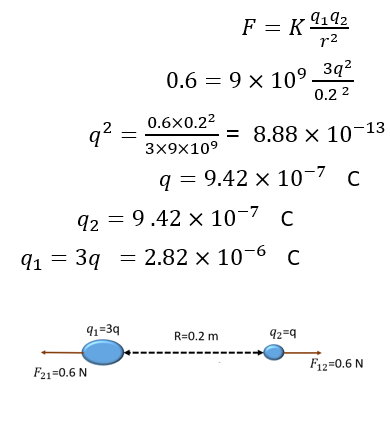
شحنتين من نفس النوع مقدار الأولى تعادل ثلاث أضعاف الشحنة الثانية كما في الشكل ادناه المسافة بينهما 0.2 m (0.6 N) إذا كانت القوة الكهربائية المتبادلة بينهما تعادل فإن مقدار كل من الشحنتين يعادل

أختر الإجابة الصحيحة
A\[q_2= 4.5 × 10^{-6}\;\;c\;\;\;\;\;\;\;\;q_1= 4.5 × 10^{-6}\;\;c\]
B\[q_2= 2.8 × 10^{-6}\;\;c\;\;\;\;\;\;\;\;q_1= 1 × 10^{-7}\;\;c\]
C\[q_2= 2.28 × 10^{-6}\;\;c\;\;\;\;\;\;\;\;q_1= 9.42 × 10^{-7}\;\;c\]
D\[q_2= 1.6 × 10^{-6}\;\;c\;\;\;\;\;\;\;\;q_1= 5.3 × 10^{-7}\;\;c\]
اضغط هنا تظهر طريقة الحل
ثلاث شحن متساوية في المقدار وأنواعها موضحة على الشكل وضعت على رؤوس مثلث متساوي الأضلاع فإن اتجاه ومقدار القوة المؤثرة على الشحنة الأولى تعادل

أختر الإجابة الصحيحة
A\[F_{net}=K\frac{q^2}{r^2}\;\;\;\;\;\;\] باتجاه الشمال
B\[F_{net}=K\frac{2q^2}{r^2}\;\;\;\;\;\;\] باتجاه شمال الشرق
C\[F_{net}=K\frac{2q^2}{r^2}\;\;\;\;\;\;\] باتجاه الشرق
D\[F_{net}=K\frac{q^2}{r^2}\;\;\;\;\;\;\] باتجاه الشرق
اضغط هنا تظهر طريقة الحل
تم وضع ثلاث شحن متساوية في النوع والمقدار شحنة كل منها \[2q\] على محيط نصف دائرة كما في الشكل أدناه بأبعاد متساوية وتم وضع في مركز الدائرة شحنة مقدارها \[-q\] فإن مقدار واتجاه القوة المؤثرة على الشحنة الموجودة في مركز الدائرة

أختر الإجابة الصحيحة
A\[F_{net}=K\frac{2q^2}{r^2}\;\;\;\;\;\;\] باتجاه اليسار
B\[F_{net}=K\frac{q^2}{r^2}\;\;\;\;\;\;\] باتجاه اليمين
C\[F_{net}=K\frac{q^2}{2r^2}\;\;\;\;\;\;\] باتجاه اليسار
D\[F_{net}=K\frac{2q^2}{4r^2}\;\;\;\;\;\;\] باتجاه شمال الشرق
اضغط هنا تظهر طريقة الحل
افترض انه تم شحن الأرض والقمر بشحنة متساوية في المقدار و النوع مقدار شحنة كل منهما \[q_e=q_m=q\] والمسافة بينهما \[r\] وأصبحت القوة الكهربائية تعادل قوة التجاب الكتلي بينهما تم تقريب القمر والأرض الى نصف المسافة بينهما حتى تتساوى القوة الكهربائية وقوة التجاذب الكتلي يجب شحن الأرض والقمر بشحنة مقدارها يعادل

أختر الإجابة الصحيحة
A\[q_e=q_m=0.5q\]
B\[q_e=q_m=q\]
C\[q_e=q_m=0.25q\]
D\[q_e=q_m=2q\]
اضغط هنا تظهر طريقة الحل
ثلاث شحن متساوية في المقدار والنوع وضعت على رؤوس مثلث متساوي الأضلاع (12 N) كما في الشكل ادناه تم حساب القوة المتبادلة بين شحنتين فكانت فإن محصلة القوى المؤثرة على أي شحنة تعادل

أختر الإجابة الصحيحة
A\[F_{net}=24 \;\; N\]
B\[F_{net}=16.65 \;\; N\]
C\[F_{net}=10.39 \;\; N\]
D\[F_{net}=20.87 \;\; N\]
اضغط هنا تظهر طريقة الحل
ثلاث شحنات وضعت على رؤوس مثلث قائم الزاوية كما في الشكل أدناه تم حساب القوة المؤثرة من الشحنة الثانية على الشحنة الأولى فكانت مركبات القوة \[F_{21}=(- 0.4\hat{x} , - 0.3\hat{y} )\] تم حساب القوة المؤثرة من الشحنة الثالثة على الشحنة الأولى فكانت مركبات القوة \[F_{31}=( 0\hat{x} , + 0.6\hat{y} )\] فإن أحد الإجابات التالية تطابق المعلومات السابقة والشكل

أختر الإجابة الصحيحة
AA
BB
CC
DD
اضغط هنا تظهر طريقة الحل
شحنتين مختلفتين في النوع مقدار الأولى يعادل ضعف الثانية \[q_1=+2q ,q_2=-q\] إذا أثرت قوة كهربائية من الشحنة الأولى على الثانية
\[F_{12}= 10 N \] نحو اليمين فإن القوة التي تؤثر بها الشحنة الثانية على الأولى تعادل
أختر الإجابة الصحيحة
A\[F_{21}=20 \;\;N \;\;\;\;\;\;\] نحو اليمين
B\[F_{21}=20 \;\;N \;\;\;\;\;\;\] نحو اليسار
C\[F_{21}=10 \;\;N \;\;\;\;\;\;\] نحو اليمين
D\[F_{21}=10 \;\;N \;\;\;\;\;\;\] نحو اليسار
اضغط هنا تظهر طريقة الحل
شحنتين لهما نفس المقدار كما في الشكل المسافة بينهما
0.2 m
فإذا كانت القوة الكهربائية المتبادلة بينهما تعادل
0.4 N
فإن مقدار كل من الشحنتين يعادل

أختر الإجابة الصحيحة
A\[q_1=q_2= 1.7 ×10^{-12} \;\;c\]
B\[q_1=q_2= 3.9 ×10^{-6}\;\;c\]
C\[q_1=q_2= 1.3 ×10^{-6}\;\;c\]
D\[q_1=q_2= 8.6 ×10^{-12}\;\;c\]
اضغط هنا تظهر طريقة الحل
جسم كروي تم ملامسة الكرة بجسم مشحون لوحظ أن الكرة عند موقع التلامس قد اكتسب شحنة مشابه للجسم المشحون وباقي الجسم بقي متعادل فإن الجسم الكروي يعتبر

أختر الإجابة الصحيحة
Aكرة فلزية
Bكرة جرفيت
Cكرة نحاسية
Dكرة زجاجية
اضغط هنا تظهر طريقة الحل
جسم مجهول الشحنة تم ملامسة الجسم مجهول الشحنة للكشاف فانفرجت ورقتي الكشاف أبعد الجسم مجهول الشحنة وتم تقريب جسم موجب الشحنة من الكشاف دون الملامسة لوحظ أن ورقتي الكشاف قد قل انفراجهما هذا دليل على أن الجسم مجهول الشحنة

أختر الإجابة الصحيحة
Aالجسم مشحون بشحنة موجبة
Bالجسم مشحون بشحنة سالبة
Cالجسم فقد الكترونات
Dالجسم غير مشحون
اضغط هنا تظهر طريقة الحل
مكشاف كهربائي متعادل رتب بشكل صحيح خطوات شحن المكشاف الكهربائي دون الملامسة بشحنة سالبة

أختر الإجابة الصحيحة
A\[B\;\;\Rightarrow\;\; D\;\;\Rightarrow\;\; C\;\;\Rightarrow A\;\;\;\;\;\; \]
B\[D\;\;\Rightarrow\;\; B\;\;\Rightarrow\;\; C\;\;\Rightarrow A \;\;\;\;\;\;\]
C\[C\;\;\Rightarrow\;\;B\;\;\Rightarrow\;\; A\;\;\Rightarrow D\;\;\;\;\;\; \]
D\[B\;\;\Rightarrow\;\; C\;\;\Rightarrow\;\; D\;\;\Rightarrow A\;\;\;\;\;\;\]
اضغط هنا تظهر طريقة الحل أجب عن الاسئلة التالية
\[1 \star\]
في الشكل أدناه وضعت أربع شحنات على رؤوس الزوايا لمربع طول ضلعة \[10\;cm\] مقدارها \[q_1=-3\;µ c\;\;\;\;\;\;\;q_2=-2\;µ c\;\;\;\;\;\;\;q_3=+3\;µ c\;\;\;\;\;\;\;q_4=-2\;µ c\] كما في الشكل أدناه احسب القوة الكهربائية المؤثرة على \[q_1\]

\[.....................................\;\;\;\;............................................\]
\[.....................................\;\;\;\;............................................\]
\[.....................................\;\;\;\;............................................\]
\[.....................................\;\;\;\;............................................\]
اضغط هنا تظهر طريقة الحل
(q1) تم حساب القوة المؤثرة على \[q_1\] فكانت 5 نيوتن واتجاهها موضح على الرسم وكانت القوة المؤثرة من q3 على q1 تعادل 3 نيوتن فإن الشحنة الثانية مقدارها ونوعها
\[.....................................\;\;\;\;............................................\]
\[.....................................\;\;\;\;............................................\]
\[.....................................\;\;\;\;............................................\]
\[.....................................\;\;\;\;............................................\]
اضغط هنا تظهر طريقة الحل
ثلاث شحنات مقدارها ونوعها \[q_1=-3\;\;𝜇𝑐\;\;\;\;\;\;q_2= +2 \;\;𝜇𝑐\;\;\;\;\;\;\;\;q_3= -4𝜇𝑐\] المسافة بينهما \[r_1=0.1 \;\;m\;\;\;\;\;\;r_2=0.2 \;\;m\] وضعت على خط واحد أبعادها كما في الشكل أحسب القوة الكهربائية المؤثرة على \[q_3\] وحدد الاتجاه \[k=9×10^9\;N.m^2/c^2\]

\[.....................................\;\;\;\;............................................\]
\[.....................................\;\;\;\;............................................\]
\[.....................................\;\;\;\;............................................\]
\[.....................................\;\;\;\;............................................\]
اضغط هنا تظهر طريقة الحل
شحنتين نفطيتين من نفس النوع مقدار الشحنة الأولى يعادل أربع أضعاف الثانية وضعت الشحنتين على مسافة من بعضهما قدرها \[r=0.4 \;\;m\] فتأثرت الشحنة الأولى بقوة نحو اليمين مقدارها \[F_{21}=0.8 \;\;N\]

احسب مقدار كل من الشحنتين
\[.........................................\;\;\;\;\;....................................\]
\[.........................................\;\;\;\;\;....................................\]
\[.........................................\;\;\;\;\;....................................\]
\[.........................................\;\;\;\;\;....................................\]
إذا زاد البعد بين الشحنتين إلى أربع أمثال كم تصبح القوة الكهربائية
\[.........................................\;\;\;\;\;....................................\]
\[.........................................\;\;\;\;\;....................................\]
\[.........................................\;\;\;\;\;....................................\]
اضغط هنا تظهر طريقة الحل
Which of the following charges could be the charge of an object?
Choose the correct answer
A\[q=3×10^{-19} \;\;c\;\;\;\;\;\;\]
B\[q=5.2×10^{-19} \;\;c\;\;\;\;\;\;\]
C\[q=2×10^{-19} \;\;c\;\;\;\;\;\;\]
D\[q=8×10^{-19} \;\;c\;\;\;\;\;\;\]
Click for AI solution
A glass rod is rubbed with a piece of wool and becomes positively charged. This means the rod:
Choose the correct answer
ALost protons
BGained protons
CGained electrons
DLost electrons
Click for AI solution
Which of the following conductors has decreased in mass? (A, B) occurred by induction, (C, D) occurred by contact.
Choose the correct answer
AA
BB
CC
DD
Click for AI solution
The number of electrons in 0.5 g of water is: (Molar mass of water = 18 g/mol, atomic numbers: O=8, H=1)
Choose the correct answer
A\[N=1.67×10^{25}\] electrons
B\[N=1.67×10^{24}\] electrons
C\[N=1.67×10^{23}\] electrons
D\[N=1.67×10^{22}\] electrons
Click for AI solution
The number of electrons in 2 grams of oxygen molecule \[O_2\] (Atomic mass of O = 16 g, atomic number = 8)
Choose the correct answer
A\[N=6.02×10^{22}\] electrons
B\[N=6.02×10^{23}\] electrons
C\[N=6.02×10^{24}\] electrons
D\[N=6.02×10^{25}\] electrons
Click for AI solution
A neutral electroscope has a positively charged conductor brought near it. The leaves of the electroscope diverge. This means:
Choose the correct answer
AThe knob is positively charged and the leaves are negatively charged
BThe knob is negatively charged and the leaves are positively charged
CBoth the knob and leaves are positively charged
DBoth the knob and leaves are negatively charged
Click for AI solution
Two identical neutral conductors have a positively charged object brought near them as shown. The conductors are separated from each other without removing the charged object. The charges on the conductors are:
Choose the correct answer
A(A negative) (B negative)
B(A positive) (B positive)
C(A negative) (B positive)
D(A positive) (B negative)
Click for AI solution
Two identical neutral conductors have a negatively charged object brought near them as shown. They are connected to ground, then the ground connection is removed, and the conductors are separated without removing the charged object. The charges on the conductors are:
Choose the correct answer
A(A neutral) (B negative)
B(A positive) (B negative)
C(A neutral) (B positive)
D(A positive) (B positive)
Click for AI solution
Two identical neutral conductors have a positively charged object brought near them as shown. They are connected to ground, then the ground connection is removed, and the charged object is removed, then the conductors are separated. The charges on the conductors are:
Choose the correct answer
A(A negative) (B negative)
B(A positive) (B negative)
C(A neutral) (B positive)
D(A positive) (B neutral)
Click for AI solution
Two identical spherical conductors A and B are charged with -3 µC and +9 µC respectively. They are touched together and then separated. The number of electrons lost by conductor A is:
Choose the correct answer
A\[ 3.75 ×10^{13}\] electrons
B\[1.87 ×10^{13}\] electrons
C\[ 4.43 ×10^{13}\] electrons
D\[5.85 ×10^{13}\] electrons
Click for AI solution
An n-type semiconductor is doped with group 15 elements. At absolute zero temperature, the charge carriers responsible for current are:
Choose the correct answer
AHoles and electrons
BOnly holes
COnly electrons
DOnly positive charges
Click for AI solution
An electroscope with its base connected to ground has a negatively charged object brought near it without touching. Which figure shows what happens to the electroscope?
Choose the correct answer
AA
BB
CC
DD
Click for AI solution
\[13 \star\]
By what factor does the distance between two charges change if the force between them doubles while all other factors remain constant?
Choose the correct answer
A\[r_2=0.7 r\]
B\[r_2=4 r\]
C\[r_2=0.25 r\]
D\[r_2=2 r\]
Click for AI solution
If charge 1 exerts an electric force of 10 N to the right on charge 2, the force exerted by charge 2 on charge 1 is:
Choose the correct answer
ACannot be determined without knowing the magnitudes of the charges
B\[F_{21}=10\;\;N\] to the right
CCannot be determined without knowing the types of charges
D\[F_{21}=10\;\;N\] to the left
Click for AI solution
Three charges of the same type are arranged in a straight line as shown. The direction and magnitude of the force on charge q2 is:
Choose the correct answer
A\[F_{net}=0.0\;\;\;\;\;\;\]
B\[F_{net}=\frac{K.q^2}{2r^2}\] to the right
C\[F_{net}=\frac{K.q^2}{4r^2}\] to the right
D\[F_{net}=\frac{K.q^2}{2r^2}\] to the left
\[16 \star \star \star\]
The force on q1 was calculated to be 5 N with direction shown in the figure. The force from q3 on q1 is 3 N. What is the magnitude and sign of charge q2?
Choose the correct answer
A\[q_2= 2.2×10^{-6}\;\;c\] positive
B\[q_2= 4.4×10^{-6}\;\;c\] positive
C\[q_2= 6.6×10^{-6}\;\;c\] negative
D\[q_2= 3.3×10^{-6}\;\;c\] negative
Click for AI solution
Two point charges q1 = -4 µC and q2 (unknown) are separated by r = 0.1 m. An electron is placed between them at r2 = 0.02 m from q2 as shown. The electron is in equilibrium. What is the magnitude and sign of q2?
Choose the correct answer
A\[q_2= 2.5×10^{-5}\;\;c\] negative
B\[q_2= 5.3×10^{-5}\;\;c\] positive
C\[q_2= 6.5×10^{-5}\;\;c\] positive
D\[q_2= 3.5×10^{-5}\;\;c\] negative
Click for AI solution
The figure shows three positive point charges on a straight line. If the net electric force on the middle charge is zero, what is the ratio \[\frac{𝑟_1}{𝑟_2}\]?
Choose the correct answer
A\[\frac{𝑟_1}{𝑟_2}=0.81\]
B\[\frac{𝑟_1}{𝑟_2}=1.22\]
C\[\frac{𝑟_1}{𝑟_2}=0.57\]
D\[\frac{𝑟_1}{𝑟_2}=1.41\]
Click for AI solution
Two charges of different types: the first is positive and four times the second which is negative. The first charge is placed at the origin and the second at 10 cm along the x-axis. At what position should a proton be placed so that the net force on it is zero?
Choose the correct answer
A\[X=0.14 \;\;m\]
B\[X=0.04 \;\;m\]
C\[X=0.2 \;\;m\]
D\[X=0.16 \;\;m\]
Click for AI solution
Two identical charged spheres of mass 0.1 kg each are suspended by massless, inextensible strings. They repel each other so that each string makes an angle of 10° with the vertical. What is the electric force on each sphere?
Choose the correct answer
A\[Fe= 0.43\;\; N\]
B\[Fe= 0.33\;\; N\]
C\[Fe= 0.59\;\; N\]
D\[Fe= 0.17\;\; N\]
Click for AI solution
If charge 1 exerts an electric force of 10 N to the right on charge 2, the force exerted by charge 2 on charge 1 is:
Choose the correct answer
ACannot be determined without knowing the magnitudes of the charges
B\[F_{21}=10\;\;N\] to the right
CCannot be determined without knowing the types of charges
D\[F_{21}=10\;\;N\] to the left
Click for AI solution
Two charges of the same type, where q1 is three times q2, are separated by 0.2 m. If the electric force between them is 0.6 N, what are the magnitudes of the charges?
Choose the correct answer
A\[q_2= 4.5 × 10^{-6}\;\;c\;\;\;\;\;\;\;\;q_1= 4.5 × 10^{-6}\;\;c\]
B\[q_2= 2.8 × 10^{-6}\;\;c\;\;\;\;\;\;\;\;q_1= 1 × 10^{-7}\;\;c\]
C\[q_2= 2.28 × 10^{-6}\;\;c\;\;\;\;\;\;\;\;q_1= 9.42 × 10^{-7}\;\;c\]
D\[q_2= 1.6 × 10^{-6}\;\;c\;\;\;\;\;\;\;\;q_1= 5.3 × 10^{-7}\;\;c\]
Click for AI solution
Three equal charges are placed at the vertices of an equilateral triangle as shown. What is the direction and magnitude of the net force on the first charge?
Choose the correct answer
A\[F_{net}=K\frac{q^2}{r^2}\] North
B\[F_{net}=K\frac{2q^2}{r^2}\] Northeast
C\[F_{net}=K\frac{2q^2}{r^2}\] East
D\[F_{net}=K\frac{q^2}{r^2}\] East
Click for AI solution
Three equal charges of 2q are placed on the circumference of a semicircle at equal distances. A charge of -q is placed at the center. What is the magnitude and direction of the force on the charge at the center?
Choose the correct answer
A\[F_{net}=K\frac{2q^2}{r^2}\] to the left
B\[F_{net}=K\frac{q^2}{r^2}\] to the right
C\[F_{net}=K\frac{q^2}{2r^2}\] to the left
D\[F_{net}=K\frac{2q^2}{4r^2}\] Northeast
Click for AI solution
Assume the Earth and Moon are charged equally with charge q. The electric force equals the gravitational force at distance r. If the distance is halved, what charge is needed on both for the forces to remain equal?
Choose the correct answer
A\[q_e=q_m=0.5q\]
B\[q_e=q_m=q\]
C\[q_e=q_m=0.25q\]
D\[q_e=q_m=2q\]
Click for AI solution
Three equal charges are placed at the vertices of an equilateral triangle. The force between any two charges is 12 N. What is the net force on any charge?
Choose the correct answer
A\[F_{net}=24 \;\; N\]
B\[F_{net}=16.65 \;\; N\]
C\[F_{net}=10.39 \;\; N\]
D\[F_{net}=20.87 \;\; N\]
Click for AI solution
Three charges are placed at the vertices of a right triangle as shown. The force from q2 on q1 has components F21 = (-0.4, -0.3). The force from q3 on q1 has components F31 = (0, +0.6). Which option matches the given information and figure?
Choose the correct answer
AA
BB
CC
DD
Click for AI solution
Two different types of charges: q1 = +2q, q2 = -q. If charge 1 exerts a force of 10 N to the right on charge 2, the force exerted by charge 2 on charge 1 is:
Choose the correct answer
A\[F_{21}=20 \;\;N\] to the right
B\[F_{21}=20 \;\;N\] to the left
C\[F_{21}=10 \;\;N\] to the right
D\[F_{21}=10 \;\;N\] to the left
Click for AI solution
Two equal charges are separated by 0.2 m. If the electric force between them is 0.4 N, what is the magnitude of each charge?
Choose the correct answer
A\[q_1=q_2= 1.7 ×10^{-12} \;\;c\]
B\[q_1=q_2= 3.9 ×10^{-6}\;\;c\]
C\[q_1=q_2= 1.3 ×10^{-6}\;\;c\]
D\[q_1=q_2= 8.6 ×10^{-12}\;\;c\]
Click for AI solution
A spherical object is touched by a charged object. The sphere acquires a charge similar to the charged object only at the point of contact, while the rest remains neutral. What type of material is the sphere?
Choose the correct answer
AMetal sphere
BGraphite sphere
CCopper sphere
DGlass sphere
Click for AI solution
An unknown charged object touches an electroscope and the leaves diverge. The unknown object is removed and a positively charged object is brought near without touching. The leaves diverge less. This indicates that the unknown object was:
Choose the correct answer
APositively charged
BNegatively charged
CLost electrons
DUncharged
Click for AI solution
A neutral electroscope. Arrange the correct steps to charge it by induction using a negative charge.
Choose the correct answer
A\[B\;\;\Rightarrow\;\; D\;\;\Rightarrow\;\; C\;\;\Rightarrow A\;\;\;\;\;\; \]
B\[D\;\;\Rightarrow\;\; B\;\;\Rightarrow\;\; C\;\;\Rightarrow A \;\;\;\;\;\;\]
C\[C\;\;\Rightarrow\;\;B\;\;\Rightarrow\;\; A\;\;\Rightarrow D\;\;\;\;\;\; \]
D\[B\;\;\Rightarrow\;\; C\;\;\Rightarrow\;\; D\;\;\Rightarrow A\;\;\;\;\;\;\]
Click for AI solution Answer the following questions
In the figure below, four charges are placed at the corners of a square of side length 10 cm: q1 = -3 µC, q2 = -2 µC, q3 = +3 µC, q4 = -2 µC. Calculate the electric force on q1.
\[.....................................\;\;\;\;............................................\]
\[.....................................\;\;\;\;............................................\]
\[.....................................\;\;\;\;............................................\]
\[.....................................\;\;\;\;............................................\]
Click for AI solution
The force on q1 was calculated to be 5 N with direction shown. The force from q3 on q1 is 3 N. What is the magnitude and sign of charge q2?
\[.....................................\;\;\;\;............................................\]
\[.....................................\;\;\;\;............................................\]
\[.....................................\;\;\;\;............................................\]
\[.....................................\;\;\;\;............................................\]
Click for AI solution
Three charges q1 = -3 µC, q2 = +2 µC, q3 = -4 µC are placed on a line with distances r1 = 0.1 m and r2 = 0.2 m as shown. Calculate the electric force on q3 and determine its direction. (k = 9×10^9 N.m²/C²)
\[.....................................\;\;\;\;............................................\]
\[.....................................\;\;\;\;............................................\]
\[.....................................\;\;\;\;............................................\]
\[.....................................\;\;\;\;............................................\]
Click for AI solution
Two point charges of the same type, where q1 = 4q2, are placed at distance r = 0.4 m. q1 experiences a force of 0.8 N to the right.
Calculate the magnitude of each charge.
\[.........................................\;\;\;\;\;....................................\]
\[.........................................\;\;\;\;\;....................................\]
\[.........................................\;\;\;\;\;....................................\]
\[.........................................\;\;\;\;\;....................................\]
If the distance is increased to four times, what will the new electric force be?
\[.........................................\;\;\;\;\;....................................\]
\[.........................................\;\;\;\;\;....................................\]
\[.........................................\;\;\;\;\;....................................\]
Click for AI solution
أحد الشحنات التالية من الممكن أن تكون شحنة جسم
أختر الإجابة الصحيحة
 اضغط هنا تظهر طريقة الحل
تم دلك قضيب من الزجاج بقطعة من الصوف فأصبح القضيب مشحون بشحنة موجبة فإن القضيب يكون
أختر الإجابة الصحيحة
 اضغط هنا تظهر طريقة الحل
أحد الموصلات التالية قد قلت كتلته
مع العلم
(A , B) حدث التقريب في الصورة
(C , D) حدث تلامس في الصورة
أختر الإجابة الصحيحة
 اضغط هنا تظهر طريقة الحل
(0.5 g) عدد الالكترونات الموجودة في
من الماء تعادل
(18) علما بأن الكتلة المولية للماء تعادل
العدد الذري للأوكسجين يعادل 8 والعدد الذري للهيدروجين يعادل 1
أختر الإجابة الصحيحة
 اضغط هنا تظهر طريقة الحل
عدد الإلكترونات الموجودة في 2جرام من جزيء الأوكسجين
\[o_2\]
علما بأن الكتلة الذرية للأوكسجين \[M=16\;g\] والعدد الذري يعادل 8
أختر الإجابة الصحيحة
 اضغط هنا تظهر طريقة الحل
كشاف كهربائي متعادل تم تقريب منة موصل مشحون بشحنة موجبة لوحظ أن الكشاف قد انفرجت ورقتاه فإن
أختر الإجابة الصحيحة
 اضغط هنا تظهر طريقة الحل
موصلان متشابهان متعادلان تم تقريب جسم مشحون بشحنة موجبة كما في الشكل من الموصلين وتم ابعاد الموصلين عن بعضهما البعض دون ابعاد الجسم المشحون فان شحنة الموصلين
أختر الإجابة الصحيحة
 اضغط هنا تظهر طريقة الحل
موصلان متشابهان متعادلان تم تقريب جسم مشحون بشحنة سالبة كما في الشكل من الموصلين ثم تم التوصيل بالأرض ومن بعدها قطع الاتصال بالأرض و تم ابعاد الموصلين عن بعضهما البعض دون ابعاد الجسم المشحون فان شحنة الموصلين
أختر الإجابة الصحيحة
 اضغط هنا تظهر طريقة الحل
موصلان متشابهان متعادلان تم تقريب جسم مشحون بشحنة موجبة كما في الشكل من الموصلين ثم تم التوصيل بالأرض ومن بعدها قطع الاتصال بالأرض و ابعد الجسم المشحون و تم ابعاد الموصلين عن بعضهما البعض فان شحنة الموصلين
أختر الإجابة الصحيحة
 اضغط هنا تظهر طريقة الحل
(A) موصلان كرويان متماثلان تم شحن الموصل
(-3µc) بشحنة مقدارها
(B) تم شحن الموصل
(9µc) بشحنة مقدارها
(A) تم ملامسة الموصلان ببعضهما البعض ثم أبعد الموصلان عن بعضهما البعض فإن عدد الإلكترونات التي فقدها الموصل
تعادل
أختر الإجابة الصحيحة
 اضغط هنا تظهر طريقة الحل
(n) في شبه موصل تم تطعيمه بعناصر من المجموعة 15 فأصبح شبة موصل نمط قادر على توصيل التيار فإن المسؤول عن نقل التيار في شبة الموصل في درجة حرارة الصفر المطلق
أختر الإجابة الصحيحة
 اضغط هنا تظهر طريقة الحل
كشاف كهربائي قاعدتة متصلة بالأرض تم تقريب جسم مشحون بشحنة سالبة من الكشاف دون الملامسة أحد الاشكال التالية تبين ماذا يحدث للكشاف
أختر الإجابة الصحيحة
 اضغط هنا تظهر طريقة الحل
بأي عامل يتغير البعد بين شحنتين إذا زادت القوة المتبادلة بين شحنتين إلى الضعف مع بقاء باقي العوامل ثابته
أختر الإجابة الصحيحة
 اضغط هنا تظهر طريقة الحل
إذا أثرت قوة كهربائية من الشحنة الأولى على الثانية
10N
نحو اليمين فإن القوة التي تؤثر بها الشحنة الثانية على الأولى تعادل
اختر الإجابة الصحيحة
 اضغط هنا تظهر طريقة الحل
ثلاث شحنات على استقامة واحدة كما في الشكل من نفس النوع ومقاديرها موضحة على الشكل فإن اتجاه و مقدار القوة المؤثرة على الشحنة
q2
أختر الإجابة الصحيحة

تم حساب القوة المؤثرة على \[q_1\] فكانت 5 نيوتن واتجاهها موضح على الرسم
وكانت القوة المؤثرة من
q3 على q1
تعادل 3 نيوتن فإن الشحنة الثانية مقدارها ونوعها
أختر الإجابة الصحيحة
 اضغط هنا تظهر طريقة الحل
شحنتين نقطيتين الأولى مقدارها \[q_1=- 4\;\;𝜇𝑐\] الثانية غير معلومة المقدار والنوع \[q_2= ?\] المسافة بينهما \[r=0.1\;\; m\] تم وضع إلكترون بين الشحنتين كما في الشكل أدناه وعلى بعد \[r_2= 0.02\;\; m\]من الشحنه الثانية لوحظ أن الإلكترون متزن فإن مقدار ونوع الشحنة الثانية تعادل
أختر الإجابة الصحيحة
 اضغط هنا تظهر طريقة الحل
يوضح الشكل أدناه رسوم ثلاث شحنات نقطية على استقامة واحدة، موجبة الشحنة. إذا كانت القوة الكهربائية الكلية المؤثرة على الشحنة الثانية معدومة فإن النسبة \[\frac{𝑟_1}{𝑟_2}\] تعادل
أختر الإجابة الصحيحة
 اضغط هنا تظهر طريقة الحل
شحنتين مختلفتين في النوع الأولى موجبة وهي أربع أمثال الثانية التي هي سالبة الشحنة تم وضع الشحنة الأولى عند نقطة الأصل والثانية على بعد \[10\;\; Cm\] باتجاه المحور الأفقي كما هو موضح بالشكل عند أي موضع نضع بروتون وتكون محصلة القوى علية معدومة
أختر الإجابة الصحيحة
 اضغط هنا تظهر طريقة الحل
كرتين مشحونتين بشحنة متماثلة ولهما نفس الكتلة كتلة كل منهما \[m_1=m_2=0.1\;\; Kg\] تم تعليقهما بخيط لا يمتط وعديم الكتلة فابتعدت الكرتين عن بعضهم بقوة كهربائية
بحيث شكل الخيط لكل منهما زاوية \[𝜃 = 10^0\] مع الخط الرأسي فإن القوة الكهربائية المؤثره على كل كرة
أختر الإجابة الصحيحة
 اضغط هنا تظهر طريقة الحل
إذا أثرت قوة كهربائية من الشحنة الأولى على الثانية
10N
نحو اليمين فإن القوة التي تؤثر بها الشحنة الثانية على الأولى تعادل
أختر الإجابة الصحيحة
اضغط هنا تظهر طريقة الحل
شحنتين من نفس النوع مقدار الأولى تعادل ثلاث أضعاف الشحنة الثانية كما في الشكل ادناه المسافة بينهما 0.2 m (0.6 N) إذا كانت القوة الكهربائية المتبادلة بينهما تعادل فإن مقدار كل من الشحنتين يعادل
أختر الإجابة الصحيحة
 اضغط هنا تظهر طريقة الحل
ثلاث شحن متساوية في المقدار وأنواعها موضحة على الشكل وضعت على رؤوس مثلث متساوي الأضلاع فإن اتجاه ومقدار القوة المؤثرة على الشحنة الأولى تعادل
أختر الإجابة الصحيحة
 اضغط هنا تظهر طريقة الحل
تم وضع ثلاث شحن متساوية في النوع والمقدار شحنة كل منها \[2q\] على محيط نصف دائرة كما في الشكل أدناه بأبعاد متساوية وتم وضع في مركز الدائرة شحنة مقدارها \[-q\] فإن مقدار واتجاه القوة المؤثرة على الشحنة الموجودة في مركز الدائرة
أختر الإجابة الصحيحة
 اضغط هنا تظهر طريقة الحل
افترض انه تم شحن الأرض والقمر بشحنة متساوية في المقدار و النوع مقدار شحنة كل منهما \[q_e=q_m=q\] والمسافة بينهما \[r\] وأصبحت القوة الكهربائية تعادل قوة التجاب الكتلي بينهما تم تقريب القمر والأرض الى نصف المسافة بينهما حتى تتساوى القوة الكهربائية وقوة التجاذب الكتلي يجب شحن الأرض والقمر بشحنة مقدارها يعادل
أختر الإجابة الصحيحة
 اضغط هنا تظهر طريقة الحل
ثلاث شحن متساوية في المقدار والنوع وضعت على رؤوس مثلث متساوي الأضلاع (12 N) كما في الشكل ادناه تم حساب القوة المتبادلة بين شحنتين فكانت فإن محصلة القوى المؤثرة على أي شحنة تعادل
أختر الإجابة الصحيحة
 اضغط هنا تظهر طريقة الحل
ثلاث شحنات وضعت على رؤوس مثلث قائم الزاوية كما في الشكل أدناه تم حساب القوة المؤثرة من الشحنة الثانية على الشحنة الأولى فكانت مركبات القوة \[F_{21}=(- 0.4\hat{x} , - 0.3\hat{y} )\] تم حساب القوة المؤثرة من الشحنة الثالثة على الشحنة الأولى فكانت مركبات القوة \[F_{31}=( 0\hat{x} , + 0.6\hat{y} )\] فإن أحد الإجابات التالية تطابق المعلومات السابقة والشكل
أختر الإجابة الصحيحة
 اضغط هنا تظهر طريقة الحل
شحنتين مختلفتين في النوع مقدار الأولى يعادل ضعف الثانية \[q_1=+2q ,q_2=-q\] إذا أثرت قوة كهربائية من الشحنة الأولى على الثانية
\[F_{12}= 10 N \] نحو اليمين فإن القوة التي تؤثر بها الشحنة الثانية على الأولى تعادل
أختر الإجابة الصحيحة
 اضغط هنا تظهر طريقة الحل
شحنتين لهما نفس المقدار كما في الشكل المسافة بينهما
0.2 m
فإذا كانت القوة الكهربائية المتبادلة بينهما تعادل
0.4 N
فإن مقدار كل من الشحنتين يعادل

أختر الإجابة الصحيحة
 اضغط هنا تظهر طريقة الحل
جسم كروي تم ملامسة الكرة بجسم مشحون لوحظ أن الكرة عند موقع التلامس قد اكتسب شحنة مشابه للجسم المشحون وباقي الجسم بقي متعادل فإن الجسم الكروي يعتبر
أختر الإجابة الصحيحة
 اضغط هنا تظهر طريقة الحل
جسم مجهول الشحنة تم ملامسة الجسم مجهول الشحنة للكشاف فانفرجت ورقتي الكشاف أبعد الجسم مجهول الشحنة وتم تقريب جسم موجب الشحنة من الكشاف دون الملامسة لوحظ أن ورقتي الكشاف قد قل انفراجهما هذا دليل على أن الجسم مجهول الشحنة
أختر الإجابة الصحيحة
 اضغط هنا تظهر طريقة الحل
مكشاف كهربائي متعادل رتب بشكل صحيح خطوات شحن المكشاف الكهربائي دون الملامسة بشحنة سالبة
أختر الإجابة الصحيحة
 اضغط هنا تظهر طريقة الحل
أجب عن الاسئلة التالية
في الشكل أدناه وضعت أربع شحنات على رؤوس الزوايا لمربع طول ضلعة \[10\;cm\] مقدارها \[q_1=-3\;µ c\;\;\;\;\;\;\;q_2=-2\;µ c\;\;\;\;\;\;\;q_3=+3\;µ c\;\;\;\;\;\;\;q_4=-2\;µ c\] كما في الشكل أدناه احسب القوة الكهربائية المؤثرة على \[q_1\]
\[.....................................\;\;\;\;............................................\]
\[.....................................\;\;\;\;............................................\]
\[.....................................\;\;\;\;............................................\]
\[.....................................\;\;\;\;............................................\]
 اضغط هنا تظهر طريقة الحل
(q1) تم حساب القوة المؤثرة على \[q_1\] فكانت 5 نيوتن واتجاهها موضح على الرسم وكانت القوة المؤثرة من q3 على q1 تعادل 3 نيوتن فإن الشحنة الثانية مقدارها ونوعها
\[.....................................\;\;\;\;............................................\]
\[.....................................\;\;\;\;............................................\]
\[.....................................\;\;\;\;............................................\]
\[.....................................\;\;\;\;............................................\]
اضغط هنا تظهر طريقة الحل
ثلاث شحنات مقدارها ونوعها \[q_1=-3\;\;𝜇𝑐\;\;\;\;\;\;q_2= +2 \;\;𝜇𝑐\;\;\;\;\;\;\;\;q_3= -4𝜇𝑐\] المسافة بينهما \[r_1=0.1 \;\;m\;\;\;\;\;\;r_2=0.2 \;\;m\] وضعت على خط واحد أبعادها كما في الشكل أحسب القوة الكهربائية المؤثرة على \[q_3\] وحدد الاتجاه \[k=9×10^9\;N.m^2/c^2\]
\[.....................................\;\;\;\;............................................\]
\[.....................................\;\;\;\;............................................\]
\[.....................................\;\;\;\;............................................\]
\[.....................................\;\;\;\;............................................\]
 اضغط هنا تظهر طريقة الحل
شحنتين نفطيتين من نفس النوع مقدار الشحنة الأولى يعادل أربع أضعاف الثانية وضعت الشحنتين على مسافة من بعضهما قدرها \[r=0.4 \;\;m\] فتأثرت الشحنة الأولى بقوة نحو اليمين مقدارها \[F_{21}=0.8 \;\;N\]
احسب مقدار كل من الشحنتين
\[.........................................\;\;\;\;\;....................................\]
\[.........................................\;\;\;\;\;....................................\]
\[.........................................\;\;\;\;\;....................................\]
إذا زاد البعد بين الشحنتين إلى أربع أمثال كم تصبح القوة الكهربائية
\[.........................................\;\;\;\;\;....................................\]
\[.........................................\;\;\;\;\;....................................\]
 اضغط هنا تظهر طريقة الحل
Which of the following charges could be the charge of an object?
Choose the correct answer
Click for AI solution
A glass rod is rubbed with a piece of wool and becomes positively charged. This means the rod:
Choose the correct answer
Click for AI solution
Which of the following conductors has decreased in mass? (A, B) occurred by induction, (C, D) occurred by contact.
Choose the correct answer
Click for AI solution
The number of electrons in 0.5 g of water is: (Molar mass of water = 18 g/mol, atomic numbers: O=8, H=1)
Choose the correct answer
Click for AI solution
The number of electrons in 2 grams of oxygen molecule \[O_2\] (Atomic mass of O = 16 g, atomic number = 8)
Choose the correct answer
Click for AI solution
A neutral electroscope has a positively charged conductor brought near it. The leaves of the electroscope diverge. This means:
Choose the correct answer
Click for AI solution
Two identical neutral conductors have a positively charged object brought near them as shown. The conductors are separated from each other without removing the charged object. The charges on the conductors are:
Choose the correct answer
Click for AI solution
Two identical neutral conductors have a negatively charged object brought near them as shown. They are connected to ground, then the ground connection is removed, and the conductors are separated without removing the charged object. The charges on the conductors are:
Choose the correct answer
Click for AI solution
Two identical neutral conductors have a positively charged object brought near them as shown. They are connected to ground, then the ground connection is removed, and the charged object is removed, then the conductors are separated. The charges on the conductors are:
Choose the correct answer
Click for AI solution
Two identical spherical conductors A and B are charged with -3 µC and +9 µC respectively. They are touched together and then separated. The number of electrons lost by conductor A is:
Choose the correct answer
Click for AI solution
An n-type semiconductor is doped with group 15 elements. At absolute zero temperature, the charge carriers responsible for current are:
Choose the correct answer
Click for AI solution
An electroscope with its base connected to ground has a negatively charged object brought near it without touching. Which figure shows what happens to the electroscope?
Choose the correct answer
Click for AI solution
By what factor does the distance between two charges change if the force between them doubles while all other factors remain constant?
Choose the correct answer
Click for AI solution
If charge 1 exerts an electric force of 10 N to the right on charge 2, the force exerted by charge 2 on charge 1 is:
Choose the correct answer
Click for AI solution
Three charges of the same type are arranged in a straight line as shown. The direction and magnitude of the force on charge q2 is:
Choose the correct answer
The force on q1 was calculated to be 5 N with direction shown in the figure. The force from q3 on q1 is 3 N. What is the magnitude and sign of charge q2?
Choose the correct answer
Click for AI solution
Two point charges q1 = -4 µC and q2 (unknown) are separated by r = 0.1 m. An electron is placed between them at r2 = 0.02 m from q2 as shown. The electron is in equilibrium. What is the magnitude and sign of q2?
Choose the correct answer
Click for AI solution
The figure shows three positive point charges on a straight line. If the net electric force on the middle charge is zero, what is the ratio \[\frac{𝑟_1}{𝑟_2}\]?
Choose the correct answer
Click for AI solution
Two charges of different types: the first is positive and four times the second which is negative. The first charge is placed at the origin and the second at 10 cm along the x-axis. At what position should a proton be placed so that the net force on it is zero?
Choose the correct answer
Click for AI solution
Two identical charged spheres of mass 0.1 kg each are suspended by massless, inextensible strings. They repel each other so that each string makes an angle of 10° with the vertical. What is the electric force on each sphere?
Choose the correct answer
Click for AI solution
If charge 1 exerts an electric force of 10 N to the right on charge 2, the force exerted by charge 2 on charge 1 is:
Choose the correct answer
Click for AI solution
Two charges of the same type, where q1 is three times q2, are separated by 0.2 m. If the electric force between them is 0.6 N, what are the magnitudes of the charges?
Choose the correct answer
Click for AI solution
Three equal charges are placed at the vertices of an equilateral triangle as shown. What is the direction and magnitude of the net force on the first charge?
Choose the correct answer
Click for AI solution
Three equal charges of 2q are placed on the circumference of a semicircle at equal distances. A charge of -q is placed at the center. What is the magnitude and direction of the force on the charge at the center?
Choose the correct answer
Click for AI solution
Assume the Earth and Moon are charged equally with charge q. The electric force equals the gravitational force at distance r. If the distance is halved, what charge is needed on both for the forces to remain equal?
Choose the correct answer
Click for AI solution
Three equal charges are placed at the vertices of an equilateral triangle. The force between any two charges is 12 N. What is the net force on any charge?
Choose the correct answer
Click for AI solution
Three charges are placed at the vertices of a right triangle as shown. The force from q2 on q1 has components F21 = (-0.4, -0.3). The force from q3 on q1 has components F31 = (0, +0.6). Which option matches the given information and figure?
Choose the correct answer
Click for AI solution
Two different types of charges: q1 = +2q, q2 = -q. If charge 1 exerts a force of 10 N to the right on charge 2, the force exerted by charge 2 on charge 1 is:
Choose the correct answer
Click for AI solution
Two equal charges are separated by 0.2 m. If the electric force between them is 0.4 N, what is the magnitude of each charge?
Choose the correct answer
Click for AI solution
A spherical object is touched by a charged object. The sphere acquires a charge similar to the charged object only at the point of contact, while the rest remains neutral. What type of material is the sphere?
Choose the correct answer
Click for AI solution
An unknown charged object touches an electroscope and the leaves diverge. The unknown object is removed and a positively charged object is brought near without touching. The leaves diverge less. This indicates that the unknown object was:
Choose the correct answer
Click for AI solution
A neutral electroscope. Arrange the correct steps to charge it by induction using a negative charge.
Choose the correct answer
Click for AI solutionAnswer the following questions
In the figure below, four charges are placed at the corners of a square of side length 10 cm: q1 = -3 µC, q2 = -2 µC, q3 = +3 µC, q4 = -2 µC. Calculate the electric force on q1.
\[.....................................\;\;\;\;............................................\]
\[.....................................\;\;\;\;............................................\]
\[.....................................\;\;\;\;............................................\]
\[.....................................\;\;\;\;............................................\]
Click for AI solution
The force on q1 was calculated to be 5 N with direction shown. The force from q3 on q1 is 3 N. What is the magnitude and sign of charge q2?
\[.....................................\;\;\;\;............................................\]
\[.....................................\;\;\;\;............................................\]
\[.....................................\;\;\;\;............................................\]
\[.....................................\;\;\;\;............................................\]
Click for AI solution
Three charges q1 = -3 µC, q2 = +2 µC, q3 = -4 µC are placed on a line with distances r1 = 0.1 m and r2 = 0.2 m as shown. Calculate the electric force on q3 and determine its direction. (k = 9×10^9 N.m²/C²)
\[.....................................\;\;\;\;............................................\]
\[.....................................\;\;\;\;............................................\]
\[.....................................\;\;\;\;............................................\]
\[.....................................\;\;\;\;............................................\]
Click for AI solution
Two point charges of the same type, where q1 = 4q2, are placed at distance r = 0.4 m. q1 experiences a force of 0.8 N to the right.
Calculate the magnitude of each charge.
\[.........................................\;\;\;\;\;....................................\]
\[.........................................\;\;\;\;\;....................................\]
\[.........................................\;\;\;\;\;....................................\]
If the distance is increased to four times, what will the new electric force be?
\[.........................................\;\;\;\;\;....................................\]
\[.........................................\;\;\;\;\;....................................\]
Click for AI solution
السلام عليكم
ReplyDeleteالسؤال 5
مش المفروض نضرب في 16 في نهاية الحل بدل 8 لأن جزيء الاكسجين فيه ذرتين ؟
o(₂)
الناتج هيكون 1.204×10²⁴
وعليكم السلام لا لوجود ذرتين في جزيئ الأوكسجين
Delete