 Physics
(12 A) بنك الاسئلة الجهد الكهربائي وطاقة الوضع |

📄 اطبع pdf
00971504825082
الأسئلة الاختياريةMultiple Choice Questions
 اضغط هنا تظهر طريقة الحلSolution
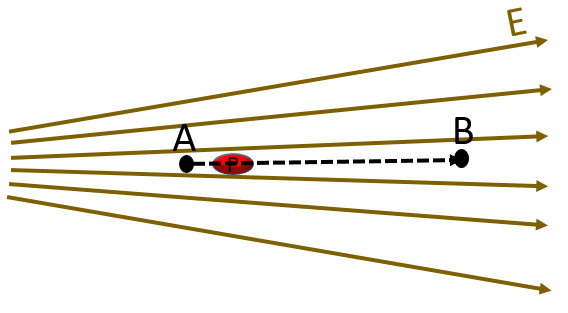
الحل: طاقة الوضع للشحنة الموجبة تزداد عند حركتها عكس اتجاه المجال الكهربائي.
اضغط هنا تظهر طريقة الحلSolution
الحل: طاقة الوضع للشحنة الموجبة تزداد عند حركتها عكس اتجاه المجال الكهربائي.
الإجابة الصحيحة: BSolution: The potential energy of a positive charge increases when moving opposite to the electric field.
Correct: B
2 \(\star\)
شحنة موجبة (بروتون) تم تحريكه بين نقطتين \[A\Rightarrow B\] إحداثيات النقطتين \[A=(2,-3)\] و \[B=(-2,2)\] في مجال منتظم \[E=4\times10^3 N/C\] يتجه نحو المحور الرأسي السالب، فإن التغير في طاقة الوضع الكهربائية تعادل \[q_p=1.6\times10^{-19}C\]
A positive charge (proton) is moved from \[A\Rightarrow B\]. Points coordinates \[A=(2,-3)\] and \[B=(-2,2)\] in a uniform field \[E=4\times10^3 N/C\] directed downward. The change in electric potential energy is \[q_p=1.6\times10^{-19}C\]
 A\[\Delta U=3.2\times10^{-15}J\]\[\Delta U=3.2\times10^{-15}J\]
B\[\Delta U=2.56\times10^{-15}J\]\[\Delta U=2.56\times10^{-15}J\]
C\[\Delta U=-2.56\times10^{-15}J\]\[\Delta U=-2.56\times10^{-15}J\]
D\[\Delta U=-3.2\times10^{-15}J\]\[\Delta U=-3.2\times10^{-15}J\]
اضغط هنا تظهر طريقة الحلSolution
الحل: \[\Delta U = q \times E \times \Delta y = 1.6\times10^{-19}\times4\times10^3\times(-5)=3.2\times10^{-15}J\]
A\[\Delta U=3.2\times10^{-15}J\]\[\Delta U=3.2\times10^{-15}J\]
B\[\Delta U=2.56\times10^{-15}J\]\[\Delta U=2.56\times10^{-15}J\]
C\[\Delta U=-2.56\times10^{-15}J\]\[\Delta U=-2.56\times10^{-15}J\]
D\[\Delta U=-3.2\times10^{-15}J\]\[\Delta U=-3.2\times10^{-15}J\]
اضغط هنا تظهر طريقة الحلSolution
الحل: \[\Delta U = q \times E \times \Delta y = 1.6\times10^{-19}\times4\times10^3\times(-5)=3.2\times10^{-15}J\]
الإجابة الصحيحة: ASolution: \[\Delta U = q \times E \times \Delta y = 1.6\times10^{-19}\times4\times10^3\times(-5)=3.2\times10^{-15}J\]
Correct: A
3 \(\star\)
لوحي مكثف شدة المجال بين اللوحين \[E=500 N/C\] والمسافة بينهما \[15 cm\]، طاقة الوضع الكهربائية للإلكترون عند نقطة تبعد عن اللوح السالب \[5 cm\] تعادل \[q_e=-1.6\times10^{-19}C\]
Two capacitor plates with field \[E=500 N/C\] and distance \[15 cm\]. The electric potential energy of an electron at a point \[5 cm\] from the negative plate is \[q_e=-1.6\times10^{-19}C\]
 A\[U=1.2\times10^{-17}J\]\[U=1.2\times10^{-17}J\]
B\[U=8\times10^{-18}J\]\[U=8\times10^{-18}J\]
C\[U=0.6\times10^{-17}J\]\[U=0.6\times10^{-17}J\]
D\[U=4\times10^{-18}J\]\[U=4\times10^{-18}J\]
اضغط هنا تظهر طريقة الحلSolution
الحل: \[V = E \times d = 500 \times 0.1 = 50V\], \[U = q \times V = -1.6\times10^{-19}\times(-50)=8\times10^{-18}J\]
A\[U=1.2\times10^{-17}J\]\[U=1.2\times10^{-17}J\]
B\[U=8\times10^{-18}J\]\[U=8\times10^{-18}J\]
C\[U=0.6\times10^{-17}J\]\[U=0.6\times10^{-17}J\]
D\[U=4\times10^{-18}J\]\[U=4\times10^{-18}J\]
اضغط هنا تظهر طريقة الحلSolution
الحل: \[V = E \times d = 500 \times 0.1 = 50V\], \[U = q \times V = -1.6\times10^{-19}\times(-50)=8\times10^{-18}J\]
الإجابة الصحيحة: BSolution: \[V = E \times d = 500 \times 0.1 = 50V\], \[U = q \times V = -1.6\times10^{-19}\times(-50)=8\times10^{-18}J\]
Correct: B
4 \(\star \star\)
إلكترون وبروتون المسافة بينهما \[2 \mu m\]، الشغل المبذول لجعل المسافة بينهما \[4 cm\]
An electron and a proton are separated by \[2 \mu m\]. The work done to make the distance \[4 cm\]
 A\[W=-1.15\times10^{-22}J\]\[W=-1.15\times10^{-22}J\]
B\[W=2.25\times10^{-22}J\]\[W=2.25\times10^{-22}J\]
C\[W=-4.24\times10^{-22}J\]\[W=-4.24\times10^{-22}J\]
D\[W=3.64\times10^{-22}J\]\[W=3.64\times10^{-22}J\]
اضغط هنا تظهر طريقة الحلSolution
الحل: \[W = k_e q_1 q_2 (\frac{1}{r_f}-\frac{1}{r_i})=9 \times 10^9 \times 1.6 \times 10^{-19}\times -1.6 \times 10^{-19}(\frac {1}{0.04}-\frac {1}{2\times 10^{-6}})\]، \[W = -1.15\times10^{-22}J\]
A\[W=-1.15\times10^{-22}J\]\[W=-1.15\times10^{-22}J\]
B\[W=2.25\times10^{-22}J\]\[W=2.25\times10^{-22}J\]
C\[W=-4.24\times10^{-22}J\]\[W=-4.24\times10^{-22}J\]
D\[W=3.64\times10^{-22}J\]\[W=3.64\times10^{-22}J\]
اضغط هنا تظهر طريقة الحلSolution
الحل: \[W = k_e q_1 q_2 (\frac{1}{r_f}-\frac{1}{r_i})=9 \times 10^9 \times 1.6 \times 10^{-19}\times -1.6 \times 10^{-19}(\frac {1}{0.04}-\frac {1}{2\times 10^{-6}})\]، \[W = -1.15\times10^{-22}J\]
الإجابة الصحيحة: ASolution: \[W = k_e q_1 q_2 (\frac{1}{r_f}-\frac{1}{r_i})=9 \times 10^9 \times 1.6 \times 10^{-19}\times -1.6 \times 10^{-19}(\frac {1}{0.04}-\frac {1}{2\times 10^{-6}})\]،\[W = -1.15\times10^{-22}J\]
Correct: A
5 \(\star\)
إلكترون تحرك بين نقطتين في مجال كهربائي، سرعته عند A \[v_A=80 m/s\] وعند B \[v_B=10^5 m/s\]، احسب فرق الجهد بين النقطتين \[q_e=-1.6\times10^{-19}C, m_e=9.1\times10^{-31}kg\]
An electron moves between two points in an electric field. Speed at A \[v_A=80 m/s\], at B \[v_B=10^5 m/s\]. Calculate the potential difference \[q_e=-1.6\times10^{-19}C, m_e=9.1\times10^{-31}kg\]
 A\[\Delta V=-0.03V\]\[\Delta V=-0.03V\]
B\[\Delta V=0.02V\]\[\Delta V=0.02V\]
C\[\Delta V=-0.04V\]\[\Delta V=-0.04V\]
D\[\Delta V=0.01V\]\[\Delta V=0.01V\]
اضغط هنا تظهر طريقة الحلSolution
الحل: \[\Delta K = -\Delta U\], \[\frac{1}{2}m(v_B^2-v_A^2) = -q\Delta V\],\[\Delta k=\frac{1}{2}mv_f^2-\frac {1}{2}mv_i^2=\frac{1}{2}\times 9.1\times10^{-31}\times {10^5}^2-\frac{1}{2}\times 9.1\times10^{-31}\times {80}^2=4.54\times 10^{-21}\] \[\Delta V =-\frac {\Delta k}{-q}\]\[\Delta V = 0.02V\]
A\[\Delta V=-0.03V\]\[\Delta V=-0.03V\]
B\[\Delta V=0.02V\]\[\Delta V=0.02V\]
C\[\Delta V=-0.04V\]\[\Delta V=-0.04V\]
D\[\Delta V=0.01V\]\[\Delta V=0.01V\]
اضغط هنا تظهر طريقة الحلSolution
الحل: \[\Delta K = -\Delta U\], \[\frac{1}{2}m(v_B^2-v_A^2) = -q\Delta V\],\[\Delta k=\frac{1}{2}mv_f^2-\frac {1}{2}mv_i^2=\frac{1}{2}\times 9.1\times10^{-31}\times {10^5}^2-\frac{1}{2}\times 9.1\times10^{-31}\times {80}^2=4.54\times 10^{-21}\] \[\Delta V =-\frac {\Delta k}{-q}\]\[\Delta V = 0.02V\]
الإجابة الصحيحة: BSolution: \[\Delta K = -\Delta U\], \[\frac{1}{2}m(v_B^2-v_A^2) = -q\Delta V\],\[\Delta k=\frac{1}{2}mv_f^2-\frac {1}{2}mv_i^2=\frac{1}{2}\times 9.1\times10^{-31}\times {10^5}^2-\frac{1}{2}\times 9.1\times10^{-31}\times {80}^2=4.54\times 10^{-21}\] \[\Delta V =-\frac {\Delta k}{-q}\]\[\Delta V = 0.02V\]
Correct: B
6 \(\star\)
بروتون ترك ليتحرك بين نقطتين فرق الجهد بينهم \[\Delta V=500V\]، سرعة البروتون النهائية \[q_p=1.6\times10^{-19}C, m_p=1.67\times10^{-27}kg\]
A proton is released to move between two points with potential difference \[\Delta V=500V\]. Final speed of proton \[q_p=1.6\times10^{-19}C, m_p=1.67\times10^{-27}kg\]
 A\[v_f=5.2\times10^5 m/s\]\[v_f=5.2\times10^5 m/s\]
B\[v_f=3.1\times10^5 m/s\]\[v_f=3.1\times10^5 m/s\]
C\[v_f=1.2\times10^5 m/s\]\[v_f=1.2\times10^5 m/s\]
D\[v_f=1.8\times10^5 m/s\]\[v_f=1.8\times10^5 m/s\]
اضغط هنا تظهر طريقة الحلSolution
الحل:\[\Delta V=-\frac{\Delta k}{q}\]\[\Delta k=\frac{1}{2}mv_f^2-\frac {1}{2}mv_i^2=-q \Delta V\] \[v_f = \sqrt{\frac{2q\Delta V}{m}} = \sqrt{\frac{2\times1.6\times10^{-19}\times500}{1.67\times10^{-27}}} = 3.1\times10^5 m/s\]
A\[v_f=5.2\times10^5 m/s\]\[v_f=5.2\times10^5 m/s\]
B\[v_f=3.1\times10^5 m/s\]\[v_f=3.1\times10^5 m/s\]
C\[v_f=1.2\times10^5 m/s\]\[v_f=1.2\times10^5 m/s\]
D\[v_f=1.8\times10^5 m/s\]\[v_f=1.8\times10^5 m/s\]
اضغط هنا تظهر طريقة الحلSolution
الحل:\[\Delta V=-\frac{\Delta k}{q}\]\[\Delta k=\frac{1}{2}mv_f^2-\frac {1}{2}mv_i^2=-q \Delta V\] \[v_f = \sqrt{\frac{2q\Delta V}{m}} = \sqrt{\frac{2\times1.6\times10^{-19}\times500}{1.67\times10^{-27}}} = 3.1\times10^5 m/s\]
الإجابة الصحيحة: BSolution: \[\Delta V=-\frac{\Delta k}{q}\]\[\Delta k=\frac{1}{2}mv_f^2-\frac {1}{2}mv_i^2=-q \Delta V\] \[v_f = \sqrt{\frac{2q\Delta V}{m}} = \sqrt{\frac{2\times1.6\times10^{-19}\times500}{1.67\times10^{-27}}} = 3.1\times10^5 m/s\]
Correct: B
7 \(\star\)
نقطتين A,B داخل مجال كهربائي \[V_A=100V, V_B=60V\] تم تحريك بروتون من A إلى B، أحد الإجابات التالية تعبر بشكل صحيح عن حركة البروتون
Points A and B in an electric field \[V_A=100V, V_B=60V\]. A proton is moved from A to B. Which answer correctly describes the proton's motion?
 A\[\Delta U=6.4\times10^{-18}J\]\[\Delta U=6.4\times10^{-18}J\]
B\[\Delta V_{AB}=40V\]\[\Delta V_{AB}=40V\]
C\[\Delta K=5.6\times10^{-20}J\]\[\Delta K=5.6\times10^{-20}J\]
D\[W=3.64\times10^{-22}J\]\[W=3.64\times10^{-22}J\]
اضغط هنا تظهر طريقة الحلSolution
الحل: \[\Delta U = q(V_B - V_A) = 1.6\times10^{-19}(60-100) = -6.4\times10^{-18}J\]
A\[\Delta U=6.4\times10^{-18}J\]\[\Delta U=6.4\times10^{-18}J\]
B\[\Delta V_{AB}=40V\]\[\Delta V_{AB}=40V\]
C\[\Delta K=5.6\times10^{-20}J\]\[\Delta K=5.6\times10^{-20}J\]
D\[W=3.64\times10^{-22}J\]\[W=3.64\times10^{-22}J\]
اضغط هنا تظهر طريقة الحلSolution
الحل: \[\Delta U = q(V_B - V_A) = 1.6\times10^{-19}(60-100) = -6.4\times10^{-18}J\]
الإجابة الصحيحة: ASolution: \[\Delta U = q(V_B - V_A) = 1.6\times10^{-19}(60-100) = -6.4\times10^{-18}J\]
Correct: A
8 \(\star \star\)
تم حساب الجهد عند النقطة A \[V_A=-45V\] والمجال عند نفس النقطة \[E=112.5 N/C\]، مقدار ونوع الشحنة المؤثرة على تلك النقطة تعادل
The potential at point A is \[V_A=-45V\] and the field at the same point is \[E=112.5 N/C\]. The magnitude and type of the charge affecting that point is
 A\[q=-4\times10^{-9}C\]\[q=-4\times10^{-9}C\]
B\[q=4\times10^{-9}C\]\[q=4\times10^{-9}C\]
C\[q=-2\times10^{-9}C\]\[q=-2\times10^{-9}C\]
D\[q=2\times10^{-9}C\]\[q=2\times10^{-9}C\]
اضغط هنا تظهر طريقة الحلSolution
الحل: \[V = k_e \frac{q}{r}\], \[E = k_e \frac{q}{r^2}\], \[\frac{V}{E} = r = 0.4m\], \[q = -2\times10^{-9}C\]
A\[q=-4\times10^{-9}C\]\[q=-4\times10^{-9}C\]
B\[q=4\times10^{-9}C\]\[q=4\times10^{-9}C\]
C\[q=-2\times10^{-9}C\]\[q=-2\times10^{-9}C\]
D\[q=2\times10^{-9}C\]\[q=2\times10^{-9}C\]
اضغط هنا تظهر طريقة الحلSolution
الحل: \[V = k_e \frac{q}{r}\], \[E = k_e \frac{q}{r^2}\], \[\frac{V}{E} = r = 0.4m\], \[q = -2\times10^{-9}C\]
الإجابة الصحيحة: CSolution: \[V = k_e \frac{q}{r}\], \[E = k_e \frac{q}{r^2}\], \[\frac{V}{E} = r = 0.4m\], \[q = -2\times10^{-9}C\]
Correct: C
9 \(\star \star\)
في الشكل أدناه تم نقل إلكترون من النقطة A إلى B، الشغل المبذول يعادل \[q_e=-1.6\times10^{-19}C\]
In the figure below, an electron is moved from point A to B. The work done is \[q_e=-1.6\times10^{-19}C\]
 A\[W=4.32\times10^{-17}J\]\[W=4.32\times10^{-17}J\]
B\[W=-4.32\times10^{-17}J\]\[W=-4.32\times10^{-17}J\]
C\[W=5.32\times10^{-17}J\]\[W=5.32\times10^{-17}J\]
D\[W=-5.32\times10^{-17}J\]\[W=-5.32\times10^{-17}J\]
اضغط هنا تظهر طريقة الحلSolution
الحل: \[W = -q\Delta V\], من الرسم \[\Delta V = 270V\]، \[W = 1.6\times10^{-19}\times270 = 4.32\times10^{-17}J\]
A\[W=4.32\times10^{-17}J\]\[W=4.32\times10^{-17}J\]
B\[W=-4.32\times10^{-17}J\]\[W=-4.32\times10^{-17}J\]
C\[W=5.32\times10^{-17}J\]\[W=5.32\times10^{-17}J\]
D\[W=-5.32\times10^{-17}J\]\[W=-5.32\times10^{-17}J\]
اضغط هنا تظهر طريقة الحلSolution
الحل: \[W = -q\Delta V\], من الرسم \[\Delta V = 270V\]، \[W = 1.6\times10^{-19}\times270 = 4.32\times10^{-17}J\]
الإجابة الصحيحة: ASolution: \[W = -q\Delta V\], from graph \[\Delta V = 270V\], \[W = 1.6\times10^{-19}\times270 = 4.32\times10^{-17}J\]
Correct: A
10 \(\star \star\)
شحنتين \[q_1=-4nC, q_2=6nC\]، الأولى سالبة عند نقطة الأصل والثانية موجبة عند نقطة تبعد \[0.4m\]، نقطة انعدام الجهد على امتداد الخط الواصل بين الشحنتين تقع عند الموقع
Two charges \[q_1=-4nC, q_2=6nC\], the first negative at origin and the second positive at \[0.4m\]. The point of zero potential on the line between them is located at
 A\[X=-0.12m\]\[X=-0.12m\]
B\[X=-0.8m\]\[X=-0.8m\]
C\[X=-0.4m\]\[X=-0.4m\]
D\[X=0.18m\]\[X=0.18m\]
اضغط هنا تظهر طريقة الحلSolution
الحل: \[V = k_e\frac{q_1}{x} + k_e\frac{q_2}{x-0.4}=0\]، \[x=-0.8m\]
A\[X=-0.12m\]\[X=-0.12m\]
B\[X=-0.8m\]\[X=-0.8m\]
C\[X=-0.4m\]\[X=-0.4m\]
D\[X=0.18m\]\[X=0.18m\]
اضغط هنا تظهر طريقة الحلSolution
الحل: \[V = k_e\frac{q_1}{x} + k_e\frac{q_2}{x-0.4}=0\]، \[x=-0.8m\]
الإجابة الصحيحة: BSolution: \[V = k_e\frac{q_1}{x} + k_e\frac{q_2}{x-0.4}=0\], \[x=-0.8m\]
Correct: B
11 \(\star \star \star\)
لوحي مكثف متوازي الصفائح فرق الجهد \[\Delta V=150V\]، المسافة بين اللوحين \[6cm\]، جهد نقطة تبعد عن اللوح الموجب \[X_A=2cm\] تعادل
Parallel plate capacitor with potential difference \[\Delta V=150V\], plate separation \[6cm\]. The potential at a point \[X_A=2cm\] from the positive plate is
 A\[V_A=120V\]\[V_A=120V\]
B\[V_A=80V\]\[V_A=80V\]
C\[V_A=50V\]\[V_A=50V\]
D\[V_A=100V\]\[V_A=100V\]
اضغط هنا تظهر طريقة الحلSolution
الحل: \[E = \frac{150}{0.06} = 2500 N/C\]، \[V_A = 150 - E \times 0.02 = 150 - 50 = 100V\]
A\[V_A=120V\]\[V_A=120V\]
B\[V_A=80V\]\[V_A=80V\]
C\[V_A=50V\]\[V_A=50V\]
D\[V_A=100V\]\[V_A=100V\]
اضغط هنا تظهر طريقة الحلSolution
الحل: \[E = \frac{150}{0.06} = 2500 N/C\]، \[V_A = 150 - E \times 0.02 = 150 - 50 = 100V\]
الإجابة الصحيحة: DSolution: \[E = \frac{150}{0.06} = 2500 N/C\], \[V_A = 150 - E \times 0.02 = 150 - 50 = 100V\]
Correct: D
12 \(\star \star\)
مجال منتظم \[E=500 N/C\]، فرق الجهد \[\Delta V_{AB}\] بين النقطتين A و B يعادل
Uniform field \[E=500 N/C\], the potential difference \[\Delta V_{AB}\] between points A and B is
 A\[\Delta V_{AB}=-200V\]\[\Delta V_{AB}=-200V\]
B\[\Delta V_{AB}=-150V\]\[\Delta V_{AB}=-150V\]
C\[\Delta V_{AB}=200V\]\[\Delta V_{AB}=200V\]
D\[\Delta V_{AB}=150V\]\[\Delta V_{AB}=150V\]
اضغط هنا تظهر طريقة الحلSolution
الحل: \[\Delta V = -E \times d = -500 \times 0.4 = -200V\] (لكن الخيارات تشير إلى 200V حسب الاتجاه)
A\[\Delta V_{AB}=-200V\]\[\Delta V_{AB}=-200V\]
B\[\Delta V_{AB}=-150V\]\[\Delta V_{AB}=-150V\]
C\[\Delta V_{AB}=200V\]\[\Delta V_{AB}=200V\]
D\[\Delta V_{AB}=150V\]\[\Delta V_{AB}=150V\]
اضغط هنا تظهر طريقة الحلSolution
الحل: \[\Delta V = -E \times d = -500 \times 0.4 = -200V\] (لكن الخيارات تشير إلى 200V حسب الاتجاه)
الإجابة الصحيحة: CSolution: \[\Delta V = -E \times d = -500 \times 0.4 = -200V\] (but options show 200V depending on direction)
Correct: C
13 \(\star\)
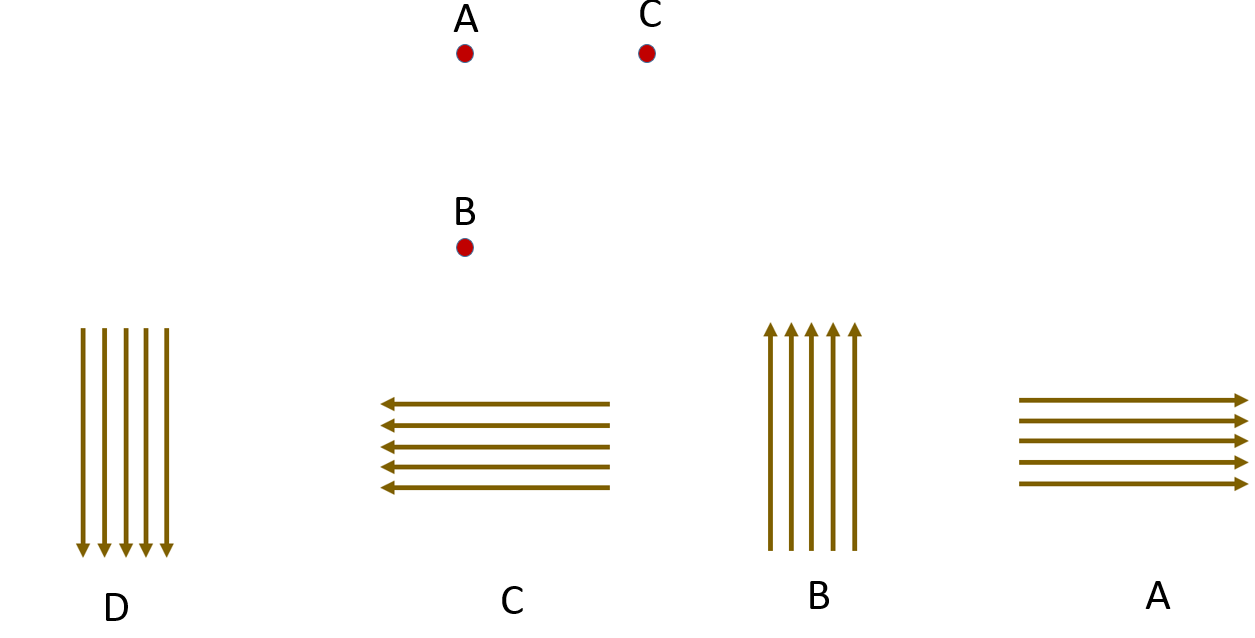
ثلاث نقاط داخل مجال منتظم، أحد الخطوط تمثل الشكل الصحيح لخطوط المجال المنتظم علما بأن \[0 > \Delta V_{AB}, \Delta V_{AC}=0\]
Three points in a uniform field. Which figure represents the correct field lines given that \[0 > \Delta V_{AB}, \Delta V_{AC}=0\]
 AAA
BBB
CCC
DDD
اضغط هنا تظهر طريقة الحلSolution
الحل: \[0 > \Delta V_{AB}\] يعني أن الجهد عند A أقل من B، و \[\Delta V_{AC}=0\] يعني A و C على نفس الجهد. الشكل D يحقق ذلك.
AAA
BBB
CCC
DDD
اضغط هنا تظهر طريقة الحلSolution
الحل: \[0 > \Delta V_{AB}\] يعني أن الجهد عند A أقل من B، و \[\Delta V_{AC}=0\] يعني A و C على نفس الجهد. الشكل D يحقق ذلك.
الإجابة الصحيحة: DSolution: \[0 > \Delta V_{AB}\] means potential at A is less than B, and \[\Delta V_{AC}=0\] means A and C have same potential. Figure D satisfies this.
Correct: D
14 \(\star \star\)
تم نقل جسيم مشحون من النقطة A إلى B، الشغل المبذول
A charged particle is moved from point A to B. The work done is
 A\[W<0\]\[W<0\]
B\[W>0\]\[W>0\]
C\[W=0\]\[W=0\]
Dلا يمكن تحديد الشغلCannot determine work
اضغط هنا تظهر طريقة الحلSolution
الحل: من الرسم، النقطتين\[ A و B\] على نفس خط تساوي الجهد، لذا \[\Delta V = 0\]، \[W = -q\Delta V = 0\]
A\[W<0\]\[W<0\]
B\[W>0\]\[W>0\]
C\[W=0\]\[W=0\]
Dلا يمكن تحديد الشغلCannot determine work
اضغط هنا تظهر طريقة الحلSolution
الحل: من الرسم، النقطتين\[ A و B\] على نفس خط تساوي الجهد، لذا \[\Delta V = 0\]، \[W = -q\Delta V = 0\]
الإجابة الصحيحة: CSolution: From the figure, points\[A and B\] are on the same equipotential line, so \[\Delta V = 0\], \[W = -q\Delta V = 0\]
Correct: C
15 \(\star\)
الشكل يوضح خطوط السطوح المتساوية بالجهد، أكبر مقدار للمجال الكهربائي عند النقطة K
The figure shows equipotential lines. The greatest electric field magnitude is at point K
 AAA
BBB
CCC
DDD
اضغط هنا تظهر طريقة الحلSolution
الحل: المجال الكهربائي يكون أكبر عندما تكون خطوط تساوي الجهد متقاربة. من الرسم، المنطقة\[ D\] هي الأكثر تقارباً للخطوط.
AAA
BBB
CCC
DDD
اضغط هنا تظهر طريقة الحلSolution
الحل: المجال الكهربائي يكون أكبر عندما تكون خطوط تساوي الجهد متقاربة. من الرسم، المنطقة\[ D\] هي الأكثر تقارباً للخطوط.
الإجابة الصحيحة: DSolution: The electric field is greatest where equipotential lines are closest together. From the figure, region D has the closest lines.
Correct: D
16 \(\star \star\)
سلك مشحون بشكل منتظم \[\lambda=4\times10^{-8} C/m\] ثني على شكل ربع دائرة، جهد النقطة في مركز الانحناء
A uniformly charged wire \[\lambda=4\times10^{-8} C/m\] is bent into a quarter circle. The potential at the center of curvature
 A\[V=565.5V\]\[V=565.5V\]
B\[V=1131V\]\[V=1131V\]
C\[V=322.2V\]\[V=322.2V\]
D\[V=630.4V\]\[V=630.4V\]
اضغط هنا تظهر طريقة الحلSolution
الحل:\[V=\int_{{\,0}}^{{\,𝜋R}}\frac{K.dq}{R}\]\[V=\int_{{\,0}}^{{\,\frac{𝜋R}{2}}}\frac{K.λ.dL}{R}\]
\[V=\frac{K.λ}{R}\int_{{\,0}}^{{\,\frac{𝜋R}{2}}}dL=\frac{K.λ}{2R} \] \[V = \frac{k_e \lambda}{R} \times \frac{\pi}{2} = \frac{9\times10^9 \times 4\times10^{-8}}{0.2} \times 1.57 = 565.5V\]
A\[V=565.5V\]\[V=565.5V\]
B\[V=1131V\]\[V=1131V\]
C\[V=322.2V\]\[V=322.2V\]
D\[V=630.4V\]\[V=630.4V\]
اضغط هنا تظهر طريقة الحلSolution
الحل:\[V=\int_{{\,0}}^{{\,𝜋R}}\frac{K.dq}{R}\]\[V=\int_{{\,0}}^{{\,\frac{𝜋R}{2}}}\frac{K.λ.dL}{R}\]
\[V=\frac{K.λ}{R}\int_{{\,0}}^{{\,\frac{𝜋R}{2}}}dL=\frac{K.λ}{2R} \] \[V = \frac{k_e \lambda}{R} \times \frac{\pi}{2} = \frac{9\times10^9 \times 4\times10^{-8}}{0.2} \times 1.57 = 565.5V\]
الإجابة الصحيحة: ASolution: \[V=\int_{{\,0}}^{{\,𝜋R}}\frac{K.dq}{R}\]\[V=\int_{{\,0}}^{{\,\frac{𝜋R}{2}}}\frac{K.λ.dL}{R}\]
\[V=\frac{K.λ}{R}\int_{{\,0}}^{{\,\frac{𝜋R}{2}}}dL=\frac{K.λ}{2R} \] \[V = \frac{k_e \lambda}{R} \times \frac{\pi}{2} = \frac{9\times10^9 \times 4\times10^{-8}}{0.2} \times 1.57 = 565.5V\]
Correct: A
17 \(\star \star \star\)
الجهد الكهربائي \[V(X,Y,Z)=5X^2+8XY+7Z\]، المجال عند النقطة \[(5,-2,-3)\] يعادل
Electric potential \[V(X,Y,Z)=5X^2+8XY+7Z\]. The field at point \[(5,-2,-3)\] is
A\[E=52.9 N/C\]\[E=52.9 N/C\]
B\[E=67.2 N/C\]\[E=67.2 N/C\]
C\[E=32.8 N/C\]\[E=32.8 N/C\]
D\[E=64.5 N/C\]\[E=64.5 N/C\]
اضغط هنا تظهر طريقة الحلSolution
الحل: \[E_X=-(\frac{dV}{dX})=-(\frac{5X^2+8XY+7Z}{dX})=-(10X+8Y)=-(10×5+8×-2)=-34\]
\[E_Y=-\frac{dV}{dY}=-(\frac{5X^2+8XY+7Z}{dY})=-(8X)=-(8×5)=-40\]
\[E_Z=-\frac{dV}{dZ}=-(\frac{5X^2+8XY+7Z}{dZ})=-7\]
\[E(-34 X,-40Y,-7Z)\]
\[E=\sqrt {34^2+40^2+7^2}=52.9 N/C\]
الإجابة الصحيحة: ASolution: \[E_X=-(\frac{dV}{dX})=-(\frac{5X^2+8XY+7Z}{dX})=-(10X+8Y)=-(10×5+8×-2)=-34\]
\[E_Y=-\frac{dV}{dY}=-(\frac{5X^2+8XY+7Z}{dY})=-(8X)=-(8×5)=-40\]
\[E_Z=-\frac{dV}{dZ}=-(\frac{5X^2+8XY+7Z}{dZ})=-7\]
\[E(-34 X,-40Y,-7Z)\]
\[E=\sqrt {34^2+40^2+7^2}=52.9 N/C\]
Correct: A
18 \(\star \star \star\)
جسم صغير شحنته \[3\mu C\] عند \[X=1m\]، الجهد \[V_x=4-3X^3\]، القوة الكهربائية المؤثرة
A small object with charge \[3\mu C\] at \[X=1m\], potential \[V_x=4-3X^3\]. The electric force is
A\[F=3.6\times10^{-5}N\]\[F=3.6\times10^{-5}N\]
B\[F=2.7\times10^{-5}N\]\[F=2.7\times10^{-5}N\]
C\[F=6.5\times10^{-5}N\]\[F=6.5\times10^{-5}N\]
D\[F=4.5\times10^{-5}N\]\[F=4.5\times10^{-5}N\]
اضغط هنا تظهر طريقة الحلSolution
الحل: \[E = -\frac{dV}{dx} = 9X^2 = 9 N/C\]، \[F = qE = 3\times10^{-6} \times 9 = 2.7\times10^{-5}N\]
الإجابة الصحيحة: BSolution: \[E = -\frac{dV}{dx} = 9X^2 = 9 N/C\], \[F = qE = 3\times10^{-6} \times 9 = 2.7\times10^{-5}N\]
Correct: B
19 \(\star \star \star\)
ثلاث شحنات متساوية \[q=2nC\] على رؤوس مثلث قائم، الشغل المبذول لجلب الشحنة من اللانهاية إلى الموضع الحالي
Three equal charges \[q=2nC\] at the vertices of a right triangle. The work done to bring the charge from infinity to its current position
 A\[W=+5.2\times10^{-7}J\]\[W=+5.2\times10^{-7}J\]
B\[W=+3.6\times10^{-7}J\]\[W=+3.6\times10^{-7}J\]
C\[W=-7.1\times10^{-7}J\]\[W=-7.1\times10^{-7}J\]
D\[W=-2.1\times10^{-7}J\]\[W=-2.1\times10^{-7}J\]
اضغط هنا تظهر طريقة الحلSolution
الحل: \[W = U_f - U_i = \frac{k_e q_1 q_2}{r} + \frac{k_e q_1 q_3}{r} + \frac{k_e q_2 q_3}{r}\]، \[W = -2.1\times10^{-7}J\]
A\[W=+5.2\times10^{-7}J\]\[W=+5.2\times10^{-7}J\]
B\[W=+3.6\times10^{-7}J\]\[W=+3.6\times10^{-7}J\]
C\[W=-7.1\times10^{-7}J\]\[W=-7.1\times10^{-7}J\]
D\[W=-2.1\times10^{-7}J\]\[W=-2.1\times10^{-7}J\]
اضغط هنا تظهر طريقة الحلSolution
الحل: \[W = U_f - U_i = \frac{k_e q_1 q_2}{r} + \frac{k_e q_1 q_3}{r} + \frac{k_e q_2 q_3}{r}\]، \[W = -2.1\times10^{-7}J\]
الإجابة الصحيحة: DSolution: \[W = U_f - U_i = \frac{k_e q_1 q_2}{r} + \frac{k_e q_1 q_3}{r} + \frac{k_e q_2 q_3}{r}\], \[W = -2.1\times10^{-7}J\]
Correct: D
20 \(\star \star\)
ثلاث شحنات \[q_1=-8nC, q_2=-6nC, q_3=3nC\] على رؤوس مثلث قائم، طاقة الوضع للنظام
Three charges \[q_1=-8nC, q_2=-6nC, q_3=3nC\] at the vertices of a right triangle. The potential energy of the system
 A\[U=+5.67\times10^{-7}J\]\[U=+5.67\times10^{-7}J\]
B\[U=+3.45\times10^{-7}J\]\[U=+3.45\times10^{-7}J\]
C\[U=+2.85\times10^{-7}J\]\[U=+2.85\times10^{-7}J\]
D\[U=+7.44\times10^{-7}J\]\[U=+7.44\times10^{-7}J\]
اضغط هنا تظهر طريقة الحلSolution
الحل: \[U = \sum \frac{k_e q_i q_j}{r_{ij}}\]، \[U = +5.67\times10^{-7}J\]
A\[U=+5.67\times10^{-7}J\]\[U=+5.67\times10^{-7}J\]
B\[U=+3.45\times10^{-7}J\]\[U=+3.45\times10^{-7}J\]
C\[U=+2.85\times10^{-7}J\]\[U=+2.85\times10^{-7}J\]
D\[U=+7.44\times10^{-7}J\]\[U=+7.44\times10^{-7}J\]
اضغط هنا تظهر طريقة الحلSolution
الحل: \[U = \sum \frac{k_e q_i q_j}{r_{ij}}\]، \[U = +5.67\times10^{-7}J\]
الإجابة الصحيحة: ASolution: \[U = \sum \frac{k_e q_i q_j}{r_{ij}}\], \[U = +5.67\times10^{-7}J\]
Correct: A
21 \(\star\)
موصل كروي نصف قطره \[R=0.5m\]، شدة المجال على السطح \[E=5000 N/C\]، جهد نقطة تبعد عن المركز \[0.2m\] تعادل
A spherical conductor of radius \[R=0.5m\], field on the surface \[E=5000 N/C\]. The potential at a point \[0.2m\] from the center is
 A\[V=0V\]\[V=0V\]
B\[V=10000V\]\[V=10000V\]
C\[V=2500V\]\[V=2500V\]
D\[V=1500V\]\[V=1500V\]
اضغط هنا تظهر طريقة الحلSolution
الحل: داخل الموصل الكروي الجهد ثابت ويساوي الجهد على السطح \[V = E \times R = 5000 \times 0.5 = 2500V\]
A\[V=0V\]\[V=0V\]
B\[V=10000V\]\[V=10000V\]
C\[V=2500V\]\[V=2500V\]
D\[V=1500V\]\[V=1500V\]
اضغط هنا تظهر طريقة الحلSolution
الحل: داخل الموصل الكروي الجهد ثابت ويساوي الجهد على السطح \[V = E \times R = 5000 \times 0.5 = 2500V\]
الإجابة الصحيحة: CSolution: Inside a spherical conductor, the potential is constant and equals the surface potential \[V = E \times R = 5000 \times 0.5 = 2500V\]
Correct: C
22 \(\star \star \star\)
الشكل يوضح الجهد كدالة في المحور الأفقي، الرسم الصحيح للمجال الكهربي المقابل
The figure shows potential as a function of horizontal position. The correct corresponding electric field graph

 AAA
BBB
CCC
DDD
اضغط هنا تظهر طريقة الحلSolution
الحل: \[E = -\frac{dV}{dx}\]، من الرسم D هي المشتقة العكسية الصحيحة للجهد المعطى.
AAA
BBB
CCC
DDD
اضغط هنا تظهر طريقة الحلSolution
الحل: \[E = -\frac{dV}{dx}\]، من الرسم D هي المشتقة العكسية الصحيحة للجهد المعطى.
الإجابة الصحيحة: DSolution: \[E = -\frac{dV}{dx}\], from the graph D is the correct derivative of the given potential.
Correct: D
23 \(\star\)
شحنة Q عند نقطة الأصل، نسبة الجهد عند A إلى الجهد عند B
Charge Q at the origin. Ratio of potential at A to potential at B
 A0.330.33
B0.50.5
C33
D22
اضغط هنا تظهر طريقة الحلSolution
الحل: \[V_A = \frac{k_e Q}{r_A}\]، \[V_B = \frac{k_e Q}{r_B}\]، \[\frac{V_A}{V_B} = \frac{r_B}{r_A} = \frac{0.3}{0.1} = 3\]
A0.330.33
B0.50.5
C33
D22
اضغط هنا تظهر طريقة الحلSolution
الحل: \[V_A = \frac{k_e Q}{r_A}\]، \[V_B = \frac{k_e Q}{r_B}\]، \[\frac{V_A}{V_B} = \frac{r_B}{r_A} = \frac{0.3}{0.1} = 3\]
الإجابة الصحيحة: CSolution: \[V_A = \frac{k_e Q}{r_A}\], \[V_B = \frac{k_e Q}{r_B}\], \[\frac{V_A}{V_B} = \frac{r_B}{r_A} = \frac{0.3}{0.1} = 3\]
Correct: C
24 \(\star\)
نقطتان A,B تبعدان مسافة r عن شحنتين غير متساويتين \[-Q, +3Q\]، الشغل لتحريك شحنة q من A إلى B
Points A and B at distance r from two unequal charges \[-Q, +3Q\]. The work to move charge q from A to B
 A\[W>0\]\[W>0\]
B\[W=0\]\[W=0\]
Cيعتمد على المسارDepends on path
D\[W<0\]\[W<0\]
اضغط هنا تظهر طريقة الحلSolution
الحل: النقطتان A و B على نفس خط تساوي الجهد، لذا \[V_A = V_B\]، \[W = q(V_B - V_A) = 0\]
A\[W>0\]\[W>0\]
B\[W=0\]\[W=0\]
Cيعتمد على المسارDepends on path
D\[W<0\]\[W<0\]
اضغط هنا تظهر طريقة الحلSolution
الحل: النقطتان A و B على نفس خط تساوي الجهد، لذا \[V_A = V_B\]، \[W = q(V_B - V_A) = 0\]
الإجابة الصحيحة: BSolution: Points A and B are on the same equipotential line, so \[V_A = V_B\], \[W = q(V_B - V_A) = 0\]
Correct: B
25 \(\star \star\)
مجال كهربائي بواسطة شحنة موجبة، أي عبارة صحيحة عن الجهد الكهربائي
Electric field from a positive charge. Which statement about electric potential is correct?
 A\[V_D>V_B>V_C>V_A\]\[V_D>V_B>V_C>V_A\]
B\[V_A>V_B>V_C>V_D\]\[V_A>V_B>V_C>V_D\]
C\[V_A>V_B=V_C>V_D\]\[V_A>V_B=V_C>V_D\]
D\[V_D>V_B=V_C>V_A\]\[V_D>V_B=V_C>V_A\]
اضغط هنا تظهر طريقة الحلSolution
الحل: بالقرب من الشحنة الموجبة الجهد أعلى. B و C على نفس خط تساوي الجهد.
A\[V_D>V_B>V_C>V_A\]\[V_D>V_B>V_C>V_A\]
B\[V_A>V_B>V_C>V_D\]\[V_A>V_B>V_C>V_D\]
C\[V_A>V_B=V_C>V_D\]\[V_A>V_B=V_C>V_D\]
D\[V_D>V_B=V_C>V_A\]\[V_D>V_B=V_C>V_A\]
اضغط هنا تظهر طريقة الحلSolution
الحل: بالقرب من الشحنة الموجبة الجهد أعلى. B و C على نفس خط تساوي الجهد.
الإجابة الصحيحة: CSolution: Near a positive charge, potential is higher. B and C are on the same equipotential line.
Correct: C
26 \(\star \star\)
أربع شحنات سالبة متساوية \[-q\] على رؤوس مربع، الجهد الصافي عند المركز
Four equal negative charges \[-q\] at the corners of a square. The net potential at the center
 A\[V_{net}=-\sqrt{2}\frac{kq}{r}\]\[V_{net}=-\sqrt{2}\frac{kq}{r}\]
B\[V_{net}=-2\sqrt{2}\frac{kq}{r}\]\[V_{net}=-2\sqrt{2}\frac{kq}{r}\]
C\[V_{net}=-4\sqrt{2}\frac{kq}{r}\]\[V_{net}=-4\sqrt{2}\frac{kq}{r}\]
D\[V_{net}=0\]\[V_{net}=0\]
اضغط هنا تظهر طريقة الحلSolution
الحل: \[V = \sum \frac{k_e(-q)}{r_i}\]، كل شحنة على بعد \[\frac{a}{\sqrt{2}}\]، \[V_{net} = -4\sqrt{2}\frac{kq}{a}\]
A\[V_{net}=-\sqrt{2}\frac{kq}{r}\]\[V_{net}=-\sqrt{2}\frac{kq}{r}\]
B\[V_{net}=-2\sqrt{2}\frac{kq}{r}\]\[V_{net}=-2\sqrt{2}\frac{kq}{r}\]
C\[V_{net}=-4\sqrt{2}\frac{kq}{r}\]\[V_{net}=-4\sqrt{2}\frac{kq}{r}\]
D\[V_{net}=0\]\[V_{net}=0\]
اضغط هنا تظهر طريقة الحلSolution
الحل: \[V = \sum \frac{k_e(-q)}{r_i}\]، كل شحنة على بعد \[\frac{a}{\sqrt{2}}\]، \[V_{net} = -4\sqrt{2}\frac{kq}{a}\]
الإجابة الصحيحة: CSolution: \[V = \sum \frac{k_e(-q)}{r_i}\], each charge at distance \[\frac{a}{\sqrt{2}}\], \[V_{net} = -4\sqrt{2}\frac{kq}{a}\]
Correct: C
27 \(\star\)
شحنة \[q_1=+6\mu C\] عند \[-3m\]، شحنة \[q_2=?\] عند \[2m\]، الجهد الصافي عند نقطة الأصل صفر، مقدار ونوع \[q_2\]
Charge \[q_1=+6\mu C\] at \[-3m\], charge \[q_2=?\] at \[2m\], net potential at origin is zero. Magnitude and sign of \[q_2\]
 A\[q_2=-4\times10^{-6}C\]\[q_2=-4\times10^{-6}C\]
B\[q_2=-5\times10^{-6}C\]\[q_2=-5\times10^{-6}C\]
C\[q_2=5\times10^{-6}C\]\[q_2=5\times10^{-6}C\]
D\[q_2=4\times10^{-6}C\]\[q_2=4\times10^{-6}C\]
اضغط هنا تظهر طريقة الحلSolution
الحل: \[V = \frac{k_e q_1}{r_1} + \frac{k_e q_2}{r_2} = 0\]، \[\frac{6\times10^{-6}}{3} + \frac{q_2}{2} = 0\]، \[q_2 = -4\times10^{-6}C\]
A\[q_2=-4\times10^{-6}C\]\[q_2=-4\times10^{-6}C\]
B\[q_2=-5\times10^{-6}C\]\[q_2=-5\times10^{-6}C\]
C\[q_2=5\times10^{-6}C\]\[q_2=5\times10^{-6}C\]
D\[q_2=4\times10^{-6}C\]\[q_2=4\times10^{-6}C\]
اضغط هنا تظهر طريقة الحلSolution
الحل: \[V = \frac{k_e q_1}{r_1} + \frac{k_e q_2}{r_2} = 0\]، \[\frac{6\times10^{-6}}{3} + \frac{q_2}{2} = 0\]، \[q_2 = -4\times10^{-6}C\]
الإجابة الصحيحة: ASolution: \[V = \frac{k_e q_1}{r_1} + \frac{k_e q_2}{r_2} = 0\], \[\frac{6\times10^{-6}}{3} + \frac{q_2}{2} = 0\], \[q_2 = -4\times10^{-6}C\]
Correct: A
المسائل المقاليةEssay Problems
 \[.....................................\;\;\;\;............................................\]\[.....................................\;\;\;\;............................................\]
\[.....................................\;\;\;\;............................................\]\[.....................................\;\;\;\;............................................\]
اضغط هنا تظهر طريقة الحلSolution
الحل:من الشكل: المجال موجه من \[A\] إلى اليمين. النقطتان \[B\;\;\;\;\; و\;\;\;\;\;C\] على نفس الخط العمودي على المجال.
والجهد يقل باتجاه المجال
\[\boxed{V_B = V_C > V_A} \]
\[.....................................\;\;\;\;............................................\]\[.....................................\;\;\;\;............................................\]
\[.....................................\;\;\;\;............................................\]\[.....................................\;\;\;\;............................................\]
\[.....................................\;\;\;\;............................................\]\[.....................................\;\;\;\;............................................\]
اضغط هنا تظهر طريقة الحلSolution
الحل:من الشكل: المجال موجه من \[A\] إلى اليمين. النقطتان \[B\;\;\;\;\; و\;\;\;\;\;C\] على نفس الخط العمودي على المجال.
والجهد يقل باتجاه المجال
\[\boxed{V_B = V_C > V_A} \] ❷ سرعة الإلكترون عند النقطة \[B\]:
باستخدام مبدأ حفظ الطاقة:
\[\Delta U = -q_e \cdot E \cdot d = -(-1.6 \times 10^{-19})(3 \times 10^3)(-0.4)\]
\[\Delta U = -1.92 \times 10^{-16} \, \text{J}\]
بما أن \[\Delta U = -\Delta K\]
\[\Delta K = 1.92 \times 10^{-16} \, \text{J}\]
\[\Delta K = \frac{1}{2} m v_f^2 - \frac{1}{2} m v_i^2\]
السرعة الابتدائية \[v_i = 0\] (بدأ من السكون):
\[1.92 \times 10^{-16} = \frac{1}{2} \times 9.1 \times 10^{-31} \times v_f^2\]
\[v_f = \sqrt{\dfrac{2 \times 1.92 \times 10^{-16}}{9.1 \times 10^{-31}}}\]
\[v_f = \sqrt{4.21978 \times 10^{14}} = 2.05 \times 10^7 \, \text{m/s}\]
❷التسارع منتظم لأن المجال منتظم
\[F_e = qE = m \cdot a\]
\[a = \dfrac{qE}{m} = \dfrac{1.6 \times 10^{-19} \times 3000}{9.1 \times 10^{-31}} = 5.2 \times 10^{14} \, \text{m/s}^2\]
Solution: ❶ Electric Potential Ranking:
The electric field is directed from \(A\) to the right. Points \(B\) and \(C\) lie on the same line perpendicular to the field (equipotential line).
The electric potential decreases in the direction of the field.
\[ \boxed{V_B = V_C > V_A} \]
❷ Electron Speed at Point \(B\):
Using the principle of energy conservation:
\[ \Delta U = -q_e \cdot E \cdot d = -(-1.6 \times 10^{-19})(3 \times 10^3)(-0.4) \]
\[ \Delta U = -1.92 \times 10^{-16} \, \text{J} \]
Since \(\Delta U = -\Delta K\):
\[ \Delta K = 1.92 \times 10^{-16} \, \text{J} \]
\[ \Delta K = \frac{1}{2} m v_f^2 - \frac{1}{2} m v_i^2 \]
Initial velocity \(v_i = 0\) (released from rest):
\[ 1.92 \times 10^{-16} = \frac{1}{2} \times 9.1 \times 10^{-31} \times v_f^2 \]
\[ v_f = \sqrt{\dfrac{2 \times 1.92 \times 10^{-16}}{9.1 \times 10^{-31}}} \]
\[ v_f = \sqrt{4.21978 \times 10^{14}} = 2.05 \times 10^7 \, \text{m/s} \]
❸ The Acceleration is Uniform Because the Field is Uniform:
\[ F_e = qE = m \cdot a \]
\[ a = \dfrac{qE}{m} = \dfrac{1.6 \times 10^{-19} \times 3000}{9.1 \times 10^{-31}} = 5.2 \times 10^{14} \, \text{m/s}^2 \]
✅ The acceleration is uniform because the electric field is uniform
2 \(\star\)
يمثل الشكل الجهد الكهربي كدالة في إحداثيات المحور الأفقي
بالاعتماد على معلومات الشكل
احسب التغير في طاقة الوضع لبروتون تحرك
من الموضع
\[0\Rightarrow 10\;\;cm\]
\[q_p=+1.6×10^{-19}\;\;c\]
احسب المجال الكهربائي
من الموضع
\[10\;\;cm\Rightarrow 16\;\;cm\]
Question 1: The figure shows the electric potential as a function of the horizontal axis coordinates. Based on the information in the figure, calculate the change in potential energy of a proton that moves from position 0 to 10 cm. Given that: qₚ = +1.6×10⁻¹⁹ C
Question 2: Calculate the electric field from position 10 cm to 16 cm.
 \[.....................................\;\;\;\;............................................\]\[.....................................\;\;\;\;............................................\]
اضغط هنا تظهر طريقة الحلSolution
الحل: \[\Delta U = q(V_f - V_i)\]،\[\Delta U=(1.6 \times10^{-19})\times (20-40)=-3.2\times10^{-18} \]الإشارة السالبة تعني أن طاقة الوضع تناقصت (فقد البروتون طاقة وضع).
\[E = -\frac{\Delta V}{\Delta x}= -\frac{V_2-V_1}{X_2-X_1}=-\frac{0-20}{0.16-0.10}=333.33 N/C\]
Solution: \[\Delta U = q(V_f - V_i)\]،\[Delta U=(1.6 \times10^{-19})\times (20-40)=-3.2\times10^{-18} \]Negative sign indicates that potential energy decreased (the proton lost potential energy).
.
\[E = -\frac{\Delta V}{\Delta x}= -\frac{V_2-V_1}{X_2-X_1}=-\frac{0-20}{0.16-0.10}=333.33 N/C\]
\[.....................................\;\;\;\;............................................\]\[.....................................\;\;\;\;............................................\]
\[.....................................\;\;\;\;............................................\]\[.....................................\;\;\;\;............................................\]
اضغط هنا تظهر طريقة الحلSolution
الحل: \[\Delta U = q(V_f - V_i)\]،\[\Delta U=(1.6 \times10^{-19})\times (20-40)=-3.2\times10^{-18} \]الإشارة السالبة تعني أن طاقة الوضع تناقصت (فقد البروتون طاقة وضع).
\[E = -\frac{\Delta V}{\Delta x}= -\frac{V_2-V_1}{X_2-X_1}=-\frac{0-20}{0.16-0.10}=333.33 N/C\]
Solution: \[\Delta U = q(V_f - V_i)\]،\[Delta U=(1.6 \times10^{-19})\times (20-40)=-3.2\times10^{-18} \]Negative sign indicates that potential energy decreased (the proton lost potential energy).
.
\[E = -\frac{\Delta V}{\Delta x}= -\frac{V_2-V_1}{X_2-X_1}=-\frac{0-20}{0.16-0.10}=333.33 N/C\]
3 \(\star\)
ثلاث شحنات نقطية لها نفس المقدار ومختلفة في النوع، ارسم خطوط تساوي الجهد
Three point charges have the same magnitude and different signs. Draw the equipotential lines
 اضغط هنا تظهر طريقة الحلSolution
الحل: خطوط تساوي الجهد عمودية على خطوط المجال. حول الشحنة الموجبة دوائر متحدة المركز، وحول السالبة دوائر متحدة المركز أيضاً.
Solution: Equipotential lines are perpendicular to field lines. Around positive charge concentric circles, around negative charge concentric circles as well.
اضغط هنا تظهر طريقة الحلSolution
الحل: خطوط تساوي الجهد عمودية على خطوط المجال. حول الشحنة الموجبة دوائر متحدة المركز، وحول السالبة دوائر متحدة المركز أيضاً.
Solution: Equipotential lines are perpendicular to field lines. Around positive charge concentric circles, around negative charge concentric circles as well.
4 \(\star\)
جسم صغير شحنته \[3\mu C\]موضوع عند \[X=2m\]إذا كان الجهد الكهربي يعطى بالعلاقة:\[V_x=4X-2X^3\]احسب:
❶ الجهد الكهربي \(V\) عند النقطة \(x = 2 \, \text{m}\)
❷ المجال الكهربي \(E\) عند النقطة \(x = 2 \, \text{m}\)
❸ القوة الكهربية \(F\) المؤثرة على الجسم
A small object with charge \[3\mu C\] is placed at \[X=2m\] The electric potential is given by \[V_x=4X-2X^3\]. Calculate:
❶ The electric potential \(V\) at \(x = 2 \, \text{m}\)
❷ The electric field \(E\) at \(x = 2 \, \text{m}\)
❸ The electric force \(F\) acting on the object
\[.....................................\;\;\;\;............................................\]\[.....................................\;\;\;\;............................................\]
\[.....................................\;\;\;\;............................................\]\[.....................................\;\;\;\;............................................\]
اضغط هنا تظهر طريقة الحلSolution
الحل: ❶ حساب الجهد الكهربي \(V\) عند \(x = 2 \, \text{m}\):
نعوض \(x = 2\) في معادلة الجهد:
\[ V(2) = 4(2) - 2(2)^3 \]
\[ V(2) = 8 - 2(8) = 8 - 16 = -8 \, \text{V} \]
\[ \boxed{V = -8 \, \text{V}} \]
❷ حساب المجال الكهربي \(E\) عند \(x = 2 \, \text{m}\):
العلاقة بين المجال والجهد:
\[ E = -\frac{dV}{dx} \]
نشتق معادلة الجهد:
\[ V(x) = 4x - 2x^3 \]
\[ \frac{dV}{dx} = 4 - 6x^2 \]
نعوض \(x = 2\):
\[ \frac{dV}{dx}\bigg|_{x=2} = 4 - 6(2)^2 = 4 - 6(4) = 4 - 24 = -20 \]
إذن:
\[ E = -\frac{dV}{dx} = -(-20) = 20 \, \text{N/C} \]
\[ \boxed{E = 20 \, \text{N/C}} \]
❸ حساب القوة الكهربية \(F\) المؤثرة على الجسم:
العلاقة بين القوة والمجال:
\[ F = qE \]
\(q = 3 \, \mu\text{C} = 3 \times 10^{-6} \, \text{C}\)
\[ F = (3 \times 10^{-6})(20) \]
\[ F = 6 \times 10^{-5} \, \text{N} \]
Solution: ❶ Calculate the Electric Potential \(V\) at \(x = 2 \, \text{m}\):
Substitute \(x = 2\) into the potential equation:
\[ V(2) = 4(2) - 2(2)^3 \]
\[ V(2) = 8 - 2(8) = 8 - 16 = -8 \, \text{V} \]
\[ \boxed{V = -8 \, \text{V}} \]
❷ Calculate the Electric Field \(E\) at \(x = 2 \, \text{m}\):
The relation between electric field and potential:
\[ E = -\frac{dV}{dx} \]
Differentiate the potential equation:
\[ V(x) = 4x - 2x^3 \]
\[ \frac{dV}{dx} = 4 - 6x^2 \]
Substitute \(x = 2\):
\[ \frac{dV}{dx}\bigg|_{x=2} = 4 - 6(2)^2 = 4 - 6(4) = 4 - 24 = -20 \]
Therefore:
\[ E = -\frac{dV}{dx} = -(-20) = 20 \, \text{N/C} \]
\[ \boxed{E = 20 \, \text{N/C}} \]
❸ Calculate the Electric Force \(F\) Acting on the Object:
The relation between force and electric field:
\[ F = qE \]
\(q = 3 \, \mu\text{C} = 3 \times 10^{-6} \, \text{C}\)
\[ F = (3 \times 10^{-6})(20) \]
\[ F = 6 \times 10^{-5} \, \text{N} \]
5 \(\star\)
جسم صغير شحنته \[q = 6 \, \mu\text{C}\] موضوع عند النقطة:
\[ A = (4\hat{X}, -2\hat{Y}) \]
إذا كان الجهد الكهربي يعطى بالعلاقة:
\[ V = 3X^2Y^3 - 2X^3Y^2 + 10 \]
احسب:
❶ الجهد الكهربي \(V\) عند النقطة \(A\)
❷ المجال الكهربي \(\vec{E}\) عند النقطة \(A\)
❸ القوة الكهربية \(\vec{F}\) المؤثرة على الجسم
A small object with charge \(q = 6 \, \mu\text{C}\) is placed at point:
\[ A = (4\hat{X}, -2\hat{Y}) \]
The electric potential is given by:
\[ V = 3X^2Y^3 - 2X^3Y^2 + 10 \]
Calculate:
❶ The electric potential \(V\) at point \(A\)
❷ The electric field \(\vec{E}\) at point \(A\)
❸ The electric force \(\vec{F}\) acting on the object
\[.....................................\;\;\;\;............................................\]\[.....................................\;\;\;\;............................................\]
اضغط هنا تظهر طريقة الحلSolution
الحل: ❶ حساب الجهد الكهربي \(V\) عند النقطة \(A(4, -2)\):
نعوض \(X = 4\) و \(Y = -2\) في معادلة الجهد:
\[ V = 3X^2Y^3 - 2X^3Y^2 + 10 \]
\[ V(4, -2) = 3(4)^2(-2)^3 - 2(4)^3(-2)^2 + 10 \]
\[ V(4, -2) = 3(16)(-8) - 2(64)(4) + 10 \]
\[ V(4, -2) = 3(-128) - 2(256) + 10 \]
\[ V(4, -2) = -384 - 512 + 10 = -886 \, \text{V} \]
\[ \boxed{V = -886 \, \text{V}} \]
❷ حساب المجال الكهربي \(\vec{E}\) عند النقطة \(A(4, -2)\):
العلاقة بين المجال والجهد:
\[ \vec{E} = -\nabla V = -\left( \frac{\partial V}{\partial X}\hat{X} + \frac{\partial V}{\partial Y}\hat{Y} \right) \]
نشتق معادلة الجهد بالنسبة لـ \(X\) و \(Y\):
\[ \frac{\partial V}{\partial X} = 6XY^3 - 6X^2Y^2 \]
\[ \frac{\partial V}{\partial Y} = 9X^2Y^2 - 4X^3Y \]
نعوض \(X = 4\) و \(Y = -2\):
\[ \frac{\partial V}{\partial X}\bigg|_{(4,-2)} = 6(4)(-2)^3 - 6(4)^2(-2)^2 \]
\[ = 6(4)(-8) - 6(16)(4) = -192 - 384 = -576 \]
\[ \frac{\partial V}{\partial Y}\bigg|_{(4,-2)} = 9(4)^2(-2)^2 - 4(4)^3(-2) \]
\[ = 9(16)(4) - 4(64)(-2) = 576 + 512 = 1088 \]
إذن:
\ \[ \vec{E} = -\left( -576\hat{X} + 1088\hat{Y} \right) \]
\
\[ \vec{E} = 576\hat{X} - 1088\hat{Y} \, \text{N/C} \]
\
\[ \boxed{\vec{E} = 576\hat{X} - 1088\hat{Y} \, \text{N/C}} \]
❸ حساب القوة الكهربية \(\vec{F}\) المؤثرة على الجسم:
العلاقة بين القوة والمجال:
\[ \vec{F} = q\vec{E} \]
\(q = 6 \, \mu\text{C} = 6 \times 10^{-6} \, \text{C}\)
\[ \vec{F} = (6 \times 10^{-6})(576\hat{X} - 1088\hat{Y}) \]
\[ \vec{F} = 3.456 \times 10^{-3}\hat{X} - 6.528 \times 10^{-3}\hat{Y} \, \text{N} \]
\[ \boxed{\vec{F} = 3.456 \times 10^{-3}\hat{X} - 6.528 \times 10^{-3}\hat{Y} \, \text{N}} \]
✅ القوة في اتجاه المجال لأن الشحنة موجبة
\[ \boxed{V = -886 \, \text{V}, \quad \vec{E} = 576\hat{X} - 1088\hat{Y} \, \text{N/C}, \quad \vec{F} = 3.456 \times 10^{-3}\hat{X} - 6.528 \times 10^{-3}\hat{Y} \, \text{N}} \]
✅ \( V = -886 \, \text{V} \)
⚡ \( \vec{E} = 576\hat{X} - 1088\hat{Y} \, \text{N/C} \)
📐 \( \vec{F} = 3.456 \times 10^{-3}\hat{X} - 6.528 \times 10^{-3}\hat{Y} \, \text{N} \)
Solution: ❶ Calculate the Electric Potential \(V\) at point \(A(4, -2)\):
Substitute \(X = 4\) and \(Y = -2\) into the potential equation:
\[ V = 3X^2Y^3 - 2X^3Y^2 + 10 \]
\[ V(4, -2) = 3(4)^2(-2)^3 - 2(4)^3(-2)^2 + 10 \]
\[ V(4, -2) = 3(16)(-8) - 2(64)(4) + 10 \]
\[ V(4, -2) = 3(-128) - 2(256) + 10 \]
\[ V(4, -2) = -384 - 512 + 10 = -886 \, \text{V} \]
\[ \boxed{V = -886 \, \text{V}} \]
❷ Calculate the Electric Field \(\vec{E}\) at point \(A(4, -2)\):
The relation between electric field and potential:
\[ \vec{E} = -\nabla V = -\left( \frac{\partial V}{\partial X}\hat{X} + \frac{\partial V}{\partial Y}\hat{Y} \right) \]
Differentiate the potential equation with respect to \(X\) and \(Y\):
\[ \frac{\partial V}{\partial X} = 6XY^3 - 6X^2Y^2 \]
\[ \frac{\partial V}{\partial Y} = 9X^2Y^2 - 4X^3Y \]
Substitute \(X = 4\) and \(Y = -2\):
\[ \frac{\partial V}{\partial X}\bigg|_{(4,-2)} = 6(4)(-2)^3 - 6(4)^2(-2)^2 \]
\[ = 6(4)(-8) - 6(16)(4) = -192 - 384 = -576 \]
\[ \frac{\partial V}{\partial Y}\bigg|_{(4,-2)} = 9(4)^2(-2)^2 - 4(4)^3(-2) \]
\[ = 9(16)(4) - 4(64)(-2) = 576 + 512 = 1088 \]
Therefore:
\[ \vec{E} = -\left( -576\hat{X} + 1088\hat{Y} \right) \]
\[ \vec{E} = 576\hat{X} - 1088\hat{Y} \, \text{N/C} \]
\[ \boxed{\vec{E} = 576\hat{X} - 1088\hat{Y} \, \text{N/C}} \]
❸ Calculate the Electric Force \(\vec{F}\) Acting on the Object:
The relation between force and electric field:
\[ \vec{F} = q\vec{E} \]
\(q = 6 \, \mu\text{C} = 6 \times 10^{-6} \, \text{C}\)
\[ \vec{F} = (6 \times 10^{-6})(576\hat{X} - 1088\hat{Y}) \]
\[ \vec{F} = 3.456 \times 10^{-3}\hat{X} - 6.528 \times 10^{-3}\hat{Y} \, \text{N} \]
\[ \boxed{\vec{F} = 3.456 \times 10^{-3}\hat{X} - 6.528 \times 10^{-3}\hat{Y} \, \text{N}} \]
✅ The force is in the direction of the field because the charge is positive
\[ \boxed{V = -886 \, \text{V}, \quad \vec{E} = 576\hat{X} - 1088\hat{Y} \, \text{N/C}, \quad \vec{F} = 3.456 \times 10^{-3}\hat{X} - 6.528 \times 10^{-3}\hat{Y} \, \text{N}} \]
6 \(\star\)
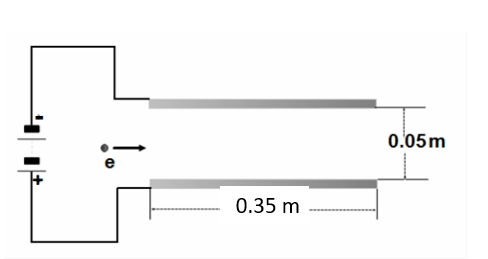
مكثف متوازي الصفائح فرق الجهد بين لوحيه \[\Delta V = 120 \, \text{V}\]
طول اللوح \[L = 0.35 \, \text{m}\]، والمسافة بين اللوحين \[d = 0.05 \, \text{m}\].
يدخل إلكترون بسرعة أفقية \[v_0 = 2.9 \times 10^7 \, \text{m/s}\] في منتصف المسافة بين اللوحين.
هل سيترك الإلكترون الفراغ بين اللوحين؟ \[q_e = -1.6 \times 10^{-19} \, \text{C}, \quad m_e = 9.1 \times 10^{-31} \, \text{kg}\]
A parallel plate capacitor has a potential difference \(\Delta V = 120 \, \text{V}\) between its plates.
Plate length \(L = 0.35 \, \text{m}\) and plate separation \(d = 0.05 \, \text{m}\).
An electron enters horizontally with speed \(v_0 = 2.9 \times 10^7 \, \text{m/s}\) at the midpoint between the plates.
Will the electron leave the space between the plates?
\[q_e = -1.6 \times 10^{-19} \, \text{C}, \quad m_e = 9.1 \times 10^{-31} \, \text{kg}\]
 \[.....................................\;\;\;\;............................................\]\[.....................................\;\;\;\;............................................\]
اضغط هنا تظهر طريقة الحلSolution
الحل:
\[.....................................\;\;\;\;............................................\]\[.....................................\;\;\;\;............................................\]
اضغط هنا تظهر طريقة الحلSolution
الحل: ❶ حساب المجال الكهربي بين الصفيحتين:
\[ E = \frac{\Delta V}{d} = \frac{120}{0.05} = 2400 \, \text{N/C} \]
❷ حساب تسارع الإلكترون (في الاتجاه العمودي):
\[ F = qE = m \cdot a \]
\[ a = \frac{qE}{m} = \frac{(1.6 \times 10^{-19})(2400)}{9.1 \times 10^{-31}} \]
\[ a = 4.22 \times 10^{14} \, \text{m/s}^2 \]
✅ التسارع في الاتجاه العمودي \(+\hat{Y}\) (نحو اللوح الموجب)
❸ حساب الزمن اللازم لقطع الطول الأفقي \(L\):
الحركة الأفقية بسرعة ثابتة (لا توجد قوة في الاتجاه الأفقي):
\[ t = \frac{L}{v_0} = \frac{0.35}{2.9 \times 10^7} = 1.207 \times 10^{-8} \, \text{s} \]
❹ حساب الإزاحة العمودية خلال هذا الزمن:
الإلكترون يبدأ من المنتصف، السرعة الابتدائية العمودية \(v_{0y} = 0\):
\[ y = \frac{1}{2} a t^2 \]
\[ y = \frac{1}{2} \times 4.22 \times 10^{14} \times (1.207 \times 10^{-8})^2 \]
\[ y = 0.5 \times 4.22 \times 10^{14} \times 1.457 \times 10^{-16} \]
\[ y = 0.0307 \, \text{m} = 3.07 \, \text{cm} \]
❺ المقارنة مع نصف المسافة بين اللوحين:
\[ \frac{d}{2} = \frac{0.05}{2} = 0.025 \, \text{m} = 2.5 \, \text{cm} \]
الإزاحة العمودية \[y = 0.0307 \, \text{m} > 0.025 \, \text{m}\]
⚡ الإلكترون سيصطدم باللوح العلوي ولن يترك الفراغ بين اللوحين
الإلكترون لا يترك الفراغ بين اللوحين
Solution: ❶ Calculate the Electric Field Between the Plates:
\[ E = \frac{\Delta V}{d} = \frac{120}{0.05} = 2400 \, \text{N/C} \]
❷ Calculate the Electron's Acceleration (in the vertical direction):
\[ F = qE = m \cdot a \]
\[ a = \frac{qE}{m} = \frac{(1.6 \times 10^{-19})(2400)}{9.1 \times 10^{-31}} \]
\[ a = 4.22 \times 10^{14} \, \text{m/s}^2 \]
✅ The acceleration is in the vertical direction \(+\hat{Y}\) (toward the positive plate)
❸ Calculate the Time to Travel the Horizontal Length \(L\):
Horizontal motion with constant velocity (no force in the horizontal direction):
\[ t = \frac{L}{v_0} = \frac{0.35}{2.9 \times 10^7} = 1.207 \times 10^{-8} \, \text{s} \]
❹ Calculate the Vertical Displacement During This Time:
The electron starts from the midpoint, initial vertical velocity \(v_{0y} = 0\):
\[ y = \frac{1}{2} a t^2 \]
\[ y = \frac{1}{2} \times 4.22 \times 10^{14} \times (1.207 \times 10^{-8})^2 \]
\[ y = 0.5 \times 4.22 \times 10^{14} \times 1.457 \times 10^{-16} \]
\[ y = 0.0307 \, \text{m} = 3.07 \, \text{cm} \]
❺ Compare with Half the Plate Separation:
\[ \frac{d}{2} = \frac{0.05}{2} = 0.025 \, \text{m} = 2.5 \, \text{cm} \]
Vertical displacement \(y = 0.0307 \, \text{m} > 0.025 \, \text{m}\)
⚡ The electron will hit the upper plate and will NOT leave the space between the plates
\[ \boxed{\text{The electron does NOT leave the space between the plates}} \]
الأسئلة الاختياريةMultiple Choice Questions
اضغط هنا تظهر طريقة الحلSolutionالإجابة الصحيحة: BSolution: The potential energy of a positive charge increases when moving opposite to the electric field.
Correct: B
اضغط هنا تظهر طريقة الحلSolutionالإجابة الصحيحة: ASolution: \[\Delta U = q \times E \times \Delta y = 1.6\times10^{-19}\times4\times10^3\times(-5)=3.2\times10^{-15}J\]
Correct: A
اضغط هنا تظهر طريقة الحلSolutionالإجابة الصحيحة: BSolution: \[V = E \times d = 500 \times 0.1 = 50V\], \[U = q \times V = -1.6\times10^{-19}\times(-50)=8\times10^{-18}J\]
Correct: B
اضغط هنا تظهر طريقة الحلSolutionالإجابة الصحيحة: ASolution: \[W = k_e q_1 q_2 (\frac{1}{r_f}-\frac{1}{r_i})=9 \times 10^9 \times 1.6 \times 10^{-19}\times -1.6 \times 10^{-19}(\frac {1}{0.04}-\frac {1}{2\times 10^{-6}})\]،\[W = -1.15\times10^{-22}J\]
Correct: A
اضغط هنا تظهر طريقة الحلSolutionالإجابة الصحيحة: BSolution: \[\Delta K = -\Delta U\], \[\frac{1}{2}m(v_B^2-v_A^2) = -q\Delta V\],\[\Delta k=\frac{1}{2}mv_f^2-\frac {1}{2}mv_i^2=\frac{1}{2}\times 9.1\times10^{-31}\times {10^5}^2-\frac{1}{2}\times 9.1\times10^{-31}\times {80}^2=4.54\times 10^{-21}\] \[\Delta V =-\frac {\Delta k}{-q}\]\[\Delta V = 0.02V\]
Correct: B
اضغط هنا تظهر طريقة الحلSolutionالإجابة الصحيحة: BSolution: \[\Delta V=-\frac{\Delta k}{q}\]\[\Delta k=\frac{1}{2}mv_f^2-\frac {1}{2}mv_i^2=-q \Delta V\] \[v_f = \sqrt{\frac{2q\Delta V}{m}} = \sqrt{\frac{2\times1.6\times10^{-19}\times500}{1.67\times10^{-27}}} = 3.1\times10^5 m/s\]
Correct: B
اضغط هنا تظهر طريقة الحلSolutionالإجابة الصحيحة: ASolution: \[\Delta U = q(V_B - V_A) = 1.6\times10^{-19}(60-100) = -6.4\times10^{-18}J\]
Correct: A
اضغط هنا تظهر طريقة الحلSolutionالإجابة الصحيحة: CSolution: \[V = k_e \frac{q}{r}\], \[E = k_e \frac{q}{r^2}\], \[\frac{V}{E} = r = 0.4m\], \[q = -2\times10^{-9}C\]
Correct: C
اضغط هنا تظهر طريقة الحلSolutionالإجابة الصحيحة: ASolution: \[W = -q\Delta V\], from graph \[\Delta V = 270V\], \[W = 1.6\times10^{-19}\times270 = 4.32\times10^{-17}J\]
Correct: A
اضغط هنا تظهر طريقة الحلSolutionالإجابة الصحيحة: BSolution: \[V = k_e\frac{q_1}{x} + k_e\frac{q_2}{x-0.4}=0\], \[x=-0.8m\]
Correct: B
اضغط هنا تظهر طريقة الحلSolutionالإجابة الصحيحة: DSolution: \[E = \frac{150}{0.06} = 2500 N/C\], \[V_A = 150 - E \times 0.02 = 150 - 50 = 100V\]
Correct: D
اضغط هنا تظهر طريقة الحلSolutionالإجابة الصحيحة: CSolution: \[\Delta V = -E \times d = -500 \times 0.4 = -200V\] (but options show 200V depending on direction)
Correct: C
اضغط هنا تظهر طريقة الحلSolutionالإجابة الصحيحة: DSolution: \[0 > \Delta V_{AB}\] means potential at A is less than B, and \[\Delta V_{AC}=0\] means A and C have same potential. Figure D satisfies this.
Correct: D
اضغط هنا تظهر طريقة الحلSolutionالإجابة الصحيحة: CSolution: From the figure, points\[A and B\] are on the same equipotential line, so \[\Delta V = 0\], \[W = -q\Delta V = 0\]
Correct: C
اضغط هنا تظهر طريقة الحلSolutionالإجابة الصحيحة: DSolution: The electric field is greatest where equipotential lines are closest together. From the figure, region D has the closest lines.
Correct: D
اضغط هنا تظهر طريقة الحلSolutionالإجابة الصحيحة: ASolution: \[V=\int_{{\,0}}^{{\,𝜋R}}\frac{K.dq}{R}\]\[V=\int_{{\,0}}^{{\,\frac{𝜋R}{2}}}\frac{K.λ.dL}{R}\] \[V=\frac{K.λ}{R}\int_{{\,0}}^{{\,\frac{𝜋R}{2}}}dL=\frac{K.λ}{2R} \] \[V = \frac{k_e \lambda}{R} \times \frac{\pi}{2} = \frac{9\times10^9 \times 4\times10^{-8}}{0.2} \times 1.57 = 565.5V\]
Correct: A
اضغط هنا تظهر طريقة الحلSolutionالإجابة الصحيحة: ASolution: \[E_X=-(\frac{dV}{dX})=-(\frac{5X^2+8XY+7Z}{dX})=-(10X+8Y)=-(10×5+8×-2)=-34\] \[E_Y=-\frac{dV}{dY}=-(\frac{5X^2+8XY+7Z}{dY})=-(8X)=-(8×5)=-40\] \[E_Z=-\frac{dV}{dZ}=-(\frac{5X^2+8XY+7Z}{dZ})=-7\] \[E(-34 X,-40Y,-7Z)\] \[E=\sqrt {34^2+40^2+7^2}=52.9 N/C\]
Correct: A
اضغط هنا تظهر طريقة الحلSolutionالإجابة الصحيحة: BSolution: \[E = -\frac{dV}{dx} = 9X^2 = 9 N/C\], \[F = qE = 3\times10^{-6} \times 9 = 2.7\times10^{-5}N\]
Correct: B
اضغط هنا تظهر طريقة الحلSolutionالإجابة الصحيحة: DSolution: \[W = U_f - U_i = \frac{k_e q_1 q_2}{r} + \frac{k_e q_1 q_3}{r} + \frac{k_e q_2 q_3}{r}\], \[W = -2.1\times10^{-7}J\]
Correct: D
اضغط هنا تظهر طريقة الحلSolutionالإجابة الصحيحة: ASolution: \[U = \sum \frac{k_e q_i q_j}{r_{ij}}\], \[U = +5.67\times10^{-7}J\]
Correct: A
اضغط هنا تظهر طريقة الحلSolutionالإجابة الصحيحة: CSolution: Inside a spherical conductor, the potential is constant and equals the surface potential \[V = E \times R = 5000 \times 0.5 = 2500V\]
Correct: C
اضغط هنا تظهر طريقة الحلSolutionالإجابة الصحيحة: DSolution: \[E = -\frac{dV}{dx}\], from the graph D is the correct derivative of the given potential.
Correct: D
اضغط هنا تظهر طريقة الحلSolutionالإجابة الصحيحة: CSolution: \[V_A = \frac{k_e Q}{r_A}\], \[V_B = \frac{k_e Q}{r_B}\], \[\frac{V_A}{V_B} = \frac{r_B}{r_A} = \frac{0.3}{0.1} = 3\]
Correct: C
اضغط هنا تظهر طريقة الحلSolutionالإجابة الصحيحة: BSolution: Points A and B are on the same equipotential line, so \[V_A = V_B\], \[W = q(V_B - V_A) = 0\]
Correct: B
اضغط هنا تظهر طريقة الحلSolutionالإجابة الصحيحة: CSolution: Near a positive charge, potential is higher. B and C are on the same equipotential line.
Correct: C
اضغط هنا تظهر طريقة الحلSolutionالإجابة الصحيحة: CSolution: \[V = \sum \frac{k_e(-q)}{r_i}\], each charge at distance \[\frac{a}{\sqrt{2}}\], \[V_{net} = -4\sqrt{2}\frac{kq}{a}\]
Correct: C
اضغط هنا تظهر طريقة الحلSolutionالإجابة الصحيحة: ASolution: \[V = \frac{k_e q_1}{r_1} + \frac{k_e q_2}{r_2} = 0\], \[\frac{6\times10^{-6}}{3} + \frac{q_2}{2} = 0\], \[q_2 = -4\times10^{-6}C\]
Correct: A
المسائل المقاليةEssay Problems
اضغط هنا تظهر طريقة الحلSolution❷ سرعة الإلكترون عند النقطة \[B\]:
باستخدام مبدأ حفظ الطاقة: \[\Delta U = -q_e \cdot E \cdot d = -(-1.6 \times 10^{-19})(3 \times 10^3)(-0.4)\] \[\Delta U = -1.92 \times 10^{-16} \, \text{J}\] بما أن \[\Delta U = -\Delta K\] \[\Delta K = 1.92 \times 10^{-16} \, \text{J}\] \[\Delta K = \frac{1}{2} m v_f^2 - \frac{1}{2} m v_i^2\] السرعة الابتدائية \[v_i = 0\] (بدأ من السكون): \[1.92 \times 10^{-16} = \frac{1}{2} \times 9.1 \times 10^{-31} \times v_f^2\] \[v_f = \sqrt{\dfrac{2 \times 1.92 \times 10^{-16}}{9.1 \times 10^{-31}}}\] \[v_f = \sqrt{4.21978 \times 10^{14}} = 2.05 \times 10^7 \, \text{m/s}\]❷التسارع منتظم لأن المجال منتظم
\[F_e = qE = m \cdot a\] \[a = \dfrac{qE}{m} = \dfrac{1.6 \times 10^{-19} \times 3000}{9.1 \times 10^{-31}} = 5.2 \times 10^{14} \, \text{m/s}^2\] Solution:❶ Electric Potential Ranking:
The electric field is directed from \(A\) to the right. Points \(B\) and \(C\) lie on the same line perpendicular to the field (equipotential line).
The electric potential decreases in the direction of the field.
\[ \boxed{V_B = V_C > V_A} \]❷ Electron Speed at Point \(B\):
Using the principle of energy conservation:
Since \(\Delta U = -\Delta K\):
\[ \Delta K = 1.92 \times 10^{-16} \, \text{J} \] \[ \Delta K = \frac{1}{2} m v_f^2 - \frac{1}{2} m v_i^2 \]Initial velocity \(v_i = 0\) (released from rest):
\[ 1.92 \times 10^{-16} = \frac{1}{2} \times 9.1 \times 10^{-31} \times v_f^2 \] \[ v_f = \sqrt{\dfrac{2 \times 1.92 \times 10^{-16}}{9.1 \times 10^{-31}}} \] \[ v_f = \sqrt{4.21978 \times 10^{14}} = 2.05 \times 10^7 \, \text{m/s} \]❸ The Acceleration is Uniform Because the Field is Uniform:
\[ F_e = qE = m \cdot a \] \[ a = \dfrac{qE}{m} = \dfrac{1.6 \times 10^{-19} \times 3000}{9.1 \times 10^{-31}} = 5.2 \times 10^{14} \, \text{m/s}^2 \]✅ The acceleration is uniform because the electric field is uniform
اضغط هنا تظهر طريقة الحلSolutionاضغط هنا تظهر طريقة الحلSolution❶ الجهد الكهربي \(V\) عند النقطة \(x = 2 \, \text{m}\)
❷ المجال الكهربي \(E\) عند النقطة \(x = 2 \, \text{m}\)
❸ القوة الكهربية \(F\) المؤثرة على الجسم A small object with charge \[3\mu C\] is placed at \[X=2m\] The electric potential is given by \[V_x=4X-2X^3\]. Calculate:
❶ The electric potential \(V\) at \(x = 2 \, \text{m}\)
❷ The electric field \(E\) at \(x = 2 \, \text{m}\)
❸ The electric force \(F\) acting on the object
اضغط هنا تظهر طريقة الحلSolution❶ حساب الجهد الكهربي \(V\) عند \(x = 2 \, \text{m}\):
نعوض \(x = 2\) في معادلة الجهد:
\[ V(2) = 4(2) - 2(2)^3 \] \[ V(2) = 8 - 2(8) = 8 - 16 = -8 \, \text{V} \] \[ \boxed{V = -8 \, \text{V}} \]❷ حساب المجال الكهربي \(E\) عند \(x = 2 \, \text{m}\):
العلاقة بين المجال والجهد:
\[ E = -\frac{dV}{dx} \]نشتق معادلة الجهد:
\[ V(x) = 4x - 2x^3 \] \[ \frac{dV}{dx} = 4 - 6x^2 \]نعوض \(x = 2\):
\[ \frac{dV}{dx}\bigg|_{x=2} = 4 - 6(2)^2 = 4 - 6(4) = 4 - 24 = -20 \]إذن:
\[ E = -\frac{dV}{dx} = -(-20) = 20 \, \text{N/C} \] \[ \boxed{E = 20 \, \text{N/C}} \]❸ حساب القوة الكهربية \(F\) المؤثرة على الجسم:
العلاقة بين القوة والمجال:
\[ F = qE \]\(q = 3 \, \mu\text{C} = 3 \times 10^{-6} \, \text{C}\)
\[ F = (3 \times 10^{-6})(20) \] \[ F = 6 \times 10^{-5} \, \text{N} \] Solution:❶ Calculate the Electric Potential \(V\) at \(x = 2 \, \text{m}\):
Substitute \(x = 2\) into the potential equation:
\[ V(2) = 4(2) - 2(2)^3 \] \[ V(2) = 8 - 2(8) = 8 - 16 = -8 \, \text{V} \] \[ \boxed{V = -8 \, \text{V}} \]❷ Calculate the Electric Field \(E\) at \(x = 2 \, \text{m}\):
The relation between electric field and potential:
\[ E = -\frac{dV}{dx} \]Differentiate the potential equation:
\[ V(x) = 4x - 2x^3 \] \[ \frac{dV}{dx} = 4 - 6x^2 \]Substitute \(x = 2\):
\[ \frac{dV}{dx}\bigg|_{x=2} = 4 - 6(2)^2 = 4 - 6(4) = 4 - 24 = -20 \]Therefore:
\[ E = -\frac{dV}{dx} = -(-20) = 20 \, \text{N/C} \] \[ \boxed{E = 20 \, \text{N/C}} \]❸ Calculate the Electric Force \(F\) Acting on the Object:
The relation between force and electric field:
\[ F = qE \]\(q = 3 \, \mu\text{C} = 3 \times 10^{-6} \, \text{C}\)
\[ F = (3 \times 10^{-6})(20) \] \[ F = 6 \times 10^{-5} \, \text{N} \]إذا كان الجهد الكهربي يعطى بالعلاقة: \[ V = 3X^2Y^3 - 2X^3Y^2 + 10 \]
احسب:
❶ الجهد الكهربي \(V\) عند النقطة \(A\)
❷ المجال الكهربي \(\vec{E}\) عند النقطة \(A\)
❸ القوة الكهربية \(\vec{F}\) المؤثرة على الجسم A small object with charge \(q = 6 \, \mu\text{C}\) is placed at point: \[ A = (4\hat{X}, -2\hat{Y}) \]
The electric potential is given by: \[ V = 3X^2Y^3 - 2X^3Y^2 + 10 \]
Calculate:
❶ The electric potential \(V\) at point \(A\)
❷ The electric field \(\vec{E}\) at point \(A\)
❸ The electric force \(\vec{F}\) acting on the object
اضغط هنا تظهر طريقة الحلSolution❶ حساب الجهد الكهربي \(V\) عند النقطة \(A(4, -2)\):
نعوض \(X = 4\) و \(Y = -2\) في معادلة الجهد:
\[ V = 3X^2Y^3 - 2X^3Y^2 + 10 \] \[ V(4, -2) = 3(4)^2(-2)^3 - 2(4)^3(-2)^2 + 10 \] \[ V(4, -2) = 3(16)(-8) - 2(64)(4) + 10 \] \[ V(4, -2) = 3(-128) - 2(256) + 10 \] \[ V(4, -2) = -384 - 512 + 10 = -886 \, \text{V} \] \[ \boxed{V = -886 \, \text{V}} \]❷ حساب المجال الكهربي \(\vec{E}\) عند النقطة \(A(4, -2)\):
العلاقة بين المجال والجهد:
\[ \vec{E} = -\nabla V = -\left( \frac{\partial V}{\partial X}\hat{X} + \frac{\partial V}{\partial Y}\hat{Y} \right) \]نشتق معادلة الجهد بالنسبة لـ \(X\) و \(Y\):
\[ \frac{\partial V}{\partial X} = 6XY^3 - 6X^2Y^2 \] \[ \frac{\partial V}{\partial Y} = 9X^2Y^2 - 4X^3Y \]نعوض \(X = 4\) و \(Y = -2\):
\[ \frac{\partial V}{\partial X}\bigg|_{(4,-2)} = 6(4)(-2)^3 - 6(4)^2(-2)^2 \] \[ = 6(4)(-8) - 6(16)(4) = -192 - 384 = -576 \] \[ \frac{\partial V}{\partial Y}\bigg|_{(4,-2)} = 9(4)^2(-2)^2 - 4(4)^3(-2) \] \[ = 9(16)(4) - 4(64)(-2) = 576 + 512 = 1088 \]إذن:
\ \[ \vec{E} = -\left( -576\hat{X} + 1088\hat{Y} \right) \] \ \[ \vec{E} = 576\hat{X} - 1088\hat{Y} \, \text{N/C} \] \ \[ \boxed{\vec{E} = 576\hat{X} - 1088\hat{Y} \, \text{N/C}} \]❸ حساب القوة الكهربية \(\vec{F}\) المؤثرة على الجسم:
العلاقة بين القوة والمجال:
\[ \vec{F} = q\vec{E} \]\(q = 6 \, \mu\text{C} = 6 \times 10^{-6} \, \text{C}\)
\[ \vec{F} = (6 \times 10^{-6})(576\hat{X} - 1088\hat{Y}) \] \[ \vec{F} = 3.456 \times 10^{-3}\hat{X} - 6.528 \times 10^{-3}\hat{Y} \, \text{N} \] \[ \boxed{\vec{F} = 3.456 \times 10^{-3}\hat{X} - 6.528 \times 10^{-3}\hat{Y} \, \text{N}} \]✅ القوة في اتجاه المجال لأن الشحنة موجبة
\[ \boxed{V = -886 \, \text{V}, \quad \vec{E} = 576\hat{X} - 1088\hat{Y} \, \text{N/C}, \quad \vec{F} = 3.456 \times 10^{-3}\hat{X} - 6.528 \times 10^{-3}\hat{Y} \, \text{N}} \] ✅ \( V = -886 \, \text{V} \) ⚡ \( \vec{E} = 576\hat{X} - 1088\hat{Y} \, \text{N/C} \) 📐 \( \vec{F} = 3.456 \times 10^{-3}\hat{X} - 6.528 \times 10^{-3}\hat{Y} \, \text{N} \) Solution:❶ Calculate the Electric Potential \(V\) at point \(A(4, -2)\):
Substitute \(X = 4\) and \(Y = -2\) into the potential equation:
\[ V = 3X^2Y^3 - 2X^3Y^2 + 10 \] \[ V(4, -2) = 3(4)^2(-2)^3 - 2(4)^3(-2)^2 + 10 \] \[ V(4, -2) = 3(16)(-8) - 2(64)(4) + 10 \] \[ V(4, -2) = 3(-128) - 2(256) + 10 \] \[ V(4, -2) = -384 - 512 + 10 = -886 \, \text{V} \] \[ \boxed{V = -886 \, \text{V}} \]❷ Calculate the Electric Field \(\vec{E}\) at point \(A(4, -2)\):
The relation between electric field and potential:
\[ \vec{E} = -\nabla V = -\left( \frac{\partial V}{\partial X}\hat{X} + \frac{\partial V}{\partial Y}\hat{Y} \right) \] Differentiate the potential equation with respect to \(X\) and \(Y\): \[ \frac{\partial V}{\partial X} = 6XY^3 - 6X^2Y^2 \] \[ \frac{\partial V}{\partial Y} = 9X^2Y^2 - 4X^3Y \] Substitute \(X = 4\) and \(Y = -2\): \[ \frac{\partial V}{\partial X}\bigg|_{(4,-2)} = 6(4)(-2)^3 - 6(4)^2(-2)^2 \] \[ = 6(4)(-8) - 6(16)(4) = -192 - 384 = -576 \] \[ \frac{\partial V}{\partial Y}\bigg|_{(4,-2)} = 9(4)^2(-2)^2 - 4(4)^3(-2) \] \[ = 9(16)(4) - 4(64)(-2) = 576 + 512 = 1088 \] Therefore: \[ \vec{E} = -\left( -576\hat{X} + 1088\hat{Y} \right) \] \[ \vec{E} = 576\hat{X} - 1088\hat{Y} \, \text{N/C} \] \[ \boxed{\vec{E} = 576\hat{X} - 1088\hat{Y} \, \text{N/C}} \]❸ Calculate the Electric Force \(\vec{F}\) Acting on the Object:
The relation between force and electric field: \[ \vec{F} = q\vec{E} \] \(q = 6 \, \mu\text{C} = 6 \times 10^{-6} \, \text{C}\) \[ \vec{F} = (6 \times 10^{-6})(576\hat{X} - 1088\hat{Y}) \] \[ \vec{F} = 3.456 \times 10^{-3}\hat{X} - 6.528 \times 10^{-3}\hat{Y} \, \text{N} \] \[ \boxed{\vec{F} = 3.456 \times 10^{-3}\hat{X} - 6.528 \times 10^{-3}\hat{Y} \, \text{N}} \]✅ The force is in the direction of the field because the charge is positive
\[ \boxed{V = -886 \, \text{V}, \quad \vec{E} = 576\hat{X} - 1088\hat{Y} \, \text{N/C}, \quad \vec{F} = 3.456 \times 10^{-3}\hat{X} - 6.528 \times 10^{-3}\hat{Y} \, \text{N}} \]اضغط هنا تظهر طريقة الحلSolution❶ حساب المجال الكهربي بين الصفيحتين:
\[ E = \frac{\Delta V}{d} = \frac{120}{0.05} = 2400 \, \text{N/C} \]❷ حساب تسارع الإلكترون (في الاتجاه العمودي):
\[ F = qE = m \cdot a \] \[ a = \frac{qE}{m} = \frac{(1.6 \times 10^{-19})(2400)}{9.1 \times 10^{-31}} \] \[ a = 4.22 \times 10^{14} \, \text{m/s}^2 \]✅ التسارع في الاتجاه العمودي \(+\hat{Y}\) (نحو اللوح الموجب)
❸ حساب الزمن اللازم لقطع الطول الأفقي \(L\):
الحركة الأفقية بسرعة ثابتة (لا توجد قوة في الاتجاه الأفقي):
\[ t = \frac{L}{v_0} = \frac{0.35}{2.9 \times 10^7} = 1.207 \times 10^{-8} \, \text{s} \]❹ حساب الإزاحة العمودية خلال هذا الزمن:
الإلكترون يبدأ من المنتصف، السرعة الابتدائية العمودية \(v_{0y} = 0\):
\[ y = \frac{1}{2} a t^2 \] \[ y = \frac{1}{2} \times 4.22 \times 10^{14} \times (1.207 \times 10^{-8})^2 \] \[ y = 0.5 \times 4.22 \times 10^{14} \times 1.457 \times 10^{-16} \] \[ y = 0.0307 \, \text{m} = 3.07 \, \text{cm} \]❺ المقارنة مع نصف المسافة بين اللوحين:
\[ \frac{d}{2} = \frac{0.05}{2} = 0.025 \, \text{m} = 2.5 \, \text{cm} \] الإزاحة العمودية \[y = 0.0307 \, \text{m} > 0.025 \, \text{m}\] ⚡ الإلكترون سيصطدم باللوح العلوي ولن يترك الفراغ بين اللوحينالإلكترون لا يترك الفراغ بين اللوحين Solution:
❶ Calculate the Electric Field Between the Plates:
\[ E = \frac{\Delta V}{d} = \frac{120}{0.05} = 2400 \, \text{N/C} \]❷ Calculate the Electron's Acceleration (in the vertical direction):
\[ F = qE = m \cdot a \] \[ a = \frac{qE}{m} = \frac{(1.6 \times 10^{-19})(2400)}{9.1 \times 10^{-31}} \] \[ a = 4.22 \times 10^{14} \, \text{m/s}^2 \]✅ The acceleration is in the vertical direction \(+\hat{Y}\) (toward the positive plate)
❸ Calculate the Time to Travel the Horizontal Length \(L\):
Horizontal motion with constant velocity (no force in the horizontal direction):
\[ t = \frac{L}{v_0} = \frac{0.35}{2.9 \times 10^7} = 1.207 \times 10^{-8} \, \text{s} \]❹ Calculate the Vertical Displacement During This Time:
The electron starts from the midpoint, initial vertical velocity \(v_{0y} = 0\):
\[ y = \frac{1}{2} a t^2 \] \[ y = \frac{1}{2} \times 4.22 \times 10^{14} \times (1.207 \times 10^{-8})^2 \] \[ y = 0.5 \times 4.22 \times 10^{14} \times 1.457 \times 10^{-16} \] \[ y = 0.0307 \, \text{m} = 3.07 \, \text{cm} \]❺ Compare with Half the Plate Separation:
\[ \frac{d}{2} = \frac{0.05}{2} = 0.025 \, \text{m} = 2.5 \, \text{cm} \]Vertical displacement \(y = 0.0307 \, \text{m} > 0.025 \, \text{m}\)
⚡ The electron will hit the upper plate and will NOT leave the space between the plates \[ \boxed{\text{The electron does NOT leave the space between the plates}} \]
No comments:
Post a Comment