 Physics
📄 اطبع pdf
00971504825082
🔄 الحركة الدورانية
الإزاحة الزاوية - السرعة الزاوية - التسارع الزاوي - عزم القوة
📐 الإزاحة الزاوية
تذكر: الإزاحة الخطية = الموقع النهائي – الموقع الابتدائي
\[ \Delta x = x_2 - x_1 \]
الإزاحة الزاوية = الزاوية النهائية – الزاوية الابتدائية
\[ \Delta \theta = \theta_2 - \theta_1 \]

إذا تحرك جسم وقطع قوس طوله \(s\) على دائرة نصف قطرها \(r\):
\[ \theta = \frac{s}{r} \]
💡 ملاحظة: الإزاحة الزاوية كمية متجهة. إذا كان الدوران عكس عقارب الساعة تأخذ إشارة موجبة (+)، وإذا كان الدوران مع عقارب الساعة تأخذ إشارة سالبة (-).


الراديان: الوحدة الأساسية لقياس الزوايا في النظام الدولي.
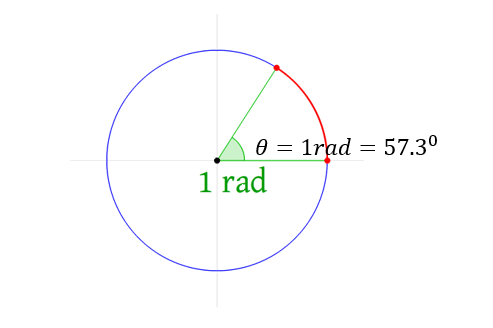
🔹 تحويل الوحدات
من الدورات (rev) إلى راديان
من الدرجات (°) إلى راديان
\[ 2\pi \text{ rad} = 1 \text{ rev} \]
\[ \pi \text{ rad} = 180^\circ \]
مثال: \( 2.25 \text{ rev} = 2.25 \times 2\pi = 14.13 \text{ rad} \)
مثال: \( 120^\circ = 120 \times \frac{\pi}{180} = 2.094 \text{ rad} \)

⚡ السرعة الزاوية
السرعة الزاوية لجسم ما: هي تغير الإحداثي الزاوي للجسم مع الزمن.
\[ \omega_{avg} = \frac{\Delta \theta}{\Delta t} = \frac{\theta_2 - \theta_1}{t_2 - t_1} \quad (\text{rad/s}) \]
⚠️ العلاقة بين السرعة الخطية والسرعة الزاوية:
\[ v = r \cdot \omega \]
📊 التجربة 1: قياس السرعة الزاوية
الفترة الزمنية
الإزاحة الزاوية النهائية \( \theta_2 \)
الإزاحة الزاوية الابتدائية \( \theta_1 \)
\( t_2 - t_1 = ....\text{s} \)
\( \theta_2 = ....\text{rad} \)
\( \theta_1 = ....\text{rad} \)
السرعة الزاوية \( \omega \)
الاتجاه
\[ \omega = \frac{\theta_2 - \theta_1}{t_2 - t_1} = ...\text{rad/s} \]
 عكس عقارب الساعة (+)
 مع عقارب الساعة (-)
📝 أسئلة على السرعة الزاوية
⭐ 1 - جسم يتحرك حركة دورانية منتظمة يعمل دورة واحدة كل ثانية. ما سرعته الزاوية بوحدة rad/s؟
A
4π rad/s
B
π rad/s
C
2π rad/s
⭐ 2 - مروحة تدور بسرعة زاوية قدرها 60π rad/s. ما الزاوية التي تقطعها إحدى شفراتها خلال زمن قدره 3s؟
A
120π rad
B
60π rad
C
180π rad
⭐ 3 - مروحة تدور في مسار دائري منتظم نصف قطره 60cm، حيث تقطع المروحة ثلاث دورات خلال زمن قدره 2s. ما سرعتها الخطية بوحدة m/s؟
A
3.64 m/s
B
5.65 m/s
C
2.41 m/s
📈 التسارع الزاوي (العجلة الزاوية)
⚠️ العجلة الزاوية المتوسطة: هي معدل تغير السرعة الزاوية.
\[ \alpha_{avg} = \frac{\omega_2 - \omega_1}{t_2 - t_1} \quad (\text{rad/s}^2) \]
العلاقة بين العجلة الزاوية والعجلة الخطية:
\[ a_t = r \cdot \alpha \]
🧪 محاكاة التسارع الزاوي
⚙️ محاكاة الحركة الدورانية المتسارعة
1.20
0.00
💡 ملاحظة: يمكنك تغيير قيم \( \alpha \) و \( \omega_0 \) أثناء المحاكاة لرؤية التأثير مباشرة.
النقطة البرتقالية تتحرك على المسار الدائري حسب معادلات الحركة الدورانية.
📊 جدول قياس التسارع الزاوي
\( \Delta t \) (s)
\( \omega_1 \) (rad/s)
\( \omega_2 \) (rad/s)
\( \alpha \) المحسوب (rad/s²)
—
—
—
—
⭐ 4 - دولاب سيارة يتحرك بسرعة 10 rad/s، غير سرعته فأصبحت 15 rad/s خلال زمن قدره 10s. ما التسارع الزاوي للدولاب؟
A
4 rad/s²
B
2 rad/s²
C
1 rad/s²
D
0.5 rad/s²
🔧 عزم القوة (Torque)
تعريف عزم القوة: هو مقياس لقدرة القوة على إحداث حركة دورانية لجسم حول محور الدوران.
\[ \tau = r \times F \times \sin\theta \]
حيث:
- \( \tau \) = عزم القوة (N·m)
- \( r \) = ذراع القوة (المسافة من محور الدوران إلى نقطة تأثير القوة)
- \( F \) = مقدار القوة (N)
- \( \theta \) = الزاوية بين القوة وذراعها

🧮 حاسبة عزم القوة
\( \tau = \) ... N·m
⭐ 5 - في الشكل أدناه قوتين متساويتين أثرت على جسم قابل للدوران. أي الإجابات التالية صحيحة؟
A
\( \tau_B > \tau_A \)
B
\( \tau_A = \tau_B \)
C
\( \tau_A > \tau_B \)

📊 محصلة العزوم
قد يكون هناك أكثر من قوة واحدة تؤثر على جسم ما، كل واحدة من هذه القوى قد تؤثر من نقاط مختلفة.
عزم الدوران الكلي هو مجموع عزوم الدوران الفردية.
\[ \tau_{net} = \sum \tau_i \]
📌 مثال: أوجد محصلة العزم. الجسم متأثر بقوتين وقابل للدوران حول محور يقع في مركز الجسم.
\( F_1 = F_2 = 50\text{ N} \), \( r_1 = 30\text{ cm} \), \( r_2 = 50\text{ cm} \), \( \theta_1 = 90^\circ \), \( \theta_2 = 60^\circ \)
\[ \tau_1 = +0.3 \times 50 \times \sin90^\circ = +15 \text{ N·m} \]
\[ \tau_2 = -0.5 \times 50 \times \sin60^\circ = -21.65 \text{ N·m} \]
\[ \tau_{net} = -6.65 \text{ N·m} \quad (\text{مع عقارب الساعة}) \]
⚖️ حاسبة محصلة العزوم
قوة 1
المحصلة = ... N·m
⚠️ ملاحظة مهمة: أي قوة تمر بمحور الدوران أو توازي محور الدوران فإن عزمها يساوي صفراً.

📊 أكمل بيانات الجدول (تجربة الميزان)
\( \tau_{net} = \tau_1 + \tau_2 \)
\( \tau_1 = r_1 \cdot F_1 \) (يسار)
\( \tau_2 = r_2 \cdot F_2 \) (يمين)
\( \tau_{net} = .......... \)
\( m_1 = 5\text{kg}, r_1 = 10\text{m} \)
\( m_2 = 8\text{kg}, r_2 = 6\text{m} \)
\( \tau_{net} = .......... \)
\( m_1 = 7\text{kg}, r_1 = 3\text{m} \)
\( m_2 = 9\text{kg}, r_2 = 3\text{m} \)
\( \tau_{net} = .......... \)
\( m_1 = 3\text{kg}, r_1 = 8\text{m} \)
\( m_2 = 8\text{kg}, r_2 = 3\text{m} \)
\( \tau_{net} = .......... \)
\( m_1 = 5\text{kg}, r_1 = 10\text{m} \)
\( m_2 = 2\text{kg}, r_2 = 2\text{m} \)
🔄 Rotational Motion
Angular Displacement - Angular Velocity - Angular Acceleration - Torque
📐 Angular Displacement
Remember: Linear displacement = Final position – Initial position
\[ \Delta x = x_2 - x_1 \]
Angular displacement = Final angle – Initial angle
\[ \Delta \theta = \theta_2 - \theta_1 \]
If an object moves an arc length \( s \) on a circle of radius \( r \):
\[ \theta = \frac{s}{r} \]
💡 Note: Angular displacement is a vector quantity. Counterclockwise rotation is positive (+), clockwise rotation is negative (-).
Radian: The SI unit for measuring angles.
🔹 Unit Conversion
Revolutions to Radians
Degrees to Radians
\[ 2\pi \text{ rad} = 1 \text{ rev} \]
\[ \pi \text{ rad} = 180^\circ \]
Example: \( 2.25 \text{ rev} = 2.25 \times 2\pi = 14.13 \text{ rad} \)
Example: \( 120^\circ = 120 \times \frac{\pi}{180} = 2.094 \text{ rad} \)
⚡ Angular Velocity
Angular velocity: The rate of change of angular displacement with time.
\[ \omega_{avg} = \frac{\Delta \theta}{\Delta t} = \frac{\theta_2 - \theta_1}{t_2 - t_1} \quad (\text{rad/s}) \]
⚠️ Relationship between linear and angular velocity:
\[ v = r \cdot \omega \]
📊 Experiment 1: Measuring Angular Velocity
Time Period
Final Angular Displacement \( \theta_2 \)
Initial Angular Displacement \( \theta_1 \)
\( t_2 - t_1 = ....\text{s} \)
\( \theta_2 = ....\text{rad} \)
\( \theta_1 = ....\text{rad} \)
Angular Velocity \( \omega \)
Direction
\[ \omega = \frac{\theta_2 - \theta_1}{t_2 - t_1} = ...\text{rad/s} \]
Counterclockwise (+)
Clockwise (-)
📝 Questions on Angular Velocity
⭐ 1 - An object completes one revolution per second. What is its angular velocity in rad/s?
A
4π rad/s
B
π rad/s
C
2π rad/s
⭐ 2 - A fan rotates with angular velocity 60π rad/s. What angle does one blade cover in 3 seconds?
A
120π rad
B
60π rad
C
180π rad
⭐ 3 - A fan rotates in a circular path of radius 60cm, completing 3 revolutions in 2 seconds. What is its linear speed in m/s?
A
3.64 m/s
B
5.65 m/s
C
2.41 m/s
📈 Angular Acceleration
⚠️ Average angular acceleration: Rate of change of angular velocity.
\[ \alpha_{avg} = \frac{\omega_2 - \omega_1}{t_2 - t_1} \quad (\text{rad/s}^2) \]
Relationship between angular and linear acceleration:
\[ a_t = r \cdot \alpha \]
🧪 Angular Acceleration Simulation
⚙️ Rotational Motion Simulation
1.20
0.00
📊 Angular Acceleration Table
\( \Delta t \) (s)
\( \omega_1 \) (rad/s)
\( \omega_2 \) (rad/s)
\( \alpha \) Calculated (rad/s²)
—
—
—
—
⭐ 4 - A car wheel rotates at 10 rad/s, then accelerates to 15 rad/s in 10 seconds. What is the angular acceleration?
A
4 rad/s²
B
2 rad/s²
C
1 rad/s²
D
0.5 rad/s²
🔧 Torque
Definition: Torque is the ability of a force to cause rotational motion about an axis.
\[ \tau = r \times F \times \sin\theta \]
🧮 Torque Calculator
\( \tau = \) ... N·m
⭐ 5 - Two equal forces act on a rotatable body as shown. Which statement is correct?
A
\( \tau_B > \tau_A \)
B
\( \tau_A = \tau_B \)
C
\( \tau_A > \tau_B \)
📊 Resultant Torque
\[ \tau_{net} = \sum \tau_i \]
📌 Example: Two forces act on a rotatable body.
\( F_1 = F_2 = 50\text{ N} \), \( r_1 = 30\text{ cm} \), \( r_2 = 50\text{ cm} \), \( \theta_1 = 90^\circ \), \( \theta_2 = 60^\circ \)
\[ \tau_1 = +0.3 \times 50 \times \sin90^\circ = +15 \text{ N·m} \]
\[ \tau_2 = -0.5 \times 50 \times \sin60^\circ = -21.65 \text{ N·m} \]
\[ \tau_{net} = -6.65 \text{ N·m} \quad (\text{clockwise}) \]
⚖️ Resultant Torque Calculator
Force 1
Resultant = ... N·m
⚠️ Important Note: Any force passing through or parallel to the axis of rotation produces zero torque.
📊 Complete the seesaw table
\( \tau_{net} = \tau_1 + \tau_2 \)
\( \tau_1 = r_1 \cdot F_1 \) (left)
\( \tau_2 = r_2 \cdot F_2 \) (right)
\( \tau_{net} = .......... \)
\( m_1 = 5\text{kg}, r_1 = 10\text{m} \)
\( m_2 = 8\text{kg}, r_2 = 6\text{m} \)
\( \tau_{net} = .......... \)
\( m_1 = 7\text{kg}, r_1 = 3\text{m} \)
\( m_2 = 9\text{kg}, r_2 = 3\text{m} \)
\( \tau_{net} = .......... \)
\( m_1 = 3\text{kg}, r_1 = 8\text{m} \)
\( m_2 = 8\text{kg}, r_2 = 3\text{m} \)
\( \tau_{net} = .......... \)
\( m_1 = 5\text{kg}, r_1 = 10\text{m} \)
\( m_2 = 2\text{kg}, r_2 = 2\text{m} \)
🔄 الحركة الدورانية
الإزاحة الزاوية - السرعة الزاوية - التسارع الزاوي - عزم القوة
📐 الإزاحة الزاوية
تذكر: الإزاحة الخطية = الموقع النهائي – الموقع الابتدائي
الإزاحة الزاوية = الزاوية النهائية – الزاوية الابتدائية
إذا تحرك جسم وقطع قوس طوله \(s\) على دائرة نصف قطرها \(r\):
الراديان: الوحدة الأساسية لقياس الزوايا في النظام الدولي.
🔹 تحويل الوحدات
| من الدورات (rev) إلى راديان | من الدرجات (°) إلى راديان |
|---|---|
| \[ 2\pi \text{ rad} = 1 \text{ rev} \] | \[ \pi \text{ rad} = 180^\circ \] |
| مثال: \( 2.25 \text{ rev} = 2.25 \times 2\pi = 14.13 \text{ rad} \) | مثال: \( 120^\circ = 120 \times \frac{\pi}{180} = 2.094 \text{ rad} \) |
⚡ السرعة الزاوية
السرعة الزاوية لجسم ما: هي تغير الإحداثي الزاوي للجسم مع الزمن.
📊 التجربة 1: قياس السرعة الزاوية
| الفترة الزمنية | الإزاحة الزاوية النهائية \( \theta_2 \) | الإزاحة الزاوية الابتدائية \( \theta_1 \) |
|---|---|---|
| \( t_2 - t_1 = ....\text{s} \) | \( \theta_2 = ....\text{rad} \) | \( \theta_1 = ....\text{rad} \) |
| السرعة الزاوية \( \omega \) | الاتجاه |
|---|---|
| \[ \omega = \frac{\theta_2 - \theta_1}{t_2 - t_1} = ...\text{rad/s} \] |
عكس عقارب الساعة (+)
مع عقارب الساعة (-)
|
📝 أسئلة على السرعة الزاوية
📈 التسارع الزاوي (العجلة الزاوية)
العلاقة بين العجلة الزاوية والعجلة الخطية:
🧪 محاكاة التسارع الزاوي
⚙️ محاكاة الحركة الدورانية المتسارعة
💡 ملاحظة: يمكنك تغيير قيم \( \alpha \) و \( \omega_0 \) أثناء المحاكاة لرؤية التأثير مباشرة.
النقطة البرتقالية تتحرك على المسار الدائري حسب معادلات الحركة الدورانية.
📊 جدول قياس التسارع الزاوي
| \( \Delta t \) (s) | \( \omega_1 \) (rad/s) | \( \omega_2 \) (rad/s) | \( \alpha \) المحسوب (rad/s²) |
|---|---|---|---|
| — | — | — | — |
🔧 عزم القوة (Torque)
تعريف عزم القوة: هو مقياس لقدرة القوة على إحداث حركة دورانية لجسم حول محور الدوران.
حيث:
- \( \tau \) = عزم القوة (N·m)
- \( r \) = ذراع القوة (المسافة من محور الدوران إلى نقطة تأثير القوة)
- \( F \) = مقدار القوة (N)
- \( \theta \) = الزاوية بين القوة وذراعها
🧮 حاسبة عزم القوة
📊 محصلة العزوم
قد يكون هناك أكثر من قوة واحدة تؤثر على جسم ما، كل واحدة من هذه القوى قد تؤثر من نقاط مختلفة. عزم الدوران الكلي هو مجموع عزوم الدوران الفردية.
\( F_1 = F_2 = 50\text{ N} \), \( r_1 = 30\text{ cm} \), \( r_2 = 50\text{ cm} \), \( \theta_1 = 90^\circ \), \( \theta_2 = 60^\circ \)
\[ \tau_1 = +0.3 \times 50 \times \sin90^\circ = +15 \text{ N·m} \]
\[ \tau_2 = -0.5 \times 50 \times \sin60^\circ = -21.65 \text{ N·m} \]
\[ \tau_{net} = -6.65 \text{ N·m} \quad (\text{مع عقارب الساعة}) \]
⚖️ حاسبة محصلة العزوم
قوة 1
📊 أكمل بيانات الجدول (تجربة الميزان)
| \( \tau_{net} = \tau_1 + \tau_2 \) | \( \tau_1 = r_1 \cdot F_1 \) (يسار) | \( \tau_2 = r_2 \cdot F_2 \) (يمين) |
|---|---|---|
| \( \tau_{net} = .......... \) | \( m_1 = 5\text{kg}, r_1 = 10\text{m} \) | \( m_2 = 8\text{kg}, r_2 = 6\text{m} \) |
| \( \tau_{net} = .......... \) | \( m_1 = 7\text{kg}, r_1 = 3\text{m} \) | \( m_2 = 9\text{kg}, r_2 = 3\text{m} \) |
| \( \tau_{net} = .......... \) | \( m_1 = 3\text{kg}, r_1 = 8\text{m} \) | \( m_2 = 8\text{kg}, r_2 = 3\text{m} \) |
| \( \tau_{net} = .......... \) | \( m_1 = 5\text{kg}, r_1 = 10\text{m} \) | \( m_2 = 2\text{kg}, r_2 = 2\text{m} \) |
🔄 Rotational Motion
Angular Displacement - Angular Velocity - Angular Acceleration - Torque
📐 Angular Displacement
Remember: Linear displacement = Final position – Initial position
Angular displacement = Final angle – Initial angle
If an object moves an arc length \( s \) on a circle of radius \( r \):
Radian: The SI unit for measuring angles.
🔹 Unit Conversion
| Revolutions to Radians | Degrees to Radians |
|---|---|
| \[ 2\pi \text{ rad} = 1 \text{ rev} \] | \[ \pi \text{ rad} = 180^\circ \] |
| Example: \( 2.25 \text{ rev} = 2.25 \times 2\pi = 14.13 \text{ rad} \) | Example: \( 120^\circ = 120 \times \frac{\pi}{180} = 2.094 \text{ rad} \) |
⚡ Angular Velocity
Angular velocity: The rate of change of angular displacement with time.
📊 Experiment 1: Measuring Angular Velocity
| Time Period | Final Angular Displacement \( \theta_2 \) | Initial Angular Displacement \( \theta_1 \) |
|---|---|---|
| \( t_2 - t_1 = ....\text{s} \) | \( \theta_2 = ....\text{rad} \) | \( \theta_1 = ....\text{rad} \) |
| Angular Velocity \( \omega \) | Direction |
|---|---|
| \[ \omega = \frac{\theta_2 - \theta_1}{t_2 - t_1} = ...\text{rad/s} \] |
Counterclockwise (+)
Clockwise (-)
|
📝 Questions on Angular Velocity
📈 Angular Acceleration
Relationship between angular and linear acceleration:
🧪 Angular Acceleration Simulation
⚙️ Rotational Motion Simulation
📊 Angular Acceleration Table
| \( \Delta t \) (s) | \( \omega_1 \) (rad/s) | \( \omega_2 \) (rad/s) | \( \alpha \) Calculated (rad/s²) |
|---|---|---|---|
| — | — | — | — |
🔧 Torque
Definition: Torque is the ability of a force to cause rotational motion about an axis.
🧮 Torque Calculator
📊 Resultant Torque
\( F_1 = F_2 = 50\text{ N} \), \( r_1 = 30\text{ cm} \), \( r_2 = 50\text{ cm} \), \( \theta_1 = 90^\circ \), \( \theta_2 = 60^\circ \)
\[ \tau_1 = +0.3 \times 50 \times \sin90^\circ = +15 \text{ N·m} \]
\[ \tau_2 = -0.5 \times 50 \times \sin60^\circ = -21.65 \text{ N·m} \]
\[ \tau_{net} = -6.65 \text{ N·m} \quad (\text{clockwise}) \]
⚖️ Resultant Torque Calculator
Force 1
📊 Complete the seesaw table
| \( \tau_{net} = \tau_1 + \tau_2 \) | \( \tau_1 = r_1 \cdot F_1 \) (left) | \( \tau_2 = r_2 \cdot F_2 \) (right) |
|---|---|---|
| \( \tau_{net} = .......... \) | \( m_1 = 5\text{kg}, r_1 = 10\text{m} \) | \( m_2 = 8\text{kg}, r_2 = 6\text{m} \) |
| \( \tau_{net} = .......... \) | \( m_1 = 7\text{kg}, r_1 = 3\text{m} \) | \( m_2 = 9\text{kg}, r_2 = 3\text{m} \) |
| \( \tau_{net} = .......... \) | \( m_1 = 3\text{kg}, r_1 = 8\text{m} \) | \( m_2 = 8\text{kg}, r_2 = 3\text{m} \) |
| \( \tau_{net} = .......... \) | \( m_1 = 5\text{kg}, r_1 = 10\text{m} \) | \( m_2 = 2\text{kg}, r_2 = 2\text{m} \) |
No comments:
Post a Comment