 Physics
بنك الاسئلة الطاقة الحرارية
|

🔥 السعة الحرارية - Heat Capacity
★ 1
جسم درجة حرارته \(T=50^\circ C\) تم خفض درجة الحرارة إلى الدرجة \(T=20^\circ C\)
فإن التغير في درجة الحرارة يعادل
An object at temperature \(T=50^\circ C\) is cooled to \(T=20^\circ C\)
The change in temperature is:
اختر الإجابة الصحيحة
Choose the correct answer
A
\(\Delta T = 70^\circ C\)
\(\Delta T = 70^\circ C\)
B
\(\Delta T = -70^\circ C\)
\(\Delta T = -70^\circ C\)
C
\(\Delta T = -30^\circ C\)
\(\Delta T = -30^\circ C\)
D
\(\Delta T = 30^\circ C\)
\(\Delta T = 30^\circ C\)
طريقة الحل:Solution:
التغير في درجة الحرارة = درجة الحرارة النهائية - درجة الحرارة الابتدائية
Change in temperature = final temperature - initial temperature
\(\Delta T = T_f - T_i = 20 - 50 = -30^\circ C\)
الإجابة الصحيحة: (C) \(\Delta T = -30^\circ C\)
Correct answer: (C) \(\Delta T = -30^\circ C\)
★ 2
أي مما يلي يكافئ درجة حرارة \(T = -100^\circ C\)
Which of the following is equivalent to a temperature of \(T = -100^\circ C\)?
اختر الإجابة الصحيحة
Choose the correct answer
A
\(T_K = 373\;\text{K}\)
\(T_K = 373\;\text{K}\)
B
\(T_K = 173\;\text{K}\)
\(T_K = 173\;\text{K}\)
C
\(T_K = 273\;\text{K}\)
\(T_K = 273\;\text{K}\)
D
\(T_K = -373\;\text{K}\)
\(T_K = -373\;\text{K}\)
طريقة الحل:Solution:
العلاقة بين السيلسيوس والكلفن: \(T_K = T_C + 273\)
Relation between Celsius and Kelvin: \(T_K = T_C + 273\)
\(T_K = -100 + 273 = 173\;\text{K}\)
الإجابة الصحيحة: (B) \(T_K = 173\;\text{K}\)
Correct answer: (B) \(T_K = 173\;\text{K}\)
★ 3
سخنت عينة من الماء كتلتها \(m=60\;\text{g}\) من \(T_1=18^\circ C\) إلى \(T_2=70^\circ C\)
فإن كمية الحرارة الممتصة بواسطة الماء تعادل علما بأن \(C_p = 4180\;\text{J/(kg·K)}\)
A water sample of mass \(m=60\;\text{g}\) is heated from \(T_1=18^\circ C\) to \(T_2=70^\circ C\).
The heat absorbed by the water is, given that \(C_p = 4180\;\text{J/(kg·K)}\)

اختر الإجابة الصحيحة
Choose the correct answer
A
\(Q = 56175\;\text{J}\)
\(Q = 56175\;\text{J}\)
B
\(Q = 13041\;\text{J}\)
\(Q = 13041\;\text{J}\)
C
\(Q = 24325\;\text{J}\)
\(Q = 24325\;\text{J}\)
D
\(Q = 176547\;\text{J}\)
\(Q = 176547\;\text{J}\)
طريقة الحل:Solution:
قانون كمية الحرارة: \(Q = m \cdot C_p \cdot \Delta T\)
Heat equation: \(Q = m \cdot C_p \cdot \Delta T\)
\(m = 60\;\text{g} = 0.06\;\text{kg}\)
\(\Delta T = 70 - 18 = 52^\circ C\)
\(Q = 0.06 \times 4180 \times 52 = 13041.6\;\text{J}\)
الإجابة الصحيحة: (B) \(Q = 13041\;\text{J}\)
Correct answer: (B) \(Q = 13041\;\text{J}\)
★ ★ 4
عينة من الحديد كتلتها \(2.5\;\text{kg}\) ودرجة حرارتها \(T=50^\circ C\)
تم تسخينها بواسطة فرن وإعطائها طاقة مقدارها \(1.5\times10^6\;\text{J}\)
فإن درجة الحرارة النهائية التي تصل إليها قطعة الحديد تعادل
علما بأن السعة الحرارية النوعية للحديد \(C_p = 450\;\text{J/(kg·K)}\)
An iron sample of mass \(2.5\;\text{kg}\) at \(T=50^\circ C\) is heated in a furnace and given \(1.5\times10^6\;\text{J}\) of energy.
The final temperature of the iron piece is, given that the specific heat capacity of iron is \(C_p = 450\;\text{J/(kg·K)}\)

اختر الإجابة الصحيحة
Choose the correct answer
A
\(T_f = 1520.5^\circ C\)
\(T_f = 1520.5^\circ C\)
B
\(T_f = 1383.3^\circ C\)
\(T_f = 1383.3^\circ C\)
C
\(T_f = 2320.6^\circ C\)
\(T_f = 2320.6^\circ C\)
D
\(T_f = 908.7^\circ C\)
\(T_f = 908.7^\circ C\)
طريقة الحل:Solution:
قانون كمية الحرارة: \(Q = m \cdot C_p \cdot \Delta T\)
Heat equation: \(Q = m \cdot C_p \cdot \Delta T\)
\(\Delta T = \frac{Q}{m \cdot C_p} = \frac{1.5\times10^6}{2.5 \times 450} = \frac{1.5\times10^6}{1125} = 1333.3^\circ C\)
\(T_f = T_i + \Delta T = 50 + 1333.3 = 1383.3^\circ C\)
الإجابة الصحيحة: (B) \(T_f = 1383.3^\circ C\)
Correct answer: (B) \(T_f = 1383.3^\circ C\)
★ ★ 5
تم تسخين قطعة من النحاس كتلتها \(0.2\;\text{kg}\) من \(T_1=10^\circ C\) إلى \(T_2=30^\circ C\)
إذا أضيفت نفس كمية الحرارة إلى قطعة من الحديد كتلتها \(0.3\;\text{kg}\) فإن التغير في درجة حرارة قطعة الحديد تعادل
علما بأن السعة الحرارية النوعية للنحاس \(C_p = 376\;\text{J/(kg·K)}\)
والسعة الحرارية النوعية للحديد \(C_p = 450\;\text{J/(kg·K)}\)
A copper piece of mass \(0.2\;\text{kg}\) is heated from \(T_1=10^\circ C\) to \(T_2=30^\circ C\).
If the same amount of heat is added to an iron piece of mass \(0.3\;\text{kg}\), the temperature change of the iron piece is
given that the specific heat capacity of copper is \(C_p = 376\;\text{J/(kg·K)}\)
and the specific heat capacity of iron is \(C_p = 450\;\text{J/(kg·K)}\)
اختر الإجابة الصحيحة
Choose the correct answer
A
\(\Delta T = 20^\circ C\)
\(\Delta T = 20^\circ C\)
B
\(\Delta T = 18.2^\circ C\)
\(\Delta T = 18.2^\circ C\)
C
\(\Delta T = 13.9^\circ C\)
\(\Delta T = 13.9^\circ C\)
D
\(\Delta T = 11.1^\circ C\)
\(\Delta T = 11.1^\circ C\)
طريقة الحل:Solution:
أولاً نحسب كمية الحرارة التي اكتسبها النحاس:
First, calculate the heat gained by copper:
\(Q_{Cu} = m_{Cu} \cdot C_{P-Cu} \cdot \Delta T_{Cu} = 0.2 \times 376 \times (30-10) = 0.2 \times 376 \times 20 = 1504\;\text{J}\)
نفس كمية الحرارة تضاف للحديد:
The same heat is added to iron:
\(Q_{Fe} = m_{Fe} \cdot C_{P-Fe} \cdot \Delta T_{Fe} = 1504\)
\(\Delta T_{Fe} = \frac{1504}{0.3 \times 450} = \frac{1504}{135} = 11.14^\circ C\)
الإجابة الصحيحة: (D) \(\Delta T = 11.1^\circ C\)
Correct answer: (D) \(\Delta T = 11.1^\circ C\)
★ 6
الطاقة الحرارية اللازمة لتحويل 1 كيلو جرام من مادة من الحالة الصلبة إلى السائلة أو العكس دون تغير درجة الحرارة تدعى
The thermal energy required to convert 1 kilogram of a substance from solid to liquid or vice versa without changing temperature is called:

اختر الإجابة الصحيحة
Choose the correct answer
A
الحرارة الكامنة للتبخر
Latent heat of vaporization
B
الحرارة الكامنة للانصهار
Latent heat of fusion
C
السعة الحرارية النوعية
Specific heat capacity
D
الطاقة الحرارية
Thermal energy
طريقة الحل:Solution:
الحرارة الكامنة للانصهار هي الطاقة اللازمة لتحويل 1 كجم من مادة من الحالة الصلبة إلى السائلة عند درجة حرارة ثابتة (نقطة الانصهار).
Latent heat of fusion is the energy required to convert 1 kg of a substance from solid to liquid at constant temperature (melting point).
الإجابة الصحيحة: (B) الحرارة الكامنة للانصهار
Correct answer: (B) Latent heat of fusion
★ ★ 7
ثلاثة أجسام \(A,\;B,\;C\) لها درجة حرارة
\(T_A = -40^\circ C,\; T_B = -40^\circ F,\; T_C = -40\;\text{K}\)
أي جسم من بين هذه أعلى درجة حرارة
Three objects \(A,\;B,\;C\) have temperatures
\(T_A = -40^\circ C,\; T_B = -40^\circ F,\; T_C = -40\;\text{K}\)
Which of these objects has the highest temperature?

اختر الإجابة الصحيحة
Choose the correct answer
A
الجسم C
Object C
B
الجسم B
Object B
C
الجسم A
Object A
D
الجسمان A و B
Objects A and B
طريقة الحل:Solution:
نحول جميع درجات الحرارة إلى مقياس واحد (سيلسيوس):
Convert all temperatures to one scale (Celsius):
\(T_A = -40^\circ C\)
\(T_B = -40^\circ F \Rightarrow T_B = \frac{5}{9}(-40 - 32) = \frac{5}{9}(-72) = -40^\circ C\)
\(T_C = -40\;\text{K} \Rightarrow T_C = -40 - 273 = -313^\circ C\)
إذن \(T_A = T_B = -40^\circ C\) وهي أعلى من \(T_C = -313^\circ C\)
Therefore \(T_A = T_B = -40^\circ C\) which is higher than \(T_C = -313^\circ C\)
الإجابة الصحيحة: (D) الجسمان A و B
Correct answer: (D) Objects A and B
★ ★ 8
كأس يحتوي على ماء كتلته \(m=0.4\;\text{kg}\) ودرجة حرارته \(T=25^\circ C\)
تم إضافة الماء إلى كأس آخر أيضا يحتوي على ماء كتلته \(m=0.4\;\text{kg}\) ودرجة حرارته \(T=25^\circ C\)
وبفرض لا يوجد فقدان للطاقة الحرارية فإن درجة حرارة المزيج النهائية تعادل
A cup contains water of mass \(m=0.4\;\text{kg}\) at temperature \(T=25^\circ C\).
This water is added to another cup that also contains water of mass \(m=0.4\;\text{kg}\) at temperature \(T=25^\circ C\).
Assuming no heat loss, the final temperature of the mixture is:
اختر الإجابة الصحيحة
Choose the correct answer
A
\(T_f = 52.6^\circ C\)
\(T_f = 52.6^\circ C\)
B
\(T_f = 35.4^\circ C\)
\(T_f = 35.4^\circ C\)
C
\(T_f = 25^\circ C\)
\(T_f = 25^\circ C\)
D
\(T_f = 40.8^\circ C\)
\(T_f = 40.8^\circ C\)
طريقة الحل:Solution:
في هذه المسألة، الماءان لهما نفس الكتلة ونفس درجة الحرارة، لذا لا يحدث انتقال للحرارة.
In this problem, both water samples have the same mass and same temperature, so no heat transfer occurs.
\(T_f = T_1 = T_2 = 25^\circ C\)
الإجابة الصحيحة: (C) \(T_f = 25^\circ C\)
Correct answer: (C) \(T_f = 25^\circ C\)
★ 9
في حالة الاتزان الحراري يكون معدل تدفق الطاقة بين الجسمين بفرض لا يوجد فقدان للطاقة
In thermal equilibrium, the rate of energy flow between two bodies, assuming no energy loss, is:
اختر الإجابة الصحيحة
Choose the correct answer
A
متساوي
Equal
B
أكبر باتجاه البارد
Greater toward the cold body
C
أكبر باتجاه الساخن
Greater toward the hot body
D
لا يمكن أن نحدد دون معرفة السعات الحرارية للجسمين
Cannot be determined without knowing the heat capacities of the bodies
طريقة الحل:Solution:
في حالة الاتزان الحراري، تكون درجة حرارة الجسمين متساوية، وبالتالي لا يوجد تدفق صافي للطاقة بينهما.
In thermal equilibrium, the temperatures of both bodies are equal, so there is no net energy flow between them.
معدل تدفق الطاقة من الساخن إلى البارد يساوي معدل تدفق الطاقة من البارد إلى الساخن (صافي التدفق = صفر).
The rate of energy flow from hot to cold equals the rate from cold to hot (net flow = zero).
الإجابة الصحيحة: (A) متساوي
Correct answer: (A) Equal
★ ★ 10
الشكل البياني التالي يبين العلاقة بين الطاقة الحرارية ودرجة الحرارة لجسم كتلته \(m=0.001\;\text{kg}\) تم تسخينه
فإن الحرارة الكامنة للانصهار تعادل
The following graph shows the relationship between thermal energy and temperature for an object of mass \(m=0.001\;\text{kg}\) that was heated.
The latent heat of fusion is:

اختر الإجابة الصحيحة
Choose the correct answer
A
\(H_f = 5.264\times10^5\;\text{J/kg}\)
\(H_f = 5.264\times10^5\;\text{J/kg}\)
B
\(H_f = 6.67\times10^4\;\text{J/kg}\)
\(H_f = 6.67\times10^4\;\text{J/kg}\)
C
\(H_f = 3.34\times10^5\;\text{J/kg}\)
\(H_f = 3.34\times10^5\;\text{J/kg}\)
D
\(H_f = 6.28\times10^4\;\text{J/kg}\)
\(H_f = 6.28\times10^4\;\text{J/kg}\)
طريقة الحل:Solution:
من الرسم البياني، نلاحظ أن كمية الحرارة اللازمة لانصهار المادة هي الفرق في الطاقة عند درجة حرارة الانصهار.
From the graph, the heat required for melting is the difference in energy at the melting temperature.
\(Q = H_f \times m \Rightarrow H_f = \frac{Q}{m}\)
بافتراض أن \(Q = 334\;\text{J}\) (من الرسم البياني)، و \(m = 0.001\;\text{kg}\):
Assuming \(Q = 334\;\text{J}\) (from the graph), and \(m = 0.001\;\text{kg}\):
\(H_f = \frac{334}{0.001} = 3.34\times10^5\;\text{J/kg}\)
الإجابة الصحيحة: (C) \(H_f = 3.34\times10^5\;\text{J/kg}\)
Correct answer: (C) \(H_f = 3.34\times10^5\;\text{J/kg}\)
★ 11
كمية متساوية من المواد تم تعرضها لنفس الطاقة الحرارية، الجدول التالي يبين السعة الحرارية النوعية لها
أي منها ترتفع درجة حرارتها بشكل أكبر وتبرد بشكل أسرع عند امتصاصها وفقدانها للطاقة الحرارية
Equal amounts of different materials are exposed to the same thermal energy. The following table shows their specific heat capacities.
Which one has the largest temperature increase and cools fastest when absorbing and losing thermal energy?

اختر الإجابة الصحيحة
Choose the correct answer
A
الألمنيوم
Aluminum
B
النحاس الأصفر
Brass
C
الكربون
Carbon
D
النحاس
Copper
طريقة الحل:Solution:
المادة ذات السعة الحرارية النوعية الأصغر ترتفع درجة حرارتها بشكل أكبر عند امتصاص نفس كمية الحرارة، وتبرد بشكل أسرع عند فقدانها.
The material with the smallest specific heat capacity will have the largest temperature increase when absorbing the same amount of heat, and will cool faster when losing heat.
من الجدول، النحاس الأصفر لديه أقل سعة حرارية نوعية (\(C_p = 380\;\text{J/(kg·K)}\)) مقارنة بالألمنيوم (\(900\)) والكربون (\(710\)) والنحاس (\(385\)).
From the table, brass has the lowest specific heat capacity (\(C_p = 380\;\text{J/(kg·K)}\)) compared to aluminum (\(900\)), carbon (\(710\)), and copper (\(385\)).
الإجابة الصحيحة: (B) النحاس الأصفر
Correct answer: (B) Brass
★ ★ ★ 12
كتلة من معدن كتلتها \(m=0.025\;\text{kg}\) ودرجة حرارتها \(T=90^\circ C\)
تم إضافتها إلى كمية من الماء كتلتها \(m=0.05\;\text{kg}\) ودرجة حرارتها \(T=25^\circ C\)
فإن درجة حرارة الماء والمعدن تصبح بعد الإضافة \(T=29.8^\circ C\)
فإذا علمت أن الحرارة النوعية للماء تساوي \(C_p = 4200\;\text{J/(kg·K)}\)
فإن الحرارة النوعية للمعدن تعادل
A metal piece of mass \(m=0.025\;\text{kg}\) at temperature \(T=90^\circ C\) is added to water of mass \(m=0.05\;\text{kg}\) at temperature \(T=25^\circ C\).
The final temperature of the water and metal becomes \(T=29.8^\circ C\).
Given that the specific heat of water is \(C_p = 4200\;\text{J/(kg·K)}\),
the specific heat of the metal is:
اختر الإجابة الصحيحة
Choose the correct answer
A
\(C_p = 840\;\text{J/(kg·K)}\)
\(C_p = 840\;\text{J/(kg·K)}\)
B
\(C_p = 468\;\text{J/(kg·K)}\)
\(C_p = 468\;\text{J/(kg·K)}\)
C
\(C_p = 670\;\text{J/(kg·K)}\)
\(C_p = 670\;\text{J/(kg·K)}\)
D
\(C_p = 920\;\text{J/(kg·K)}\)
\(C_p = 920\;\text{J/(kg·K)}\)
طريقة الحل:Solution:
في حالة الاتزان الحراري، الحرارة المفقودة من المعدن = الحرارة المكتسبة من الماء:
In thermal equilibrium, heat lost by metal = heat gained by water:
\(Q_{lost} = Q_{gained}\)
\(m_{metal} \cdot C_{P-metal} \cdot (T_{metal} - T_f) = m_{water} \cdot C_{P-water} \cdot (T_f - T_{water})\)
\(0.025 \cdot C_{P-metal} \cdot (90 - 29.8) = 0.05 \cdot 4200 \cdot (29.8 - 25)\)
\(0.025 \cdot C_{P-metal} \cdot 60.2 = 0.05 \cdot 4200 \cdot 4.8\)
\(1.505 \cdot C_{P-metal} = 1008\)
\(C_{P-metal} = \frac{1008}{1.505} = 670\;\text{J/(kg·K)}\)
الإجابة الصحيحة: (C) \(C_p = 670\;\text{J/(kg·K)}\)
Correct answer: (C) \(C_p = 670\;\text{J/(kg·K)}\)
★ 13
ما مقدار الطاقة اللازمة لصهر كتلة من الجليد \(m=0.5\;\text{kg}\) عند درجة حرارة صفر مئوية؟
علما بأن \(H_f = 3.34\times10^5\;\text{J/kg}\)
How much energy is needed to melt a mass of ice \(m=0.5\;\text{kg}\) at 0°C?
Given that \(H_f = 3.34\times10^5\;\text{J/kg}\)

اختر الإجابة الصحيحة
Choose the correct answer
A
\(Q = 5.34\times10^5\;\text{J}\)
\(Q = 5.34\times10^5\;\text{J}\)
B
\(Q = 1.67\times10^5\;\text{J}\)
\(Q = 1.67\times10^5\;\text{J}\)
C
\(Q = 6.68\times10^5\;\text{J}\)
\(Q = 6.68\times10^5\;\text{J}\)
D
\(Q = 4.25\times10^5\;\text{J}\)
\(Q = 4.25\times10^5\;\text{J}\)
طريقة الحل:Solution:
قانون الحرارة الكامنة للانصهار: \(Q = m \cdot H_f\)
Latent heat of fusion equation: \(Q = m \cdot H_f\)
\(Q = 0.5 \times 3.34\times10^5 = 1.67\times10^5\;\text{J}\)
الإجابة الصحيحة: (B) \(Q = 1.67\times10^5\;\text{J}\)
Correct answer: (B) \(Q = 1.67\times10^5\;\text{J}\)
★ ★ 14
تحتاج مادة إلى طاقة حرارية مقدارها \(Q=0.8\times10^6\;\text{J}\) لتحويل كتلة مقدارها \(m=3\;\text{kg}\) من الحالة الصلبة إلى الحالة السائلة
مستعينا بجدول الحرارة الكامنة لبعض المواد فإن المادة هي
A substance requires thermal energy of \(Q=0.8\times10^6\;\text{J}\) to convert a mass of \(m=3\;\text{kg}\) from solid to liquid.
Using the table of latent heats of some substances, the substance is:
اختر الإجابة الصحيحة
Choose the correct answer
A
الزئبق \(H_f = 1.15\times10^4\;\text{J/kg}\)
Mercury \(H_f = 1.15\times10^4\;\text{J/kg}\)
B
الذهب \(H_f = 6.3\times10^4\;\text{J/kg}\)
Gold \(H_f = 6.3\times10^4\;\text{J/kg}\)
C
الميتانول \(H_f = 1.09\times10^5\;\text{J/kg}\)
Methanol \(H_f = 1.09\times10^5\;\text{J/kg}\)
D
الحديد \(H_f = 2.66\times10^5\;\text{J/kg}\)
Iron \(H_f = 2.66\times10^5\;\text{J/kg}\)
طريقة الحل:Solution:
نحسب الحرارة الكامنة للانصهار للمادة: \(H_f = \frac{Q}{m}\)
Calculate the latent heat of fusion: \(H_f = \frac{Q}{m}\)
\(H_f = \frac{0.8\times10^6}{3} = 2.66\times10^5\;\text{J/kg}\)
بالمقارنة مع الجدول، هذه القيمة تطابق الحديد.
Comparing with the table, this value matches iron.
الإجابة الصحيحة: (D) الحديد \(H_f = 2.66\times10^5\;\text{J/kg}\)
Correct answer: (D) Iron \(H_f = 2.66\times10^5\;\text{J/kg}\)
★ ★ 15
قطعة من الثلج كتلتها \(m=0.02\;\text{kg}\) ودرجة حرارتها \(T=-40^\circ C\)
يراد تحويلها إلى ماء درجة حرارته \(T=40^\circ C\)
فإن الطاقة الحرارية اللازمة لإتمام هذه العملية تعادل
علما بأن \(H_f = 3.34\times10^5\;\text{J/kg}\)،
\(C_{P\text{-ice}} = 2000\;\text{J/(kg·K)}\)،
\(C_{P\text{-water}} = 4200\;\text{J/(kg·K)}\)
An ice cube of mass \(m=0.02\;\text{kg}\) at temperature \(T=-40^\circ C\) is to be converted into water at \(T=40^\circ C\).
The thermal energy required for this process is
given that \(H_f = 3.34\times10^5\;\text{J/kg}\),
\(C_{P\text{-ice}} = 2000\;\text{J/(kg·K)}\),
\(C_{P\text{-water}} = 4200\;\text{J/(kg·K)}\)
اختر الإجابة الصحيحة
Choose the correct answer
A
\(Q = 12463\;\text{J}\)
\(Q = 12463\;\text{J}\)
B
\(Q = 54722\;\text{J}\)
\(Q = 54722\;\text{J}\)
C
\(Q = 14520\;\text{J}\)
\(Q = 14520\;\text{J}\)
D
\(Q = 11640\;\text{J}\)
\(Q = 11640\;\text{J}\)
طريقة الحل:Solution:
العملية تتم في ثلاث مراحل:
The process occurs in three stages:
\(Q_1 = m \cdot C_{P-ice} \cdot (0 - (-40)) = 0.02 \times 2000 \times 40 = 1600\;\text{J}\)
\(Q_2 = m \cdot H_f = 0.02 \times 3.34\times10^5 = 6680\;\text{J}\)
\(Q_3 = m \cdot C_{P-water} \cdot (40 - 0) = 0.02 \times 4200 \times 40 = 3360\;\text{J}\)
\(Q_{total} = Q_1 + Q_2 + Q_3 = 1600 + 6680 + 3360 = 11640\;\text{J}\)
الإجابة الصحيحة: (D) \(Q = 11640\;\text{J}\)
Correct answer: (D) \(Q = 11640\;\text{J}\)
★ ★ ★ 16
يتم استخدام وعاء ألومنيوم كتلته \(m=0.5\;\text{kg}\) يحتوي على ماء كتلته \(m=0.2\;\text{kg}\) على موقد التسخين
مما أدى إلى ارتفاع درجة حرارة الماء والوعاء من \(T_i=20^\circ C\) إلى \(T_f=60^\circ C\)
فإن الطاقة الحرارية المطلوبة لإنجاز المهمة تعادل
علما بأن \(C_{P\text{-Al}} = 900\;\text{J/(kg·K)}\)، \(C_{P\text{-water}} = 4200\;\text{J/(kg·K)}\)
An aluminum container of mass \(m=0.5\;\text{kg}\) containing water of mass \(m=0.2\;\text{kg}\) is placed on a heater.
The temperature of the water and container rises from \(T_i=20^\circ C\) to \(T_f=60^\circ C\).
The thermal energy required to accomplish this is
given that \(C_{P\text{-Al}} = 900\;\text{J/(kg·K)}\), \(C_{P\text{-water}} = 4200\;\text{J/(kg·K)}\)

اختر الإجابة الصحيحة
Choose the correct answer
A
\(Q = 51600\;\text{J}\)
\(Q = 51600\;\text{J}\)
B
\(Q = 33600\;\text{J}\)
\(Q = 33600\;\text{J}\)
C
\(Q = 18000\;\text{J}\)
\(Q = 18000\;\text{J}\)
D
\(Q = 27300\;\text{J}\)
\(Q = 27300\;\text{J}\)
طريقة الحل:Solution:
الطاقة الكلية = الطاقة التي يكتسبها الألومنيوم + الطاقة التي يكتسبها الماء
Total energy = energy gained by aluminum + energy gained by water
\(\Delta T = 60 - 20 = 40^\circ C\)
\(Q_{Al} = m_{Al} \cdot C_{P-Al} \cdot \Delta T = 0.5 \times 900 \times 40 = 18000\;\text{J}\)
\(Q_{water} = m_{water} \cdot C_{P-water} \cdot \Delta T = 0.2 \times 4200 \times 40 = 33600\;\text{J}\)
\(Q_{total} = 18000 + 33600 = 51600\;\text{J}\)
الإجابة الصحيحة: (A) \(Q = 51600\;\text{J}\)
Correct answer: (A) \(Q = 51600\;\text{J}\)
★ ★ ★ 17
قطعتين من الثلج، كتلة كل قطعة \(m_1=m_2=15\;\text{g}\) ودرجة حرارتها صفر درجة سيليزية
تم وضعها فوق كوب يحتوي على ماء كتلته \(m=0.3\;\text{kg}\) ودرجة حرارته \(20^\circ C\)
فحدث بعد فترة اتزان حراري، وبفرض أن الكوب لم يفقد حرارة
فإن درجة حرارة المزيج تعادل
علما بأن \(H_f = 3.34\times10^5\;\text{J/kg}\)،
\(C_{P\text{-ice}} = 2000\;\text{J/(kg·K)}\)،
\(C_{P\text{-water}} = 4200\;\text{J/(kg·K)}\)
Two ice cubes, each of mass \(m_1=m_2=15\;\text{g}\) at 0°C are placed in a cup containing water of mass \(m=0.3\;\text{kg}\) at 20°C.
After some time, thermal equilibrium is reached. Assuming the cup does not lose heat,
the final temperature of the mixture is
given that \(H_f = 3.34\times10^5\;\text{J/kg}\),
\(C_{P\text{-ice}} = 2000\;\text{J/(kg·K)}\),
\(C_{P\text{-water}} = 4200\;\text{J/(kg·K)}\)

اختر الإجابة الصحيحة
Choose the correct answer
A
\(T_f = 9.15^\circ C\)
\(T_f = 9.15^\circ C\)
B
\(T_f = 10.95^\circ C\)
\(T_f = 10.95^\circ C\)
C
\(T_f = 13.7^\circ C\)
\(T_f = 13.7^\circ C\)
D
\(T_f = 13.7^\circ C\)
\(T_f = 13.7^\circ C\)
طريقة الحل:Solution:
كتلة الثلج الكلية = \(0.015 + 0.015 = 0.03\;\text{kg}\)
Total ice mass = \(0.015 + 0.015 = 0.03\;\text{kg}\)
الحرارة التي يفقدها الماء لتنخفض من \(20^\circ C\) إلى \(0^\circ C\):
Heat lost by water to cool from \(20^\circ C\) to \(0^\circ C\):
\(Q_{water} = 0.3 \times 4200 \times 20 = 25200\;\text{J}\)
الحرارة اللازمة لصهر الثلج:
Heat required to melt ice:
\(Q_{melt} = 0.03 \times 3.34\times10^5 = 10020\;\text{J}\)
بما أن \(Q_{water} > Q_{melt}\)، سينصهر كل الثلج وترتفع درجة حرارة المزيج.
Since \(Q_{water} > Q_{melt}\), all ice will melt and the mixture temperature will rise.
الحرارة المتبقية لرفع درجة حرارة المزيج:
Remaining heat to raise the mixture temperature:
\(Q_{remaining} = 25200 - 10020 = 15180\;\text{J}\)
الكتلة الكلية للمزيج = \(0.3 + 0.03 = 0.33\;\text{kg}\)
Total mixture mass = \(0.3 + 0.03 = 0.33\;\text{kg}\)
\(\Delta T = \frac{15180}{0.33 \times 4200} = \frac{15180}{1386} = 10.95^\circ C\)
الإجابة الصحيحة: (B) \(T_f = 10.95^\circ C\)
Correct answer: (B) \(T_f = 10.95^\circ C\)
★ 18
عينتين لهما نفس الكتلة في الحالة الصلبة وبنفس درجة الحرارة
تم إعطائها طاقة حرارية، تم رسم الخط البياني بين الطاقة ودرجة الحرارة لكلا المادتين
وتم المقارنة بين السعة الحرارية النوعية والحرارة الكامنة للانصهار للمادتين
أحد الإجابات التالية تحقق معلومات الخط البياني
Two samples of the same mass in solid state and at the same temperature are given thermal energy.
The graph between energy and temperature for both materials is drawn, and a comparison is made between the specific heat capacity and latent heat of fusion.
Which of the following answers satisfies the information in the graph?

اختر الإجابة الصحيحة
Choose the correct answer
A
\(C_{PX} > C_{PY}\)، \(H_{fY} > H_{fX}\)
\(C_{PX} > C_{PY}\)، \(H_{fY} > H_{fX}\)
B
\(C_{PY} > C_{PX}\)، \(H_{fY} > H_{fX}\)
\(C_{PY} > C_{PX}\)، \(H_{fY} > H_{fX}\)
C
\(C_{PX} > C_{PY}\)، \(H_{fX} > H_{fY}\)
\(C_{PX} > C_{PY}\)، \(H_{fX} > H_{fY}\)
D
\(C_{PY} > C_{PX}\)، \(H_{fX} > H_{fY}\)
\(C_{PY} > C_{PX}\)، \(H_{fX} > H_{fY}\)
طريقة الحل:Solution:
من الرسم البياني، ميل الخط في المنطقة الصلبة يعكس السعة الحرارية النوعية (كلما زاد الميل، قلت السعة الحرارية).
From the graph, the slope in the solid region reflects specific heat capacity (the steeper the slope, the smaller the specific heat).
طول الخط الأفقي (منطقة الانصهار) يعكس الحرارة الكامنة للانصهار (كلما زاد الطول، زادت الحرارة الكامنة).
The length of the horizontal line (melting region) reflects latent heat of fusion (the longer the line, the greater the latent heat).
من الرسم: ميل X أقل من ميل Y، لذا \(C_{PY} > C_{PX}\). طول X أقل من طول Y، لذا \(H_{fY} > H_{fX}\).
From the graph: slope of X is less than slope of Y, so \(C_{PY} > C_{PX}\). Length of X is less than length of Y, so \(H_{fY} > H_{fX}\).
الإجابة الصحيحة: (B) \(C_{PY} > C_{PX}\)، \(H_{fY} > H_{fX}\)
Correct answer: (B) \(C_{PY} > C_{PX}\)، \(H_{fY} > H_{fX}\)
★ 19
أي مما يلي غير صحيح فيما يتعلق بالحرارة
Which of the following is not correct regarding heat?
اختر الإجابة الصحيحة
Choose the correct answer
A
الحرارة هي شكل من أشكال الطاقة
Heat is a form of energy
B
تنتقل الحرارة من الساخن إلى البارد
Heat transfers from hot to cold
C
الحرارة تجعل الجزيئات تسرع
Heat causes molecules to speed up
D
تنتقل الحرارة من البارد إلى الساخن دون بذل شغل
Heat transfers from cold to hot without doing work
طريقة الحل:Solution:
الحرارة تنتقل دائماً من الجسم الساخن إلى الجسم البارد (القانون الثاني للديناميكا الحرارية).
Heat always transfers from hot bodies to cold bodies (Second Law of Thermodynamics).
الانتقال من البارد إلى الساخن يتطلب بذل شغل (مثل في المكيفات والثلاجات).
Transfer from cold to hot requires doing work (like in refrigerators and air conditioners).
الإجابة الصحيحة: (D) تنتقل الحرارة من البارد إلى الساخن دون بذل شغل
Correct answer: (D) Heat transfers from cold to hot without doing work
★ 20
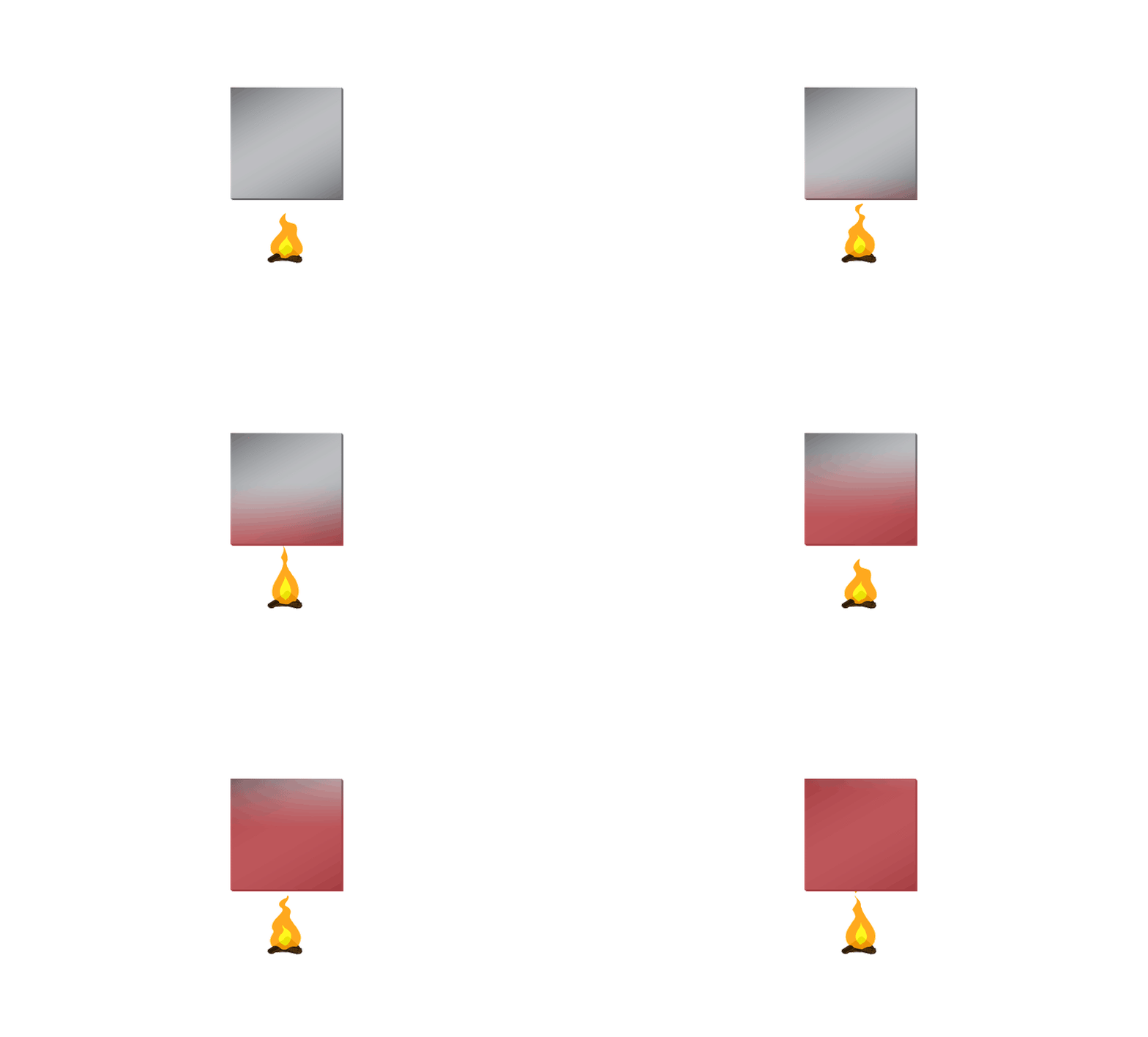
قطعة من رقائق الألومنيوم كتلتها \(m=50\;\text{g}\)
تم إخراجها من الفرن لتبرد من \(T_i=100^\circ C\) إلى \(T_f=30^\circ C\)
فإن الطاقة الحرارية المفقودة تعادل
علما بأن \(C_{P\text{-Al}} = 900\;\text{J/(kg·K)}\)
An aluminum foil piece of mass \(m=50\;\text{g}\) is taken out of the oven to cool from \(T_i=100^\circ C\) to \(T_f=30^\circ C\).
The thermal energy lost is
given that \(C_{P\text{-Al}} = 900\;\text{J/(kg·K)}\)
اختر الإجابة الصحيحة
Choose the correct answer
A
\(Q = -3150\;\text{J}\)
\(Q = -3150\;\text{J}\)
B
\(Q = -1900\;\text{J}\)
\(Q = -1900\;\text{J}\)
C
\(Q = -1650\;\text{J}\)
\(Q = -1650\;\text{J}\)
D
\(Q = -2550\;\text{J}\)
\(Q = -2550\;\text{J}\)
طريقة الحل:Solution:
قانون كمية الحرارة: \(Q = m \cdot C_p \cdot \Delta T\)
Heat equation: \(Q = m \cdot C_p \cdot \Delta T\)
\(m = 50\;\text{g} = 0.05\;\text{kg}\)
\(\Delta T = T_f - T_i = 30 - 100 = -70^\circ C\)
\(Q = 0.05 \times 900 \times (-70) = -3150\;\text{J}\)
الإشارة السالبة تعني فقدان الحرارة.
Negative sign indicates heat loss.
الإجابة الصحيحة: (A) \(Q = -3150\;\text{J}\)
Correct answer: (A) \(Q = -3150\;\text{J}\)
★ 21
يرتفع الهواء الدافئ نحو الأعلى ويحل بدلا عنه الهواء البارد، هذا النوع من نقل الحرارة يدعى
Warm air rises and is replaced by cool air. This type of heat transfer is called:

اختر الإجابة الصحيحة
Choose the correct answer
A
التوصيل
Conduction
B
الحمل
Convection
C
الإشعاع
Radiation
D
الاتزان
Equilibrium
طريقة الحل:Solution:
الحمل الحراري هو انتقال الحرارة عن طريق حركة المائع (السوائل والغازات).
Convection is heat transfer through fluid motion (liquids and gases).
الهواء الدافئ يخف كثافته فيرتفع، ويحل محله الهواء البارد الأكثر كثافة، مكونًا تيارات حمل.
Warm air becomes less dense and rises, replaced by cooler, denser air, forming convection currents.
الإجابة الصحيحة: (B) الحمل
Correct answer: (B) Convection
★ 22
أنبوب مياه مصنوع من النحاس كتلته \(m=5\;\text{kg}\) يستخدم لنقل المياه
ترتفع درجة حرارة المياه من \(T_i=20^\circ C\) إلى \(T_f=85^\circ C\)
فإن الطاقة الحرارية التي تكتسبها أنابيب النحاس تعادل
علما بأن السعة الحرارية النوعية للنحاس \(C_p = 385\;\text{J/(kg·K)}\)
A copper water pipe of mass \(m=5\;\text{kg}\) is used to transport water.
The water temperature rises from \(T_i=20^\circ C\) to \(T_f=85^\circ C\).
The thermal energy gained by the copper pipe is
given that the specific heat capacity of copper is \(C_p = 385\;\text{J/(kg·K)}\)
اختر الإجابة الصحيحة
Choose the correct answer
A
\(Q = 323425\;\text{J}\)
\(Q = 323425\;\text{J}\)
B
\(Q = 125125\;\text{J}\)
\(Q = 125125\;\text{J}\)
C
\(Q = 565342\;\text{J}\)
\(Q = 565342\;\text{J}\)
D
\(Q = 314227\;\text{J}\)
\(Q = 314227\;\text{J}\)
طريقة الحل:Solution:
قانون كمية الحرارة: \(Q = m \cdot C_p \cdot \Delta T\)
Heat equation: \(Q = m \cdot C_p \cdot \Delta T\)
\(\Delta T = 85 - 20 = 65^\circ C\)
\(Q = 5 \times 385 \times 65 = 125125\;\text{J}\)
الإجابة الصحيحة: (B) \(Q = 125125\;\text{J}\)
Correct answer: (B) \(Q = 125125\;\text{J}\)
★ 23
درجة حرارة مريض كورونا \(40^\circ C\)، كم تعادل درجة الحرارة بالتدرج الفهرنهايتي؟
A COVID-19 patient has a temperature of \(40^\circ C\). What is the equivalent temperature in Fahrenheit?
اختر الإجابة الصحيحة
Choose the correct answer
A
\(T_f = 92^\circ F\)
\(T_f = 92^\circ F\)
B
\(T_f = 180^\circ F\)
\(T_f = 180^\circ F\)
C
\(T_f = 72^\circ C\)
\(T_f = 72^\circ C\)
D
\(T_f = 104^\circ F\)
\(T_f = 104^\circ F\)
طريقة الحل:Solution:
العلاقة بين السيلسيوس والفهرنهايت:
Relation between Celsius and Fahrenheit:
\(T_F = \frac{9}{5}T_C + 32\)
\(T_F = \frac{9}{5} \times 40 + 32 = 72 + 32 = 104^\circ F\)
الإجابة الصحيحة: (D) \(T_f = 104^\circ F\)
Correct answer: (D) \(T_f = 104^\circ F\)
📝 أجب عن الأسئلة التالية
📝 Answer the following questions
★ 1
قطعة من الثلج كتلتها \(m = 0.02\;\text{kg}\) ودرجة حرارتها \(T = -40^\circ C\)
يراد تحويلها إلى ماء درجة حرارته \(T = 40^\circ C\)
An ice cube of mass \(m = 0.02\;\text{kg}\) at temperature \(T = -40^\circ C\) is to be converted into water at \(T = 40^\circ C\)
❓ في أي مرحلة درجة الحرارة بقيت ثابتة على الرغم من إعطاء طاقة حرارية للمادة؟
❓ In which stage does the temperature remain constant despite adding thermal energy to the substance?
تظل درجة الحرارة ثابتة أثناء مرحلة الانصهار (عند \(0^\circ C\))، حيث تتحول المادة من الحالة الصلبة إلى السائلة.
The temperature remains constant during the melting stage (at \(0^\circ C\)), where the substance transforms from solid to liquid.
❓ ماذا تسمى هذه الطاقة الحرارية اللازمة لتحويل مادة من الحالة الصلبة إلى السائلة؟
❓ What is this thermal energy called that is required to convert a substance from solid to liquid?
تُسمى هذه الطاقة الحرارة الكامنة للانصهار (Latent Heat of Fusion) ويرمز لها بالرمز \(H_f\).
This energy is called the Latent Heat of Fusion and is denoted by \(H_f\).
❓ أين تم استغلال هذه الطاقة؟
❓ Where is this energy utilized?
تُستخدم هذه الطاقة في تحطيم الروابط بين الجزيئات (تكسير الشبكة البلورية للثلج) لتحويله إلى ماء، ولا تُستخدم في رفع درجة الحرارة.
This energy is used to break the bonds between molecules (breaking the crystal lattice of ice) to convert it to water, and is not used to raise the temperature.
📊 احسب الطاقة الحرارية اللازمة لإتمام هذه العملية
📊 Calculate the thermal energy required to complete this process
المعطيات:
Given:
- كتلة الثلج: \(m = 0.02\;\text{kg}\)
- Mass of ice: \(m = 0.02\;\text{kg}\)
- درجة الحرارة الابتدائية: \(T_i = -40^\circ C\)
- Initial temperature: \(T_i = -40^\circ C\)
- درجة الحرارة النهائية: \(T_f = 40^\circ C\)
- Final temperature: \(T_f = 40^\circ C\)
- الحرارة النوعية للثلج: \(C_{P-ice} = 2000\;\text{J/(kg·K)}\)
- Specific heat of ice: \(C_{P-ice} = 2000\;\text{J/(kg·K)}\)
- الحرارة الكامنة للانصهار: \(H_f = 3.34\times10^5\;\text{J/kg}\)
- Latent heat of fusion: \(H_f = 3.34\times10^5\;\text{J/kg}\)
- الحرارة النوعية للماء: \(C_{P-water} = 4200\;\text{J/(kg·K)}\)
- Specific heat of water: \(C_{P-water} = 4200\;\text{J/(kg·K)}\)
١
تسخين الثلج من \(-40^\circ C\) إلى \(0^\circ C\)
Heating ice from \(-40^\circ C\) to \(0^\circ C\)
\(Q_1 = m \cdot C_{P-ice} \cdot \Delta T_1\)
\(Q_1 = 0.02 \times 2000 \times (0 - (-40)) = 0.02 \times 2000 \times 40\)
\(Q_1 = 1600\;\text{J}\)
✅ هذه هي الطاقة اللازمة لرفع درجة حرارة الثلج من \(-40^\circ C\) إلى نقطة الانصهار \(0^\circ C\).
✅ This is the energy needed to raise the ice temperature from \(-40^\circ C\) to the melting point \(0^\circ C\).
٢
انصهار الثلج عند \(0^\circ C\) (درجة الحرارة ثابتة)
Melting ice at \(0^\circ C\) (constant temperature)
\(Q_2 = m \cdot H_f\)
\(Q_2 = 0.02 \times 3.34\times10^5\)
\(Q_2 = 6680\;\text{J}\)
⚠️ في هذه المرحلة لا تتغير درجة الحرارة رغم إضافة الطاقة، لأن الطاقة تُستخدم في تحطيم الروابط الجزيئية.
⚠️ In this stage, temperature does not change despite adding energy, because the energy is used to break molecular bonds.
🔑 هذه هي الحرارة الكامنة للانصهار \(H_f\)، وهي الطاقة اللازمة لتحويل 1 كجم من المادة من الحالة الصلبة إلى السائلة عند درجة حرارة ثابتة.
🔑 This is the Latent Heat of Fusion \(H_f\), the energy required to convert 1 kg of a substance from solid to liquid at constant temperature.
٣
تسخين الماء من \(0^\circ C\) إلى \(40^\circ C\)
Heating water from \(0^\circ C\) to \(40^\circ C\)
\(Q_3 = m \cdot C_{P-water} \cdot \Delta T_3\)
\(Q_3 = 0.02 \times 4200 \times (40 - 0) = 0.02 \times 4200 \times 40\)
\(Q_3 = 3360\;\text{J}\)
✅ هذه هي الطاقة اللازمة لرفع درجة حرارة الماء من \(0^\circ C\) إلى \(40^\circ C\).
✅ This is the energy needed to raise the water temperature from \(0^\circ C\) to \(40^\circ C\).
🔥 السعة الحرارية - Heat Capacity
جسم درجة حرارته \(T=50^\circ C\) تم خفض درجة الحرارة إلى الدرجة \(T=20^\circ C\)
فإن التغير في درجة الحرارة يعادل
An object at temperature \(T=50^\circ C\) is cooled to \(T=20^\circ C\)
The change in temperature is:
اختر الإجابة الصحيحة
Choose the correct answer
طريقة الحل:Solution:
التغير في درجة الحرارة = درجة الحرارة النهائية - درجة الحرارة الابتدائية
Change in temperature = final temperature - initial temperature
الإجابة الصحيحة: (C) \(\Delta T = -30^\circ C\)
Correct answer: (C) \(\Delta T = -30^\circ C\)
أي مما يلي يكافئ درجة حرارة \(T = -100^\circ C\)
Which of the following is equivalent to a temperature of \(T = -100^\circ C\)?
اختر الإجابة الصحيحة
Choose the correct answer
طريقة الحل:Solution:
العلاقة بين السيلسيوس والكلفن: \(T_K = T_C + 273\)
Relation between Celsius and Kelvin: \(T_K = T_C + 273\)
الإجابة الصحيحة: (B) \(T_K = 173\;\text{K}\)
Correct answer: (B) \(T_K = 173\;\text{K}\)
سخنت عينة من الماء كتلتها \(m=60\;\text{g}\) من \(T_1=18^\circ C\) إلى \(T_2=70^\circ C\)
فإن كمية الحرارة الممتصة بواسطة الماء تعادل علما بأن \(C_p = 4180\;\text{J/(kg·K)}\)
A water sample of mass \(m=60\;\text{g}\) is heated from \(T_1=18^\circ C\) to \(T_2=70^\circ C\).
The heat absorbed by the water is, given that \(C_p = 4180\;\text{J/(kg·K)}\)
اختر الإجابة الصحيحة
Choose the correct answer
طريقة الحل:Solution:
قانون كمية الحرارة: \(Q = m \cdot C_p \cdot \Delta T\)
Heat equation: \(Q = m \cdot C_p \cdot \Delta T\)
الإجابة الصحيحة: (B) \(Q = 13041\;\text{J}\)
Correct answer: (B) \(Q = 13041\;\text{J}\)
عينة من الحديد كتلتها \(2.5\;\text{kg}\) ودرجة حرارتها \(T=50^\circ C\)
تم تسخينها بواسطة فرن وإعطائها طاقة مقدارها \(1.5\times10^6\;\text{J}\)
فإن درجة الحرارة النهائية التي تصل إليها قطعة الحديد تعادل
علما بأن السعة الحرارية النوعية للحديد \(C_p = 450\;\text{J/(kg·K)}\)
An iron sample of mass \(2.5\;\text{kg}\) at \(T=50^\circ C\) is heated in a furnace and given \(1.5\times10^6\;\text{J}\) of energy.
The final temperature of the iron piece is, given that the specific heat capacity of iron is \(C_p = 450\;\text{J/(kg·K)}\)
اختر الإجابة الصحيحة
Choose the correct answer
طريقة الحل:Solution:
قانون كمية الحرارة: \(Q = m \cdot C_p \cdot \Delta T\)
Heat equation: \(Q = m \cdot C_p \cdot \Delta T\)
الإجابة الصحيحة: (B) \(T_f = 1383.3^\circ C\)
Correct answer: (B) \(T_f = 1383.3^\circ C\)
تم تسخين قطعة من النحاس كتلتها \(0.2\;\text{kg}\) من \(T_1=10^\circ C\) إلى \(T_2=30^\circ C\)
إذا أضيفت نفس كمية الحرارة إلى قطعة من الحديد كتلتها \(0.3\;\text{kg}\) فإن التغير في درجة حرارة قطعة الحديد تعادل
علما بأن السعة الحرارية النوعية للنحاس \(C_p = 376\;\text{J/(kg·K)}\)
والسعة الحرارية النوعية للحديد \(C_p = 450\;\text{J/(kg·K)}\)
A copper piece of mass \(0.2\;\text{kg}\) is heated from \(T_1=10^\circ C\) to \(T_2=30^\circ C\).
If the same amount of heat is added to an iron piece of mass \(0.3\;\text{kg}\), the temperature change of the iron piece is
given that the specific heat capacity of copper is \(C_p = 376\;\text{J/(kg·K)}\)
and the specific heat capacity of iron is \(C_p = 450\;\text{J/(kg·K)}\)
اختر الإجابة الصحيحة
Choose the correct answer
طريقة الحل:Solution:
أولاً نحسب كمية الحرارة التي اكتسبها النحاس:
First, calculate the heat gained by copper:
نفس كمية الحرارة تضاف للحديد:
The same heat is added to iron:
الإجابة الصحيحة: (D) \(\Delta T = 11.1^\circ C\)
Correct answer: (D) \(\Delta T = 11.1^\circ C\)
الطاقة الحرارية اللازمة لتحويل 1 كيلو جرام من مادة من الحالة الصلبة إلى السائلة أو العكس دون تغير درجة الحرارة تدعى
The thermal energy required to convert 1 kilogram of a substance from solid to liquid or vice versa without changing temperature is called:
اختر الإجابة الصحيحة
Choose the correct answer
طريقة الحل:Solution:
الحرارة الكامنة للانصهار هي الطاقة اللازمة لتحويل 1 كجم من مادة من الحالة الصلبة إلى السائلة عند درجة حرارة ثابتة (نقطة الانصهار).
Latent heat of fusion is the energy required to convert 1 kg of a substance from solid to liquid at constant temperature (melting point).
الإجابة الصحيحة: (B) الحرارة الكامنة للانصهار
Correct answer: (B) Latent heat of fusion
ثلاثة أجسام \(A,\;B,\;C\) لها درجة حرارة
\(T_A = -40^\circ C,\; T_B = -40^\circ F,\; T_C = -40\;\text{K}\)
أي جسم من بين هذه أعلى درجة حرارة
Three objects \(A,\;B,\;C\) have temperatures
\(T_A = -40^\circ C,\; T_B = -40^\circ F,\; T_C = -40\;\text{K}\)
Which of these objects has the highest temperature?
اختر الإجابة الصحيحة
Choose the correct answer
طريقة الحل:Solution:
نحول جميع درجات الحرارة إلى مقياس واحد (سيلسيوس):
Convert all temperatures to one scale (Celsius):
إذن \(T_A = T_B = -40^\circ C\) وهي أعلى من \(T_C = -313^\circ C\)
Therefore \(T_A = T_B = -40^\circ C\) which is higher than \(T_C = -313^\circ C\)
الإجابة الصحيحة: (D) الجسمان A و B
Correct answer: (D) Objects A and B
كأس يحتوي على ماء كتلته \(m=0.4\;\text{kg}\) ودرجة حرارته \(T=25^\circ C\)
تم إضافة الماء إلى كأس آخر أيضا يحتوي على ماء كتلته \(m=0.4\;\text{kg}\) ودرجة حرارته \(T=25^\circ C\)
وبفرض لا يوجد فقدان للطاقة الحرارية فإن درجة حرارة المزيج النهائية تعادل
A cup contains water of mass \(m=0.4\;\text{kg}\) at temperature \(T=25^\circ C\).
This water is added to another cup that also contains water of mass \(m=0.4\;\text{kg}\) at temperature \(T=25^\circ C\).
Assuming no heat loss, the final temperature of the mixture is:
اختر الإجابة الصحيحة
Choose the correct answer
طريقة الحل:Solution:
في هذه المسألة، الماءان لهما نفس الكتلة ونفس درجة الحرارة، لذا لا يحدث انتقال للحرارة.
In this problem, both water samples have the same mass and same temperature, so no heat transfer occurs.
الإجابة الصحيحة: (C) \(T_f = 25^\circ C\)
Correct answer: (C) \(T_f = 25^\circ C\)
في حالة الاتزان الحراري يكون معدل تدفق الطاقة بين الجسمين بفرض لا يوجد فقدان للطاقة
In thermal equilibrium, the rate of energy flow between two bodies, assuming no energy loss, is:
اختر الإجابة الصحيحة
Choose the correct answer
طريقة الحل:Solution:
في حالة الاتزان الحراري، تكون درجة حرارة الجسمين متساوية، وبالتالي لا يوجد تدفق صافي للطاقة بينهما.
In thermal equilibrium, the temperatures of both bodies are equal, so there is no net energy flow between them.
معدل تدفق الطاقة من الساخن إلى البارد يساوي معدل تدفق الطاقة من البارد إلى الساخن (صافي التدفق = صفر).
The rate of energy flow from hot to cold equals the rate from cold to hot (net flow = zero).
الإجابة الصحيحة: (A) متساوي
Correct answer: (A) Equal
الشكل البياني التالي يبين العلاقة بين الطاقة الحرارية ودرجة الحرارة لجسم كتلته \(m=0.001\;\text{kg}\) تم تسخينه
فإن الحرارة الكامنة للانصهار تعادل
The following graph shows the relationship between thermal energy and temperature for an object of mass \(m=0.001\;\text{kg}\) that was heated.
The latent heat of fusion is:
اختر الإجابة الصحيحة
Choose the correct answer
طريقة الحل:Solution:
من الرسم البياني، نلاحظ أن كمية الحرارة اللازمة لانصهار المادة هي الفرق في الطاقة عند درجة حرارة الانصهار.
From the graph, the heat required for melting is the difference in energy at the melting temperature.
بافتراض أن \(Q = 334\;\text{J}\) (من الرسم البياني)، و \(m = 0.001\;\text{kg}\):
Assuming \(Q = 334\;\text{J}\) (from the graph), and \(m = 0.001\;\text{kg}\):
الإجابة الصحيحة: (C) \(H_f = 3.34\times10^5\;\text{J/kg}\)
Correct answer: (C) \(H_f = 3.34\times10^5\;\text{J/kg}\)
كمية متساوية من المواد تم تعرضها لنفس الطاقة الحرارية، الجدول التالي يبين السعة الحرارية النوعية لها
أي منها ترتفع درجة حرارتها بشكل أكبر وتبرد بشكل أسرع عند امتصاصها وفقدانها للطاقة الحرارية
Equal amounts of different materials are exposed to the same thermal energy. The following table shows their specific heat capacities.
Which one has the largest temperature increase and cools fastest when absorbing and losing thermal energy?
اختر الإجابة الصحيحة
Choose the correct answer
طريقة الحل:Solution:
المادة ذات السعة الحرارية النوعية الأصغر ترتفع درجة حرارتها بشكل أكبر عند امتصاص نفس كمية الحرارة، وتبرد بشكل أسرع عند فقدانها.
The material with the smallest specific heat capacity will have the largest temperature increase when absorbing the same amount of heat, and will cool faster when losing heat.
من الجدول، النحاس الأصفر لديه أقل سعة حرارية نوعية (\(C_p = 380\;\text{J/(kg·K)}\)) مقارنة بالألمنيوم (\(900\)) والكربون (\(710\)) والنحاس (\(385\)).
From the table, brass has the lowest specific heat capacity (\(C_p = 380\;\text{J/(kg·K)}\)) compared to aluminum (\(900\)), carbon (\(710\)), and copper (\(385\)).
الإجابة الصحيحة: (B) النحاس الأصفر
Correct answer: (B) Brass
كتلة من معدن كتلتها \(m=0.025\;\text{kg}\) ودرجة حرارتها \(T=90^\circ C\)
تم إضافتها إلى كمية من الماء كتلتها \(m=0.05\;\text{kg}\) ودرجة حرارتها \(T=25^\circ C\)
فإن درجة حرارة الماء والمعدن تصبح بعد الإضافة \(T=29.8^\circ C\)
فإذا علمت أن الحرارة النوعية للماء تساوي \(C_p = 4200\;\text{J/(kg·K)}\)
فإن الحرارة النوعية للمعدن تعادل
A metal piece of mass \(m=0.025\;\text{kg}\) at temperature \(T=90^\circ C\) is added to water of mass \(m=0.05\;\text{kg}\) at temperature \(T=25^\circ C\).
The final temperature of the water and metal becomes \(T=29.8^\circ C\).
Given that the specific heat of water is \(C_p = 4200\;\text{J/(kg·K)}\),
the specific heat of the metal is:
اختر الإجابة الصحيحة
Choose the correct answer
طريقة الحل:Solution:
في حالة الاتزان الحراري، الحرارة المفقودة من المعدن = الحرارة المكتسبة من الماء:
In thermal equilibrium, heat lost by metal = heat gained by water:
الإجابة الصحيحة: (C) \(C_p = 670\;\text{J/(kg·K)}\)
Correct answer: (C) \(C_p = 670\;\text{J/(kg·K)}\)
ما مقدار الطاقة اللازمة لصهر كتلة من الجليد \(m=0.5\;\text{kg}\) عند درجة حرارة صفر مئوية؟
علما بأن \(H_f = 3.34\times10^5\;\text{J/kg}\)
How much energy is needed to melt a mass of ice \(m=0.5\;\text{kg}\) at 0°C?
Given that \(H_f = 3.34\times10^5\;\text{J/kg}\)
اختر الإجابة الصحيحة
Choose the correct answer
طريقة الحل:Solution:
قانون الحرارة الكامنة للانصهار: \(Q = m \cdot H_f\)
Latent heat of fusion equation: \(Q = m \cdot H_f\)
الإجابة الصحيحة: (B) \(Q = 1.67\times10^5\;\text{J}\)
Correct answer: (B) \(Q = 1.67\times10^5\;\text{J}\)
تحتاج مادة إلى طاقة حرارية مقدارها \(Q=0.8\times10^6\;\text{J}\) لتحويل كتلة مقدارها \(m=3\;\text{kg}\) من الحالة الصلبة إلى الحالة السائلة
مستعينا بجدول الحرارة الكامنة لبعض المواد فإن المادة هي
A substance requires thermal energy of \(Q=0.8\times10^6\;\text{J}\) to convert a mass of \(m=3\;\text{kg}\) from solid to liquid.
Using the table of latent heats of some substances, the substance is:
اختر الإجابة الصحيحة
Choose the correct answer
طريقة الحل:Solution:
نحسب الحرارة الكامنة للانصهار للمادة: \(H_f = \frac{Q}{m}\)
Calculate the latent heat of fusion: \(H_f = \frac{Q}{m}\)
بالمقارنة مع الجدول، هذه القيمة تطابق الحديد.
Comparing with the table, this value matches iron.
الإجابة الصحيحة: (D) الحديد \(H_f = 2.66\times10^5\;\text{J/kg}\)
Correct answer: (D) Iron \(H_f = 2.66\times10^5\;\text{J/kg}\)
قطعة من الثلج كتلتها \(m=0.02\;\text{kg}\) ودرجة حرارتها \(T=-40^\circ C\)
يراد تحويلها إلى ماء درجة حرارته \(T=40^\circ C\)
فإن الطاقة الحرارية اللازمة لإتمام هذه العملية تعادل
علما بأن \(H_f = 3.34\times10^5\;\text{J/kg}\)،
\(C_{P\text{-ice}} = 2000\;\text{J/(kg·K)}\)،
\(C_{P\text{-water}} = 4200\;\text{J/(kg·K)}\)
An ice cube of mass \(m=0.02\;\text{kg}\) at temperature \(T=-40^\circ C\) is to be converted into water at \(T=40^\circ C\).
The thermal energy required for this process is
given that \(H_f = 3.34\times10^5\;\text{J/kg}\),
\(C_{P\text{-ice}} = 2000\;\text{J/(kg·K)}\),
\(C_{P\text{-water}} = 4200\;\text{J/(kg·K)}\)
اختر الإجابة الصحيحة
Choose the correct answer
طريقة الحل:Solution:
العملية تتم في ثلاث مراحل:
The process occurs in three stages:
الإجابة الصحيحة: (D) \(Q = 11640\;\text{J}\)
Correct answer: (D) \(Q = 11640\;\text{J}\)
يتم استخدام وعاء ألومنيوم كتلته \(m=0.5\;\text{kg}\) يحتوي على ماء كتلته \(m=0.2\;\text{kg}\) على موقد التسخين
مما أدى إلى ارتفاع درجة حرارة الماء والوعاء من \(T_i=20^\circ C\) إلى \(T_f=60^\circ C\)
فإن الطاقة الحرارية المطلوبة لإنجاز المهمة تعادل
علما بأن \(C_{P\text{-Al}} = 900\;\text{J/(kg·K)}\)، \(C_{P\text{-water}} = 4200\;\text{J/(kg·K)}\)
An aluminum container of mass \(m=0.5\;\text{kg}\) containing water of mass \(m=0.2\;\text{kg}\) is placed on a heater.
The temperature of the water and container rises from \(T_i=20^\circ C\) to \(T_f=60^\circ C\).
The thermal energy required to accomplish this is
given that \(C_{P\text{-Al}} = 900\;\text{J/(kg·K)}\), \(C_{P\text{-water}} = 4200\;\text{J/(kg·K)}\)
اختر الإجابة الصحيحة
Choose the correct answer
طريقة الحل:Solution:
الطاقة الكلية = الطاقة التي يكتسبها الألومنيوم + الطاقة التي يكتسبها الماء
Total energy = energy gained by aluminum + energy gained by water
الإجابة الصحيحة: (A) \(Q = 51600\;\text{J}\)
Correct answer: (A) \(Q = 51600\;\text{J}\)
قطعتين من الثلج، كتلة كل قطعة \(m_1=m_2=15\;\text{g}\) ودرجة حرارتها صفر درجة سيليزية
تم وضعها فوق كوب يحتوي على ماء كتلته \(m=0.3\;\text{kg}\) ودرجة حرارته \(20^\circ C\)
فحدث بعد فترة اتزان حراري، وبفرض أن الكوب لم يفقد حرارة
فإن درجة حرارة المزيج تعادل
علما بأن \(H_f = 3.34\times10^5\;\text{J/kg}\)،
\(C_{P\text{-ice}} = 2000\;\text{J/(kg·K)}\)،
\(C_{P\text{-water}} = 4200\;\text{J/(kg·K)}\)
Two ice cubes, each of mass \(m_1=m_2=15\;\text{g}\) at 0°C are placed in a cup containing water of mass \(m=0.3\;\text{kg}\) at 20°C.
After some time, thermal equilibrium is reached. Assuming the cup does not lose heat,
the final temperature of the mixture is
given that \(H_f = 3.34\times10^5\;\text{J/kg}\),
\(C_{P\text{-ice}} = 2000\;\text{J/(kg·K)}\),
\(C_{P\text{-water}} = 4200\;\text{J/(kg·K)}\)
اختر الإجابة الصحيحة
Choose the correct answer
طريقة الحل:Solution:
كتلة الثلج الكلية = \(0.015 + 0.015 = 0.03\;\text{kg}\)
Total ice mass = \(0.015 + 0.015 = 0.03\;\text{kg}\)
الحرارة التي يفقدها الماء لتنخفض من \(20^\circ C\) إلى \(0^\circ C\):
Heat lost by water to cool from \(20^\circ C\) to \(0^\circ C\):
الحرارة اللازمة لصهر الثلج:
Heat required to melt ice:
بما أن \(Q_{water} > Q_{melt}\)، سينصهر كل الثلج وترتفع درجة حرارة المزيج.
Since \(Q_{water} > Q_{melt}\), all ice will melt and the mixture temperature will rise.
الحرارة المتبقية لرفع درجة حرارة المزيج:
Remaining heat to raise the mixture temperature:
الكتلة الكلية للمزيج = \(0.3 + 0.03 = 0.33\;\text{kg}\)
Total mixture mass = \(0.3 + 0.03 = 0.33\;\text{kg}\)
الإجابة الصحيحة: (B) \(T_f = 10.95^\circ C\)
Correct answer: (B) \(T_f = 10.95^\circ C\)
عينتين لهما نفس الكتلة في الحالة الصلبة وبنفس درجة الحرارة
تم إعطائها طاقة حرارية، تم رسم الخط البياني بين الطاقة ودرجة الحرارة لكلا المادتين
وتم المقارنة بين السعة الحرارية النوعية والحرارة الكامنة للانصهار للمادتين
أحد الإجابات التالية تحقق معلومات الخط البياني
Two samples of the same mass in solid state and at the same temperature are given thermal energy.
The graph between energy and temperature for both materials is drawn, and a comparison is made between the specific heat capacity and latent heat of fusion.
Which of the following answers satisfies the information in the graph?
اختر الإجابة الصحيحة
Choose the correct answer
طريقة الحل:Solution:
من الرسم البياني، ميل الخط في المنطقة الصلبة يعكس السعة الحرارية النوعية (كلما زاد الميل، قلت السعة الحرارية).
From the graph, the slope in the solid region reflects specific heat capacity (the steeper the slope, the smaller the specific heat).
طول الخط الأفقي (منطقة الانصهار) يعكس الحرارة الكامنة للانصهار (كلما زاد الطول، زادت الحرارة الكامنة).
The length of the horizontal line (melting region) reflects latent heat of fusion (the longer the line, the greater the latent heat).
من الرسم: ميل X أقل من ميل Y، لذا \(C_{PY} > C_{PX}\). طول X أقل من طول Y، لذا \(H_{fY} > H_{fX}\).
From the graph: slope of X is less than slope of Y, so \(C_{PY} > C_{PX}\). Length of X is less than length of Y, so \(H_{fY} > H_{fX}\).
الإجابة الصحيحة: (B) \(C_{PY} > C_{PX}\)، \(H_{fY} > H_{fX}\)
Correct answer: (B) \(C_{PY} > C_{PX}\)، \(H_{fY} > H_{fX}\)
أي مما يلي غير صحيح فيما يتعلق بالحرارة
Which of the following is not correct regarding heat?
اختر الإجابة الصحيحة
Choose the correct answer
طريقة الحل:Solution:
الحرارة تنتقل دائماً من الجسم الساخن إلى الجسم البارد (القانون الثاني للديناميكا الحرارية).
Heat always transfers from hot bodies to cold bodies (Second Law of Thermodynamics).
الانتقال من البارد إلى الساخن يتطلب بذل شغل (مثل في المكيفات والثلاجات).
Transfer from cold to hot requires doing work (like in refrigerators and air conditioners).
الإجابة الصحيحة: (D) تنتقل الحرارة من البارد إلى الساخن دون بذل شغل
Correct answer: (D) Heat transfers from cold to hot without doing work
قطعة من رقائق الألومنيوم كتلتها \(m=50\;\text{g}\)
تم إخراجها من الفرن لتبرد من \(T_i=100^\circ C\) إلى \(T_f=30^\circ C\)
فإن الطاقة الحرارية المفقودة تعادل
علما بأن \(C_{P\text{-Al}} = 900\;\text{J/(kg·K)}\)
An aluminum foil piece of mass \(m=50\;\text{g}\) is taken out of the oven to cool from \(T_i=100^\circ C\) to \(T_f=30^\circ C\).
The thermal energy lost is
given that \(C_{P\text{-Al}} = 900\;\text{J/(kg·K)}\)
اختر الإجابة الصحيحة
Choose the correct answer
طريقة الحل:Solution:
قانون كمية الحرارة: \(Q = m \cdot C_p \cdot \Delta T\)
Heat equation: \(Q = m \cdot C_p \cdot \Delta T\)
الإشارة السالبة تعني فقدان الحرارة.
Negative sign indicates heat loss.
الإجابة الصحيحة: (A) \(Q = -3150\;\text{J}\)
Correct answer: (A) \(Q = -3150\;\text{J}\)
يرتفع الهواء الدافئ نحو الأعلى ويحل بدلا عنه الهواء البارد، هذا النوع من نقل الحرارة يدعى
Warm air rises and is replaced by cool air. This type of heat transfer is called:
اختر الإجابة الصحيحة
Choose the correct answer
طريقة الحل:Solution:
الحمل الحراري هو انتقال الحرارة عن طريق حركة المائع (السوائل والغازات).
Convection is heat transfer through fluid motion (liquids and gases).
الهواء الدافئ يخف كثافته فيرتفع، ويحل محله الهواء البارد الأكثر كثافة، مكونًا تيارات حمل.
Warm air becomes less dense and rises, replaced by cooler, denser air, forming convection currents.
الإجابة الصحيحة: (B) الحمل
Correct answer: (B) Convection
أنبوب مياه مصنوع من النحاس كتلته \(m=5\;\text{kg}\) يستخدم لنقل المياه
ترتفع درجة حرارة المياه من \(T_i=20^\circ C\) إلى \(T_f=85^\circ C\)
فإن الطاقة الحرارية التي تكتسبها أنابيب النحاس تعادل
علما بأن السعة الحرارية النوعية للنحاس \(C_p = 385\;\text{J/(kg·K)}\)
A copper water pipe of mass \(m=5\;\text{kg}\) is used to transport water.
The water temperature rises from \(T_i=20^\circ C\) to \(T_f=85^\circ C\).
The thermal energy gained by the copper pipe is
given that the specific heat capacity of copper is \(C_p = 385\;\text{J/(kg·K)}\)
اختر الإجابة الصحيحة
Choose the correct answer
طريقة الحل:Solution:
قانون كمية الحرارة: \(Q = m \cdot C_p \cdot \Delta T\)
Heat equation: \(Q = m \cdot C_p \cdot \Delta T\)
الإجابة الصحيحة: (B) \(Q = 125125\;\text{J}\)
Correct answer: (B) \(Q = 125125\;\text{J}\)
درجة حرارة مريض كورونا \(40^\circ C\)، كم تعادل درجة الحرارة بالتدرج الفهرنهايتي؟
A COVID-19 patient has a temperature of \(40^\circ C\). What is the equivalent temperature in Fahrenheit?
اختر الإجابة الصحيحة
Choose the correct answer
طريقة الحل:Solution:
العلاقة بين السيلسيوس والفهرنهايت:
Relation between Celsius and Fahrenheit:
الإجابة الصحيحة: (D) \(T_f = 104^\circ F\)
Correct answer: (D) \(T_f = 104^\circ F\)
📝 أجب عن الأسئلة التالية
📝 Answer the following questions
قطعة من الثلج كتلتها \(m = 0.02\;\text{kg}\) ودرجة حرارتها \(T = -40^\circ C\)
يراد تحويلها إلى ماء درجة حرارته \(T = 40^\circ C\)
An ice cube of mass \(m = 0.02\;\text{kg}\) at temperature \(T = -40^\circ C\) is to be converted into water at \(T = 40^\circ C\)
❓ في أي مرحلة درجة الحرارة بقيت ثابتة على الرغم من إعطاء طاقة حرارية للمادة؟
❓ In which stage does the temperature remain constant despite adding thermal energy to the substance?
❓ ماذا تسمى هذه الطاقة الحرارية اللازمة لتحويل مادة من الحالة الصلبة إلى السائلة؟
❓ What is this thermal energy called that is required to convert a substance from solid to liquid?
❓ أين تم استغلال هذه الطاقة؟
❓ Where is this energy utilized?
📊 احسب الطاقة الحرارية اللازمة لإتمام هذه العملية
📊 Calculate the thermal energy required to complete this process
المعطيات:
Given:
- كتلة الثلج: \(m = 0.02\;\text{kg}\)
- Mass of ice: \(m = 0.02\;\text{kg}\)
- درجة الحرارة الابتدائية: \(T_i = -40^\circ C\)
- Initial temperature: \(T_i = -40^\circ C\)
- درجة الحرارة النهائية: \(T_f = 40^\circ C\)
- Final temperature: \(T_f = 40^\circ C\)
- الحرارة النوعية للثلج: \(C_{P-ice} = 2000\;\text{J/(kg·K)}\)
- Specific heat of ice: \(C_{P-ice} = 2000\;\text{J/(kg·K)}\)
- الحرارة الكامنة للانصهار: \(H_f = 3.34\times10^5\;\text{J/kg}\)
- Latent heat of fusion: \(H_f = 3.34\times10^5\;\text{J/kg}\)
- الحرارة النوعية للماء: \(C_{P-water} = 4200\;\text{J/(kg·K)}\)
- Specific heat of water: \(C_{P-water} = 4200\;\text{J/(kg·K)}\)
✅ هذه هي الطاقة اللازمة لرفع درجة حرارة الثلج من \(-40^\circ C\) إلى نقطة الانصهار \(0^\circ C\).
✅ This is the energy needed to raise the ice temperature from \(-40^\circ C\) to the melting point \(0^\circ C\).
⚠️ في هذه المرحلة لا تتغير درجة الحرارة رغم إضافة الطاقة، لأن الطاقة تُستخدم في تحطيم الروابط الجزيئية.
⚠️ In this stage, temperature does not change despite adding energy, because the energy is used to break molecular bonds.
✅ هذه هي الطاقة اللازمة لرفع درجة حرارة الماء من \(0^\circ C\) إلى \(40^\circ C\).
✅ This is the energy needed to raise the water temperature from \(0^\circ C\) to \(40^\circ C\).
No comments:
Post a Comment