 Physics
📄 اطبع pdf
00971504825082
تأثير دوبلر
The Doppler Effect
تأثير دوبلر
اكتشف التأثير العالم النمساوي كريستيان دوبلر عام 1842
تأثير دوبلر
ما هو تأثير دوبلر؟
تأثير دوبلر هو تغيُّر ظاهري في تردد أو طول موجة عندما يتحرك المصدر الموجي بالنسبة للمراقب (أو يتحرك المراقب بالنسبة للمصدر). يُلاحظ هذا التأثير في الأمواج الصوتية والكهرومغناطيسية مثل الضوء. مثال كلاسيكي: تغيُّر صوت صفارة الإنذار عند مرور سيارة إسعاف بالقرب منك
عندما يتحرك مصدر الموجة الصوتية بالنسبة للمراقب الذي يسمع الموجة،
يكون هناك تحول في التردد الظاهر الذي يسمعه المراقب.
انظر إلى الرسم المتحرك أدناه لفهم العملية.
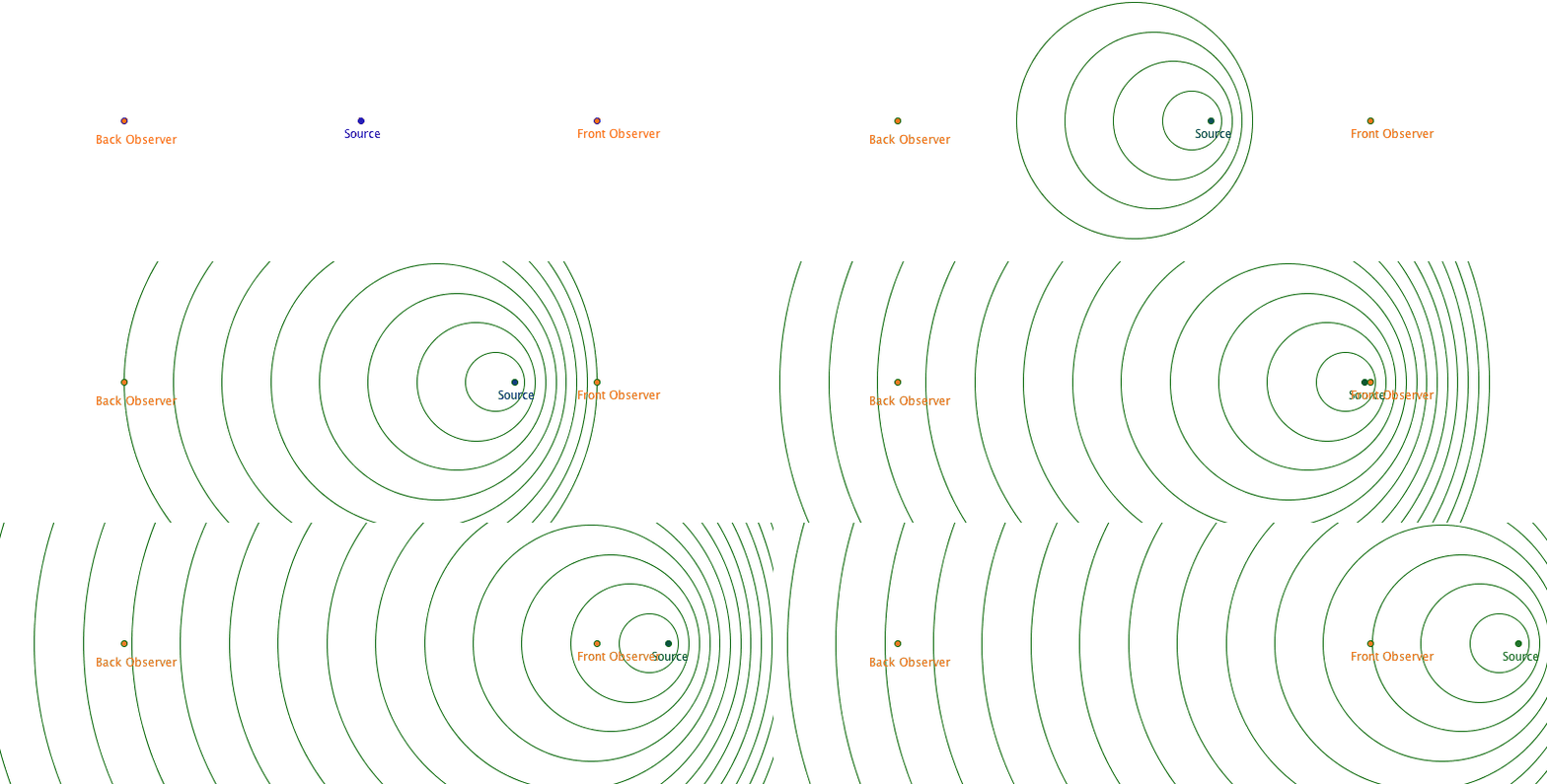
تأثير دوبلر (مصدر الصوت يتحرك بشكل أبطأ من سرعة الصوت)
لاحظ كيف تتجمع الموجات الصوتية أمام المصدر وتمتد خلف المصدر.
تصل المزيد من القمم إلى أذن المراقب الأمامي كل ثانية.
مقارنة بالتردد الفعلي الذي ينتجه المصدر، يلاحظ المراقب الموجود أمام المصدر
ترددًا أعلى والمراقب خلف المصدر يرى ترددًا أقل.
يُنظر إلى تحول مماثل إذا كان المصدر ثابتًا والمراقب يتحرك باتجاه المصدر أو بعيدًا عنه.
في حالة التحرك نحو مصدر الصوت، يتم إدراك تردد أعلى. في حالة الابتعاد عن المصدر، يُنظر إلى تردد أقل.

مصدر الصوت يتحرك بسرعة الصوت
عندما يقترب مصدر سرعة الصوت من سرعة الصوت، تقترب الأطوال الموجية أمام المصدر من الصفر.
مع تجمع الموجات على بعضها البعض أمام المصدر، تتراكم مساحة كبيرة من التداخل البناء.
إذا وصلت منطقة التداخل البناء الكبير إلى أذن المراقب، يُسمع صوت انفجار.

مصدر الصوت يتحرك أسرع من سرعة الصوت
عندما ينتقل مصدر الصوت بسرعة أكبر من سرعة الصوت، فإن مخروط التداخل البناء يسير خلف المصدر.
في اللحظة التي تقطع فيها حافة هذا المخروط مسار مراقب، يُسمع صوت عالٍ من نوع حاجز الصوت.
لاحظ أن الدوي الصوتي ليس شيئًا يحدث في الوقت الذي يكسر فيه المصدر سرعة الصوت،
بل يرجع إلى موجة الصدمة المستمرة التي تتخلف خلف مصدر الصوت. انظر إلى الرسم المتحرك أعلاه ولاحظ الطفرة التي تحدث تمامًا عندما تعبر حافة الموجة النقطة التي يقف فيها كل مراقب
المعادلات الأساسية:
المراقب يتحرك مبتعدا عن المصدر
المراقب يتحرك نحو المصدر
مراقب ثابت
\[f_d=f_s\frac {v-v_d}{v-v_s}\]
\[f_d=f_s\frac {v-v_d}{v}\]
\[f_d=f_s\frac {v+v_d}{v}\]
\[f_s=f_d\]
مصدر ثابت
\[f_d=f_s\frac {v-v_d}{v-v_s}\]
\[f_d=f_s\frac {v+v_d}{v-v_s}\]
\[f_d=f_s\frac {v}{v-v_s}\]
المصدر يتحرك نحو المراقب
\[f_d=f_s\frac {v-v_d}{v+v_s}\]
\[f_d=f_s\frac {v+v_d}{v+v_s}\]
\[f_d=f_s\frac {v}{v+v_s}\]
المصدر يبتعد عن المراقب
التطبيقات العملية:
رادارات المرور 🚔
تُستخدم لقياس سرعة السيارات عن طريق حساب التغير في تردد الموجات المرتدة.
الرصد الجوي 🌪️
تحديد سرعة الرياح وحركة العواصف باستخدام رادار دوبلر.
الفحوصات الطبية 🏥
قياس سرعة تدفق الدم في الأوعية الدموية (دوبلر الملون).
الفلك 🌌
دراسة حركة النجوم والمجرات عبر الانزياح الأحمر/الأزرق.
أنظمة الإنذار 🚨
كاشفات السرعة في السيارات الحديثة عند اقتراب سيارات الإسعاف.
محاكاة تأثير دوبلر في الصوت
استخدم المحاكاة أدناه لتجربة تأثير دوبلر وسماع الصوت.
\[1 \star \]
إذا تحرك مصدر صوت بسرعة 30 م/ث نحو مراقب ساكن، وسرعة الصوت 340 م/ث، والتردد الأصلي 500 هرتز، فما التردد الظاهري الذي يسمعه المراقب؟
أختر الإجابة الصحيحة
A450 Hz
B500 Hz
C548 Hz
D600 Hz
 اضغط هنا تظهر طريقة الحل
الحل: باستخدام معادلة دوبلر (المصدر يتحرك نحو المراقب):
\[f_d = f_s \frac{v}{v - v_s} = 500 \times \frac{340}{340 - 30} = 500 \times \frac{340}{310} = 548.4 \, Hz\]
الإجابة الصحيحة: C) 548 Hz
\[2 \star \]
إذا تحرك مراقب بسرعة 20 م/ث نحو مصدر صوت ساكن، وسرعة الصوت 340 م/ث، والتردد الأصلي 400 هرتز، فما التردد الظاهري الذي يسمعه المراقب؟
أختر الإجابة الصحيحة
A380 Hz
B400 Hz
C420 Hz
D423.5 Hz
اضغط هنا تظهر طريقة الحل
الحل: باستخدام معادلة دوبلر (المراقب يتحرك نحو المصدر):
\[f_d = f_s \frac{v + v_d}{v} = 400 \times \frac{340 + 20}{340} = 400 \times \frac{360}{340} = 423.5 \, Hz\]
الإجابة الصحيحة: D) 423.5 Hz
\[3 \star \]
في تأثير دوبلر، عندما يتحرك المصدر باتجاه المراقب، فإن التردد الظاهر:
أختر الإجابة الصحيحة
Aيقل
Bيزيد
Cيبقى ثابتاً
Dيصبح صفراً
اضغط هنا تظهر طريقة الحل
الحل: عندما يتحرك المصدر باتجاه المراقب، تقل المسافة بين الموجات المتتالية (يقل الطول الموجي)، وبالتالي يزداد التردد الظاهر.
الإجابة الصحيحة: B) يزيد
\[4 \star \]
عندما يتحرك مصدر الصوت بسرعة تساوي سرعة الصوت، فإن الأمواج أمام المصدر:
أختر الإجابة الصحيحة
Aتتضاعف
Bتتباعد
Cتتراكم وتصبح طولها الموجي صفراً
Dتختفي تماماً
اضغط هنا تظهر طريقة الحل
الحل: عندما يتحرك المصدر بسرعة تساوي سرعة الصوت، تتجمع الموجات أمام المصدر وتتراكم، مما يؤدي إلى طول موجي يقترب من الصفر.
الإجابة الصحيحة: C) تتراكم وتصبح طولها الموجي صفراً
🔊 اختبار ظاهرة دوبلر
التغير الظاهري في التردد - تطبيقات ظاهرة دوبلر - 15 سؤالاً
20:00
السؤال 1/15
التقدم: 0%
تم الإجابة: 0/15
Doppler Effect
Discovered by Austrian scientist Christian Doppler in 1842
Doppler Effect
What is the Doppler Effect?
The Doppler Effect is the apparent change in frequency or wavelength when the wave source moves relative to the observer (or the observer moves relative to the source). This effect is observed in sound waves and electromagnetic waves like light. A classic example is the change in the sound of a siren as an ambulance passes by.
When a sound source moves relative to the observer,
there is a shift in the apparent frequency heard by the observer.
Watch the animation below to understand the process.
Doppler Effect (Sound source moving slower than the speed of sound)
Notice how sound waves bunch up in front of the source and spread out behind the source.
More wave crests reach the front observer's ear each second.
Compared to the actual frequency produced by the source, the observer in front of the source hears
a higher frequency, while the observer behind hears a lower frequency.
A similar shift occurs if the source is stationary and the observer moves toward or away from the source.
Moving toward the sound source results in a higher perceived frequency. Moving away from the source results in a lower perceived frequency.
Sound source moving at the speed of sound
As the sound source approaches the speed of sound, the wavelengths in front of the source approach zero.
As waves pile up in front of the source, a large region of constructive interference builds up.
If this region of large constructive interference reaches an observer's ear, a sonic boom is heard.
Sound source moving faster than the speed of sound
When a sound source travels faster than the speed of sound, a cone of constructive interference trails behind the source.
At the moment the edge of this cone passes an observer, a loud sonic boom is heard.
Note that the sonic boom is not something that happens at the moment the source breaks the sound barrier,
but rather it is due to the continuous shock wave that trails behind the sound source. Watch the animation above and notice the boom that occurs exactly when the wave edge passes each observer's point.
Basic Equations:
Observer moving away from source
Observer moving toward source
Observer stationary
\[f_d=f_s\frac {v-v_d}{v-v_s}\]
\[f_d=f_s\frac {v-v_d}{v}\]
\[f_d=f_s\frac {v+v_d}{v}\]
\[f_s=f_d\]
Source stationary
\[f_d=f_s\frac {v-v_d}{v-v_s}\]
\[f_d=f_s\frac {v+v_d}{v-v_s}\]
\[f_d=f_s\frac {v}{v-v_s}\]
Source moving toward observer
\[f_d=f_s\frac {v-v_d}{v+v_s}\]
\[f_d=f_s\frac {v+v_d}{v+v_s}\]
\[f_d=f_s\frac {v}{v+v_s}\]
Source moving away from observer
Practical Applications:
Traffic Radars 🚔
Used to measure vehicle speed by calculating the change in frequency of reflected waves.
Weather Monitoring 🌪️
Determining wind speed and storm movement using Doppler radar.
Medical Examinations 🏥
Measuring blood flow velocity in blood vessels (Color Doppler).
Astronomy 🌌
Studying the motion of stars and galaxies through redshift/blueshift.
Alarm Systems 🚨
Speed detectors in modern cars when approaching emergency vehicles.
Doppler Effect Sound Simulation
Use the simulation below to experience the Doppler effect and hear the sound.
\[1 \star \]
A sound source moves at 30 m/s toward a stationary observer. Speed of sound is 340 m/s, original frequency is 500 Hz. What is the apparent frequency heard by the observer?
Choose the correct answer
A450 Hz
B500 Hz
C548 Hz
D600 Hz
Click here for solution
Solution: Using Doppler equation (source moving toward observer):
\[f_d = f_s \frac{v}{v - v_s} = 500 \times \frac{340}{340 - 30} = 500 \times \frac{340}{310} = 548.4 \, Hz\]
Correct Answer: C) 548 Hz
\[2 \star \]
An observer moves at 20 m/s toward a stationary sound source. Speed of sound is 340 m/s, original frequency is 400 Hz. What is the apparent frequency heard?
Choose the correct answer
A380 Hz
B400 Hz
C420 Hz
D423.5 Hz
Click here for solution
Solution: Using Doppler equation (observer moving toward source):
\[f_d = f_s \frac{v + v_d}{v} = 400 \times \frac{340 + 20}{340} = 400 \times \frac{360}{340} = 423.5 \, Hz\]
Correct Answer: D) 423.5 Hz
\[3 \star \]
In the Doppler effect, when the source moves toward the observer, the apparent frequency:
Choose the correct answer
ADecreases
BIncreases
CRemains constant
DBecomes zero
Click here for solution
Solution: When the source moves toward the observer, the distance between consecutive waves decreases (wavelength decreases), so the apparent frequency increases.
Correct Answer: B) Increases
\[4 \star \]
When a sound source moves at the speed of sound, the waves in front of the source:
Choose the correct answer
ADouble in size
BSpread apart
CPile up and have zero wavelength
DDisappear completely
Click here for solution
Solution: When the source moves at the speed of sound, waves pile up in front of the source, and the wavelength approaches zero.
Correct Answer: C) Pile up and have zero wavelength
🔊 Doppler Effect Quiz
Apparent Frequency Change - Applications - 15 Questions
20:00
Question 1/15
Progress: 0%
Answered: 0/15
تأثير دوبلر
|
تأثير دوبلر
اكتشف التأثير العالم النمساوي كريستيان دوبلر عام 1842
تأثير دوبلر
ما هو تأثير دوبلر؟
تأثير دوبلر هو تغيُّر ظاهري في تردد أو طول موجة عندما يتحرك المصدر الموجي بالنسبة للمراقب (أو يتحرك المراقب بالنسبة للمصدر). يُلاحظ هذا التأثير في الأمواج الصوتية والكهرومغناطيسية مثل الضوء. مثال كلاسيكي: تغيُّر صوت صفارة الإنذار عند مرور سيارة إسعاف بالقرب منك
عندما يتحرك مصدر الموجة الصوتية بالنسبة للمراقب الذي يسمع الموجة،
يكون هناك تحول في التردد الظاهر الذي يسمعه المراقب.
انظر إلى الرسم المتحرك أدناه لفهم العملية.
تأثير دوبلر (مصدر الصوت يتحرك بشكل أبطأ من سرعة الصوت)
لاحظ كيف تتجمع الموجات الصوتية أمام المصدر وتمتد خلف المصدر.
تصل المزيد من القمم إلى أذن المراقب الأمامي كل ثانية.
مقارنة بالتردد الفعلي الذي ينتجه المصدر، يلاحظ المراقب الموجود أمام المصدر
ترددًا أعلى والمراقب خلف المصدر يرى ترددًا أقل.
يُنظر إلى تحول مماثل إذا كان المصدر ثابتًا والمراقب يتحرك باتجاه المصدر أو بعيدًا عنه.
في حالة التحرك نحو مصدر الصوت، يتم إدراك تردد أعلى. في حالة الابتعاد عن المصدر، يُنظر إلى تردد أقل.
مصدر الصوت يتحرك بسرعة الصوت
عندما يقترب مصدر سرعة الصوت من سرعة الصوت، تقترب الأطوال الموجية أمام المصدر من الصفر.
مع تجمع الموجات على بعضها البعض أمام المصدر، تتراكم مساحة كبيرة من التداخل البناء.
إذا وصلت منطقة التداخل البناء الكبير إلى أذن المراقب، يُسمع صوت انفجار.
مصدر الصوت يتحرك أسرع من سرعة الصوت
عندما ينتقل مصدر الصوت بسرعة أكبر من سرعة الصوت، فإن مخروط التداخل البناء يسير خلف المصدر.
في اللحظة التي تقطع فيها حافة هذا المخروط مسار مراقب، يُسمع صوت عالٍ من نوع حاجز الصوت.
لاحظ أن الدوي الصوتي ليس شيئًا يحدث في الوقت الذي يكسر فيه المصدر سرعة الصوت،
بل يرجع إلى موجة الصدمة المستمرة التي تتخلف خلف مصدر الصوت. انظر إلى الرسم المتحرك أعلاه ولاحظ الطفرة التي تحدث تمامًا عندما تعبر حافة الموجة النقطة التي يقف فيها كل مراقب
المعادلات الأساسية:
المراقب يتحرك مبتعدا عن المصدر |
المراقب يتحرك نحو المصدر |
مراقب ثابت |
\[f_d=f_s\frac {v-v_d}{v-v_s}\] |
\[f_d=f_s\frac {v-v_d}{v}\] |
\[f_d=f_s\frac {v+v_d}{v}\] |
\[f_s=f_d\] |
مصدر ثابت |
\[f_d=f_s\frac {v-v_d}{v-v_s}\] |
\[f_d=f_s\frac {v+v_d}{v-v_s}\] |
\[f_d=f_s\frac {v}{v-v_s}\] |
المصدر يتحرك نحو المراقب |
\[f_d=f_s\frac {v-v_d}{v+v_s}\] |
\[f_d=f_s\frac {v+v_d}{v+v_s}\] |
\[f_d=f_s\frac {v}{v+v_s}\] |
المصدر يبتعد عن المراقب |
التطبيقات العملية:
رادارات المرور 🚔
تُستخدم لقياس سرعة السيارات عن طريق حساب التغير في تردد الموجات المرتدة.
الرصد الجوي 🌪️
تحديد سرعة الرياح وحركة العواصف باستخدام رادار دوبلر.
الفحوصات الطبية 🏥
قياس سرعة تدفق الدم في الأوعية الدموية (دوبلر الملون).
الفلك 🌌
دراسة حركة النجوم والمجرات عبر الانزياح الأحمر/الأزرق.
أنظمة الإنذار 🚨
كاشفات السرعة في السيارات الحديثة عند اقتراب سيارات الإسعاف.
محاكاة تأثير دوبلر في الصوت
استخدم المحاكاة أدناه لتجربة تأثير دوبلر وسماع الصوت.
\[1 \star \]
إذا تحرك مصدر صوت بسرعة 30 م/ث نحو مراقب ساكن، وسرعة الصوت 340 م/ث، والتردد الأصلي 500 هرتز، فما التردد الظاهري الذي يسمعه المراقب؟
أختر الإجابة الصحيحة
اضغط هنا تظهر طريقة الحل
الحل: باستخدام معادلة دوبلر (المصدر يتحرك نحو المراقب):
\[f_d = f_s \frac{v}{v - v_s} = 500 \times \frac{340}{340 - 30} = 500 \times \frac{340}{310} = 548.4 \, Hz\]
الإجابة الصحيحة: C) 548 Hz
\[2 \star \]
إذا تحرك مراقب بسرعة 20 م/ث نحو مصدر صوت ساكن، وسرعة الصوت 340 م/ث، والتردد الأصلي 400 هرتز، فما التردد الظاهري الذي يسمعه المراقب؟
أختر الإجابة الصحيحة
اضغط هنا تظهر طريقة الحل
الحل: باستخدام معادلة دوبلر (المراقب يتحرك نحو المصدر):
\[f_d = f_s \frac{v + v_d}{v} = 400 \times \frac{340 + 20}{340} = 400 \times \frac{360}{340} = 423.5 \, Hz\]
الإجابة الصحيحة: D) 423.5 Hz
\[3 \star \]
في تأثير دوبلر، عندما يتحرك المصدر باتجاه المراقب، فإن التردد الظاهر:
أختر الإجابة الصحيحة
اضغط هنا تظهر طريقة الحل
الحل: عندما يتحرك المصدر باتجاه المراقب، تقل المسافة بين الموجات المتتالية (يقل الطول الموجي)، وبالتالي يزداد التردد الظاهر.
الإجابة الصحيحة: B) يزيد
\[4 \star \]
عندما يتحرك مصدر الصوت بسرعة تساوي سرعة الصوت، فإن الأمواج أمام المصدر:
أختر الإجابة الصحيحة
اضغط هنا تظهر طريقة الحل
الحل: عندما يتحرك المصدر بسرعة تساوي سرعة الصوت، تتجمع الموجات أمام المصدر وتتراكم، مما يؤدي إلى طول موجي يقترب من الصفر.
الإجابة الصحيحة: C) تتراكم وتصبح طولها الموجي صفراً
🔊 اختبار ظاهرة دوبلر
التغير الظاهري في التردد - تطبيقات ظاهرة دوبلر - 15 سؤالاً
Doppler Effect
Discovered by Austrian scientist Christian Doppler in 1842
Doppler Effect
What is the Doppler Effect?
The Doppler Effect is the apparent change in frequency or wavelength when the wave source moves relative to the observer (or the observer moves relative to the source). This effect is observed in sound waves and electromagnetic waves like light. A classic example is the change in the sound of a siren as an ambulance passes by.
When a sound source moves relative to the observer,
there is a shift in the apparent frequency heard by the observer.
Watch the animation below to understand the process.
Doppler Effect (Sound source moving slower than the speed of sound)
Notice how sound waves bunch up in front of the source and spread out behind the source.
More wave crests reach the front observer's ear each second.
Compared to the actual frequency produced by the source, the observer in front of the source hears
a higher frequency, while the observer behind hears a lower frequency.
A similar shift occurs if the source is stationary and the observer moves toward or away from the source.
Moving toward the sound source results in a higher perceived frequency. Moving away from the source results in a lower perceived frequency.
Sound source moving at the speed of sound
As the sound source approaches the speed of sound, the wavelengths in front of the source approach zero.
As waves pile up in front of the source, a large region of constructive interference builds up.
If this region of large constructive interference reaches an observer's ear, a sonic boom is heard.
Sound source moving faster than the speed of sound
When a sound source travels faster than the speed of sound, a cone of constructive interference trails behind the source.
At the moment the edge of this cone passes an observer, a loud sonic boom is heard.
Note that the sonic boom is not something that happens at the moment the source breaks the sound barrier,
but rather it is due to the continuous shock wave that trails behind the sound source. Watch the animation above and notice the boom that occurs exactly when the wave edge passes each observer's point.
Basic Equations:
Observer moving away from source |
Observer moving toward source |
Observer stationary |
\[f_d=f_s\frac {v-v_d}{v-v_s}\] |
\[f_d=f_s\frac {v-v_d}{v}\] |
\[f_d=f_s\frac {v+v_d}{v}\] |
\[f_s=f_d\] |
Source stationary |
\[f_d=f_s\frac {v-v_d}{v-v_s}\] |
\[f_d=f_s\frac {v+v_d}{v-v_s}\] |
\[f_d=f_s\frac {v}{v-v_s}\] |
Source moving toward observer |
\[f_d=f_s\frac {v-v_d}{v+v_s}\] |
\[f_d=f_s\frac {v+v_d}{v+v_s}\] |
\[f_d=f_s\frac {v}{v+v_s}\] |
Source moving away from observer |
Practical Applications:
Traffic Radars 🚔
Used to measure vehicle speed by calculating the change in frequency of reflected waves.
Weather Monitoring 🌪️
Determining wind speed and storm movement using Doppler radar.
Medical Examinations 🏥
Measuring blood flow velocity in blood vessels (Color Doppler).
Astronomy 🌌
Studying the motion of stars and galaxies through redshift/blueshift.
Alarm Systems 🚨
Speed detectors in modern cars when approaching emergency vehicles.
Doppler Effect Sound Simulation
Use the simulation below to experience the Doppler effect and hear the sound.
\[1 \star \]
A sound source moves at 30 m/s toward a stationary observer. Speed of sound is 340 m/s, original frequency is 500 Hz. What is the apparent frequency heard by the observer?
Choose the correct answer
Click here for solution
Solution: Using Doppler equation (source moving toward observer):
\[f_d = f_s \frac{v}{v - v_s} = 500 \times \frac{340}{340 - 30} = 500 \times \frac{340}{310} = 548.4 \, Hz\]
Correct Answer: C) 548 Hz
\[2 \star \]
An observer moves at 20 m/s toward a stationary sound source. Speed of sound is 340 m/s, original frequency is 400 Hz. What is the apparent frequency heard?
Choose the correct answer
Click here for solution
Solution: Using Doppler equation (observer moving toward source):
\[f_d = f_s \frac{v + v_d}{v} = 400 \times \frac{340 + 20}{340} = 400 \times \frac{360}{340} = 423.5 \, Hz\]
Correct Answer: D) 423.5 Hz
\[3 \star \]
In the Doppler effect, when the source moves toward the observer, the apparent frequency:
Choose the correct answer
Click here for solution
Solution: When the source moves toward the observer, the distance between consecutive waves decreases (wavelength decreases), so the apparent frequency increases.
Correct Answer: B) Increases
\[4 \star \]
When a sound source moves at the speed of sound, the waves in front of the source:
Choose the correct answer
Click here for solution
Solution: When the source moves at the speed of sound, waves pile up in front of the source, and the wavelength approaches zero.
Correct Answer: C) Pile up and have zero wavelength
🔊 Doppler Effect Quiz
Apparent Frequency Change - Applications - 15 Questions
No comments:
Post a Comment