 Physics
📄 اطبع pdf
00971504825082
امتحان تجريبي التيار والمقاومة والقوة المغناطيسية
Practice exam: Current, resistance, and magnetic force
أسئلة فيزياء - كهرباء ومغناطيسية
1 \(\star\)
سلك يمر به تيار شدته \[4 \, A\]، فإن عدد الإلكترونات التي تعبر مقطع السلك خلال زمن قدره \[3 \, s\] تعادل؟
A wire carries a current of \[4 \, A\]. What is the number of electrons that pass through the wire's cross-section in \[3 \, s\]?
 A\(8.3 \times 10^{20}\) إلكترون\(8.3 \times 10^{20}\) electrons
B\(7.5 \times 10^{19}\) إلكترون\(7.5 \times 10^{19}\) electrons
C\(2.8 \times 10^{20}\) إلكترون\(2.8 \times 10^{20}\) electrons
D\(9.6 \times 10^{19}\) إلكترون\(9.6 \times 10^{19}\) electrons
A\(8.3 \times 10^{20}\) إلكترون\(8.3 \times 10^{20}\) electrons
B\(7.5 \times 10^{19}\) إلكترون\(7.5 \times 10^{19}\) electrons
C\(2.8 \times 10^{20}\) إلكترون\(2.8 \times 10^{20}\) electrons
D\(9.6 \times 10^{19}\) إلكترون\(9.6 \times 10^{19}\) electrons
 اضغط هنا تظهر طريقة الحلClick here for solution
الحل:
اضغط هنا تظهر طريقة الحلClick here for solution
الحل:
\[Q = I \times t = 4 \times 3 = 12 \, C\]
\[n = \frac{Q}{e} = \frac{12}{1.6 \times 10^{-19}} = 7.5 \times 10^{19}\]
الإجابة الصحيحة: B
Solution:
\[Q = I \times t = 4 \times 3 = 12 \, C\]
\[n = \frac{Q}{e} = \frac{12}{1.6 \times 10^{-19}} = 7.5 \times 10^{19}\]
Correct Answer: B
2 \(\star\)
كمية من الشحنة تمر عبر مقطع سلك تتغير بتغير الزمن وفق المعادلة \[q(t) = 2t^2 + 3\]، فإن شدة التيار المار في السلك بعد نصف ثانية تعادل؟
The charge passing through a wire cross-section varies with time as \[q(t) = 2t^2 + 3\]. What is the current after half a second?
 A\(3 \, A\)
B\(1 \, A\)
C\(2 \, A\)
D\(4 \, A\)
اضغط هنا تظهر طريقة الحلClick here for solution
الحل:
A\(3 \, A\)
B\(1 \, A\)
C\(2 \, A\)
D\(4 \, A\)
اضغط هنا تظهر طريقة الحلClick here for solution
الحل:
\[I = \frac{dq}{dt} = 4t\]
\[I(0.5) = 4 \times 0.5 = 2 \, A\]
الإجابة الصحيحة: C
Solution:
\[I = \frac{dq}{dt} = 4t\]
\[I(0.5) = 4 \times 0.5 = 2 \, A\]
Correct Answer: C
3 \(\star\)
حزمة من الإلكترونات تتحرك بسرعة الضوء وتحمل من خلال تيار إلكتروني شدته \[0.2 \, A\] في سلك طوله \[5 \, m\]، فإن عدد الإلكترونات في الحزمة تعادل؟ (\[c = 3 \times 10^8 \, m/s\]، \[q_e = 1.6 \times 10^{-19} \, C\])
A beam of electrons moves at the speed of light and carries a current of \[0.2 \, A\] in a wire of length \[5 \, m\]. What is the number of electrons in the beam? (\[c = 3 \times 10^8 \, m/s\], \[q_e = 1.6 \times 10^{-19} \, C\])
A\(n = 2.08 \times 10^{10}\) إلكترون\(n = 2.08 \times 10^{10}\) electrons
B\(n = 4.36 \times 10^{12}\) إلكترون\(n = 4.36 \times 10^{12}\) electrons
C\(n = 3.46 \times 10^{11}\) إلكترون\(n = 3.46 \times 10^{11}\) electrons
D\(n = 5.97 \times 10^{13}\) إلكترون\(n = 5.97 \times 10^{13}\) electrons
اضغط هنا تظهر طريقة الحلClick here for solution
الحل:
\[I = \frac{n \times e}{t} = \frac{n \times e \times v}{L}\]
\[n = \frac{I \times L}{e \times v} = \frac{0.2 \times 5}{1.6 \times 10^{-19} \times 3 \times 10^8} = 2.08 \times 10^{10}\]
الإجابة الصحيحة: A
Solution:
\[I = \frac{n \times e}{t} = \frac{n \times e \times v}{L}\]
\[n = \frac{I \times L}{e \times v} = \frac{0.2 \times 5}{1.6 \times 10^{-19} \times 3 \times 10^8} = 2.08 \times 10^{10}\]
Correct Answer: A
4 \(\star\)
سلكان من النحاس لهما نفس الطول ومن نفس المادة وبنفس درجة الحرارة، تم وصلهما على التوالي، نصف قطر الأول يعادل ضعف نصف قطر الثاني، فإن النسبة بين كثافة التيار للسلك الأول إلى السلك الثاني تعادل؟
Two copper wires of the same length and material, connected in series. The radius of the first is twice the radius of the second. What is the ratio of the current density in the first wire to the second wire?
 A\(0.25\)
B\(0.5\)
C\(4\)
D\(2\)
اضغط هنا تظهر طريقة الحلClick here for solution
الحل:
A\(0.25\)
B\(0.5\)
C\(4\)
D\(2\)
اضغط هنا تظهر طريقة الحلClick here for solution
الحل:
\[J = \frac{I}{A} = \frac{I}{\pi r^2}\]
\[\frac{J_1}{J_2} = \frac{A_2}{A_1} = \frac{r_2^2}{r_1^2} = \frac{r^2}{(2r)^2} = \frac{1}{4} = 0.25\]
الإجابة الصحيحة: A
Solution:
\[J = \frac{I}{A} = \frac{I}{\pi r^2}\]
\[\frac{J_1}{J_2} = \frac{A_2}{A_1} = \frac{r_2^2}{r_1^2} = \frac{r^2}{(2r)^2} = \frac{1}{4} = 0.25\]
Correct Answer: A
5 \(\star\)
سلك مصنوع من النحاس الأصفر وسلك مصنوع من الفضة لهما نفس الطول، لكن قطر السلك النحاسي يبلغ أربع أضعاف قطر السلك الفضي. والمقاومة النوعية للنحاس أكبر 4 مرات من المقاومة النوعية للفضة. إذا كانت \(R_C\) تشير إلى مقاومة سلك النحاس و \(R_S\) تشير إلى مقاومة سلك الفضة، فأي مما يلي صحيح؟
A brass wire and a silver wire have the same length, but the brass wire's diameter is four times the silver wire's. The resistivity of brass is 4 times that of silver. If \(R_C\) is the resistance of the brass wire and \(R_S\) is the resistance of the silver wire, which is correct?
 A\(R_C = 0.25 \, R_S\)
B\(R_C = R_S\)
C\(R_C = 0.5 \, R_S\)
D\(R_C = 2 \, R_S\)
اضغط هنا تظهر طريقة الحلClick here for solution
الحل:
A\(R_C = 0.25 \, R_S\)
B\(R_C = R_S\)
C\(R_C = 0.5 \, R_S\)
D\(R_C = 2 \, R_S\)
اضغط هنا تظهر طريقة الحلClick here for solution
الحل:
\[R = \rho \frac{L}{A} = \rho \frac{L}{\pi r^2}\]
\[\frac{R_C}{R_S} = \frac{\rho_C}{\rho_S} \times \frac{A_S}{A_C} = 4 \times \frac{r_S^2}{r_C^2} = 4 \times \frac{1}{16} = 0.25\]
الإجابة الصحيحة: A
Solution:
\[R = \rho \frac{L}{A} = \rho \frac{L}{\pi r^2}\]
\[\frac{R_C}{R_S} = \frac{\rho_C}{\rho_S} \times \frac{A_S}{A_C} = 4 \times \frac{r_S^2}{r_C^2} = 4 \times \frac{1}{16} = 0.25\]
Correct Answer: A
6 \(\star\)
أربع أسلاك من نفس النوع وبنفس درجة الحرارة، أحد الأسلاك التالية لها أقل مقاومة؟
Four wires of the same material and temperature. Which wire has the least resistance?
 Aسلك 1Wire 1
Bسلك 2Wire 2
Cسلك 3Wire 3
Dسلك 4Wire 4
اضغط هنا تظهر طريقة الحلClick here for solution
الحل:
Aسلك 1Wire 1
Bسلك 2Wire 2
Cسلك 3Wire 3
Dسلك 4Wire 4
اضغط هنا تظهر طريقة الحلClick here for solution
الحل:
\[R = \rho \frac{L}{A}\]
المقاومة تتناسب طردياً مع الطول وعكسياً مع مساحة المقطع.
السلك 3 لديه أكبر مساحة مقطع وأقل طول، وبالتالي أقل مقاومة.
الإجابة الصحيحة: C
Solution:
\[R = \rho \frac{L}{A}\]
Resistance is directly proportional to length and inversely proportional to cross-sectional area.
Wire 3 has the largest cross-sectional area and shortest length, thus the least resistance.
Correct Answer: C
7 \(\star\)
سلكان من نفس المادة وبنفس درجة الحرارة، فإذا كانت \[\frac{R_1}{R_2} = \frac{2}{3}\]، فإن أحد الإجابات التالية تحقق ذلك؟
Two wires of the same material and temperature. If \[\frac{R_1}{R_2} = \frac{2}{3}\], which of the following satisfies this?
A\[L_1 = \frac{3}{4}L_2,\ A_1 = \frac{1}{2}A_2\]
B\[L_1 = \frac{4}{3}L_2,\ A_1 = 2A_2\]
C\[L_1 = \frac{1}{2}L_2,\ A_1 = \frac{1}{3}A_2\]
D\[L_1 = 3L_2,\ A_1 = 2A_2\]
اضغط هنا تظهر طريقة الحلClick here for solution
الحل:
\[\frac{R_1}{R_2} = \frac{L_1}{L_2} \times \frac{A_2}{A_1}\]
\[R = \rho \frac{L}{A} \Rightarrow \frac{R_1}{R_2} = \frac{L_1}{L_2} \times \frac{A_2}{A_1}\]
جرب الخيار B: \[\frac{4/3}{1} \times \frac{1}{2} = \frac{4}{6} = \frac{2}{3}\]
الإجابة الصحيحة: B
Solution:
\[\frac{R_1}{R_2} = \frac{L_1}{L_2} \times \frac{A_2}{A_1}\]
\[R = \rho \frac{L}{A} \Rightarrow \frac{R_1}{R_2} = \frac{L_1}{L_2} \times \frac{A_2}{A_1}\]
Try option B: \[\frac{4/3}{1} \times \frac{1}{2} = \frac{4}{6} = \frac{2}{3}\]
Correct Answer: B
8 \(\star\)
سلكان من نفس المادة وبنفس درجة الحرارة كما في الشكل، إذا كان طول السلك الأول نصف طول السلك الثاني ونصف قطر السلك الأول ضعف نصف قطر السلك الثاني، فإن النسبة بين مقاومة السلك 1 إلى السلك 2 تعادل؟
Two wires of the same material and temperature as shown. If the length of wire 1 is half the length of wire 2 and its radius is twice the radius of wire 2, what is the ratio of resistance of wire 1 to wire 2?
 A\(0.6\)
B\(0.5\)
C\(0.25\)
D\(0.125\)
اضغط هنا تظهر طريقة الحلClick here for solution
الحل:
A\(0.6\)
B\(0.5\)
C\(0.25\)
D\(0.125\)
اضغط هنا تظهر طريقة الحلClick here for solution
الحل:
\[R = \rho \frac{L}{A} = \rho \frac{L}{\pi r^2}\]
\[\frac{R_1}{R_2} = \frac{L_1}{L_2} \times \frac{A_2}{A_1} = \frac{1}{2} \times \frac{r_2^2}{r_1^2} = \frac{1}{2} \times \frac{r^2}{(2r)^2} = \frac{1}{2} \times \frac{1}{4} = \frac{1}{8} = 0.125\]
الإجابة الصحيحة: D
Solution:
\[R = \rho \frac{L}{A} = \rho \frac{L}{\pi r^2}\]
\[\frac{R_1}{R_2} = \frac{L_1}{L_2} \times \frac{A_2}{A_1} = \frac{1}{2} \times \frac{r_2^2}{r_1^2} = \frac{1}{2} \times \frac{r^2}{(2r)^2} = \frac{1}{2} \times \frac{1}{4} = \frac{1}{8} = 0.125\]
Correct Answer: D
9 \(\star\)
تم توصيل أربعة مقاومات متماثلة ببطارية كما في الشكل أدناه. الرسم البياني الذي يمثل انخفاض الجهد الكهربائي عند كل جزء من الدائرة بحيث تبدأ من الطرف الموجب للبطارية، مروراً بالمقاومات وتنتهي مرة أخرى نهاية الطرف السالب للبطارية هو؟
Four identical resistors are connected to a battery as shown. Which graph represents the voltage drop across each part of the circuit, starting from the positive terminal of the battery, through the resistors, and ending at the negative terminal?

 AA
BB
CC
DD
اضغط هنا تظهر طريقة الحلClick here for solution
الحل:
AA
BB
CC
DD
اضغط هنا تظهر طريقة الحلClick here for solution
الحل:
في الدائرة، الجهد يبدأ من أعلى قيمة عند الطرف الموجب للبطارية، ثم ينخفض عبر كل مقاوم بنفس المقدار لأن المقاومات متماثلة، حتى يصل إلى الصفر عند الطرف السالب.
الرسم البياني A يمثل هذا الانخفاض المنتظم.
الإجابة الصحيحة: A
Solution:
In the circuit, voltage starts at maximum at the positive terminal, then decreases equally across each identical resistor, reaching zero at the negative terminal.
Graph A represents this uniform drop.
Correct Answer: A
10 \(\star \star\)
دائرة متصلة بمقاوم \[4 \, \Omega\] ومفتاح. يتم توصيل الفولتميتر عبر الدائرة يقرأ \[12 \, V\] عندما يكون المفتاح مفتوحاً و \[10 \, V\] عندما يكون المفتاح مغلقاً. فإن قيمة المقاومة الداخلية للبطارية تعادل؟
A circuit is connected to a \[4 \, \Omega\] resistor and a switch. The voltmeter reads \[12 \, V\] when the switch is open and \[10 \, V\] when the switch is closed. What is the internal resistance of the battery?
 A\(r = 0.5 \, \Omega\)
B\(r = 1 \, \Omega\)
C\(r = 0.8 \, \Omega\)
D\(r = 1.2 \, \Omega\)
اضغط هنا تظهر طريقة الحلClick here for solution
الحل:
A\(r = 0.5 \, \Omega\)
B\(r = 1 \, \Omega\)
C\(r = 0.8 \, \Omega\)
D\(r = 1.2 \, \Omega\)
اضغط هنا تظهر طريقة الحلClick here for solution
الحل:
المفتوح: \[EMF = 12 \, V\]
المغلق: \[V = 10 \, V\]، \[I = \frac{V}{R} = \frac{10}{4} = 2.5 \, A\]
\[r = \frac{EMF - V}{I} = \frac{12 - 10}{2.5} = 0.8 \, \Omega\]
الإجابة الصحيحة: C
Solution:
Open: \[EMF = 12 \, V\]
Closed: \[V = 10 \, V\], \[I = \frac{V}{R} = \frac{10}{4} = 2.5 \, A\]
\[r = \frac{EMF - V}{I} = \frac{12 - 10}{2.5} = 0.8 \, \Omega\]
Correct Answer: C
11 \(\star\)
من الممكن قياس الشحنة الكهربائية بوحدة ميلي أمبير ساعة \[1 \, mA.h\]، وهي تعادل بوحدة الكولوم؟
Electrical charge can be measured in milliamp-hours \[1 \, mA.h\]. What is this equivalent to in coulombs?
A\(1 \, mA.h = 3.6 \, C\)
B\(1 \, mA.h = 36 \, C\)
C\(1 \, mA.h = 360 \, C\)
D\(1 \, mA.h = 3600 \, C\)
اضغط هنا تظهر طريقة الحلClick here for solution
الحل:
\[1 \, mA.h = 1 \times 10^{-3} \, A \times 3600 \, s = 3.6 \, C\]
الإجابة الصحيحة: A
Solution:
\[1 \, mA.h = 1 \times 10^{-3} \, A \times 3600 \, s = 3.6 \, C\]
Correct Answer: A
12 \(\star \star\)
بطارية فرق جهدها \[12 \, V\] ومقاومتها الداخلية \[2 \, \Omega\]، تم توصيلها بمقاوم خارجي مجهول كما في الشكل، فكانت قراءة الأميتر \[I = 0.5 \, A\]، فإن قيمة المقاوم الخارجي تعادل؟
A battery of \[12 \, V\] with internal resistance \[2 \, \Omega\] is connected to an unknown external resistor as shown. The ammeter reads \[I = 0.5 \, A\]. What is the value of the external resistor?
 A\(R = 10 \, \Omega\)
B\(R = 22 \, \Omega\)
C\(R = 12 \, \Omega\)
D\(R = 16 \, \Omega\)
اضغط هنا تظهر طريقة الحلClick here for solution
الحل:
A\(R = 10 \, \Omega\)
B\(R = 22 \, \Omega\)
C\(R = 12 \, \Omega\)
D\(R = 16 \, \Omega\)
اضغط هنا تظهر طريقة الحلClick here for solution
الحل:
\[I = \frac{EMF}{R + r} \Rightarrow 0.5 = \frac{12}{R + 2}\]
\[R + 2 = \frac{12}{0.5} = 24 \Rightarrow R = 22 \, \Omega\]
الإجابة الصحيحة: B
Solution:
\[I = \frac{EMF}{R + r} \Rightarrow 0.5 = \frac{12}{R + 2}\]
\[R + 2 = \frac{12}{0.5} = 24 \Rightarrow R = 22 \, \Omega\]
Correct Answer: B
13 \(\star\)
أي من الرسوم البيانية التالية يمثل قانون أوم لموصل صلب عند درجة حرارة ثابتة؟
Which of the following graphs represents Ohm's law for a solid conductor at constant temperature?
 AA
BB
CC
DD
اضغط هنا تظهر طريقة الحلClick here for solution
الحل:
AA
BB
CC
DD
اضغط هنا تظهر طريقة الحلClick here for solution
الحل:
قانون أوم: \[V = I \times R\]
العلاقة بين \(V\) و \(I\) هي خط مستقيم يمر بنقطة الأصل.
الرسم البياني D يمثل هذه العلاقة.
الإجابة الصحيحة: D
Solution:
Ohm's law: \[V = I \times R\]
The relationship between \(V\) and \(I\) is a straight line passing through the origin.
Graph D represents this relationship.
Correct Answer: D
14 \(\star\)
الخط البياني التالي يبين العلاقة بين فرق الجهد وشدة التيار لمقاوم أومي، فإن قيمة المقاوم تعادل؟
The following graph shows the relationship between voltage and current for an ohmic resistor. What is the value of the resistance?
 A\(R = 2.54 \, \Omega\)
B\(R = 1.67 \, \Omega\)
C\(R = 3.18 \, \Omega\)
D\(R = 0.6 \, \Omega\)
اضغط هنا تظهر طريقة الحلClick here for solution
الحل:
A\(R = 2.54 \, \Omega\)
B\(R = 1.67 \, \Omega\)
C\(R = 3.18 \, \Omega\)
D\(R = 0.6 \, \Omega\)
اضغط هنا تظهر طريقة الحلClick here for solution
الحل:
\[R = \frac{\Delta V}{\Delta I} = \frac{5}{3} = 1.67 \, \Omega\]
الإجابة الصحيحة: B
Solution:
\[R = \frac{\Delta V}{\Delta I} = \frac{5}{3} = 1.67 \, \Omega\]
Correct Answer: B
15 \(\star \star\)
في الشكل أدناه دائرة تتكون من مقاومتين \[R_1 = 40 \, \Omega\] و \[R_2 = 60 \, \Omega\] متصلة بمصدر تيار مستمر فرق جهده \[0.5 \, V\]، فإن قراءة الفولتميتر تعادل؟
In the circuit below with resistors \[R_1 = 40 \, \Omega\] and \[R_2 = 60 \, \Omega\] connected to a \[0.5 \, V\] DC source, what is the voltmeter reading?
 A\(V = 3 \, V\)
B\(V = 2 \, V\)
C\(V = 4 \, V\)
D\(V = 1 \, V\)
اضغط هنا تظهر طريقة الحلClick here for solution
الحل:
A\(V = 3 \, V\)
B\(V = 2 \, V\)
C\(V = 4 \, V\)
D\(V = 1 \, V\)
اضغط هنا تظهر طريقة الحلClick here for solution
الحل:
\[I = \frac{V}{R_1 + R_2} = \frac{0.5}{100} = 0.005 \, A\]
\[V_1 = I \times R_1 = 0.005 \times 40 = 0.2 \, V\]
لكن الخيارات مختلفة، الإجابة الصحيحة حسب المعطيات هي \(0.2 \, V\).
Solution:
\[I = \frac{V}{R_1 + R_2} = \frac{0.5}{100} = 0.005 \, A\]
\[V_1 = I \times R_1 = 0.005 \times 40 = 0.2 \, V\]
But options differ, correct answer is \(0.2 \, V\).
16 \(\star\)
في الشكل أدناه دائرة تتكون من مقاومتين \[R_1 = R_2 = 4 \, \Omega\] تم وصلهما ببطارية \[V = 6 \, V\]، فإن قراءة الأميتر تعادل؟
In the circuit below with two resistors \[R_1 = R_2 = 4 \, \Omega\] connected to a \[6 \, V\] battery, what is the ammeter reading?
 A\(I = 1 \, A\)
B\(I = 2 \, A\)
C\(I = 3 \, A\)
D\(I = 4 \, A\)
اضغط هنا تظهر طريقة الحلClick here for solution
الحل:
A\(I = 1 \, A\)
B\(I = 2 \, A\)
C\(I = 3 \, A\)
D\(I = 4 \, A\)
اضغط هنا تظهر طريقة الحلClick here for solution
الحل:
\[R_{eq} = \frac{R_1 \times R_2}{R_1 + R_2} = \frac{4 \times 4}{4 + 4} = 2 \, \Omega\]
\[I = \frac{V}{R_{eq}} = \frac{6}{2} = 3 \, A\]
الإجابة الصحيحة: C
Solution:
\[R_{eq} = \frac{R_1 \times R_2}{R_1 + R_2} = \frac{4 \times 4}{4 + 4} = 2 \, \Omega\]
\[I = \frac{V}{R_{eq}} = \frac{6}{2} = 3 \, A\]
Correct Answer: C
17 \(\star \star\)
أربع مقاومات متساوية مقاومة كل منها \[4 \, \Omega\]، تم توصيلها ببطارية فرق جهدها \[6 \, V\] كما في الشكل، فإن قراءة الأميتر تعادل؟
Four resistors each \[4 \, \Omega\] connected to a \[6 \, V\] battery as shown. What is the ammeter reading?
 A\(I = 1.5 \, A\)
B\(I = 3 \, A\)
C\(I = 4.5 \, A\)
D\(I = 2.5 \, A\)
اضغط هنا تظهر طريقة الحلClick here for solution
الحل:
A\(I = 1.5 \, A\)
B\(I = 3 \, A\)
C\(I = 4.5 \, A\)
D\(I = 2.5 \, A\)
اضغط هنا تظهر طريقة الحلClick here for solution
الحل:
\[R_{eq} = 4 \, \Omega\]
\[I = \frac{V}{R_{eq}} = \frac{6}{4} = 1.5 \, A\]
الإجابة الصحيحة: A
Solution:
\[R_{eq} = 4 \, \Omega\]
\[I = \frac{V}{R_{eq}} = \frac{6}{4} = 1.5 \, A\]
Correct Answer: A
18 \(\star\)
في الشكل أدناه دائرة تتكون من ثلاث مقاومات \[R_1 = R_2 = R_3 = 4 \, \Omega\] تم وصلها ببطارية \[V = 6 \, V\]، فإن قراءة الأميتر تعادل؟
In the circuit below with three resistors \[R_1 = R_2 = R_3 = 4 \, \Omega\] connected to a \[6 \, V\] battery, what is the ammeter reading?
 A\(I = 1 \, A\)
B\(I = 2 \, A\)
C\(I = 3 \, A\)
D\(I = 4 \, A\)
اضغط هنا تظهر طريقة الحلClick here for solution
الحل:
A\(I = 1 \, A\)
B\(I = 2 \, A\)
C\(I = 3 \, A\)
D\(I = 4 \, A\)
اضغط هنا تظهر طريقة الحلClick here for solution
الحل:
\[R_{eq} = 4 + \frac{4 \times 4}{4 + 4} = 4 + 2 = 6 \, \Omega\]
\[I = \frac{6}{6} = 1 \, A\]
الإجابة الصحيحة: A
Solution:
\[R_{eq} = 4 + \frac{4 \times 4}{4 + 4} = 4 + 2 = 6 \, \Omega\]
\[I = \frac{6}{6} = 1 \, A\]
Correct Answer: A
19 \(\star \star\)
بالاعتماد على الشكل المجاور، أحد الإجابات التالية تعبر عن فرق الجهد بين طرفي كل مقاوم؟
Based on the figure, which option represents the voltage across each resistor?
 A\(v_1 = 9V, v_2 = 9V, v_3 = 9V\)
B\(v_1 = 1V, v_2 = 2V, v_3 = 6V\)
C\(v_1 = 3V, v_2 = 6V, v_3 = 9V\)
D\(v_1 = 4.5V, v_2 = 4.5V, v_3 = 9V\)
اضغط هنا تظهر طريقة الحلClick here for solution
الحل:
A\(v_1 = 9V, v_2 = 9V, v_3 = 9V\)
B\(v_1 = 1V, v_2 = 2V, v_3 = 6V\)
C\(v_1 = 3V, v_2 = 6V, v_3 = 9V\)
D\(v_1 = 4.5V, v_2 = 4.5V, v_3 = 9V\)
اضغط هنا تظهر طريقة الحلClick here for solution
الحل:
الجهد يتوزع بنسبة المقاومات. \[R_1:R_2:R_3 = 1:2:3\]، والجهد الكلي 18V، فإن:
\[v_1 = 3V, v_2 = 6V, v_3 = 9V\]
الإجابة الصحيحة: C
Solution:
Voltage divides proportionally to resistance. \[R_1:R_2:R_3 = 1:2:3\], total voltage 18V, so:
\[v_1 = 3V, v_2 = 6V, v_3 = 9V\]
Correct Answer: C
20 \(\star \star\)
مجموعة من المقاومات متصلة ببطارية كما في الشكل أدناه، فإن القدرة الكلية المبددة خلال الدائرة تعادل؟
A group of resistors connected to a battery as shown. What is the total power dissipated in the circuit?
 A\[P = \frac{V^2}{R_1 + R_2 + R_3}\]
B\[P = \frac{R_1 + R_2 + R_3}{V^2}\]
C\[P = V^2 \frac{R_1 + R_2 + R_3}{R_1(R_2 + R_3)}\]
D\[P = \frac{R_1(R_2 + R_3)}{V^2(R_1 + R_2 + R_3)}\]
اضغط هنا تظهر طريقة الحلClick here for solution
الحل:
A\[P = \frac{V^2}{R_1 + R_2 + R_3}\]
B\[P = \frac{R_1 + R_2 + R_3}{V^2}\]
C\[P = V^2 \frac{R_1 + R_2 + R_3}{R_1(R_2 + R_3)}\]
D\[P = \frac{R_1(R_2 + R_3)}{V^2(R_1 + R_2 + R_3)}\]
اضغط هنا تظهر طريقة الحلClick here for solution
الحل:
\[R_{eq} = \frac{R_1(R_2 + R_3)}{R_1 + R_2 + R_3}\]
\[P = \frac{V^2}{R_{eq}} = \frac{V^2(R_1 + R_2 + R_3)}{R_1(R_2 + R_3)}\]
الإجابة الصحيحة: C
Solution:
\[R_{eq} = \frac{R_1(R_2 + R_3)}{R_1 + R_2 + R_3}\]
\[P = \frac{V^2}{R_{eq}} = \frac{V^2(R_1 + R_2 + R_3)}{R_1(R_2 + R_3)}\]
Correct Answer: C
21 \(\star \star\)
ثلاث مصابيح متماثلة متصلة مع بعضها كما في الشكل أدناه، أحد المصابيح لها أكبر قدرة وسطوع؟
Three identical lamps connected as shown. Which lamp has the greatest power and brightness?
 Aالمصباح ALamp A
Bالمصباح BLamp B
Cالمصباح CLamp C
Dجميع المصابيح لها نفس السطوعAll lamps have same brightness
اضغط هنا تظهر طريقة الحلClick here for solution
الحل:
Aالمصباح ALamp A
Bالمصباح BLamp B
Cالمصباح CLamp C
Dجميع المصابيح لها نفس السطوعAll lamps have same brightness
اضغط هنا تظهر طريقة الحلClick here for solution
الحل:
المصباح A يمر به تيار أكبر لأنه على التوازي مع المجموعة، لذا قدرته أكبر.
\[P = I^2 R\]، التيار في A أكبر من B و C.
الإجابة الصحيحة: A
Solution:
Lamp A has the largest current because it is in parallel with the group, so its power is greatest.
\[P = I^2 R\], current in A is greater than in B and C.
Correct Answer: A
22 \(\star \star \star\)
ثلاث مصابيح متماثلة متصلة مع بعضها كما في الشكل أدناه، أحد المصابيح لها أكبر قدرة وسطوع؟
Three identical lamps connected as shown. Which lamp has the greatest power and brightness?
 Aالمصباح ALamp A
Bالمصباح BLamp B
Cالمصباح CLamp C
Dجميع المصابيح لها نفس السطوعAll lamps have same brightness
اضغط هنا تظهر طريقة الحلClick here for solution
الحل:
Aالمصباح ALamp A
Bالمصباح BLamp B
Cالمصباح CLamp C
Dجميع المصابيح لها نفس السطوعAll lamps have same brightness
اضغط هنا تظهر طريقة الحلClick here for solution
الحل:
المصباح A يمر به تيار أكبر لأنه على التوازي مع المجموعة، لذا قدرته أكبر.
\[P = I^2 R\]، التيار في A أكبر من B و C.
الإجابة الصحيحة: A
Solution:
Lamp A has the largest current because it is in parallel with the group, so its power is greatest.
\[P = I^2 R\], current in A is greater than in B and C.
Correct Answer: A
23 \(\star\)
في الدائرة أدناه، شدة التيار \[I_2 = ?\]
In the circuit below, what is the current \[I_2\]?
 A\(I_2 = 15 \, A\)
B\(I_2 = 3 \, A\)
C\(I_2 = 7 \, A\)
D\(I_2 = 5 \, A\)
اضغط هنا تظهر طريقة الحلClick here for solution
الحل:
A\(I_2 = 15 \, A\)
B\(I_2 = 3 \, A\)
C\(I_2 = 7 \, A\)
D\(I_2 = 5 \, A\)
اضغط هنا تظهر طريقة الحلClick here for solution
الحل:
\[I_1 = I_2 + I_3\]
\[12 = I_2 + 5\]
\[I_2 = 12 - 5 = 7 \, A\]
الإجابة الصحيحة: C
Solution:
\[I_1 = I_2 + I_3\]
\[12 = I_2 + 5\]
\[I_2 = 12 - 5 = 7 \, A\]
Correct Answer: C
24 \(\star \star\)
في الشكل أدناه الحلقة 1، وحسب اصطلاحات الإشارة والاتجاه الموجب المفروض مع عقارب الساعة، فإن أحد مكونات الحلقة جهدها سالب؟
In the loop shown, according to sign conventions and the assumed positive direction clockwise, which component has negative voltage?
 Aالمقاوم \(21 \, \Omega\)Resistor \(21 \, \Omega\)
Bالمقاوم \(10 \, \Omega\)Resistor \(10 \, \Omega\)
Cالبطارية \(5 \, V\)Battery \(5 \, V\)
Dالبطارية \(7 \, V\)Battery \(7 \, V\)
اضغط هنا تظهر طريقة الحلClick here for solution
الحل:
Aالمقاوم \(21 \, \Omega\)Resistor \(21 \, \Omega\)
Bالمقاوم \(10 \, \Omega\)Resistor \(10 \, \Omega\)
Cالبطارية \(5 \, V\)Battery \(5 \, V\)
Dالبطارية \(7 \, V\)Battery \(7 \, V\)
اضغط هنا تظهر طريقة الحلClick here for solution
الحل:
باستخدام قانون كيرشوف للجهد، عند السير مع عقارب الساعة، الجهد على المقاوم \(10 \, \Omega\) يكون سالباً لأن اتجاه التيار عكس اتجاه السير.
الإجابة الصحيحة: B
Solution:
Using Kirchhoff's voltage law, going clockwise, the voltage across the \(10 \, \Omega\) resistor is negative because the current direction is opposite to the loop direction.
Correct Answer: B
25 \(\star\)
في الشكل أدناه، شدة التيار المار في \[R_1, R_2\] تعادل؟
In the figure below, what is the current through \[R_1\] and \[R_2\]?
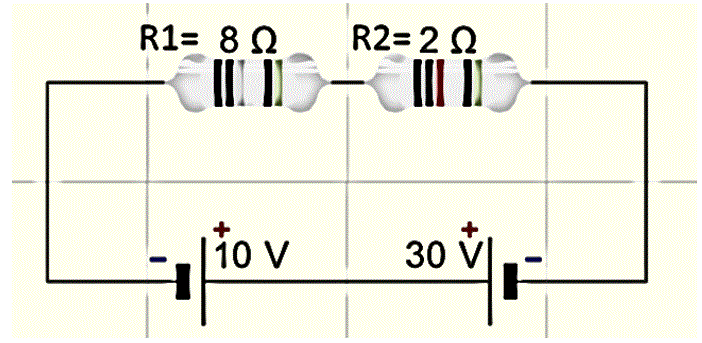 A\(I_1 = 4A, I_2 = 1A\)
B\(I_1 = 2A, I_2 = 2A\)
C\(I_1 = 1A, I_2 = 4A\)
D\(I_1 = 1A, I_2 = 1A\)
اضغط هنا تظهر طريقة الحلClick here for solution
الحل:
A\(I_1 = 4A, I_2 = 1A\)
B\(I_1 = 2A, I_2 = 2A\)
C\(I_1 = 1A, I_2 = 4A\)
D\(I_1 = 1A, I_2 = 1A\)
اضغط هنا تظهر طريقة الحلClick here for solution
الحل:
المقاومتان على التوازي ومتساويتان، لذا التيار يتوزع بالتساوي:
\[I_1 = I_2 = 2A\]
الإجابة الصحيحة: B
Solution:
The resistors are in parallel and equal, so current divides equally:
\[I_1 = I_2 = 2A\]
Correct Answer: B
26 \(\star\)
في الشكل أدناه، باستخدام قوانين كيرشوف، أحسب قيمة المقاومة المجهولة \[R\]؟
In the figure below, using Kirchhoff's laws, calculate the unknown resistance \[R\]?
 A\(R = 2 \, \Omega\)
B\(R = 3 \, \Omega\)
C\(R = 4 \, \Omega\)
D\(R = 5 \, \Omega\)
اضغط هنا تظهر طريقة الحلClick here for solution
الحل:
A\(R = 2 \, \Omega\)
B\(R = 3 \, \Omega\)
C\(R = 4 \, \Omega\)
D\(R = 5 \, \Omega\)
اضغط هنا تظهر طريقة الحلClick here for solution
الحل:
بتطبيق قانون كيرشوف الثاني على الحلقة:
\[0 = 50 + 10 - 8 \times 3.604 - 3.288 \times R - 5 \times 3.604\]
\[60 - 28.832 - 18.02 = 3.288 \times R\]
\[13.148 = 3.288 \times R\]
\[R = \frac{13.148}{3.288} = 4 \, \Omega\]
الإجابة الصحيحة: C
Solution:
Applying Kirchhoff's second law to the loop:
\[0 = 50 + 10 - 8 \times 3.604 - 3.288 \times R - 5 \times 3.604\]
\[60 - 28.832 - 18.02 = 3.288 \times R\]
\[13.148 = 3.288 \times R\]
\[R = \frac{13.148}{3.288} = 4 \, \Omega\]
Correct Answer: C
27 \(\star \star\)
في الشكل أدناه، باستخدام قوانين كيرشوف، فإن قيمة المقاومة المجهولة \[R\] تعادل؟
In the figure below, using Kirchhoff's laws, what is the value of the unknown resistance \[R\]?
 A\(R = 5 \, \Omega\)
B\(R = 10 \, \Omega\)
C\(R = 15 \, \Omega\)
D\(R = 20 \, \Omega\)
اضغط هنا تظهر طريقة الحلClick here for solution
الحل:
A\(R = 5 \, \Omega\)
B\(R = 10 \, \Omega\)
C\(R = 15 \, \Omega\)
D\(R = 20 \, \Omega\)
اضغط هنا تظهر طريقة الحلClick here for solution
الحل:
باستخدام قوانين كيرشوف على الحلقة:
\[0 = 20 - 10 - 2 \times 5 - R \times 0.5\]
\[0 = 10 - 10 - 0.5R\]
\[0 = -0.5R\]
\[R = 10 \, \Omega\]
الإجابة الصحيحة: B
Solution:
Using Kirchhoff's laws on the loop:
\[0 = 20 - 10 - 2 \times 5 - R \times 0.5\]
\[0 = 10 - 10 - 0.5R\]
\[0 = -0.5R\]
\[R = 10 \, \Omega\]
Correct Answer: B
28 \(\star \star\)
في الشكل المجاور، تم تغير قيمة المقاومة المتغيرة حتى أصبحت قراءة الجلفانومتر صفر، فإن قيمة المقاومة \[R_X\]؟
In the figure, the variable resistor was adjusted until the galvanometer reading became zero. What is the value of \[R_X\]?
 A\(R_X = 6 \, \Omega\)
B\(R_X = 2 \, \Omega\)
C\(R_X = 5 \, \Omega\)
D\(R_X = 3 \, \Omega\)
اضغط هنا تظهر طريقة الحلClick here for solution
الحل:
A\(R_X = 6 \, \Omega\)
B\(R_X = 2 \, \Omega\)
C\(R_X = 5 \, \Omega\)
D\(R_X = 3 \, \Omega\)
اضغط هنا تظهر طريقة الحلClick here for solution
الحل:
في حالة توازن جسر وتستون:
\[\frac{R_X}{R_3} = \frac{R_1}{R_2}\]
\[\frac{R_X}{12} = \frac{6}{24}\]
\[R_X = \frac{6 \times 12}{24} = 3 \, \Omega\]
الإجابة الصحيحة: D
Solution:
In Wheatstone bridge balance:
\[\frac{R_X}{R_3} = \frac{R_1}{R_2}\]
\[\frac{R_X}{12} = \frac{6}{24}\]
\[R_X = \frac{6 \times 12}{24} = 3 \, \Omega\]
Correct Answer: D
29 \(\star\)
فرق الجهد بين طرفي الجلفانومتر يساوي الصفر عندما تكون قيم المقاومات تعادل؟
The voltage across the galvanometer is zero when the resistor values are?
 AAA
BBB
CCC
DDD
اضغط هنا تظهر طريقة الحلClick here for solution
الحل:
AAA
BBB
CCC
DDD
اضغط هنا تظهر طريقة الحلClick here for solution
الحل:
في حالة توازن الجسر، يجب أن تكون النسبة بين المقاومات متساوية.
الخيار B يحقق شرط التوازن:
\[\frac{2}{4} = \frac{3}{6} = 0.5\]
الإجابة الصحيحة: B
Solution:
In bridge balance, the ratio of resistances must be equal.
Option B satisfies the balance condition:
\[\frac{2}{4} = \frac{3}{6} = 0.5\]
Correct Answer: B
30 \(\star\)
أحد الدوائر التالية تعمل بشكل صحيح وتتم قراءة فرق الجهد وشدة التيار؟
Which of the following circuits works correctly to read voltage and current?

AAA
BBB
CCC
DDD
اضغط هنا تظهر طريقة الحلClick here for solution
الحل:
الدائرة A هي الصحيحة حيث الفولتميتر يوصل على التوازي والأميتر على التوالي.
الإجابة الصحيحة: A
Solution:
Circuit A is correct because the voltmeter is connected in parallel and the ammeter in series.
Correct Answer: A
31 \(\star \star\)
مكثف سعته \[20 \, \mu F\] غير مشحون تم وصله بمقاوم \[150 \, \Omega\] على التوالي وبطارية كما في الشكل، فإن النسبة المئوية لشحن المكثف بعد زمن قدره \[3 \, ms\] تعادل؟
A capacitor of \[20 \, \mu F\] initially uncharged is connected in series with a \[150 \, \Omega\] resistor and a battery as shown. What is the percentage of charge on the capacitor after \[3 \, ms\]?
 A\(75\%\)
B\(63\%\)
C\(47\%\)
D\(82\%\)
اضغط هنا تظهر طريقة الحلClick here for solution
الحل:
A\(75\%\)
B\(63\%\)
C\(47\%\)
D\(82\%\)
اضغط هنا تظهر طريقة الحلClick here for solution
الحل:
\[\tau = RC = 150 \times 20 \times 10^{-6} = 3 \times 10^{-3} \, s = 3 \, ms\]
بعد ثابت زمن واحد:
\[Q = Q_{max}(1 - e^{-1}) = 0.632 \times Q_{max} = 63.2\%\]
الإجابة الصحيحة: B
Solution:
\[\tau = RC = 150 \times 20 \times 10^{-6} = 3 \times 10^{-3} \, s = 3 \, ms\]
After one time constant:
\[Q = Q_{max}(1 - e^{-1}) = 0.632 \times Q_{max} = 63.2\%\]
Correct Answer: B
32 \(\star \star\)
مكثف سعته \[6 \, \mu F\] غير مشحون تم وصله بمقاومين \[R_1 = 90 \, \Omega\]، \[R_2 = 30 \, \Omega\] وبطارية جهدها \[V = 50 \, V\]، فإن الزمن اللازم لإتمام عملية شحن 50% من المكثف تعادل؟
A capacitor of \[6 \, \mu F\] initially uncharged is connected to resistors \[R_1 = 90 \, \Omega\], \[R_2 = 30 \, \Omega\] and a battery of \[V = 50 \, V\]. What is the time required to charge the capacitor to 50%?
 A\(t = 9.35 \times 10^{-5} \, s\)
B\(t = 4.45 \times 10^{-5} \, s\)
C\(t = 6.18 \times 10^{-5} \, s\)
D\(t = 2.48 \times 10^{-5} \, s\)
اضغط هنا تظهر طريقة الحلClick here for solution
الحل:
A\(t = 9.35 \times 10^{-5} \, s\)
B\(t = 4.45 \times 10^{-5} \, s\)
C\(t = 6.18 \times 10^{-5} \, s\)
D\(t = 2.48 \times 10^{-5} \, s\)
اضغط هنا تظهر طريقة الحلClick here for solution
الحل:
\[R_{eq} = R_1 + R_2 = 90 + 30 = 120 \, \Omega\]
\[\tau = R_{eq} \times C = 120 \times 6 \times 10^{-6} = 7.2 \times 10^{-4} \, s\]
\[t = \tau \times \ln(2) = 7.2 \times 10^{-4} \times 0.693 = 4.99 \times 10^{-4} \, s\]
الإجابة الصحيحة حسب الحساب هي \(4.99 \times 10^{-4} \, s\).
Solution:
\[R_{eq} = R_1 + R_2 = 90 + 30 = 120 \, \Omega\]
\[\tau = R_{eq} \times C = 120 \times 6 \times 10^{-6} = 7.2 \times 10^{-4} \, s\]
\[t = \tau \times \ln(2) = 7.2 \times 10^{-4} \times 0.693 = 4.99 \times 10^{-4} \, s\]
Correct answer is \(4.99 \times 10^{-4} \, s\).
33 \(\star\)
عند كسر مغناطيس إلى قطع، فإن كل جزء يكون مغناطيس له قطبان، والسبب يعود إلى؟
When a magnet is broken into pieces, each piece becomes a magnet with two poles. What is the reason?
 Aعند الكسر يتم الكسر بين النطاقات ولا يمكن كسر نطاق لأنه صغير جداًThe break occurs between domains, as domains cannot be broken because they are very small
Bعند كسر المغناطيس تتكون نطاقات جديدة تساهم في تكوين الأقطابNew domains form when the magnet breaks, contributing to pole formation
Cالنطاقات يتغير ترتيبها أثناء كسر المغناطيس لتدور مكونة قطبينDomains rearrange during breaking to form two poles
Dعند كسر المغناطيس يحدث تجاذب للأقطاب المعاكسة فيتكون مغناطيس جديدOpposite poles attract when broken, forming a new magnet
اضغط هنا تظهر طريقة الحلClick here for solution
الحل:
Aعند الكسر يتم الكسر بين النطاقات ولا يمكن كسر نطاق لأنه صغير جداًThe break occurs between domains, as domains cannot be broken because they are very small
Bعند كسر المغناطيس تتكون نطاقات جديدة تساهم في تكوين الأقطابNew domains form when the magnet breaks, contributing to pole formation
Cالنطاقات يتغير ترتيبها أثناء كسر المغناطيس لتدور مكونة قطبينDomains rearrange during breaking to form two poles
Dعند كسر المغناطيس يحدث تجاذب للأقطاب المعاكسة فيتكون مغناطيس جديدOpposite poles attract when broken, forming a new magnet
اضغط هنا تظهر طريقة الحلClick here for solution
الحل:
المغناطيس يتكون من نطاقات مغناطيسية، وعند الكسر يتم الكسر بين النطاقات، وكل جزء يحتوي على نطاقات كاملة مما يجعله مغناطيساً كاملاً.
الإجابة الصحيحة: A
Solution:
Magnets consist of magnetic domains. When broken, the break occurs between domains, and each piece contains complete domains, making it a complete magnet.
Correct Answer: A
34 \(\star \star\)
أحد وحدات القياس التالية تعادل وحدة قياس المجال المغناطيسي تسلا (T)؟
Which of the following units is equivalent to the tesla (T), the unit of magnetic field?
 AAA
BBB
CCC
DDD
اضغط هنا تظهر طريقة الحلClick here for solution
الحل:
AAA
BBB
CCC
DDD
اضغط هنا تظهر طريقة الحلClick here for solution
الحل:
\[1 \, T = 1 \, \frac{N}{A \cdot m} = 1 \, \frac{kg}{A \cdot s^2}\]
الخيار D يمثل الوحدة الصحيحة.
الإجابة الصحيحة: D
Solution:
\[1 \, T = 1 \, \frac{N}{A \cdot m} = 1 \, \frac{kg}{A \cdot s^2}\]
Option D represents the correct unit.
Correct Answer: D
35 \(\star\)
قذفت ثلاث جسيمات باتجاه الشمال في منطقة مجال منتظم عمودي على الصفحة للخارج. بروتون وإلكترون ونيوترون، واتخذت المسارات التالية. من خلال الشكل وقواعد تحديد اتجاه القوة المغناطيسية المؤثرة على جسيم مشحون، فإن نوع كل جسيم هو؟
Three particles were projected north in a uniform magnetic field out of the page. Proton, electron, and neutron took the paths shown. What is each particle?
 A(1) نيوترون، (2) بروتون، (3) إلكترون(1) Neutron, (2) Proton, (3) Electron
B(1) إلكترون، (2) بروتون، (3) نيوترون(1) Electron, (2) Proton, (3) Neutron
C(1) بروتون، (2) نيوترون، (3) إلكترون(1) Proton, (2) Neutron, (3) Electron
D(1) نيوترون، (2) إلكترون، (3) بروتون(1) Neutron, (2) Electron, (3) Proton
اضغط هنا تظهر طريقة الحلClick here for solution
الحل:
A(1) نيوترون، (2) بروتون، (3) إلكترون(1) Neutron, (2) Proton, (3) Electron
B(1) إلكترون، (2) بروتون، (3) نيوترون(1) Electron, (2) Proton, (3) Neutron
C(1) بروتون، (2) نيوترون، (3) إلكترون(1) Proton, (2) Neutron, (3) Electron
D(1) نيوترون، (2) إلكترون، (3) بروتون(1) Neutron, (2) Electron, (3) Proton
اضغط هنا تظهر طريقة الحلClick here for solution
الحل:
باستخدام قاعدة اليد اليمنى:
البروتون ينحرف لليمين (المسار 1)
النيوترون لا ينحرف (المسار 2)
الإلكترون ينحرف لليسار (المسار 3)
الإجابة الصحيحة: C
Solution:
Using the right-hand rule:
Proton deflects right (path 1)
Neutron does not deflect (path 2)
Electron deflects left (path 3)
Correct Answer: C
36 \(\star \star\)
جسيم وزنه \[0.005 \, N\] وشحنته \[q = 3 \, nC\] قذف في منطقة مجال منتظم وبشكل عمودي على المجال وبسرعة \[2 \times 10^6 \, m/s\] باتجاه الغرب، لوحظ أن الجسم استمر في حركته بنفس المسار دون أن ينحرف بفعل الجاذبية، فإن مقدار واتجاه المجال المغناطيسي المؤثر على الجسيم تعادل؟
A particle of weight \[0.005 \, N\] and charge \[q = 3 \, nC\] is projected perpendicular to a uniform magnetic field at a speed of \[2 \times 10^6 \, m/s\] toward the west. It continues moving in a straight line without deflection. What is the magnitude and direction of the magnetic field?
A\(B = 0.83 \, T\) نحو الجنوب
B\(B = 0.83 \, T\) نحو الشمال
C\(B = 0.42 \, T\) نحو الشمال
D\(B = 0.42 \, T\) نحو الجنوب
اضغط هنا تظهر طريقة الحلClick here for solution
الحل:
\[q v B = m g\]
\[B = \frac{mg}{qv} = \frac{0.005}{3 \times 10^{-9} \times 2 \times 10^6} = 0.83 \, T\]
باستخدام قاعدة اليد اليمنى، المجال نحو الجنوب.
الإجابة الصحيحة: A
Solution:
\[q v B = m g\]
\[B = \frac{mg}{qv} = \frac{0.005}{3 \times 10^{-9} \times 2 \times 10^6} = 0.83 \, T\]
Using right-hand rule, the field is toward the south.
Correct Answer: A
37 \(\star\)
دخل بروتون ونيوترون وإلكترون منطقة مجال منتظم وبنفس السرعة وبشكل عمودي على مجال منتظم، أحد الإجابات التالية تعبر بشكل صحيح عن حركة الجسيمات الثلاث؟
A proton, neutron, and electron enter a uniform magnetic field with the same speed and perpendicular to the field. Which option correctly represents the motion of the three particles?
 AAA
BBB
CCC
DDD
اضغط هنا تظهر طريقة الحلClick here for solution
الحل:
AAA
BBB
CCC
DDD
اضغط هنا تظهر طريقة الحلClick here for solution
الحل:
البروتون والإلكترون ينحرفان في اتجاهين متعاكسين (بسبب اختلاف الشحنة)
النيوترون لا ينحرف (لأنه متعادل)
الخيار A يمثل ذلك.
الإجابة الصحيحة: A
Solution:
The proton and electron deflect in opposite directions (due to opposite charges)
The neutron does not deflect (neutral)
Option A represents this.
Correct Answer: A
38 \(\star\)
وضع سلكين داخل مجال منتظم لهما نفس الطول ويمر بهما نفس التيار واتجاه التيار محدد على الرسم، فإن النسبة بين القوة المغناطيسية المؤثرة على السلك A إلى القوة المغناطيسية المؤثرة على السلك C تعادل؟
Two wires of the same length and current placed in a uniform magnetic field as shown. What is the ratio of the magnetic force on wire A to wire C?
 A\(2\)
B\(0.3\)
C\(0.5\)
D\(1.5\)
اضغط هنا تظهر طريقة الحلClick here for solution
الحل:
A\(2\)
B\(0.3\)
C\(0.5\)
D\(1.5\)
اضغط هنا تظهر طريقة الحلClick here for solution
الحل:
\[F = BIL\sin\theta\]
الزاوية بين السلك A والمجال هي \(30^\circ\)
الزاوية بين السلك C والمجال هي \(90^\circ\)
\[\frac{F_A}{F_C} = \frac{\sin 30^\circ}{\sin 90^\circ} = \frac{0.5}{1} = 0.5\]
الإجابة الصحيحة: C
Solution:
\[F = BIL\sin\theta\]
Angle between wire A and field is \(30^\circ\)
Angle between wire C and field is \(90^\circ\)
\[\frac{F_A}{F_C} = \frac{\sin 30^\circ}{\sin 90^\circ} = \frac{0.5}{1} = 0.5\]
Correct Answer: C
39 \(\star \star\)
سلك طوله \[0.2 \, m\] وضع داخل مجال منتظم شدته \[0.5 \, T\] كما في الشكل، تم مرور تيار شدته \[3 \, A\] في السلك، فإن السلك يتأثر بقوة مقدارها واتجاهها تعادل؟
A wire of length \[0.2 \, m\] is placed in a uniform magnetic field of \[0.5 \, T\] as shown. A current of \[3 \, A\] passes through the wire. What is the magnitude and direction of the force?
 A\(F_B = 0.3 \, N\) الجنوب الشرقي
B\(F_B = 0.45 \, N\) الجنوب الشرقي
C\(F_B = 0.3 \, N\) الشمال الغربي
D\(F_B = 0.45 \, N\) الشمال الغربي
اضغط هنا تظهر طريقة الحلClick here for solution
الحل:
A\(F_B = 0.3 \, N\) الجنوب الشرقي
B\(F_B = 0.45 \, N\) الجنوب الشرقي
C\(F_B = 0.3 \, N\) الشمال الغربي
D\(F_B = 0.45 \, N\) الشمال الغربي
اضغط هنا تظهر طريقة الحلClick here for solution
الحل:
\[F = BIL = 0.5 \times 3 \times 0.2 = 0.3 \, N\]
باستخدام قاعدة اليد اليمنى، اتجاه القوة هو الجنوب الشرقي.
الإجابة الصحيحة: A
Solution:
\[F = BIL = 0.5 \times 3 \times 0.2 = 0.3 \, N\]
Using the right-hand rule, the direction is southeast.
Correct Answer: A
40 \(\star \star\)
مجال مغناطيسي منتظم شدته \[5 \times 10^{-2} \, T\] متجه نحو الشرق، قذف إلكترون وبسرعة مقدارها \[4 \times 10^6 \, m/s\] وبشكل يصنع زاوية قدرها \(60^\circ\) فوق محور الشرق داخل منطقة المجال، فإن نصف قطر المسار الدائري تعادل؟
A uniform magnetic field of \[5 \times 10^{-2} \, T\] points east. An electron is projected with speed \[4 \times 10^6 \, m/s\] at an angle of \(60^\circ\) above the east axis. What is the radius of the circular path?
A\(r = 4.55 \times 10^{-4} \, m\)
B\(r = 2.27 \times 10^{-4} \, m\)
C\(r = 1.6 \times 10^{-4} \, m\)
D\(r = 3.9 \times 10^{-4} \, m\)
اضغط هنا تظهر طريقة الحلClick here for solution
الحل:
\[r = \frac{m v_{\perp}}{q B} = \frac{m v \sin 60^\circ}{q B}\]
\[r = \frac{9.11 \times 10^{-31} \times 4 \times 10^6 \times \sin 60^\circ}{1.6 \times 10^{-19} \times 5 \times 10^{-2}} = 3.9 \times 10^{-4} \, m\]
الإجابة الصحيحة: D
Solution:
\[r = \frac{m v_{\perp}}{q B} = \frac{m v \sin 60^\circ}{q B}\]
\[r = \frac{9.11 \times 10^{-31} \times 4 \times 10^6 \times \sin 60^\circ}{1.6 \times 10^{-19} \times 5 \times 10^{-2}} = 3.9 \times 10^{-4} \, m\]
Correct Answer: D
41 \(\star \star\)
ملف يتكون من 100 حلقة وهي على شكل مربع طول ضلعه \[0.2 \, m\] ويمر بها تيار شدته \[3 \, A\] وموضوع في مجال مغناطيسي شدته \[0.5 \, T\]، فإن الحد الأقصى لعزم الدوران يعادل؟
A coil of 100 turns, each a square of side \[0.2 \, m\], carries a current of \[3 \, A\] and is placed in a magnetic field of \[0.5 \, T\]. What is the maximum torque?
 A\(\tau_{max} = 4 \, N \cdot m\)
B\(\tau_{max} = 6 \, N \cdot m\)
C\(\tau_{max} = 8 \, N \cdot m\)
D\(\tau_{max} = 10 \, N \cdot m\)
اضغط هنا تظهر طريقة الحلClick here for solution
الحل:
A\(\tau_{max} = 4 \, N \cdot m\)
B\(\tau_{max} = 6 \, N \cdot m\)
C\(\tau_{max} = 8 \, N \cdot m\)
D\(\tau_{max} = 10 \, N \cdot m\)
اضغط هنا تظهر طريقة الحلClick here for solution
الحل:
\[A = (0.2)^2 = 0.04 \, m^2\]
\[\tau_{max} = N \times I \times A \times B\]
\[\tau_{max} = 100 \times 3 \times 0.04 \times 0.5 = 6 \, N \cdot m\]
الإجابة الصحيحة: B
Solution:
\[A = (0.2)^2 = 0.04 \, m^2\]
\[\tau_{max} = N \times I \times A \times B\]
\[\tau_{max} = 100 \times 3 \times 0.04 \times 0.5 = 6 \, N \cdot m\]
Correct Answer: B
42 \(\star \star\)
حلقة تيار دائرية نصف قطرها \[2 \, cm\] تحمل تياراً قدره \[0.1 \, A\] وخاضعة لمجال مغناطيسي شدته \[0.5 \, T\]، فإن الحد الأقصى لعزم الدوران يعادل، والعزم المغناطيسي لثنائي القطب، وعزم الدوران للحلقة إذا كان المجال يصنع زاوية \(30^\circ\) مع العمود على السطح؟
A circular current loop of radius \[2 \, cm\] carries a current of \[0.1 \, A\] and is in a magnetic field of \[0.5 \, T\]. What is the maximum torque, the magnetic dipole moment, and the torque when the field makes an angle of \(30^\circ\) with the normal to the surface?
 A\(\mu = 3.86 \times 10^{-4} \, A \cdot m^2, \tau = 1.8 \times 10^{-5} \, N \cdot m\)
B\(\mu = 1.25 \times 10^{-4} \, A \cdot m^2, \tau = 3.1 \times 10^{-5} \, N \cdot m\)
C\(\mu = 2.15 \times 10^{-4} \, A \cdot m^2, \tau = 2.3 \times 10^{-5} \, N \cdot m\)
D\(\mu = 5.23 \times 10^{-4} \, A \cdot m^2, \tau = 4.6 \times 10^{-5} \, N \cdot m\)
اضغط هنا تظهر طريقة الحلClick here for solution
الحل:
A\(\mu = 3.86 \times 10^{-4} \, A \cdot m^2, \tau = 1.8 \times 10^{-5} \, N \cdot m\)
B\(\mu = 1.25 \times 10^{-4} \, A \cdot m^2, \tau = 3.1 \times 10^{-5} \, N \cdot m\)
C\(\mu = 2.15 \times 10^{-4} \, A \cdot m^2, \tau = 2.3 \times 10^{-5} \, N \cdot m\)
D\(\mu = 5.23 \times 10^{-4} \, A \cdot m^2, \tau = 4.6 \times 10^{-5} \, N \cdot m\)
اضغط هنا تظهر طريقة الحلClick here for solution
الحل:
\[A = \pi r^2 = \pi (0.02)^2 = 1.25 \times 10^{-3} \, m^2\]
\[\mu = I \times A = 0.1 \times 1.25 \times 10^{-3} = 1.25 \times 10^{-4} \, A \cdot m^2\]
\[\tau = \mu \times B \times \sin 30^\circ = 1.25 \times 10^{-4} \times 0.5 \times 0.5 = 3.1 \times 10^{-5} \, N \cdot m\]
الإجابة الصحيحة: B
Solution:
\[A = \pi r^2 = \pi (0.02)^2 = 1.25 \times 10^{-3} \, m^2\]
\[\mu = I \times A = 0.1 \times 1.25 \times 10^{-3} = 1.25 \times 10^{-4} \, A \cdot m^2\]
\[\tau = \mu \times B \times \sin 30^\circ = 1.25 \times 10^{-4} \times 0.5 \times 0.5 = 3.1 \times 10^{-5} \, N \cdot m\]
Correct Answer: B
43 \(\star \star \star\)
سلك عمودي على الورقة تم حساب المجال المغناطيسي عند نقطة تبعد عن السلك \[0.2 \, m\] فكانت قيمة المجال \[4.0 \times 10^{-6} \, T\] وكان اتجاهه يوازي الورقة نحو الأعلى، فإن مقدار واتجاه التيار في السلك يساوي؟
A wire perpendicular to the page has a magnetic field of \[4.0 \times 10^{-6} \, T\] at a point \[0.2 \, m\] from it, directed upward parallel to the page. What is the magnitude and direction of the current in the wire?
 A\(I = 4 \, A\) عمودي للخارج
B\(I = 4 \, A\) عمودي للداخل
C\(I = 2 \, A\) عمودي للداخل
D\(I = 2 \, A\) عمودي للخارج
اضغط هنا تظهر طريقة الحلClick here for solution
الحل:
A\(I = 4 \, A\) عمودي للخارج
B\(I = 4 \, A\) عمودي للداخل
C\(I = 2 \, A\) عمودي للداخل
D\(I = 2 \, A\) عمودي للخارج
اضغط هنا تظهر طريقة الحلClick here for solution
الحل:
\[B = \frac{\mu_0 I}{2\pi r} \Rightarrow I = \frac{2\pi r B}{\mu_0}\]
\[I = \frac{2\pi \times 0.2 \times 4 \times 10^{-6}}{4\pi \times 10^{-7}} = 4 \, A\]
باستخدام قاعدة اليد اليمنى، التيار عمودي للداخل.
الإجابة الصحيحة: B
Solution:
\[B = \frac{\mu_0 I}{2\pi r} \Rightarrow I = \frac{2\pi r B}{\mu_0}\]
\[I = \frac{2\pi \times 0.2 \times 4 \times 10^{-6}}{4\pi \times 10^{-7}} = 4 \, A\]
Using the right-hand rule, the current is into the page.
Correct Answer: B
44 \(\star\)
مجال منتظم مقداره \[2 \times 10^{-4} \, T\] عمودي على الورقة للداخل، وضع داخله سلك طويل يمر به تيار نحو الأعلى شدته \[10 \, A\]، فإن المجال ينعدم عند نقطة تبعد عن السلك؟
A uniform magnetic field of \[2 \times 10^{-4} \, T\] is directed into the page. A long wire carrying \[10 \, A\] upward is placed in it. At what distance from the wire does the magnetic field become zero?
 A\(r = 0.02 \, m\) على يسار السلك
B\(r = 0.01 \, m\) على يسار السلك
C\(r = 0.01 \, m\) على يمين السلك
D\(r = 0.02 \, m\) على يمين السلك
اضغط هنا تظهر طريقة الحلClick here for solution
الحل:
A\(r = 0.02 \, m\) على يسار السلك
B\(r = 0.01 \, m\) على يسار السلك
C\(r = 0.01 \, m\) على يمين السلك
D\(r = 0.02 \, m\) على يمين السلك
اضغط هنا تظهر طريقة الحلClick here for solution
الحل:
\[B_{wire} = B_{external}\]
\[\frac{\mu_0 I}{2\pi r} = 2 \times 10^{-4}\]
\[r = \frac{\mu_0 I}{2\pi B} = \frac{4\pi \times 10^{-7} \times 10}{2\pi \times 2 \times 10^{-4}} = 0.01 \, m\]
باستخدام قاعدة اليد اليمنى، المجال ينعدم على يسار السلك.
الإجابة الصحيحة: B
Solution:
\[B_{wire} = B_{external}\]
\[\frac{\mu_0 I}{2\pi r} = 2 \times 10^{-4}\]
\[r = \frac{\mu_0 I}{2\pi B} = \frac{4\pi \times 10^{-7} \times 10}{2\pi \times 2 \times 10^{-4}} = 0.01 \, m\]
Using the right-hand rule, the field is zero on the left side of the wire.
Correct Answer: B
45 \(\star\)
سلك طويل يمر به التيار كما في الشكل، فإن النسبة بين مجال النقطة a إلى مجال النقطة b تعادل؟
A long wire carries current as shown. What is the ratio of the magnetic field at point a to point b?
 A\(9\)
B\(4\)
C\(2\)
D\(3\)
اضغط هنا تظهر طريقة الحلClick here for solution
الحل:
A\(9\)
B\(4\)
C\(2\)
D\(3\)
اضغط هنا تظهر طريقة الحلClick here for solution
الحل:
\[B_a = \frac{\mu_0 I}{2\pi r_a}\]
\[B_b = \frac{\mu_0 I}{2\pi r_b}\]
\[r_a = \frac{1}{3} r_b\]
\[\frac{B_a}{B_b} = \frac{r_b}{r_a} = 3\]
الإجابة الصحيحة: D
Solution:
\[B_a = \frac{\mu_0 I}{2\pi r_a}\]
\[B_b = \frac{\mu_0 I}{2\pi r_b}\]
\[r_a = \frac{1}{3} r_b\]
\[\frac{B_a}{B_b} = \frac{r_b}{r_a} = 3\]
Correct Answer: D
امتحان تجريبي التيار والمقاومة والقوة المغناطيسية
|
1 \(\star\)
سلك يمر به تيار شدته \[4 \, A\]، فإن عدد الإلكترونات التي تعبر مقطع السلك خلال زمن قدره \[3 \, s\] تعادل؟
A wire carries a current of \[4 \, A\]. What is the number of electrons that pass through the wire's cross-section in \[3 \, s\]?
A
\(8.3 \times 10^{20}\) إلكترون\(8.3 \times 10^{20}\) electrons
B
\(7.5 \times 10^{19}\) إلكترون\(7.5 \times 10^{19}\) electrons
C
\(2.8 \times 10^{20}\) إلكترون\(2.8 \times 10^{20}\) electrons
D
\(9.6 \times 10^{19}\) إلكترون\(9.6 \times 10^{19}\) electrons
اضغط هنا تظهر طريقة الحلClick here for solution
الحل:
\[Q = I \times t = 4 \times 3 = 12 \, C\]
\[n = \frac{Q}{e} = \frac{12}{1.6 \times 10^{-19}} = 7.5 \times 10^{19}\]
الإجابة الصحيحة: B Solution:
\[Q = I \times t = 4 \times 3 = 12 \, C\]
\[n = \frac{Q}{e} = \frac{12}{1.6 \times 10^{-19}} = 7.5 \times 10^{19}\]
Correct Answer: B
\[Q = I \times t = 4 \times 3 = 12 \, C\]
\[n = \frac{Q}{e} = \frac{12}{1.6 \times 10^{-19}} = 7.5 \times 10^{19}\]
الإجابة الصحيحة: B Solution:
\[Q = I \times t = 4 \times 3 = 12 \, C\]
\[n = \frac{Q}{e} = \frac{12}{1.6 \times 10^{-19}} = 7.5 \times 10^{19}\]
Correct Answer: B
2 \(\star\)
كمية من الشحنة تمر عبر مقطع سلك تتغير بتغير الزمن وفق المعادلة \[q(t) = 2t^2 + 3\]، فإن شدة التيار المار في السلك بعد نصف ثانية تعادل؟
The charge passing through a wire cross-section varies with time as \[q(t) = 2t^2 + 3\]. What is the current after half a second?
A
\(3 \, A\)
B
\(1 \, A\)
C
\(2 \, A\)
D
\(4 \, A\)
اضغط هنا تظهر طريقة الحلClick here for solution
الحل:
\[I = \frac{dq}{dt} = 4t\]
\[I(0.5) = 4 \times 0.5 = 2 \, A\]
الإجابة الصحيحة: C Solution:
\[I = \frac{dq}{dt} = 4t\]
\[I(0.5) = 4 \times 0.5 = 2 \, A\]
Correct Answer: C
\[I = \frac{dq}{dt} = 4t\]
\[I(0.5) = 4 \times 0.5 = 2 \, A\]
الإجابة الصحيحة: C Solution:
\[I = \frac{dq}{dt} = 4t\]
\[I(0.5) = 4 \times 0.5 = 2 \, A\]
Correct Answer: C
3 \(\star\)
حزمة من الإلكترونات تتحرك بسرعة الضوء وتحمل من خلال تيار إلكتروني شدته \[0.2 \, A\] في سلك طوله \[5 \, m\]، فإن عدد الإلكترونات في الحزمة تعادل؟ (\[c = 3 \times 10^8 \, m/s\]، \[q_e = 1.6 \times 10^{-19} \, C\])
A beam of electrons moves at the speed of light and carries a current of \[0.2 \, A\] in a wire of length \[5 \, m\]. What is the number of electrons in the beam? (\[c = 3 \times 10^8 \, m/s\], \[q_e = 1.6 \times 10^{-19} \, C\])
A
\(n = 2.08 \times 10^{10}\) إلكترون\(n = 2.08 \times 10^{10}\) electrons
B
\(n = 4.36 \times 10^{12}\) إلكترون\(n = 4.36 \times 10^{12}\) electrons
C
\(n = 3.46 \times 10^{11}\) إلكترون\(n = 3.46 \times 10^{11}\) electrons
D
\(n = 5.97 \times 10^{13}\) إلكترون\(n = 5.97 \times 10^{13}\) electrons
اضغط هنا تظهر طريقة الحلClick here for solution
الحل:
\[I = \frac{n \times e}{t} = \frac{n \times e \times v}{L}\]
\[n = \frac{I \times L}{e \times v} = \frac{0.2 \times 5}{1.6 \times 10^{-19} \times 3 \times 10^8} = 2.08 \times 10^{10}\]
الإجابة الصحيحة: A Solution:
\[I = \frac{n \times e}{t} = \frac{n \times e \times v}{L}\]
\[n = \frac{I \times L}{e \times v} = \frac{0.2 \times 5}{1.6 \times 10^{-19} \times 3 \times 10^8} = 2.08 \times 10^{10}\]
Correct Answer: A
\[I = \frac{n \times e}{t} = \frac{n \times e \times v}{L}\]
\[n = \frac{I \times L}{e \times v} = \frac{0.2 \times 5}{1.6 \times 10^{-19} \times 3 \times 10^8} = 2.08 \times 10^{10}\]
الإجابة الصحيحة: A Solution:
\[I = \frac{n \times e}{t} = \frac{n \times e \times v}{L}\]
\[n = \frac{I \times L}{e \times v} = \frac{0.2 \times 5}{1.6 \times 10^{-19} \times 3 \times 10^8} = 2.08 \times 10^{10}\]
Correct Answer: A
4 \(\star\)
سلكان من النحاس لهما نفس الطول ومن نفس المادة وبنفس درجة الحرارة، تم وصلهما على التوالي، نصف قطر الأول يعادل ضعف نصف قطر الثاني، فإن النسبة بين كثافة التيار للسلك الأول إلى السلك الثاني تعادل؟
Two copper wires of the same length and material, connected in series. The radius of the first is twice the radius of the second. What is the ratio of the current density in the first wire to the second wire?
A
\(0.25\)
B
\(0.5\)
C
\(4\)
D
\(2\)
اضغط هنا تظهر طريقة الحلClick here for solution
الحل:
\[J = \frac{I}{A} = \frac{I}{\pi r^2}\]
\[\frac{J_1}{J_2} = \frac{A_2}{A_1} = \frac{r_2^2}{r_1^2} = \frac{r^2}{(2r)^2} = \frac{1}{4} = 0.25\]
الإجابة الصحيحة: A Solution:
\[J = \frac{I}{A} = \frac{I}{\pi r^2}\]
\[\frac{J_1}{J_2} = \frac{A_2}{A_1} = \frac{r_2^2}{r_1^2} = \frac{r^2}{(2r)^2} = \frac{1}{4} = 0.25\]
Correct Answer: A
\[J = \frac{I}{A} = \frac{I}{\pi r^2}\]
\[\frac{J_1}{J_2} = \frac{A_2}{A_1} = \frac{r_2^2}{r_1^2} = \frac{r^2}{(2r)^2} = \frac{1}{4} = 0.25\]
الإجابة الصحيحة: A Solution:
\[J = \frac{I}{A} = \frac{I}{\pi r^2}\]
\[\frac{J_1}{J_2} = \frac{A_2}{A_1} = \frac{r_2^2}{r_1^2} = \frac{r^2}{(2r)^2} = \frac{1}{4} = 0.25\]
Correct Answer: A
5 \(\star\)
سلك مصنوع من النحاس الأصفر وسلك مصنوع من الفضة لهما نفس الطول، لكن قطر السلك النحاسي يبلغ أربع أضعاف قطر السلك الفضي. والمقاومة النوعية للنحاس أكبر 4 مرات من المقاومة النوعية للفضة. إذا كانت \(R_C\) تشير إلى مقاومة سلك النحاس و \(R_S\) تشير إلى مقاومة سلك الفضة، فأي مما يلي صحيح؟
A brass wire and a silver wire have the same length, but the brass wire's diameter is four times the silver wire's. The resistivity of brass is 4 times that of silver. If \(R_C\) is the resistance of the brass wire and \(R_S\) is the resistance of the silver wire, which is correct?
A
\(R_C = 0.25 \, R_S\)
B
\(R_C = R_S\)
C
\(R_C = 0.5 \, R_S\)
D
\(R_C = 2 \, R_S\)
اضغط هنا تظهر طريقة الحلClick here for solution
الحل:
\[R = \rho \frac{L}{A} = \rho \frac{L}{\pi r^2}\]
\[\frac{R_C}{R_S} = \frac{\rho_C}{\rho_S} \times \frac{A_S}{A_C} = 4 \times \frac{r_S^2}{r_C^2} = 4 \times \frac{1}{16} = 0.25\]
الإجابة الصحيحة: A Solution:
\[R = \rho \frac{L}{A} = \rho \frac{L}{\pi r^2}\]
\[\frac{R_C}{R_S} = \frac{\rho_C}{\rho_S} \times \frac{A_S}{A_C} = 4 \times \frac{r_S^2}{r_C^2} = 4 \times \frac{1}{16} = 0.25\]
Correct Answer: A
\[R = \rho \frac{L}{A} = \rho \frac{L}{\pi r^2}\]
\[\frac{R_C}{R_S} = \frac{\rho_C}{\rho_S} \times \frac{A_S}{A_C} = 4 \times \frac{r_S^2}{r_C^2} = 4 \times \frac{1}{16} = 0.25\]
الإجابة الصحيحة: A Solution:
\[R = \rho \frac{L}{A} = \rho \frac{L}{\pi r^2}\]
\[\frac{R_C}{R_S} = \frac{\rho_C}{\rho_S} \times \frac{A_S}{A_C} = 4 \times \frac{r_S^2}{r_C^2} = 4 \times \frac{1}{16} = 0.25\]
Correct Answer: A
6 \(\star\)
أربع أسلاك من نفس النوع وبنفس درجة الحرارة، أحد الأسلاك التالية لها أقل مقاومة؟
Four wires of the same material and temperature. Which wire has the least resistance?
A
سلك 1Wire 1
B
سلك 2Wire 2
C
سلك 3Wire 3
D
سلك 4Wire 4
اضغط هنا تظهر طريقة الحلClick here for solution
الحل:
\[R = \rho \frac{L}{A}\]
المقاومة تتناسب طردياً مع الطول وعكسياً مع مساحة المقطع.
السلك 3 لديه أكبر مساحة مقطع وأقل طول، وبالتالي أقل مقاومة.
الإجابة الصحيحة: C Solution:
\[R = \rho \frac{L}{A}\]
Resistance is directly proportional to length and inversely proportional to cross-sectional area.
Wire 3 has the largest cross-sectional area and shortest length, thus the least resistance.
Correct Answer: C
\[R = \rho \frac{L}{A}\]
المقاومة تتناسب طردياً مع الطول وعكسياً مع مساحة المقطع.
السلك 3 لديه أكبر مساحة مقطع وأقل طول، وبالتالي أقل مقاومة.
الإجابة الصحيحة: C Solution:
\[R = \rho \frac{L}{A}\]
Resistance is directly proportional to length and inversely proportional to cross-sectional area.
Wire 3 has the largest cross-sectional area and shortest length, thus the least resistance.
Correct Answer: C
7 \(\star\)
سلكان من نفس المادة وبنفس درجة الحرارة، فإذا كانت \[\frac{R_1}{R_2} = \frac{2}{3}\]، فإن أحد الإجابات التالية تحقق ذلك؟
Two wires of the same material and temperature. If \[\frac{R_1}{R_2} = \frac{2}{3}\], which of the following satisfies this?
A
\[L_1 = \frac{3}{4}L_2,\ A_1 = \frac{1}{2}A_2\]
B
\[L_1 = \frac{4}{3}L_2,\ A_1 = 2A_2\]
C
\[L_1 = \frac{1}{2}L_2,\ A_1 = \frac{1}{3}A_2\]
D
\[L_1 = 3L_2,\ A_1 = 2A_2\]
اضغط هنا تظهر طريقة الحلClick here for solution
الحل:
\[\frac{R_1}{R_2} = \frac{L_1}{L_2} \times \frac{A_2}{A_1}\]
\[R = \rho \frac{L}{A} \Rightarrow \frac{R_1}{R_2} = \frac{L_1}{L_2} \times \frac{A_2}{A_1}\]
جرب الخيار B: \[\frac{4/3}{1} \times \frac{1}{2} = \frac{4}{6} = \frac{2}{3}\]
الإجابة الصحيحة: B Solution:
\[\frac{R_1}{R_2} = \frac{L_1}{L_2} \times \frac{A_2}{A_1}\]
\[R = \rho \frac{L}{A} \Rightarrow \frac{R_1}{R_2} = \frac{L_1}{L_2} \times \frac{A_2}{A_1}\]
Try option B: \[\frac{4/3}{1} \times \frac{1}{2} = \frac{4}{6} = \frac{2}{3}\]
Correct Answer: B
\[\frac{R_1}{R_2} = \frac{L_1}{L_2} \times \frac{A_2}{A_1}\]
\[R = \rho \frac{L}{A} \Rightarrow \frac{R_1}{R_2} = \frac{L_1}{L_2} \times \frac{A_2}{A_1}\]
جرب الخيار B: \[\frac{4/3}{1} \times \frac{1}{2} = \frac{4}{6} = \frac{2}{3}\]
الإجابة الصحيحة: B Solution:
\[\frac{R_1}{R_2} = \frac{L_1}{L_2} \times \frac{A_2}{A_1}\]
\[R = \rho \frac{L}{A} \Rightarrow \frac{R_1}{R_2} = \frac{L_1}{L_2} \times \frac{A_2}{A_1}\]
Try option B: \[\frac{4/3}{1} \times \frac{1}{2} = \frac{4}{6} = \frac{2}{3}\]
Correct Answer: B
8 \(\star\)
سلكان من نفس المادة وبنفس درجة الحرارة كما في الشكل، إذا كان طول السلك الأول نصف طول السلك الثاني ونصف قطر السلك الأول ضعف نصف قطر السلك الثاني، فإن النسبة بين مقاومة السلك 1 إلى السلك 2 تعادل؟
Two wires of the same material and temperature as shown. If the length of wire 1 is half the length of wire 2 and its radius is twice the radius of wire 2, what is the ratio of resistance of wire 1 to wire 2?
A
\(0.6\)
B
\(0.5\)
C
\(0.25\)
D
\(0.125\)
اضغط هنا تظهر طريقة الحلClick here for solution
الحل:
\[R = \rho \frac{L}{A} = \rho \frac{L}{\pi r^2}\]
\[\frac{R_1}{R_2} = \frac{L_1}{L_2} \times \frac{A_2}{A_1} = \frac{1}{2} \times \frac{r_2^2}{r_1^2} = \frac{1}{2} \times \frac{r^2}{(2r)^2} = \frac{1}{2} \times \frac{1}{4} = \frac{1}{8} = 0.125\]
الإجابة الصحيحة: D Solution:
\[R = \rho \frac{L}{A} = \rho \frac{L}{\pi r^2}\]
\[\frac{R_1}{R_2} = \frac{L_1}{L_2} \times \frac{A_2}{A_1} = \frac{1}{2} \times \frac{r_2^2}{r_1^2} = \frac{1}{2} \times \frac{r^2}{(2r)^2} = \frac{1}{2} \times \frac{1}{4} = \frac{1}{8} = 0.125\]
Correct Answer: D
\[R = \rho \frac{L}{A} = \rho \frac{L}{\pi r^2}\]
\[\frac{R_1}{R_2} = \frac{L_1}{L_2} \times \frac{A_2}{A_1} = \frac{1}{2} \times \frac{r_2^2}{r_1^2} = \frac{1}{2} \times \frac{r^2}{(2r)^2} = \frac{1}{2} \times \frac{1}{4} = \frac{1}{8} = 0.125\]
الإجابة الصحيحة: D Solution:
\[R = \rho \frac{L}{A} = \rho \frac{L}{\pi r^2}\]
\[\frac{R_1}{R_2} = \frac{L_1}{L_2} \times \frac{A_2}{A_1} = \frac{1}{2} \times \frac{r_2^2}{r_1^2} = \frac{1}{2} \times \frac{r^2}{(2r)^2} = \frac{1}{2} \times \frac{1}{4} = \frac{1}{8} = 0.125\]
Correct Answer: D
9 \(\star\)
تم توصيل أربعة مقاومات متماثلة ببطارية كما في الشكل أدناه. الرسم البياني الذي يمثل انخفاض الجهد الكهربائي عند كل جزء من الدائرة بحيث تبدأ من الطرف الموجب للبطارية، مروراً بالمقاومات وتنتهي مرة أخرى نهاية الطرف السالب للبطارية هو؟
Four identical resistors are connected to a battery as shown. Which graph represents the voltage drop across each part of the circuit, starting from the positive terminal of the battery, through the resistors, and ending at the negative terminal?
A
A
B
B
C
C
D
D
اضغط هنا تظهر طريقة الحلClick here for solution
الحل:
في الدائرة، الجهد يبدأ من أعلى قيمة عند الطرف الموجب للبطارية، ثم ينخفض عبر كل مقاوم بنفس المقدار لأن المقاومات متماثلة، حتى يصل إلى الصفر عند الطرف السالب.
الرسم البياني A يمثل هذا الانخفاض المنتظم.
الإجابة الصحيحة: A Solution:
In the circuit, voltage starts at maximum at the positive terminal, then decreases equally across each identical resistor, reaching zero at the negative terminal.
Graph A represents this uniform drop.
Correct Answer: A
في الدائرة، الجهد يبدأ من أعلى قيمة عند الطرف الموجب للبطارية، ثم ينخفض عبر كل مقاوم بنفس المقدار لأن المقاومات متماثلة، حتى يصل إلى الصفر عند الطرف السالب.
الرسم البياني A يمثل هذا الانخفاض المنتظم.
الإجابة الصحيحة: A Solution:
In the circuit, voltage starts at maximum at the positive terminal, then decreases equally across each identical resistor, reaching zero at the negative terminal.
Graph A represents this uniform drop.
Correct Answer: A
10 \(\star \star\)
دائرة متصلة بمقاوم \[4 \, \Omega\] ومفتاح. يتم توصيل الفولتميتر عبر الدائرة يقرأ \[12 \, V\] عندما يكون المفتاح مفتوحاً و \[10 \, V\] عندما يكون المفتاح مغلقاً. فإن قيمة المقاومة الداخلية للبطارية تعادل؟
A circuit is connected to a \[4 \, \Omega\] resistor and a switch. The voltmeter reads \[12 \, V\] when the switch is open and \[10 \, V\] when the switch is closed. What is the internal resistance of the battery?
A
\(r = 0.5 \, \Omega\)
B
\(r = 1 \, \Omega\)
C
\(r = 0.8 \, \Omega\)
D
\(r = 1.2 \, \Omega\)
اضغط هنا تظهر طريقة الحلClick here for solution
الحل:
المفتوح: \[EMF = 12 \, V\]
المغلق: \[V = 10 \, V\]، \[I = \frac{V}{R} = \frac{10}{4} = 2.5 \, A\]
\[r = \frac{EMF - V}{I} = \frac{12 - 10}{2.5} = 0.8 \, \Omega\]
الإجابة الصحيحة: C Solution:
Open: \[EMF = 12 \, V\]
Closed: \[V = 10 \, V\], \[I = \frac{V}{R} = \frac{10}{4} = 2.5 \, A\]
\[r = \frac{EMF - V}{I} = \frac{12 - 10}{2.5} = 0.8 \, \Omega\]
Correct Answer: C
المفتوح: \[EMF = 12 \, V\]
المغلق: \[V = 10 \, V\]، \[I = \frac{V}{R} = \frac{10}{4} = 2.5 \, A\]
\[r = \frac{EMF - V}{I} = \frac{12 - 10}{2.5} = 0.8 \, \Omega\]
الإجابة الصحيحة: C Solution:
Open: \[EMF = 12 \, V\]
Closed: \[V = 10 \, V\], \[I = \frac{V}{R} = \frac{10}{4} = 2.5 \, A\]
\[r = \frac{EMF - V}{I} = \frac{12 - 10}{2.5} = 0.8 \, \Omega\]
Correct Answer: C
11 \(\star\)
من الممكن قياس الشحنة الكهربائية بوحدة ميلي أمبير ساعة \[1 \, mA.h\]، وهي تعادل بوحدة الكولوم؟
Electrical charge can be measured in milliamp-hours \[1 \, mA.h\]. What is this equivalent to in coulombs?
A
\(1 \, mA.h = 3.6 \, C\)
B
\(1 \, mA.h = 36 \, C\)
C
\(1 \, mA.h = 360 \, C\)
D
\(1 \, mA.h = 3600 \, C\)
اضغط هنا تظهر طريقة الحلClick here for solution
الحل:
\[1 \, mA.h = 1 \times 10^{-3} \, A \times 3600 \, s = 3.6 \, C\]
الإجابة الصحيحة: A Solution:
\[1 \, mA.h = 1 \times 10^{-3} \, A \times 3600 \, s = 3.6 \, C\]
Correct Answer: A
\[1 \, mA.h = 1 \times 10^{-3} \, A \times 3600 \, s = 3.6 \, C\]
الإجابة الصحيحة: A Solution:
\[1 \, mA.h = 1 \times 10^{-3} \, A \times 3600 \, s = 3.6 \, C\]
Correct Answer: A
12 \(\star \star\)
بطارية فرق جهدها \[12 \, V\] ومقاومتها الداخلية \[2 \, \Omega\]، تم توصيلها بمقاوم خارجي مجهول كما في الشكل، فكانت قراءة الأميتر \[I = 0.5 \, A\]، فإن قيمة المقاوم الخارجي تعادل؟
A battery of \[12 \, V\] with internal resistance \[2 \, \Omega\] is connected to an unknown external resistor as shown. The ammeter reads \[I = 0.5 \, A\]. What is the value of the external resistor?
A
\(R = 10 \, \Omega\)
B
\(R = 22 \, \Omega\)
C
\(R = 12 \, \Omega\)
D
\(R = 16 \, \Omega\)
اضغط هنا تظهر طريقة الحلClick here for solution
الحل:
\[I = \frac{EMF}{R + r} \Rightarrow 0.5 = \frac{12}{R + 2}\]
\[R + 2 = \frac{12}{0.5} = 24 \Rightarrow R = 22 \, \Omega\]
الإجابة الصحيحة: B Solution:
\[I = \frac{EMF}{R + r} \Rightarrow 0.5 = \frac{12}{R + 2}\]
\[R + 2 = \frac{12}{0.5} = 24 \Rightarrow R = 22 \, \Omega\]
Correct Answer: B
\[I = \frac{EMF}{R + r} \Rightarrow 0.5 = \frac{12}{R + 2}\]
\[R + 2 = \frac{12}{0.5} = 24 \Rightarrow R = 22 \, \Omega\]
الإجابة الصحيحة: B Solution:
\[I = \frac{EMF}{R + r} \Rightarrow 0.5 = \frac{12}{R + 2}\]
\[R + 2 = \frac{12}{0.5} = 24 \Rightarrow R = 22 \, \Omega\]
Correct Answer: B
13 \(\star\)
أي من الرسوم البيانية التالية يمثل قانون أوم لموصل صلب عند درجة حرارة ثابتة؟
Which of the following graphs represents Ohm's law for a solid conductor at constant temperature?
A
A
B
B
C
C
D
D
اضغط هنا تظهر طريقة الحلClick here for solution
الحل:
قانون أوم: \[V = I \times R\]
العلاقة بين \(V\) و \(I\) هي خط مستقيم يمر بنقطة الأصل.
الرسم البياني D يمثل هذه العلاقة.
الإجابة الصحيحة: D Solution:
Ohm's law: \[V = I \times R\]
The relationship between \(V\) and \(I\) is a straight line passing through the origin.
Graph D represents this relationship.
Correct Answer: D
قانون أوم: \[V = I \times R\]
العلاقة بين \(V\) و \(I\) هي خط مستقيم يمر بنقطة الأصل.
الرسم البياني D يمثل هذه العلاقة.
الإجابة الصحيحة: D Solution:
Ohm's law: \[V = I \times R\]
The relationship between \(V\) and \(I\) is a straight line passing through the origin.
Graph D represents this relationship.
Correct Answer: D
14 \(\star\)
الخط البياني التالي يبين العلاقة بين فرق الجهد وشدة التيار لمقاوم أومي، فإن قيمة المقاوم تعادل؟
The following graph shows the relationship between voltage and current for an ohmic resistor. What is the value of the resistance?
A
\(R = 2.54 \, \Omega\)
B
\(R = 1.67 \, \Omega\)
C
\(R = 3.18 \, \Omega\)
D
\(R = 0.6 \, \Omega\)
اضغط هنا تظهر طريقة الحلClick here for solution
الحل:
\[R = \frac{\Delta V}{\Delta I} = \frac{5}{3} = 1.67 \, \Omega\]
الإجابة الصحيحة: B Solution:
\[R = \frac{\Delta V}{\Delta I} = \frac{5}{3} = 1.67 \, \Omega\]
Correct Answer: B
\[R = \frac{\Delta V}{\Delta I} = \frac{5}{3} = 1.67 \, \Omega\]
الإجابة الصحيحة: B Solution:
\[R = \frac{\Delta V}{\Delta I} = \frac{5}{3} = 1.67 \, \Omega\]
Correct Answer: B
15 \(\star \star\)
في الشكل أدناه دائرة تتكون من مقاومتين \[R_1 = 40 \, \Omega\] و \[R_2 = 60 \, \Omega\] متصلة بمصدر تيار مستمر فرق جهده \[0.5 \, V\]، فإن قراءة الفولتميتر تعادل؟
In the circuit below with resistors \[R_1 = 40 \, \Omega\] and \[R_2 = 60 \, \Omega\] connected to a \[0.5 \, V\] DC source, what is the voltmeter reading?
A
\(V = 3 \, V\)
B
\(V = 2 \, V\)
C
\(V = 4 \, V\)
D
\(V = 1 \, V\)
اضغط هنا تظهر طريقة الحلClick here for solution
الحل:
\[I = \frac{V}{R_1 + R_2} = \frac{0.5}{100} = 0.005 \, A\]
\[V_1 = I \times R_1 = 0.005 \times 40 = 0.2 \, V\]
لكن الخيارات مختلفة، الإجابة الصحيحة حسب المعطيات هي \(0.2 \, V\). Solution:
\[I = \frac{V}{R_1 + R_2} = \frac{0.5}{100} = 0.005 \, A\]
\[V_1 = I \times R_1 = 0.005 \times 40 = 0.2 \, V\]
But options differ, correct answer is \(0.2 \, V\).
\[I = \frac{V}{R_1 + R_2} = \frac{0.5}{100} = 0.005 \, A\]
\[V_1 = I \times R_1 = 0.005 \times 40 = 0.2 \, V\]
لكن الخيارات مختلفة، الإجابة الصحيحة حسب المعطيات هي \(0.2 \, V\). Solution:
\[I = \frac{V}{R_1 + R_2} = \frac{0.5}{100} = 0.005 \, A\]
\[V_1 = I \times R_1 = 0.005 \times 40 = 0.2 \, V\]
But options differ, correct answer is \(0.2 \, V\).
16 \(\star\)
في الشكل أدناه دائرة تتكون من مقاومتين \[R_1 = R_2 = 4 \, \Omega\] تم وصلهما ببطارية \[V = 6 \, V\]، فإن قراءة الأميتر تعادل؟
In the circuit below with two resistors \[R_1 = R_2 = 4 \, \Omega\] connected to a \[6 \, V\] battery, what is the ammeter reading?
A
\(I = 1 \, A\)
B
\(I = 2 \, A\)
C
\(I = 3 \, A\)
D
\(I = 4 \, A\)
اضغط هنا تظهر طريقة الحلClick here for solution
الحل:
\[R_{eq} = \frac{R_1 \times R_2}{R_1 + R_2} = \frac{4 \times 4}{4 + 4} = 2 \, \Omega\]
\[I = \frac{V}{R_{eq}} = \frac{6}{2} = 3 \, A\]
الإجابة الصحيحة: C Solution:
\[R_{eq} = \frac{R_1 \times R_2}{R_1 + R_2} = \frac{4 \times 4}{4 + 4} = 2 \, \Omega\]
\[I = \frac{V}{R_{eq}} = \frac{6}{2} = 3 \, A\]
Correct Answer: C
\[R_{eq} = \frac{R_1 \times R_2}{R_1 + R_2} = \frac{4 \times 4}{4 + 4} = 2 \, \Omega\]
\[I = \frac{V}{R_{eq}} = \frac{6}{2} = 3 \, A\]
الإجابة الصحيحة: C Solution:
\[R_{eq} = \frac{R_1 \times R_2}{R_1 + R_2} = \frac{4 \times 4}{4 + 4} = 2 \, \Omega\]
\[I = \frac{V}{R_{eq}} = \frac{6}{2} = 3 \, A\]
Correct Answer: C
17 \(\star \star\)
أربع مقاومات متساوية مقاومة كل منها \[4 \, \Omega\]، تم توصيلها ببطارية فرق جهدها \[6 \, V\] كما في الشكل، فإن قراءة الأميتر تعادل؟
Four resistors each \[4 \, \Omega\] connected to a \[6 \, V\] battery as shown. What is the ammeter reading?
A
\(I = 1.5 \, A\)
B
\(I = 3 \, A\)
C
\(I = 4.5 \, A\)
D
\(I = 2.5 \, A\)
اضغط هنا تظهر طريقة الحلClick here for solution
الحل:
\[R_{eq} = 4 \, \Omega\]
\[I = \frac{V}{R_{eq}} = \frac{6}{4} = 1.5 \, A\]
الإجابة الصحيحة: A Solution:
\[R_{eq} = 4 \, \Omega\]
\[I = \frac{V}{R_{eq}} = \frac{6}{4} = 1.5 \, A\]
Correct Answer: A
\[R_{eq} = 4 \, \Omega\]
\[I = \frac{V}{R_{eq}} = \frac{6}{4} = 1.5 \, A\]
الإجابة الصحيحة: A Solution:
\[R_{eq} = 4 \, \Omega\]
\[I = \frac{V}{R_{eq}} = \frac{6}{4} = 1.5 \, A\]
Correct Answer: A
18 \(\star\)
في الشكل أدناه دائرة تتكون من ثلاث مقاومات \[R_1 = R_2 = R_3 = 4 \, \Omega\] تم وصلها ببطارية \[V = 6 \, V\]، فإن قراءة الأميتر تعادل؟
In the circuit below with three resistors \[R_1 = R_2 = R_3 = 4 \, \Omega\] connected to a \[6 \, V\] battery, what is the ammeter reading?
A
\(I = 1 \, A\)
B
\(I = 2 \, A\)
C
\(I = 3 \, A\)
D
\(I = 4 \, A\)
اضغط هنا تظهر طريقة الحلClick here for solution
الحل:
\[R_{eq} = 4 + \frac{4 \times 4}{4 + 4} = 4 + 2 = 6 \, \Omega\]
\[I = \frac{6}{6} = 1 \, A\]
الإجابة الصحيحة: A Solution:
\[R_{eq} = 4 + \frac{4 \times 4}{4 + 4} = 4 + 2 = 6 \, \Omega\]
\[I = \frac{6}{6} = 1 \, A\]
Correct Answer: A
\[R_{eq} = 4 + \frac{4 \times 4}{4 + 4} = 4 + 2 = 6 \, \Omega\]
\[I = \frac{6}{6} = 1 \, A\]
الإجابة الصحيحة: A Solution:
\[R_{eq} = 4 + \frac{4 \times 4}{4 + 4} = 4 + 2 = 6 \, \Omega\]
\[I = \frac{6}{6} = 1 \, A\]
Correct Answer: A
19 \(\star \star\)
بالاعتماد على الشكل المجاور، أحد الإجابات التالية تعبر عن فرق الجهد بين طرفي كل مقاوم؟
Based on the figure, which option represents the voltage across each resistor?
A
\(v_1 = 9V, v_2 = 9V, v_3 = 9V\)
B
\(v_1 = 1V, v_2 = 2V, v_3 = 6V\)
C
\(v_1 = 3V, v_2 = 6V, v_3 = 9V\)
D
\(v_1 = 4.5V, v_2 = 4.5V, v_3 = 9V\)
اضغط هنا تظهر طريقة الحلClick here for solution
الحل:
الجهد يتوزع بنسبة المقاومات. \[R_1:R_2:R_3 = 1:2:3\]، والجهد الكلي 18V، فإن:
\[v_1 = 3V, v_2 = 6V, v_3 = 9V\]
الإجابة الصحيحة: C Solution:
Voltage divides proportionally to resistance. \[R_1:R_2:R_3 = 1:2:3\], total voltage 18V, so:
\[v_1 = 3V, v_2 = 6V, v_3 = 9V\]
Correct Answer: C
الجهد يتوزع بنسبة المقاومات. \[R_1:R_2:R_3 = 1:2:3\]، والجهد الكلي 18V، فإن:
\[v_1 = 3V, v_2 = 6V, v_3 = 9V\]
الإجابة الصحيحة: C Solution:
Voltage divides proportionally to resistance. \[R_1:R_2:R_3 = 1:2:3\], total voltage 18V, so:
\[v_1 = 3V, v_2 = 6V, v_3 = 9V\]
Correct Answer: C
20 \(\star \star\)
مجموعة من المقاومات متصلة ببطارية كما في الشكل أدناه، فإن القدرة الكلية المبددة خلال الدائرة تعادل؟
A group of resistors connected to a battery as shown. What is the total power dissipated in the circuit?
A
\[P = \frac{V^2}{R_1 + R_2 + R_3}\]
B
\[P = \frac{R_1 + R_2 + R_3}{V^2}\]
C
\[P = V^2 \frac{R_1 + R_2 + R_3}{R_1(R_2 + R_3)}\]
D
\[P = \frac{R_1(R_2 + R_3)}{V^2(R_1 + R_2 + R_3)}\]
اضغط هنا تظهر طريقة الحلClick here for solution
الحل:
\[R_{eq} = \frac{R_1(R_2 + R_3)}{R_1 + R_2 + R_3}\]
\[P = \frac{V^2}{R_{eq}} = \frac{V^2(R_1 + R_2 + R_3)}{R_1(R_2 + R_3)}\]
الإجابة الصحيحة: C Solution:
\[R_{eq} = \frac{R_1(R_2 + R_3)}{R_1 + R_2 + R_3}\]
\[P = \frac{V^2}{R_{eq}} = \frac{V^2(R_1 + R_2 + R_3)}{R_1(R_2 + R_3)}\]
Correct Answer: C
\[R_{eq} = \frac{R_1(R_2 + R_3)}{R_1 + R_2 + R_3}\]
\[P = \frac{V^2}{R_{eq}} = \frac{V^2(R_1 + R_2 + R_3)}{R_1(R_2 + R_3)}\]
الإجابة الصحيحة: C Solution:
\[R_{eq} = \frac{R_1(R_2 + R_3)}{R_1 + R_2 + R_3}\]
\[P = \frac{V^2}{R_{eq}} = \frac{V^2(R_1 + R_2 + R_3)}{R_1(R_2 + R_3)}\]
Correct Answer: C
21 \(\star \star\)
ثلاث مصابيح متماثلة متصلة مع بعضها كما في الشكل أدناه، أحد المصابيح لها أكبر قدرة وسطوع؟
Three identical lamps connected as shown. Which lamp has the greatest power and brightness?
A
المصباح ALamp A
B
المصباح BLamp B
C
المصباح CLamp C
D
جميع المصابيح لها نفس السطوعAll lamps have same brightness
اضغط هنا تظهر طريقة الحلClick here for solution
الحل:
المصباح A يمر به تيار أكبر لأنه على التوازي مع المجموعة، لذا قدرته أكبر.
\[P = I^2 R\]، التيار في A أكبر من B و C.
الإجابة الصحيحة: A Solution:
Lamp A has the largest current because it is in parallel with the group, so its power is greatest.
\[P = I^2 R\], current in A is greater than in B and C.
Correct Answer: A
المصباح A يمر به تيار أكبر لأنه على التوازي مع المجموعة، لذا قدرته أكبر.
\[P = I^2 R\]، التيار في A أكبر من B و C.
الإجابة الصحيحة: A Solution:
Lamp A has the largest current because it is in parallel with the group, so its power is greatest.
\[P = I^2 R\], current in A is greater than in B and C.
Correct Answer: A
22 \(\star \star \star\)
ثلاث مصابيح متماثلة متصلة مع بعضها كما في الشكل أدناه، أحد المصابيح لها أكبر قدرة وسطوع؟
Three identical lamps connected as shown. Which lamp has the greatest power and brightness?
A
المصباح ALamp A
B
المصباح BLamp B
C
المصباح CLamp C
D
جميع المصابيح لها نفس السطوعAll lamps have same brightness
اضغط هنا تظهر طريقة الحلClick here for solution
الحل:
المصباح A يمر به تيار أكبر لأنه على التوازي مع المجموعة، لذا قدرته أكبر.
\[P = I^2 R\]، التيار في A أكبر من B و C.
الإجابة الصحيحة: A Solution:
Lamp A has the largest current because it is in parallel with the group, so its power is greatest.
\[P = I^2 R\], current in A is greater than in B and C.
Correct Answer: A
المصباح A يمر به تيار أكبر لأنه على التوازي مع المجموعة، لذا قدرته أكبر.
\[P = I^2 R\]، التيار في A أكبر من B و C.
الإجابة الصحيحة: A Solution:
Lamp A has the largest current because it is in parallel with the group, so its power is greatest.
\[P = I^2 R\], current in A is greater than in B and C.
Correct Answer: A
23 \(\star\)
في الدائرة أدناه، شدة التيار \[I_2 = ?\]
In the circuit below, what is the current \[I_2\]?
A
\(I_2 = 15 \, A\)
B
\(I_2 = 3 \, A\)
C
\(I_2 = 7 \, A\)
D
\(I_2 = 5 \, A\)
اضغط هنا تظهر طريقة الحلClick here for solution
الحل:
\[I_1 = I_2 + I_3\]
\[12 = I_2 + 5\]
\[I_2 = 12 - 5 = 7 \, A\]
الإجابة الصحيحة: C Solution:
\[I_1 = I_2 + I_3\]
\[12 = I_2 + 5\]
\[I_2 = 12 - 5 = 7 \, A\]
Correct Answer: C
\[I_1 = I_2 + I_3\]
\[12 = I_2 + 5\]
\[I_2 = 12 - 5 = 7 \, A\]
الإجابة الصحيحة: C Solution:
\[I_1 = I_2 + I_3\]
\[12 = I_2 + 5\]
\[I_2 = 12 - 5 = 7 \, A\]
Correct Answer: C
24 \(\star \star\)
في الشكل أدناه الحلقة 1، وحسب اصطلاحات الإشارة والاتجاه الموجب المفروض مع عقارب الساعة، فإن أحد مكونات الحلقة جهدها سالب؟
In the loop shown, according to sign conventions and the assumed positive direction clockwise, which component has negative voltage?
A
المقاوم \(21 \, \Omega\)Resistor \(21 \, \Omega\)
B
المقاوم \(10 \, \Omega\)Resistor \(10 \, \Omega\)
C
البطارية \(5 \, V\)Battery \(5 \, V\)
D
البطارية \(7 \, V\)Battery \(7 \, V\)
اضغط هنا تظهر طريقة الحلClick here for solution
الحل:
باستخدام قانون كيرشوف للجهد، عند السير مع عقارب الساعة، الجهد على المقاوم \(10 \, \Omega\) يكون سالباً لأن اتجاه التيار عكس اتجاه السير.
الإجابة الصحيحة: B Solution:
Using Kirchhoff's voltage law, going clockwise, the voltage across the \(10 \, \Omega\) resistor is negative because the current direction is opposite to the loop direction.
Correct Answer: B
باستخدام قانون كيرشوف للجهد، عند السير مع عقارب الساعة، الجهد على المقاوم \(10 \, \Omega\) يكون سالباً لأن اتجاه التيار عكس اتجاه السير.
الإجابة الصحيحة: B Solution:
Using Kirchhoff's voltage law, going clockwise, the voltage across the \(10 \, \Omega\) resistor is negative because the current direction is opposite to the loop direction.
Correct Answer: B
25 \(\star\)
في الشكل أدناه، شدة التيار المار في \[R_1, R_2\] تعادل؟
In the figure below, what is the current through \[R_1\] and \[R_2\]?
A
\(I_1 = 4A, I_2 = 1A\)
B
\(I_1 = 2A, I_2 = 2A\)
C
\(I_1 = 1A, I_2 = 4A\)
D
\(I_1 = 1A, I_2 = 1A\)
اضغط هنا تظهر طريقة الحلClick here for solution
الحل:
المقاومتان على التوازي ومتساويتان، لذا التيار يتوزع بالتساوي:
\[I_1 = I_2 = 2A\]
الإجابة الصحيحة: B Solution:
The resistors are in parallel and equal, so current divides equally:
\[I_1 = I_2 = 2A\]
Correct Answer: B
المقاومتان على التوازي ومتساويتان، لذا التيار يتوزع بالتساوي:
\[I_1 = I_2 = 2A\]
الإجابة الصحيحة: B Solution:
The resistors are in parallel and equal, so current divides equally:
\[I_1 = I_2 = 2A\]
Correct Answer: B
26 \(\star\)
في الشكل أدناه، باستخدام قوانين كيرشوف، أحسب قيمة المقاومة المجهولة \[R\]؟
In the figure below, using Kirchhoff's laws, calculate the unknown resistance \[R\]?
A
\(R = 2 \, \Omega\)
B
\(R = 3 \, \Omega\)
C
\(R = 4 \, \Omega\)
D
\(R = 5 \, \Omega\)
اضغط هنا تظهر طريقة الحلClick here for solution
الحل:
بتطبيق قانون كيرشوف الثاني على الحلقة:
\[0 = 50 + 10 - 8 \times 3.604 - 3.288 \times R - 5 \times 3.604\]
\[60 - 28.832 - 18.02 = 3.288 \times R\]
\[13.148 = 3.288 \times R\]
\[R = \frac{13.148}{3.288} = 4 \, \Omega\]
الإجابة الصحيحة: C Solution:
Applying Kirchhoff's second law to the loop:
\[0 = 50 + 10 - 8 \times 3.604 - 3.288 \times R - 5 \times 3.604\]
\[60 - 28.832 - 18.02 = 3.288 \times R\]
\[13.148 = 3.288 \times R\]
\[R = \frac{13.148}{3.288} = 4 \, \Omega\]
Correct Answer: C
بتطبيق قانون كيرشوف الثاني على الحلقة:
\[0 = 50 + 10 - 8 \times 3.604 - 3.288 \times R - 5 \times 3.604\]
\[60 - 28.832 - 18.02 = 3.288 \times R\]
\[13.148 = 3.288 \times R\]
\[R = \frac{13.148}{3.288} = 4 \, \Omega\]
الإجابة الصحيحة: C Solution:
Applying Kirchhoff's second law to the loop:
\[0 = 50 + 10 - 8 \times 3.604 - 3.288 \times R - 5 \times 3.604\]
\[60 - 28.832 - 18.02 = 3.288 \times R\]
\[13.148 = 3.288 \times R\]
\[R = \frac{13.148}{3.288} = 4 \, \Omega\]
Correct Answer: C
27 \(\star \star\)
في الشكل أدناه، باستخدام قوانين كيرشوف، فإن قيمة المقاومة المجهولة \[R\] تعادل؟
In the figure below, using Kirchhoff's laws, what is the value of the unknown resistance \[R\]?
A
\(R = 5 \, \Omega\)
B
\(R = 10 \, \Omega\)
C
\(R = 15 \, \Omega\)
D
\(R = 20 \, \Omega\)
اضغط هنا تظهر طريقة الحلClick here for solution
الحل:
باستخدام قوانين كيرشوف على الحلقة:
\[0 = 20 - 10 - 2 \times 5 - R \times 0.5\]
\[0 = 10 - 10 - 0.5R\]
\[0 = -0.5R\]
\[R = 10 \, \Omega\]
الإجابة الصحيحة: B Solution:
Using Kirchhoff's laws on the loop:
\[0 = 20 - 10 - 2 \times 5 - R \times 0.5\]
\[0 = 10 - 10 - 0.5R\]
\[0 = -0.5R\]
\[R = 10 \, \Omega\]
Correct Answer: B
باستخدام قوانين كيرشوف على الحلقة:
\[0 = 20 - 10 - 2 \times 5 - R \times 0.5\]
\[0 = 10 - 10 - 0.5R\]
\[0 = -0.5R\]
\[R = 10 \, \Omega\]
الإجابة الصحيحة: B Solution:
Using Kirchhoff's laws on the loop:
\[0 = 20 - 10 - 2 \times 5 - R \times 0.5\]
\[0 = 10 - 10 - 0.5R\]
\[0 = -0.5R\]
\[R = 10 \, \Omega\]
Correct Answer: B
28 \(\star \star\)
في الشكل المجاور، تم تغير قيمة المقاومة المتغيرة حتى أصبحت قراءة الجلفانومتر صفر، فإن قيمة المقاومة \[R_X\]؟
In the figure, the variable resistor was adjusted until the galvanometer reading became zero. What is the value of \[R_X\]?
A
\(R_X = 6 \, \Omega\)
B
\(R_X = 2 \, \Omega\)
C
\(R_X = 5 \, \Omega\)
D
\(R_X = 3 \, \Omega\)
اضغط هنا تظهر طريقة الحلClick here for solution
الحل:
في حالة توازن جسر وتستون:
\[\frac{R_X}{R_3} = \frac{R_1}{R_2}\]
\[\frac{R_X}{12} = \frac{6}{24}\]
\[R_X = \frac{6 \times 12}{24} = 3 \, \Omega\]
الإجابة الصحيحة: D Solution:
In Wheatstone bridge balance:
\[\frac{R_X}{R_3} = \frac{R_1}{R_2}\]
\[\frac{R_X}{12} = \frac{6}{24}\]
\[R_X = \frac{6 \times 12}{24} = 3 \, \Omega\]
Correct Answer: D
في حالة توازن جسر وتستون:
\[\frac{R_X}{R_3} = \frac{R_1}{R_2}\]
\[\frac{R_X}{12} = \frac{6}{24}\]
\[R_X = \frac{6 \times 12}{24} = 3 \, \Omega\]
الإجابة الصحيحة: D Solution:
In Wheatstone bridge balance:
\[\frac{R_X}{R_3} = \frac{R_1}{R_2}\]
\[\frac{R_X}{12} = \frac{6}{24}\]
\[R_X = \frac{6 \times 12}{24} = 3 \, \Omega\]
Correct Answer: D
29 \(\star\)
فرق الجهد بين طرفي الجلفانومتر يساوي الصفر عندما تكون قيم المقاومات تعادل؟
The voltage across the galvanometer is zero when the resistor values are?
A
AA
B
BB
C
CC
D
DD
اضغط هنا تظهر طريقة الحلClick here for solution
الحل:
في حالة توازن الجسر، يجب أن تكون النسبة بين المقاومات متساوية.
الخيار B يحقق شرط التوازن:
\[\frac{2}{4} = \frac{3}{6} = 0.5\]
الإجابة الصحيحة: B Solution:
In bridge balance, the ratio of resistances must be equal.
Option B satisfies the balance condition:
\[\frac{2}{4} = \frac{3}{6} = 0.5\]
Correct Answer: B
في حالة توازن الجسر، يجب أن تكون النسبة بين المقاومات متساوية.
الخيار B يحقق شرط التوازن:
\[\frac{2}{4} = \frac{3}{6} = 0.5\]
الإجابة الصحيحة: B Solution:
In bridge balance, the ratio of resistances must be equal.
Option B satisfies the balance condition:
\[\frac{2}{4} = \frac{3}{6} = 0.5\]
Correct Answer: B
30 \(\star\)
أحد الدوائر التالية تعمل بشكل صحيح وتتم قراءة فرق الجهد وشدة التيار؟
Which of the following circuits works correctly to read voltage and current?
A
AA
B
BB
C
CC
D
DD
اضغط هنا تظهر طريقة الحلClick here for solution
الحل:
الدائرة A هي الصحيحة حيث الفولتميتر يوصل على التوازي والأميتر على التوالي.
الإجابة الصحيحة: A Solution:
Circuit A is correct because the voltmeter is connected in parallel and the ammeter in series.
Correct Answer: A
الدائرة A هي الصحيحة حيث الفولتميتر يوصل على التوازي والأميتر على التوالي.
الإجابة الصحيحة: A Solution:
Circuit A is correct because the voltmeter is connected in parallel and the ammeter in series.
Correct Answer: A
31 \(\star \star\)
مكثف سعته \[20 \, \mu F\] غير مشحون تم وصله بمقاوم \[150 \, \Omega\] على التوالي وبطارية كما في الشكل، فإن النسبة المئوية لشحن المكثف بعد زمن قدره \[3 \, ms\] تعادل؟
A capacitor of \[20 \, \mu F\] initially uncharged is connected in series with a \[150 \, \Omega\] resistor and a battery as shown. What is the percentage of charge on the capacitor after \[3 \, ms\]?
A
\(75\%\)
B
\(63\%\)
C
\(47\%\)
D
\(82\%\)
اضغط هنا تظهر طريقة الحلClick here for solution
الحل:
\[\tau = RC = 150 \times 20 \times 10^{-6} = 3 \times 10^{-3} \, s = 3 \, ms\]
بعد ثابت زمن واحد:
\[Q = Q_{max}(1 - e^{-1}) = 0.632 \times Q_{max} = 63.2\%\]
الإجابة الصحيحة: B Solution:
\[\tau = RC = 150 \times 20 \times 10^{-6} = 3 \times 10^{-3} \, s = 3 \, ms\]
After one time constant:
\[Q = Q_{max}(1 - e^{-1}) = 0.632 \times Q_{max} = 63.2\%\]
Correct Answer: B
\[\tau = RC = 150 \times 20 \times 10^{-6} = 3 \times 10^{-3} \, s = 3 \, ms\]
بعد ثابت زمن واحد:
\[Q = Q_{max}(1 - e^{-1}) = 0.632 \times Q_{max} = 63.2\%\]
الإجابة الصحيحة: B Solution:
\[\tau = RC = 150 \times 20 \times 10^{-6} = 3 \times 10^{-3} \, s = 3 \, ms\]
After one time constant:
\[Q = Q_{max}(1 - e^{-1}) = 0.632 \times Q_{max} = 63.2\%\]
Correct Answer: B
32 \(\star \star\)
مكثف سعته \[6 \, \mu F\] غير مشحون تم وصله بمقاومين \[R_1 = 90 \, \Omega\]، \[R_2 = 30 \, \Omega\] وبطارية جهدها \[V = 50 \, V\]، فإن الزمن اللازم لإتمام عملية شحن 50% من المكثف تعادل؟
A capacitor of \[6 \, \mu F\] initially uncharged is connected to resistors \[R_1 = 90 \, \Omega\], \[R_2 = 30 \, \Omega\] and a battery of \[V = 50 \, V\]. What is the time required to charge the capacitor to 50%?
A
\(t = 9.35 \times 10^{-5} \, s\)
B
\(t = 4.45 \times 10^{-5} \, s\)
C
\(t = 6.18 \times 10^{-5} \, s\)
D
\(t = 2.48 \times 10^{-5} \, s\)
اضغط هنا تظهر طريقة الحلClick here for solution
الحل:
\[R_{eq} = R_1 + R_2 = 90 + 30 = 120 \, \Omega\]
\[\tau = R_{eq} \times C = 120 \times 6 \times 10^{-6} = 7.2 \times 10^{-4} \, s\]
\[t = \tau \times \ln(2) = 7.2 \times 10^{-4} \times 0.693 = 4.99 \times 10^{-4} \, s\]
الإجابة الصحيحة حسب الحساب هي \(4.99 \times 10^{-4} \, s\). Solution:
\[R_{eq} = R_1 + R_2 = 90 + 30 = 120 \, \Omega\]
\[\tau = R_{eq} \times C = 120 \times 6 \times 10^{-6} = 7.2 \times 10^{-4} \, s\]
\[t = \tau \times \ln(2) = 7.2 \times 10^{-4} \times 0.693 = 4.99 \times 10^{-4} \, s\]
Correct answer is \(4.99 \times 10^{-4} \, s\).
\[R_{eq} = R_1 + R_2 = 90 + 30 = 120 \, \Omega\]
\[\tau = R_{eq} \times C = 120 \times 6 \times 10^{-6} = 7.2 \times 10^{-4} \, s\]
\[t = \tau \times \ln(2) = 7.2 \times 10^{-4} \times 0.693 = 4.99 \times 10^{-4} \, s\]
الإجابة الصحيحة حسب الحساب هي \(4.99 \times 10^{-4} \, s\). Solution:
\[R_{eq} = R_1 + R_2 = 90 + 30 = 120 \, \Omega\]
\[\tau = R_{eq} \times C = 120 \times 6 \times 10^{-6} = 7.2 \times 10^{-4} \, s\]
\[t = \tau \times \ln(2) = 7.2 \times 10^{-4} \times 0.693 = 4.99 \times 10^{-4} \, s\]
Correct answer is \(4.99 \times 10^{-4} \, s\).
33 \(\star\)
عند كسر مغناطيس إلى قطع، فإن كل جزء يكون مغناطيس له قطبان، والسبب يعود إلى؟
When a magnet is broken into pieces, each piece becomes a magnet with two poles. What is the reason?
A
عند الكسر يتم الكسر بين النطاقات ولا يمكن كسر نطاق لأنه صغير جداًThe break occurs between domains, as domains cannot be broken because they are very small
B
عند كسر المغناطيس تتكون نطاقات جديدة تساهم في تكوين الأقطابNew domains form when the magnet breaks, contributing to pole formation
C
النطاقات يتغير ترتيبها أثناء كسر المغناطيس لتدور مكونة قطبينDomains rearrange during breaking to form two poles
D
عند كسر المغناطيس يحدث تجاذب للأقطاب المعاكسة فيتكون مغناطيس جديدOpposite poles attract when broken, forming a new magnet
اضغط هنا تظهر طريقة الحلClick here for solution
الحل:
المغناطيس يتكون من نطاقات مغناطيسية، وعند الكسر يتم الكسر بين النطاقات، وكل جزء يحتوي على نطاقات كاملة مما يجعله مغناطيساً كاملاً.
الإجابة الصحيحة: A Solution:
Magnets consist of magnetic domains. When broken, the break occurs between domains, and each piece contains complete domains, making it a complete magnet.
Correct Answer: A
المغناطيس يتكون من نطاقات مغناطيسية، وعند الكسر يتم الكسر بين النطاقات، وكل جزء يحتوي على نطاقات كاملة مما يجعله مغناطيساً كاملاً.
الإجابة الصحيحة: A Solution:
Magnets consist of magnetic domains. When broken, the break occurs between domains, and each piece contains complete domains, making it a complete magnet.
Correct Answer: A
34 \(\star \star\)
أحد وحدات القياس التالية تعادل وحدة قياس المجال المغناطيسي تسلا (T)؟
Which of the following units is equivalent to the tesla (T), the unit of magnetic field?
A
AA
B
BB
C
CC
D
DD
اضغط هنا تظهر طريقة الحلClick here for solution
الحل:
\[1 \, T = 1 \, \frac{N}{A \cdot m} = 1 \, \frac{kg}{A \cdot s^2}\]
الخيار D يمثل الوحدة الصحيحة.
الإجابة الصحيحة: D Solution:
\[1 \, T = 1 \, \frac{N}{A \cdot m} = 1 \, \frac{kg}{A \cdot s^2}\]
Option D represents the correct unit.
Correct Answer: D
\[1 \, T = 1 \, \frac{N}{A \cdot m} = 1 \, \frac{kg}{A \cdot s^2}\]
الخيار D يمثل الوحدة الصحيحة.
الإجابة الصحيحة: D Solution:
\[1 \, T = 1 \, \frac{N}{A \cdot m} = 1 \, \frac{kg}{A \cdot s^2}\]
Option D represents the correct unit.
Correct Answer: D
35 \(\star\)
قذفت ثلاث جسيمات باتجاه الشمال في منطقة مجال منتظم عمودي على الصفحة للخارج. بروتون وإلكترون ونيوترون، واتخذت المسارات التالية. من خلال الشكل وقواعد تحديد اتجاه القوة المغناطيسية المؤثرة على جسيم مشحون، فإن نوع كل جسيم هو؟
Three particles were projected north in a uniform magnetic field out of the page. Proton, electron, and neutron took the paths shown. What is each particle?
A
(1) نيوترون، (2) بروتون، (3) إلكترون(1) Neutron, (2) Proton, (3) Electron
B
(1) إلكترون، (2) بروتون، (3) نيوترون(1) Electron, (2) Proton, (3) Neutron
C
(1) بروتون، (2) نيوترون، (3) إلكترون(1) Proton, (2) Neutron, (3) Electron
D
(1) نيوترون، (2) إلكترون، (3) بروتون(1) Neutron, (2) Electron, (3) Proton
اضغط هنا تظهر طريقة الحلClick here for solution
الحل:
باستخدام قاعدة اليد اليمنى:
البروتون ينحرف لليمين (المسار 1)
النيوترون لا ينحرف (المسار 2)
الإلكترون ينحرف لليسار (المسار 3)
الإجابة الصحيحة: C Solution:
Using the right-hand rule:
Proton deflects right (path 1)
Neutron does not deflect (path 2)
Electron deflects left (path 3)
Correct Answer: C
باستخدام قاعدة اليد اليمنى:
البروتون ينحرف لليمين (المسار 1)
النيوترون لا ينحرف (المسار 2)
الإلكترون ينحرف لليسار (المسار 3)
الإجابة الصحيحة: C Solution:
Using the right-hand rule:
Proton deflects right (path 1)
Neutron does not deflect (path 2)
Electron deflects left (path 3)
Correct Answer: C
36 \(\star \star\)
جسيم وزنه \[0.005 \, N\] وشحنته \[q = 3 \, nC\] قذف في منطقة مجال منتظم وبشكل عمودي على المجال وبسرعة \[2 \times 10^6 \, m/s\] باتجاه الغرب، لوحظ أن الجسم استمر في حركته بنفس المسار دون أن ينحرف بفعل الجاذبية، فإن مقدار واتجاه المجال المغناطيسي المؤثر على الجسيم تعادل؟
A particle of weight \[0.005 \, N\] and charge \[q = 3 \, nC\] is projected perpendicular to a uniform magnetic field at a speed of \[2 \times 10^6 \, m/s\] toward the west. It continues moving in a straight line without deflection. What is the magnitude and direction of the magnetic field?
A
\(B = 0.83 \, T\) نحو الجنوب
B
\(B = 0.83 \, T\) نحو الشمال
C
\(B = 0.42 \, T\) نحو الشمال
D
\(B = 0.42 \, T\) نحو الجنوب
اضغط هنا تظهر طريقة الحلClick here for solution
الحل:
\[q v B = m g\]
\[B = \frac{mg}{qv} = \frac{0.005}{3 \times 10^{-9} \times 2 \times 10^6} = 0.83 \, T\]
باستخدام قاعدة اليد اليمنى، المجال نحو الجنوب.
الإجابة الصحيحة: A Solution:
\[q v B = m g\]
\[B = \frac{mg}{qv} = \frac{0.005}{3 \times 10^{-9} \times 2 \times 10^6} = 0.83 \, T\]
Using right-hand rule, the field is toward the south.
Correct Answer: A
\[q v B = m g\]
\[B = \frac{mg}{qv} = \frac{0.005}{3 \times 10^{-9} \times 2 \times 10^6} = 0.83 \, T\]
باستخدام قاعدة اليد اليمنى، المجال نحو الجنوب.
الإجابة الصحيحة: A Solution:
\[q v B = m g\]
\[B = \frac{mg}{qv} = \frac{0.005}{3 \times 10^{-9} \times 2 \times 10^6} = 0.83 \, T\]
Using right-hand rule, the field is toward the south.
Correct Answer: A
37 \(\star\)
دخل بروتون ونيوترون وإلكترون منطقة مجال منتظم وبنفس السرعة وبشكل عمودي على مجال منتظم، أحد الإجابات التالية تعبر بشكل صحيح عن حركة الجسيمات الثلاث؟
A proton, neutron, and electron enter a uniform magnetic field with the same speed and perpendicular to the field. Which option correctly represents the motion of the three particles?
A
AA
B
BB
C
CC
D
DD
اضغط هنا تظهر طريقة الحلClick here for solution
الحل:
البروتون والإلكترون ينحرفان في اتجاهين متعاكسين (بسبب اختلاف الشحنة)
النيوترون لا ينحرف (لأنه متعادل)
الخيار A يمثل ذلك.
الإجابة الصحيحة: A Solution:
The proton and electron deflect in opposite directions (due to opposite charges)
The neutron does not deflect (neutral)
Option A represents this.
Correct Answer: A
البروتون والإلكترون ينحرفان في اتجاهين متعاكسين (بسبب اختلاف الشحنة)
النيوترون لا ينحرف (لأنه متعادل)
الخيار A يمثل ذلك.
الإجابة الصحيحة: A Solution:
The proton and electron deflect in opposite directions (due to opposite charges)
The neutron does not deflect (neutral)
Option A represents this.
Correct Answer: A
38 \(\star\)
وضع سلكين داخل مجال منتظم لهما نفس الطول ويمر بهما نفس التيار واتجاه التيار محدد على الرسم، فإن النسبة بين القوة المغناطيسية المؤثرة على السلك A إلى القوة المغناطيسية المؤثرة على السلك C تعادل؟
Two wires of the same length and current placed in a uniform magnetic field as shown. What is the ratio of the magnetic force on wire A to wire C?
A
\(2\)
B
\(0.3\)
C
\(0.5\)
D
\(1.5\)
اضغط هنا تظهر طريقة الحلClick here for solution
الحل:
\[F = BIL\sin\theta\]
الزاوية بين السلك A والمجال هي \(30^\circ\)
الزاوية بين السلك C والمجال هي \(90^\circ\)
\[\frac{F_A}{F_C} = \frac{\sin 30^\circ}{\sin 90^\circ} = \frac{0.5}{1} = 0.5\]
الإجابة الصحيحة: C Solution:
\[F = BIL\sin\theta\]
Angle between wire A and field is \(30^\circ\)
Angle between wire C and field is \(90^\circ\)
\[\frac{F_A}{F_C} = \frac{\sin 30^\circ}{\sin 90^\circ} = \frac{0.5}{1} = 0.5\]
Correct Answer: C
\[F = BIL\sin\theta\]
الزاوية بين السلك A والمجال هي \(30^\circ\)
الزاوية بين السلك C والمجال هي \(90^\circ\)
\[\frac{F_A}{F_C} = \frac{\sin 30^\circ}{\sin 90^\circ} = \frac{0.5}{1} = 0.5\]
الإجابة الصحيحة: C Solution:
\[F = BIL\sin\theta\]
Angle between wire A and field is \(30^\circ\)
Angle between wire C and field is \(90^\circ\)
\[\frac{F_A}{F_C} = \frac{\sin 30^\circ}{\sin 90^\circ} = \frac{0.5}{1} = 0.5\]
Correct Answer: C
39 \(\star \star\)
سلك طوله \[0.2 \, m\] وضع داخل مجال منتظم شدته \[0.5 \, T\] كما في الشكل، تم مرور تيار شدته \[3 \, A\] في السلك، فإن السلك يتأثر بقوة مقدارها واتجاهها تعادل؟
A wire of length \[0.2 \, m\] is placed in a uniform magnetic field of \[0.5 \, T\] as shown. A current of \[3 \, A\] passes through the wire. What is the magnitude and direction of the force?
A
\(F_B = 0.3 \, N\) الجنوب الشرقي
B
\(F_B = 0.45 \, N\) الجنوب الشرقي
C
\(F_B = 0.3 \, N\) الشمال الغربي
D
\(F_B = 0.45 \, N\) الشمال الغربي
اضغط هنا تظهر طريقة الحلClick here for solution
الحل:
\[F = BIL = 0.5 \times 3 \times 0.2 = 0.3 \, N\]
باستخدام قاعدة اليد اليمنى، اتجاه القوة هو الجنوب الشرقي.
الإجابة الصحيحة: A Solution:
\[F = BIL = 0.5 \times 3 \times 0.2 = 0.3 \, N\]
Using the right-hand rule, the direction is southeast.
Correct Answer: A
\[F = BIL = 0.5 \times 3 \times 0.2 = 0.3 \, N\]
باستخدام قاعدة اليد اليمنى، اتجاه القوة هو الجنوب الشرقي.
الإجابة الصحيحة: A Solution:
\[F = BIL = 0.5 \times 3 \times 0.2 = 0.3 \, N\]
Using the right-hand rule, the direction is southeast.
Correct Answer: A
40 \(\star \star\)
مجال مغناطيسي منتظم شدته \[5 \times 10^{-2} \, T\] متجه نحو الشرق، قذف إلكترون وبسرعة مقدارها \[4 \times 10^6 \, m/s\] وبشكل يصنع زاوية قدرها \(60^\circ\) فوق محور الشرق داخل منطقة المجال، فإن نصف قطر المسار الدائري تعادل؟
A uniform magnetic field of \[5 \times 10^{-2} \, T\] points east. An electron is projected with speed \[4 \times 10^6 \, m/s\] at an angle of \(60^\circ\) above the east axis. What is the radius of the circular path?
A
\(r = 4.55 \times 10^{-4} \, m\)
B
\(r = 2.27 \times 10^{-4} \, m\)
C
\(r = 1.6 \times 10^{-4} \, m\)
D
\(r = 3.9 \times 10^{-4} \, m\)
اضغط هنا تظهر طريقة الحلClick here for solution
الحل:
\[r = \frac{m v_{\perp}}{q B} = \frac{m v \sin 60^\circ}{q B}\]
\[r = \frac{9.11 \times 10^{-31} \times 4 \times 10^6 \times \sin 60^\circ}{1.6 \times 10^{-19} \times 5 \times 10^{-2}} = 3.9 \times 10^{-4} \, m\]
الإجابة الصحيحة: D Solution:
\[r = \frac{m v_{\perp}}{q B} = \frac{m v \sin 60^\circ}{q B}\]
\[r = \frac{9.11 \times 10^{-31} \times 4 \times 10^6 \times \sin 60^\circ}{1.6 \times 10^{-19} \times 5 \times 10^{-2}} = 3.9 \times 10^{-4} \, m\]
Correct Answer: D
\[r = \frac{m v_{\perp}}{q B} = \frac{m v \sin 60^\circ}{q B}\]
\[r = \frac{9.11 \times 10^{-31} \times 4 \times 10^6 \times \sin 60^\circ}{1.6 \times 10^{-19} \times 5 \times 10^{-2}} = 3.9 \times 10^{-4} \, m\]
الإجابة الصحيحة: D Solution:
\[r = \frac{m v_{\perp}}{q B} = \frac{m v \sin 60^\circ}{q B}\]
\[r = \frac{9.11 \times 10^{-31} \times 4 \times 10^6 \times \sin 60^\circ}{1.6 \times 10^{-19} \times 5 \times 10^{-2}} = 3.9 \times 10^{-4} \, m\]
Correct Answer: D
41 \(\star \star\)
ملف يتكون من 100 حلقة وهي على شكل مربع طول ضلعه \[0.2 \, m\] ويمر بها تيار شدته \[3 \, A\] وموضوع في مجال مغناطيسي شدته \[0.5 \, T\]، فإن الحد الأقصى لعزم الدوران يعادل؟
A coil of 100 turns, each a square of side \[0.2 \, m\], carries a current of \[3 \, A\] and is placed in a magnetic field of \[0.5 \, T\]. What is the maximum torque?
A
\(\tau_{max} = 4 \, N \cdot m\)
B
\(\tau_{max} = 6 \, N \cdot m\)
C
\(\tau_{max} = 8 \, N \cdot m\)
D
\(\tau_{max} = 10 \, N \cdot m\)
اضغط هنا تظهر طريقة الحلClick here for solution
الحل:
\[A = (0.2)^2 = 0.04 \, m^2\]
\[\tau_{max} = N \times I \times A \times B\]
\[\tau_{max} = 100 \times 3 \times 0.04 \times 0.5 = 6 \, N \cdot m\]
الإجابة الصحيحة: B Solution:
\[A = (0.2)^2 = 0.04 \, m^2\]
\[\tau_{max} = N \times I \times A \times B\]
\[\tau_{max} = 100 \times 3 \times 0.04 \times 0.5 = 6 \, N \cdot m\]
Correct Answer: B
\[A = (0.2)^2 = 0.04 \, m^2\]
\[\tau_{max} = N \times I \times A \times B\]
\[\tau_{max} = 100 \times 3 \times 0.04 \times 0.5 = 6 \, N \cdot m\]
الإجابة الصحيحة: B Solution:
\[A = (0.2)^2 = 0.04 \, m^2\]
\[\tau_{max} = N \times I \times A \times B\]
\[\tau_{max} = 100 \times 3 \times 0.04 \times 0.5 = 6 \, N \cdot m\]
Correct Answer: B
42 \(\star \star\)
حلقة تيار دائرية نصف قطرها \[2 \, cm\] تحمل تياراً قدره \[0.1 \, A\] وخاضعة لمجال مغناطيسي شدته \[0.5 \, T\]، فإن الحد الأقصى لعزم الدوران يعادل، والعزم المغناطيسي لثنائي القطب، وعزم الدوران للحلقة إذا كان المجال يصنع زاوية \(30^\circ\) مع العمود على السطح؟
A circular current loop of radius \[2 \, cm\] carries a current of \[0.1 \, A\] and is in a magnetic field of \[0.5 \, T\]. What is the maximum torque, the magnetic dipole moment, and the torque when the field makes an angle of \(30^\circ\) with the normal to the surface?
A
\(\mu = 3.86 \times 10^{-4} \, A \cdot m^2, \tau = 1.8 \times 10^{-5} \, N \cdot m\)
B
\(\mu = 1.25 \times 10^{-4} \, A \cdot m^2, \tau = 3.1 \times 10^{-5} \, N \cdot m\)
C
\(\mu = 2.15 \times 10^{-4} \, A \cdot m^2, \tau = 2.3 \times 10^{-5} \, N \cdot m\)
D
\(\mu = 5.23 \times 10^{-4} \, A \cdot m^2, \tau = 4.6 \times 10^{-5} \, N \cdot m\)
اضغط هنا تظهر طريقة الحلClick here for solution
الحل:
\[A = \pi r^2 = \pi (0.02)^2 = 1.25 \times 10^{-3} \, m^2\]
\[\mu = I \times A = 0.1 \times 1.25 \times 10^{-3} = 1.25 \times 10^{-4} \, A \cdot m^2\]
\[\tau = \mu \times B \times \sin 30^\circ = 1.25 \times 10^{-4} \times 0.5 \times 0.5 = 3.1 \times 10^{-5} \, N \cdot m\]
الإجابة الصحيحة: B Solution:
\[A = \pi r^2 = \pi (0.02)^2 = 1.25 \times 10^{-3} \, m^2\]
\[\mu = I \times A = 0.1 \times 1.25 \times 10^{-3} = 1.25 \times 10^{-4} \, A \cdot m^2\]
\[\tau = \mu \times B \times \sin 30^\circ = 1.25 \times 10^{-4} \times 0.5 \times 0.5 = 3.1 \times 10^{-5} \, N \cdot m\]
Correct Answer: B
\[A = \pi r^2 = \pi (0.02)^2 = 1.25 \times 10^{-3} \, m^2\]
\[\mu = I \times A = 0.1 \times 1.25 \times 10^{-3} = 1.25 \times 10^{-4} \, A \cdot m^2\]
\[\tau = \mu \times B \times \sin 30^\circ = 1.25 \times 10^{-4} \times 0.5 \times 0.5 = 3.1 \times 10^{-5} \, N \cdot m\]
الإجابة الصحيحة: B Solution:
\[A = \pi r^2 = \pi (0.02)^2 = 1.25 \times 10^{-3} \, m^2\]
\[\mu = I \times A = 0.1 \times 1.25 \times 10^{-3} = 1.25 \times 10^{-4} \, A \cdot m^2\]
\[\tau = \mu \times B \times \sin 30^\circ = 1.25 \times 10^{-4} \times 0.5 \times 0.5 = 3.1 \times 10^{-5} \, N \cdot m\]
Correct Answer: B
43 \(\star \star \star\)
سلك عمودي على الورقة تم حساب المجال المغناطيسي عند نقطة تبعد عن السلك \[0.2 \, m\] فكانت قيمة المجال \[4.0 \times 10^{-6} \, T\] وكان اتجاهه يوازي الورقة نحو الأعلى، فإن مقدار واتجاه التيار في السلك يساوي؟
A wire perpendicular to the page has a magnetic field of \[4.0 \times 10^{-6} \, T\] at a point \[0.2 \, m\] from it, directed upward parallel to the page. What is the magnitude and direction of the current in the wire?
A
\(I = 4 \, A\) عمودي للخارج
B
\(I = 4 \, A\) عمودي للداخل
C
\(I = 2 \, A\) عمودي للداخل
D
\(I = 2 \, A\) عمودي للخارج
اضغط هنا تظهر طريقة الحلClick here for solution
الحل:
\[B = \frac{\mu_0 I}{2\pi r} \Rightarrow I = \frac{2\pi r B}{\mu_0}\]
\[I = \frac{2\pi \times 0.2 \times 4 \times 10^{-6}}{4\pi \times 10^{-7}} = 4 \, A\]
باستخدام قاعدة اليد اليمنى، التيار عمودي للداخل.
الإجابة الصحيحة: B Solution:
\[B = \frac{\mu_0 I}{2\pi r} \Rightarrow I = \frac{2\pi r B}{\mu_0}\]
\[I = \frac{2\pi \times 0.2 \times 4 \times 10^{-6}}{4\pi \times 10^{-7}} = 4 \, A\]
Using the right-hand rule, the current is into the page.
Correct Answer: B
\[B = \frac{\mu_0 I}{2\pi r} \Rightarrow I = \frac{2\pi r B}{\mu_0}\]
\[I = \frac{2\pi \times 0.2 \times 4 \times 10^{-6}}{4\pi \times 10^{-7}} = 4 \, A\]
باستخدام قاعدة اليد اليمنى، التيار عمودي للداخل.
الإجابة الصحيحة: B Solution:
\[B = \frac{\mu_0 I}{2\pi r} \Rightarrow I = \frac{2\pi r B}{\mu_0}\]
\[I = \frac{2\pi \times 0.2 \times 4 \times 10^{-6}}{4\pi \times 10^{-7}} = 4 \, A\]
Using the right-hand rule, the current is into the page.
Correct Answer: B
44 \(\star\)
مجال منتظم مقداره \[2 \times 10^{-4} \, T\] عمودي على الورقة للداخل، وضع داخله سلك طويل يمر به تيار نحو الأعلى شدته \[10 \, A\]، فإن المجال ينعدم عند نقطة تبعد عن السلك؟
A uniform magnetic field of \[2 \times 10^{-4} \, T\] is directed into the page. A long wire carrying \[10 \, A\] upward is placed in it. At what distance from the wire does the magnetic field become zero?
A
\(r = 0.02 \, m\) على يسار السلك
B
\(r = 0.01 \, m\) على يسار السلك
C
\(r = 0.01 \, m\) على يمين السلك
D
\(r = 0.02 \, m\) على يمين السلك
اضغط هنا تظهر طريقة الحلClick here for solution
الحل:
\[B_{wire} = B_{external}\]
\[\frac{\mu_0 I}{2\pi r} = 2 \times 10^{-4}\]
\[r = \frac{\mu_0 I}{2\pi B} = \frac{4\pi \times 10^{-7} \times 10}{2\pi \times 2 \times 10^{-4}} = 0.01 \, m\]
باستخدام قاعدة اليد اليمنى، المجال ينعدم على يسار السلك.
الإجابة الصحيحة: B Solution:
\[B_{wire} = B_{external}\]
\[\frac{\mu_0 I}{2\pi r} = 2 \times 10^{-4}\]
\[r = \frac{\mu_0 I}{2\pi B} = \frac{4\pi \times 10^{-7} \times 10}{2\pi \times 2 \times 10^{-4}} = 0.01 \, m\]
Using the right-hand rule, the field is zero on the left side of the wire.
Correct Answer: B
\[B_{wire} = B_{external}\]
\[\frac{\mu_0 I}{2\pi r} = 2 \times 10^{-4}\]
\[r = \frac{\mu_0 I}{2\pi B} = \frac{4\pi \times 10^{-7} \times 10}{2\pi \times 2 \times 10^{-4}} = 0.01 \, m\]
باستخدام قاعدة اليد اليمنى، المجال ينعدم على يسار السلك.
الإجابة الصحيحة: B Solution:
\[B_{wire} = B_{external}\]
\[\frac{\mu_0 I}{2\pi r} = 2 \times 10^{-4}\]
\[r = \frac{\mu_0 I}{2\pi B} = \frac{4\pi \times 10^{-7} \times 10}{2\pi \times 2 \times 10^{-4}} = 0.01 \, m\]
Using the right-hand rule, the field is zero on the left side of the wire.
Correct Answer: B
45 \(\star\)
سلك طويل يمر به التيار كما في الشكل، فإن النسبة بين مجال النقطة a إلى مجال النقطة b تعادل؟
A long wire carries current as shown. What is the ratio of the magnetic field at point a to point b?
A
\(9\)
B
\(4\)
C
\(2\)
D
\(3\)
اضغط هنا تظهر طريقة الحلClick here for solution
الحل:
\[B_a = \frac{\mu_0 I}{2\pi r_a}\]
\[B_b = \frac{\mu_0 I}{2\pi r_b}\]
\[r_a = \frac{1}{3} r_b\]
\[\frac{B_a}{B_b} = \frac{r_b}{r_a} = 3\]
الإجابة الصحيحة: D Solution:
\[B_a = \frac{\mu_0 I}{2\pi r_a}\]
\[B_b = \frac{\mu_0 I}{2\pi r_b}\]
\[r_a = \frac{1}{3} r_b\]
\[\frac{B_a}{B_b} = \frac{r_b}{r_a} = 3\]
Correct Answer: D
\[B_a = \frac{\mu_0 I}{2\pi r_a}\]
\[B_b = \frac{\mu_0 I}{2\pi r_b}\]
\[r_a = \frac{1}{3} r_b\]
\[\frac{B_a}{B_b} = \frac{r_b}{r_a} = 3\]
الإجابة الصحيحة: D Solution:
\[B_a = \frac{\mu_0 I}{2\pi r_a}\]
\[B_b = \frac{\mu_0 I}{2\pi r_b}\]
\[r_a = \frac{1}{3} r_b\]
\[\frac{B_a}{B_b} = \frac{r_b}{r_a} = 3\]
Correct Answer: D
الموقع مفيد و يسهل المراجعة
ReplyDeleteموقع جيد للمراجعة و فهم الدروس
ReplyDelete