 Physics
📄 اطبع pdf
00971504825082
امتحان تجريبي الشغل والطاقة ومبدأ حفظ الطاقة والزخم وعلاقتها بالدفع
Practice Exam: Work, Energy, Conservation of Energy, Momentum, and Their Relation to Impulse
📄 اطبع pdf
00971504825082
أسئلة فيزياء - 49 سؤالاً
\[1\star\]
أي من اوحدات القياس التالية تعادل الجول ؟Which of the following units of measurement is equivalent to the joule?
 AAA
BBB
CCC
DDD
AAA
BBB
CCC
DDD
 اضغط هنا تظهر طريقة الحلClick for solution
الحل: \[W=F.d\].
اضغط هنا تظهر طريقة الحلClick for solution
الحل: \[W=F.d\].
\[J=N.m=\frac {kg.m}{s^2}.m =\frac {kg.m^2}{s^2}\]الإجابة الصحيحة: CSolution: .
\[J=N.m=\frac {kg.m}{s^2}.m =\frac {kg.m^2}{s^2}\]Correct Answer: C
\[2\star\]
ما مقدار الشغل المبذول عند تطبيق قوة مقدارها 10 نيوتن لتحريك صندوق بمقدار 4 أمتار في اتجاه القوة؟What is work done by a 10 N force moving a box 4 m in force direction?
 A\(W = 20 \, \text{J}\)
B\(W = 60 \, \text{J}\)
C\(W = 40 \, \text{J}\)
D\(W = 80 \, \text{J}\)
اضغط هنا تظهر طريقة الحلClick for solution
الحل:
A\(W = 20 \, \text{J}\)
B\(W = 60 \, \text{J}\)
C\(W = 40 \, \text{J}\)
D\(W = 80 \, \text{J}\)
اضغط هنا تظهر طريقة الحلClick for solution
الحل:
\[W = F \times d = 10 \times 4 = 40 \, \text{J}\]الإجابة الصحيحة: CSolution:
\[W = F \times d = 10 \times 4 = 40 \, \text{J}\]Correct Answer: C
\[3\star\]
ما مقدار الشغل المبذول عند تطبيق قوة مقدارها 60 نيوتن تميل بزاوية 35° فوق الأفق لتحريك صندوق بمقدار 10 أمتار؟Work done by a 60 N force at 35° above horizontal moving a box 10 m?
 A\(W = 520.3 \, \text{J}\)
B\(W = 312.8 \, \text{J}\)
C\(W = 615.6 \, \text{J}\)
D\(W = 491.5 \, \text{J}\)
اضغط هنا تظهر طريقة الحلClick for solution
الحل:
A\(W = 520.3 \, \text{J}\)
B\(W = 312.8 \, \text{J}\)
C\(W = 615.6 \, \text{J}\)
D\(W = 491.5 \, \text{J}\)
اضغط هنا تظهر طريقة الحلClick for solution
الحل:
\[W = F \times d \times \cos\theta = 60 \times 10 \times \cos(35^\circ) = 491.5 \, \text{J}\]الإجابة الصحيحة: DSolution:
\[W = F \times d \times \cos\theta = 60 \times 10 \times \cos(35^\circ) = 491.5 \, \text{J}\]Correct Answer: D
\[4\star\]
جسم كتلته
\[3 kg \]على مستوى مائل بزاوية \[\theta = 20^\circ\]، انزلق
\[4 m،\] شغل قوة الوزن يعادل؟A 3 kg object slides 4 m down a 20° incline. Work done by gravity?

A\(W = 110.5 \, \text{J}\)
B\(W = 11.2 \, \text{J}\)
C\(W = 40.2 \, \text{J}\)
D\(W = 4.1 \, \text{J}\)
اضغط هنا تظهر طريقة الحلClick for solution
الحل:
\[W = m \times g \times d \times \sin\theta = 3 \times 9.81 \times 4 \times \sin(20^\circ) = 40.2 \, \text{J}\]الإجابة الصحيحة: CSolution:
\[W = m \times g \times d \times \sin\theta = 3 \times 9.81 \times 4 \times \sin(20^\circ) = 40.2 \, \text{J}\]Correct Answer: C
\[5\star\]
مكعب خشبي يسحب لأعلى مستوى مائل خشن بقوة موازية للسطح. أي قوة شغلها معدوم؟A cube is pulled up a rough incline. Which force does zero work?

A\(W(F_g) = 0\)
B\(W(F_a) = 0\)
C\(W(F_N) = 0\)
D\(W(F_K) = 0\)
اضغط هنا تظهر طريقة الحلClick for solution
الحل: القوة العمودية \(F_N\) عمودية على الإزاحة (\(\theta = 90^\circ\))
\[W(F_N) = F_N \times d \times \cos(90^\circ) = 0\]الإجابة الصحيحة: CSolution: Normal force is perpendicular to displacement (\(\theta = 90^\circ\))
\[W(F_N) = F_N \times d \times \cos(90^\circ) = 0\]Correct Answer: C
\[6\star\]
صندوق
كتلته \[10 kg \]يسحب بقوة
\[50 N\] بزاوية 25° فوق الأفق لمسافة
\[8 m،\] احتكاك
\[15 N.\] الشغل الكلي يعادل A box with a mass of 10 kg is pulled by a force of 50 N at an angle of 25° above the horizontal for a distance of 8 m, with friction of 15 N. The total work done is equivalent to...
 A\(W_{tot} = 482.5 \, \text{J}\)
B\(W_{tot} = 242.5 \, \text{J}\)
C\(W_{tot} = 385.5 \, \text{J}\)
D\(W_{tot} = 255.5 \, \text{J}\)
اضغط هنا تظهر طريقة الحلClick for solution
الحل:
A\(W_{tot} = 482.5 \, \text{J}\)
B\(W_{tot} = 242.5 \, \text{J}\)
C\(W_{tot} = 385.5 \, \text{J}\)
D\(W_{tot} = 255.5 \, \text{J}\)
اضغط هنا تظهر طريقة الحلClick for solution
الحل:
\[W_{tot} = F \times d \times \cos\theta - F_K \times d = 50 \times 8 \times \cos(25^\circ) - 15 \times 8 = 242.5 \, \text{J}\]الإجابة الصحيحة: BSolution:
\[W_{tot} = F \times d \times \cos\theta - F_K \times d = 50 \times 8 \times \cos(25^\circ) - 15 \times 8 = 242.5 \, \text{J}\]Correct Answer: B
\[7\star\]
تتحرك على مستوى أفقي
وتم رصد تغير القوة
والازاحة وكتابتها بالجدول أدناه
وعند رسم العلاقة بين القوة والازاحة فتج الخط البياني التالي
A car moves on a horizontal surface.
The changes in force and displacement were recorded and written in the table below.
When the relationship between force and displacement was plotted, the following graph was obtained


A\(W = 20 \, \text{J}\)
B\(W = 80 \, \text{J}\)
C\(W = 40 \, \text{J}\)
D\(W = 160 \, \text{J}\)
اضغط هنا تظهر طريقة الحلClick for solution
الحل: الشغل = المساحة تحت المنحنى
\[W = \frac{1}{2} \times 8 \times 20 = 80 \, \text{J}\]الإجابة الصحيحة: BSolution: Work = area under curve
\[W = \frac{1}{2} \times 8 \times 20 = 80 \, \text{J}\]Correct Answer: B
\[8\star\star\]
الرسم البياني للقوة والإزاحة لقوة متغيرة. الشغل المبذول من القوة يعادل؟Force-displacement graph for variable force. Work done?
 A\(W = 6 \, \text{J}\)
B\(W = 9 \, \text{J}\)
C\(W = -3 \, \text{J}\)
D\(W = 3 \, \text{J}\)
اضغط هنا تظهر طريقة الحلClick for solution
الحل:
A\(W = 6 \, \text{J}\)
B\(W = 9 \, \text{J}\)
C\(W = -3 \, \text{J}\)
D\(W = 3 \, \text{J}\)
اضغط هنا تظهر طريقة الحلClick for solution
الحل:
\[W = \frac{1}{2} \times 2 \times 3 = 3 \, \text{J}\]الإجابة الصحيحة: DSolution:
\[W = \frac{1}{2} \times 2 \times 3 = 3 \, \text{J}\]Correct Answer: D
\[9\star\]
سيارة طاقتها الحركية
\[10 J\]، إذا تضاعفت سرعتها، تصبح طاقتها الحركية؟A car has KE = 10 J. If speed doubles, new KE?
 A\(KE = 40 \, \text{J}\)
B\(KE = 20 \, \text{J}\)
C\(KE = 60 \, \text{J}\)
D\(KE = 80 \, \text{J}\)
اضغط هنا تظهر طريقة الحلClick for solution
الحل:
A\(KE = 40 \, \text{J}\)
B\(KE = 20 \, \text{J}\)
C\(KE = 60 \, \text{J}\)
D\(KE = 80 \, \text{J}\)
اضغط هنا تظهر طريقة الحلClick for solution
الحل:
\[KE' = \frac{1}{2} m (2v)^2 = 4 \times \frac{1}{2} m v^2 = 4 \times 10 = 40 \, \text{J}\]الإجابة الصحيحة: ASolution:
\[KE' = \frac{1}{2} m (2v)^2 = 4 \times \frac{1}{2} m v^2 = 4 \times 10 = 40 \, \text{J}\]Correct Answer: A
\[10\star\]
سيارتين نفس الكتلة، سرعة الأولى ضعف الثانية. النسبة بين طاقتيهما الحركيتين؟Two cars same mass, first speed double. Ratio of KEs?
 A2
B6
C4
D8
اضغط هنا تظهر طريقة الحلClick for solution
الحل:
A2
B6
C4
D8
اضغط هنا تظهر طريقة الحلClick for solution
الحل:
\[\frac{KE_1}{KE_2} = \frac{\frac{1}{2}m(2v)^2}{\frac{1}{2}mv^2} = 4\]الإجابة الصحيحة: CSolution:
\[\frac{KE_1}{KE_2} = \frac{\frac{1}{2}m(2v)^2}{\frac{1}{2}mv^2} = 4\]Correct Answer: C
\[11\star\]
سيارة كتلتها
\[1500 kg\] سرعتها من
\[10 m/s \longrightarrow 3m/s\]. التغير في الطاقة الحركية يغادل A car of mass\[ 1500 kg\]changes its speed from \[10 m/s \longrightarrow 3m/s\]The change in kinetic energy is equal to
 A\(\Delta KE = -25600 \, \text{J}\)
B\(\Delta KE = -68250 \, \text{J}\)
C\(\Delta KE = -56430 \, \text{J}\)
D\(\Delta KE = -34670 \, \text{J}\)
اضغط هنا تظهر طريقة الحلClick for solution
الحل:
A\(\Delta KE = -25600 \, \text{J}\)
B\(\Delta KE = -68250 \, \text{J}\)
C\(\Delta KE = -56430 \, \text{J}\)
D\(\Delta KE = -34670 \, \text{J}\)
اضغط هنا تظهر طريقة الحلClick for solution
الحل:
\[\Delta KE = \frac{1}{2} m (v_f^2 - v_i^2) = \frac{1}{2} \times 1500 \times (9 - 100) = -68250 \, \text{J}\]الإجابة الصحيحة: BSolution:
\[\Delta KE = \frac{1}{2} m (v_f^2 - v_i^2) = \frac{1}{2} \times 1500 \times (9 - 100) = -68250 \, \text{J}\]Correct Answer: B
\[12\star\]
وضع جسم على قمة مائل أملس يميل على الأفق بزاوية
\[𝜃=30^0\]ويرتفع عن سطح الأرض مسافة \[h=5 m\]كما في الشكل أدناه فإن سرعة الجسم عند نهاية المستوى المائل يعادل
استخدم نظرية الشغل وعلاقتها بالطاقة الحركية An object is placed at the top of a smooth inclined plane that makes an angle\[30^0\]
with the horizontal, and it is at a height
\[h=5\;m\]
above the ground, as shown in the figure below. The speed of the object at the bottom of the inclined plane is equivalent to
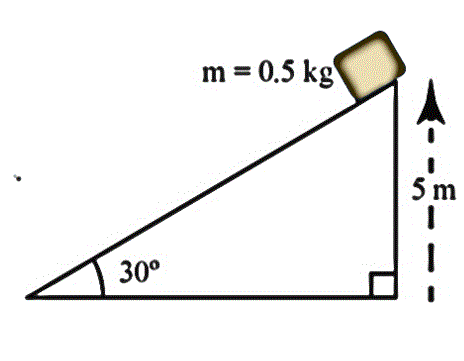 A\(v_f = 9.9 \, \text{m/s}\)
B\(v_f = 6.4 \, \text{m/s}\)
C\(v_f = 12.3 \, \text{m/s}\)
D\(v_f = 7.8 \, \text{m/s}\)
اضغط هنا تظهر طريقة الحلClick for solution
الحل:
A\(v_f = 9.9 \, \text{m/s}\)
B\(v_f = 6.4 \, \text{m/s}\)
C\(v_f = 12.3 \, \text{m/s}\)
D\(v_f = 7.8 \, \text{m/s}\)
اضغط هنا تظهر طريقة الحلClick for solution
الحل:
\[W_{tot}=\Delta KE\]\[W_{FN}+W_{Fg}=\frac {1}{2} m.v_f^2-\frac {1}{2}mv_i^2\]\[0+m.g.d.cos {60}=\frac {1}{2}m.v_f^2\]\[v_f = \sqrt{2gh} = \sqrt{2 \times 9.81 \times 5} = 9.9 \, \text{m/s}\]الإجابة الصحيحة: ASolution:
\[W_{tot}=\Delta KE\]\[W_{FN}+W_{Fg}=\frac {1}{2} m.v_f^2-\frac {1}{2}mv_i^2\]\[0+m.g.d.cos {60}=\frac {1}{2}m.v_f^2\]\[v_f = \sqrt{2gh} = \sqrt{2 \times 9.81 \times 5} = 9.9 \, \text{m/s}\]Correct Answer: A
\[13\star\]
عربة كتلتها
\[10 kg \] تتحرك أفقيا بسرعة ابتدائية
\[ 5m/s\] يتم تطبيق قوة
\[30 N \]على العربة بسحب المقبض الصلب الذي يميل بزاوية 60 درجة فوق الأفق. تستمر العربة في التحرك أفقيًا لمسافة 20 مترًا أخرى. بفرض عدم وجود احتكاك .فإن سرعة العربة بعد قطع كامل المسافة
A cart of mass (10 kg) is moving horizontally with an initial speed of (5 m/s). A force of 30 N is applied to the cart by pulling a rigid handle that makes an angle of 60° above the horizontal. The cart continues to move horizontally for an additional distance of 20 meters. Assuming no friction, the speed of the cart after covering the entire distance is
 A\(v_f = 14.3 \, \text{m/s}\)
B\(v_f = 6.8 \, \text{m/s}\)
C\(v_f = 11.4 \, \text{m/s}\)
D\(v_f = 9.2 \, \text{m/s}\)
اضغط هنا تظهر طريقة الحلClick for solution
الحل: \(W = \Delta KE\)
A\(v_f = 14.3 \, \text{m/s}\)
B\(v_f = 6.8 \, \text{m/s}\)
C\(v_f = 11.4 \, \text{m/s}\)
D\(v_f = 9.2 \, \text{m/s}\)
اضغط هنا تظهر طريقة الحلClick for solution
الحل: \(W = \Delta KE\)
\[v_f = \sqrt{v_i^2 + \frac{2F \times d \times \cos\theta}{m}} = \sqrt{25 + \frac{2 \times 30 \times 20 \times 0.5}{10}} = 9.2 \, \text{m/s}\]الإجابة الصحيحة: DSolution: \(W = \Delta KE\)
\[v_f = \sqrt{v_i^2 + \frac{2F \times d \times \cos\theta}{m}} = \sqrt{25 + \frac{2 \times 30 \times 20 \times 0.5}{10}} = 9.2 \, \text{m/s}\]Correct Answer: D
\[14\star\]
جسم كتلته
\[3\; kg\]
أثرت علية قوة متغيرة
الرسم البياني يبين كيف تتغير العجلة
للجسم مع الإزاحة المقطوعة فإن الشغل
المنجز على الجسم يعادل
A body of mass (3 kg) is acted upon by a variable force. The graph shows how the acceleration of the body changes with the displacement traveled. The work done on the body is equivalent to:
 A\(W = 300 \, \text{J}\)
B\(W = 900 \, \text{J}\)
C\(W = 1200 \, \text{J}\)
D\(W = 1500 \, \text{J}\)
اضغط هنا تظهر طريقة الحلClick for solution
الحل: \(F = ma\)، الشغل = المساحة تحت منحنى \(F\)-\(x\)
A\(W = 300 \, \text{J}\)
B\(W = 900 \, \text{J}\)
C\(W = 1200 \, \text{J}\)
D\(W = 1500 \, \text{J}\)
اضغط هنا تظهر طريقة الحلClick for solution
الحل: \(F = ma\)، الشغل = المساحة تحت منحنى \(F\)-\(x\)
\[W = m \times \textA } = 3 \times \frac {25+15}{2}\times20 = 1200 \, \text{J}\]الإجابة الصحيحة: CSolution: \(F = ma\), work = area under \(F\)-\(x\) curve
\[W = m \times \textA } = 3 \times \frac {25+15}{2}\times20 = 1200 \, \text{J}\]Correct Answer: C
\[15\star\]
طالب كتلته 50 كيلو جرام. يستغرق 40. ثانية لتسلق درج بارتفاع 18 مترًا. فإن مقدار القدرة التي استهلكها A student of mass 50 kg takes 40 seconds to climb a staircase of height 18 meters. The amount of power expended by the student is:
 A\(P = 187.4 \, \text{W}\)
B\(P = 115.9 \, \text{W}\)
C\(P = 220.7 \, \text{W}\)
D\(P = 330.1 \, \text{W}\)
اضغط هنا تظهر طريقة الحلClick for solution
الحل:
A\(P = 187.4 \, \text{W}\)
B\(P = 115.9 \, \text{W}\)
C\(P = 220.7 \, \text{W}\)
D\(P = 330.1 \, \text{W}\)
اضغط هنا تظهر طريقة الحلClick for solution
الحل:
\[P = \frac{W}{t} = \frac{mgh}{t} = \frac{50 \times 9.81 \times 18}{40} = 220.7 \, \text{W}\]الإجابة الصحيحة: CSolution:
\[P = \frac{W}{t} = \frac{mgh}{t} = \frac{50 \times 9.81 \times 18}{40} = 220.7 \, \text{W}\]Correct Answer: C
\[16\star\]
صندوق وزنه 40 نيوتن يتم رفعة بسرعة ثابتة مقدارها
3 m/s
ما هي القدرة المطلوبة لإنجاز هذا العمل
A box weighing 40 N is lifted at a constant speed of
3 m/s.
What is the power required to accomplish this work?

A\(P = 43 \, \text{W}\)
B\(P = 13.3 \, \text{W}\)
C\(P = 120 \, \text{W}\)
D\(P = 60 \, \text{W}\)
اضغط هنا تظهر طريقة الحلClick for solution
الحل:
\[P = F \times v = 40 \times 3 = 120 \, \text{W}\]الإجابة الصحيحة: CSolution:
\[P = F \times v = 40 \times 3 = 120 \, \text{W}\]Correct Answer: C
\[17\star\]
في تدريب رياضي على التسلق طالب وزنة
700 نيوتن
تسلق حبل لمسافة 10 متر فاستهلك طاقة
قدرها
2.5 hp
فإن الزمن الذي اتم به هذا التسلق
In a climbing training exercise, a student weighing 700 N climbs a rope to a height of 10 meters, expending energy at a rate of 2.5 hp. The time taken to complete this climb is:

A\(t = 3.75 \, \text{s}\)
B\(t = 4.25 \, \text{s}\)
C\(t = 2.5 \, \text{s}\)
D\(t = 5.25 \, \text{s}\)
اضغط هنا تظهر طريقة الحلClick for solution
الحل: \(1 \, \text{hp} = 746 \, \text{W}\)
\[t = \frac{W}{P} = \frac{F \times d}{2.5 \times 746} = \frac{700 \times 10}{1865} = 3.75 \, \text{s}\]الإجابة الصحيحة: ASolution: \(1 \, \text{hp} = 746 \, \text{W}\)
\[t = \frac{W}{P} = \frac{F \times d}{2.5 \times 746} = \frac{700 \times 10}{1865} = 3.75 \, \text{s}\]Correct Answer: A
\[18\star\]
الخط البياني التالي يبين العلاقة بين القوة المؤثرة على عربة صغيرة والزمن فإن التغير في الزخم يعادل Force-time graph for a cart. Change in momentum?
 A\(\Delta P = 1.8 \, \text{N.s}\)
B\(\Delta P = 0.9 \, \text{N.s}\)
C\(\Delta P = 1.2 \, \text{N.s}\)
D\(\Delta P = 0.6 \, \text{N.s}\)
اضغط هنا تظهر طريقة الحلClick for solution
الحل: الدفع = التغير في الزخم = المساحة تحت منحنى \(F\)-\(t\)
A\(\Delta P = 1.8 \, \text{N.s}\)
B\(\Delta P = 0.9 \, \text{N.s}\)
C\(\Delta P = 1.2 \, \text{N.s}\)
D\(\Delta P = 0.6 \, \text{N.s}\)
اضغط هنا تظهر طريقة الحلClick for solution
الحل: الدفع = التغير في الزخم = المساحة تحت منحنى \(F\)-\(t\)
\[\Delta P = \frac{1}{2} \times 3 \times 0.6 = 0.9 \, \text{N.s}\]الإجابة الصحيحة: BSolution: Impulse = change in momentum = area under \(F\)-\(t\) curve
\[\Delta P = \frac{1}{2} \times 3 \times 0.6 = 0.9 \, \text{N.s}\]Correct Answer: B
\[19\star\]
كرة كتلتها
\[0.4 kg\] تتحرك بسرعة
\[15 m/s \]نحو الغرب. زخمها يعادل؟A ball of mass (0.4 kg) is moving with a speed of (15 m/s) toward the west. The momentum of the ball is equivalent to:

A\(P = 2 \, \text{kg.m/s}\)
B\(P = 6 \, \text{kg.m/s}\)
C\(P = -6 \, \text{kg.m/s}\)
D\(P = -2 \, \text{kg.m/s}\)
اضغط هنا تظهر طريقة الحلClick for solution
الحل:
\[P = m \times v = 0.4 \times (-15) = -6 \, \text{kg.m/s}\]الإجابة الصحيحة: CSolution:
\[P = m \times v = 0.4 \times (-15) = -6 \, \text{kg.m/s}\]Correct Answer: C
\[20\star\]
( 0.5 Kg )كره كتلتها
( 10 N ) ساكنة أثرنا عليها بقوة ثابتة
( 2 S ) نحو الشرق لمدة من الزمن قدرها
فإن سرعة الكرة لحظة زوال القوة المؤثرة تعادل
A ball of mass (0.5 kg) is initially at rest. A constant force of (10 N) is applied to it toward the east for a time duration of (2 s). The speed of the ball at the moment the applied force is removed is equivalent to:

A\(v_f = 20 \, \text{m/s}\)
B\(v_f = 40 \, \text{m/s}\)
C\(v_f = 30 \, \text{m/s}\)
D\(v_f = 10 \, \text{m/s}\)
اضغط هنا تظهر طريقة الحلClick for solution
الحل:
\[v_f = \frac{F \times t}{m} = \frac{10 \times 2}{0.5} = 40 \, \text{m/s}\]الإجابة الصحيحة: BSolution:
\[v_f = \frac{F \times t}{m} = \frac{10 \times 2}{0.5} = 40 \, \text{m/s}\]Correct Answer: B
\[21\star\]
(0.4 Kg ) كره كتلتها
( 10 m/S )تتحرك بسرعة مقدارها
( 10 N ) نحو الشرق تم التأثير عليها بقوة ثابتة
( 15 m/S ) نحو الشرق فأصبحت سرعتها
شرقا فإن الفترة الزمنية التي تم بها ملامسة القوة للكرة تعادل
A ball of mass (0.4 kg) is moving with a speed of (10 m/s) toward the east. A constant force of (10 N) is applied to it, and its speed becomes (15 m/s) toward the east. The time interval during which the force was in contact with the ball is equivalent to:

A\(\Delta t = 0.35 \, \text{s}\)
B\(\Delta t = 0.3 \, \text{s}\)
C\(\Delta t = 0.25 \, \text{s}\)
D\(\Delta t = 0.2 \, \text{s}\)
اضغط هنا تظهر طريقة الحلClick for solution
الحل:
\[\Delta t = \frac{m \times \Delta v}{F} = \frac{0.4 \times (15-10)}{10} = 0.2 \, \text{s}\]الإجابة الصحيحة: DSolution:
\[\Delta t = \frac{m \times \Delta v}{F} = \frac{0.4 \times (15-10)}{10} = 0.2 \, \text{s}\]Correct Answer: D
\[22\star\]
أحد وحدات القياس التالية تعادل وحدة قياس الدفع
\[N.S\]
Which unit is equivalent to impulse N.s?
A\(\text{kg.m}^2/\text{s}^2\)
B\(\text{kg.m/s}\)
C\(\text{kg.m/s}^2\)
D\(\text{kg.m}^2/\text{s}\)
اضغط هنا تظهر طريقة الحلClick for solution
الحل: الدفع = القوة × الزمن = N.s = kg.m/s
\[1 \, \text{N.s} = 1 \, \text{kg.m/s}\]الإجابة الصحيحة: BSolution: Impulse = force × time = N.s = kg.m/s
\[1 \, \text{N.s} = 1 \, \text{kg.m/s}\]Correct Answer: B
\[23\star\]
كرة كتلتها 0.5 كيلو جرام اصطدمت بالأرض بسرعة قدرها
10 m /s
وارتدت بسرعة قدرها
10 m /s
فإن التغير في كمية الحركة يعادل
A ball of mass 0.5 kg strikes the ground with a speed of
10 m/s
and rebounds with a speed of
10 m/s.
The change in momentum is equivalent to:

A\(\Delta P = 10 \, \text{N.s}\) upward
B\(\Delta P = 0\)
C\(\Delta P = 20 \, \text{N.s}\) upward
D\(\Delta P = 10 \, \text{N.s}\) downward
اضغط هنا تظهر طريقة الحلClick for solution
الحل:
\[\Delta P = m(v_f - v_i) = 0.5 \times (10 - (-10)) = 10 \, \text{N.s}\]الإجابة الصحيحة: ASolution:
\[\Delta P = m(v_f - v_i) = 0.5 \times (10 - (-10)) = 10 \, \text{N.s}\]Correct Answer: A
\[24\star\]
في تجربة صناعة السيارات وقياس مدى قدرة تحملها
سيارة كتلتها 1000 كيلوجرام تتحرك بسرعة
30 m / s
اصطدمت بجدار وتوقفت خلال فترة زمنية قدرها
5 s
فإن قوة تأثير الجدار على السيارة
تعادل
In an experiment for manufacturing cars and measuring their crashworthiness, a car of mass 1000 kg moving at a speed of 30 m/s collides with a wall and comes to a stop during a time interval of 5 s. The force exerted by the wall on the car is equivalent to:

A\(F = 3000 \, \text{N}\)
B\(F = 6000 \, \text{N}\)
C\(F = -3000 \, \text{N}\)
D\(F = -6000 \, \text{N}\)
اضغط هنا تظهر طريقة الحلClick for solution
الحل:
\[F = \frac{m \times \Delta v}{\Delta t} = \frac{1000 \times (0-30)}{5} = -6000 \, \text{N}\]الإجابة الصحيحة: DSolution:
\[F = \frac{m \times \Delta v}{\Delta t} = \frac{1000 \times (0-30)}{5} = -6000 \, \text{N}\]Correct Answer: D
\[25\star\]
سيارة كتلتها 1000 كيلو جرام تتحرك نحو الشرق بسرعة
20 m/s
شاهد السائق طفل يعبر الطريق فطبق نظام الفرملة حتى توقف خلال
6 s
فإن القوة التي طبقها السائق على السيارة حتى توقفت A car of mass 1000 kg is moving toward the east at a speed of
20 m/s. The driver sees a child crossing the road and applies the braking system until the car comes to a stop within
6 s. The force applied by the driver on the car to bring it to a stop is:

A\(F = -2222.2 \, \text{N}\)
B\(F = -3333.3 \, \text{N}\)
C\(F = 2222.2 \, \text{N}\)
D\(F = 3333.3 \, \text{N}\)
اضغط هنا تظهر طريقة الحلClick for solution
الحل:
\[F = \frac{m \times \Delta v}{\Delta t} = \frac{1000 \times (0-20)}{6} = -3333.3 \, \text{N}\]الإجابة الصحيحة: BSolution:
\[F = \frac{m \times \Delta v}{\Delta t} = \frac{1000 \times (0-20)}{6} = -3333.3 \, \text{N}\]Correct Answer: B
\[26\star\]
(15 m/s )سيارةتتحرك بسرعة
فإن النسبة بين الطاقة الحركية إلى الزخم يعادل
A car is moving at a speed of (15 m/s). The ratio of its kinetic energy to its momentum is equivalent to:
A\(20 \, \text{m/s}\)
B\(10 \, \text{m/s}\)
C\(5 \, \text{m/s}\)
D\(2.5 \, \text{m/s}\)
اضغط هنا تظهر طريقة الحلClick for solution
الحل:
\[\frac{KE}{P} = \frac{\frac{1}{2}mv^2}{mv} = \frac{v}{2} = \frac{15}{2} = 7.5 \, \text{m/s}\]أقرب خيار: C (5 m/s) - الإجابة الصحيحة 7.5 m/sSolution:
\[\frac{KE}{P} = \frac{\frac{1}{2}mv^2}{mv} = \frac{v}{2} = \frac{15}{2} = 7.5 \, \text{m/s}\]Closest option: C (5 m/s) - correct is 7.5 m/s
\[27\star\]
الرسم البياني يمثل منحنى القوة و الزمن ،المؤثرة على كرة كتلتها 0.5 كيلو جرام
إذا كانت الكرة تتحرك بسرعة
5 m /s
قبل أن تتأثر بالقوة
فإن سرعتها بعد ان تم دفعها
لمدة 5 ثواني
علما بأن القوة التي تأثرت بها بنفس اتجاه حركتها
The graph represents the force–time curve of the force acting on a ball of mass 0.5 kg. If the ball is moving at a speed of 5 m/s before being affected by the force, then its speed after being pushed for 5 seconds is:
Given that the force applied on it is in the same direction as its motion.

A\(v_f = 105 \, \text{m/s}\)
B\(v_f = 55 \, \text{m/s}\)
C\(v_f = 65 \, \text{m/s}\)
D\(v_f = 75 \, \text{m/s}\)
اضغط هنا تظهر طريقة الحلClick for solution
الحل: المساحة تحت المنحنى = 50 N.s
\[v_f = v_i + \frac{\text{Area}}{m} = 5 + \frac{50}{0.5} = 105 \, \text{m/s}\]الإجابة الصحيحة: ASolution: Area under curve = 50 N.s
\[v_f = v_i + \frac{\text{Area}}{m} = 5 + \frac{50}{0.5} = 105 \, \text{m/s}\]Correct Answer: A
\[28\star\]
طائرة كتلتها 3000 كيلو جرام تتحرك نحو الغرب بسرعة ثابتة مقدارها
200 m /s
فإن الزخم ( كمية الحركة) للطائرة يعادل
An airplane of mass 3000 kg is moving toward the west at a constant speed of
200 m/s. The momentum (quantity of motion) of the airplane is equivalent to:
A\(p = 4 \times 10^5 \, \text{kg.m/s}\) east
B\(p = 6 \times 10^5 \, \text{kg.m/s}\) east
C\(p = 4 \times 10^5 \, \text{kg.m/s}\) west
D\(p = 6 \times 10^5 \, \text{kg.m/s}\) west
اضغط هنا تظهر طريقة الحلClick for solution
الحل:
\[p = m \times v = 3000 \times (-200) = -6 \times 10^5 \, \text{kg.m/s}\]الإجابة الصحيحة: DSolution:
\[p = m \times v = 3000 \times (-200) = -6 \times 10^5 \, \text{kg.m/s}\]Correct Answer: D
\[29\star\]
رائد فضاء كتلته 95 كجم يحمل خزان أكسجين فارغ كتلته 30 كجم وهو ثابت بالنسبة إلى مكوك فضاء بعيد عنة يريد أن يعود للمركبة فيعمل على رمي الخزان بعيدًا عن نفسة في اللإتجاه المعاكس للمركبة و بسرعة
2 m/s
(تقاس بالنسبة للمركبة )
فإن سرعة رائد الفضاء التي سوف يتحرك بهاAn astronaut with a mass of 95 kg is carrying an empty oxygen tank with a mass of 30 kg. He is at rest relative to a space shuttle that is far away from him. He wants to return to the spacecraft, so he throws the tank away from himself in the direction opposite to the spacecraft, with a speed of 2 m/s (measured relative to the spacecraft). The speed at which the astronaut will move is
A\(v_f = 0.55 \, \text{m/s}\)
B\(v_f = 0.42 \, \text{m/s}\)
C\(v_f = 0.63 \, \text{m/s}\)
D\(v_f = 0.37 \, \text{m/s}\)
اضغط هنا تظهر طريقة الحلClick for solution
الحل: حفظ كمية الحركة
\[0 = m_a v_a + m_t v_t \Rightarrow v_a = -\frac{m_t v_t}{m_a} = -\frac{30 \times 2}{95} = 0.63 \, \text{m/s}\]الإجابة الصحيحة: CSolution: Conservation of momentum
\[0 = m_a v_a + m_t v_t \Rightarrow v_a = -\frac{m_t v_t}{m_a} = -\frac{30 \times 2}{95} = 0.63 \, \text{m/s}\]Correct Answer: C
\[30\star\]
( 0.14 kg )كرة كولف كتلتها
تتحرك نحو جدار بسرعة
60 m/s
اصطدمت بالجدار وارتدت كما هو في الصورة المتحركة بسرعة
55 m/s
حدث التصادم خلال فترة زمنية مقدارها
0.15 s
فإن متوسط القوة المؤثرة من الجدار على الكرة تعادل
A golf ball of mass (0.14 kg) is moving toward a wall with a speed of 60 m/s. It collides with the wall and rebounds as shown in the animation, with a speed of 55 m/s. The collision occurs over a time interval of 0.15 s. The average force exerted by the wall on the ball is equivalent to:

A\(F = 107.3 \, \text{N}\) east
B\(F = 85.6 \, \text{N}\) east
C\(F = -107.3 \, \text{N}\) west
D\(F = -85.6 \, \text{N}\) west
اضغط هنا تظهر طريقة الحلClick for solution
الحل:
\[F = \frac{m(v_f - v_i)}{\Delta t} = \frac{0.14 \times (-55 - 60)}{0.15} = -107.3 \, \text{N}\]الإجابة الصحيحة: CSolution:
\[F = \frac{m(v_f - v_i)}{\Delta t} = \frac{0.14 \times (-55 - 60)}{0.15} = -107.3 \, \text{N}\]Correct Answer: C
\[31\star\]
مدفع كتلتة 1000 كجم يطلق قذيفة كتلتها 5 كجم بسرعة أفقية تبلغ
150 m/s
. نحو اليمين فإن سرعة ارتداد المدفع تعادل
A cannon of mass 1000 kg fires a projectile of mass 5 kg with a horizontal speed of
150 m/s toward the right. The recoil speed of the cannon is equivalent to:

A\(v_{f2} = -2.5 \, \text{m/s}\)
B\(v_{f2} = -1.75 \, \text{m/s}\)
C\(v_{f2} = -1.5 \, \text{m/s}\)
D\(v_{f2} = -0.75 \, \text{m/s}\)
اضغط هنا تظهر طريقة الحلClick for solution
الحل:
\[v_{cannon} = -\frac{m_{shell} \times v_{shell}}{m_{cannon}} = -\frac{5 \times 150}{1000} = -0.75 \, \text{m/s}\]الإجابة الصحيحة: DSolution:
\[v_{cannon} = -\frac{m_{shell} \times v_{shell}}{m_{cannon}} = -\frac{5 \times 150}{1000} = -0.75 \, \text{m/s}\]Correct Answer: D
\[32\star\]
طوافة مطاطية منفوخة كتلتها 30 كجم تحمل سباحين كتلتة الأول 50 كجم وكتلة السباح الثاني 70 كجم. الطوافة في البداية وهي ساكنة
يقفز كلا السباحين بنفس اللحظة الأول يقفز نحو اليمين بسرعة
4m/s
والثاني يقفز نحو اليسار بسرعة
6 m/s
تم القفز من أطراف الطوافة فإن السرعة التي تتحرك بها الطوافة وإتجاهها يعادل
An inflated rubber raft of mass 30 kg carries two swimmers: the first swimmer has a mass of 50 kg, and the second swimmer has a mass of 70 kg. The raft is initially at rest. Both swimmers jump off at the same instant — the first jumps to the right with a speed of 4 m/s, and the second jumps to the left with a speed of 6 m/s. They jump from the ends of the raft. The speed and direction of the raft's motion after the jumps is equivalent to:

A\(v_f = 7.33 \, \text{m/s}\) east
B\(v_f = 5.42 \, \text{m/s}\) east
C\(v_f = -7.33 \, \text{m/s}\) west
D\(v_f = -5.42 \, \text{m/s}\) west
اضغط هنا تظهر طريقة الحلClick for solution
الحل: حفظ كمية الحركة
\[0 = m_{raft} v_{raft} + m_1 v_1 + m_2 v_2\]\[v_{raft} = -\frac{50(4) + 70(-6)}{30} = 7.33 \, \text{m/s}\]الإجابة الصحيحة: ASolution: Conservation of momentum
\[0 = m_{raft} v_{raft} + m_1 v_1 + m_2 v_2\]\[v_{raft} = -\frac{50(4) + 70(-6)}{30} = 7.33 \, \text{m/s}\]Correct Answer: A
\[33\star\]
كرة تنس كتلتها
m ( kg)
تتحرك نحو اليسار بسرعة أفقية قدرها
u ( m /s )
تصطدم الكرة بالمضرب وترتد
نحو اليمين بسرعة أفقية مقدارها
𝜗 ( m/s )
فإن التغير في مقدار كمية الحركة للكرة يعادل
A tennis ball of mass m (kg) is moving to the left with a horizontal speed of u (m/s). The ball hits the racket and rebounds to the right with a horizontal speed of v (m/s). The change in the magnitude of the momentum of the ball is equivalent to:
 A\(\Delta p = m(v+u)\)
B\(\Delta p = m(v-u)\)
C\(\Delta p = -m(v+u)\)
D\(\Delta p = m(u-v)\)
اضغط هنا تظهر طريقة الحلClick for solution
الحل:
A\(\Delta p = m(v+u)\)
B\(\Delta p = m(v-u)\)
C\(\Delta p = -m(v+u)\)
D\(\Delta p = m(u-v)\)
اضغط هنا تظهر طريقة الحلClick for solution
الحل:
\[\Delta p = m(v - (-u)) = m(v+u)\]الإجابة الصحيحة: ASolution:
\[\Delta p = m(v - (-u)) = m(v+u)\]Correct Answer: A
\[34\star\]
رجل يجلس على مقعد دوار يدور بمعدل دورة واحدة كل 0.25 ثانية
فإذا كان عزم القصور الذاتي يعادل \[I=0.3 Kg.m^2\]
ويدور الرجل عكس عقارب الساعة فإن الزحم الزاوي
يعادل
A man sits on a rotating seat that spins at a rate of one revolution every 0.25 seconds. If the moment of inertia is \[I=0.3 Kg.m^2\]
and the man rotates counterclockwise, then the angular momentum is equivalent to:

A\(L = 5.4 \, \text{kg.m}^2/\text{s}\)
B\(L = 7.5 \, \text{kg.m}^2/\text{s}\)
C\(L = 8.3 \, \text{kg.m}^2/\text{s}\)
D\(L = 3.8 \, \text{kg.m}^2/\text{s}\)
اضغط هنا تظهر طريقة الحلClick for solution
الحل:
\[\omega = \frac{2\pi}{T} = \frac{2\pi}{0.25} = 25.13 \, \text{rad/s}\]\[L = I \times \omega = 0.3 \times 25.13 = 7.5 \, \text{kg.m}^2/\text{s}\]الإجابة الصحيحة: BSolution:
\[\omega = \frac{2\pi}{T} = \frac{2\pi}{0.25} = 25.13 \, \text{rad/s}\]\[L = I \times \omega = 0.3 \times 25.13 = 7.5 \, \text{kg.m}^2/\text{s}\]Correct Answer: B
\[35\star\]
( 22 Cm ) إطار سيارة نصف قطره
(300 rpm ) يدور بمعدل
طبق السائق
نظام الفرملة على السيارة ليتوقف الإطار عن الدوران
فإذا كان عزم القصور الذاتي للإطار
\[I=0.4 Kg,m^2\] وينتج عن الاحتكاك
بين الفرامل والإطار عزم دوران يعادل \[𝜏=6.1 N.m\]لإبطاء الحركة فإن عدد الثواني اللازمة
لإيقاف الإطار تعادل
A car tire has a radius of (22 cm) and rotates at a rate of (300 rpm). The driver applies the braking system to stop the tire from rotating. If the moment of inertia of the tire is
\[I=0.4 Kg,m^2\]
and the friction between the brake and the tire produces a torque of
\[𝜏=6.1 N.m\]
τ=6.1N⋅m
to slow down the motion, then the number of seconds required to stop the tire is equivalent to:
 A\(t = 2.1 \, \text{s}\)
B\(t = 3.4 \, \text{s}\)
C\(t = 5.6 \, \text{s}\)
D\(t = 4.5 \, \text{s}\)
اضغط هنا تظهر طريقة الحلClick for solution
الحل:
A\(t = 2.1 \, \text{s}\)
B\(t = 3.4 \, \text{s}\)
C\(t = 5.6 \, \text{s}\)
D\(t = 4.5 \, \text{s}\)
اضغط هنا تظهر طريقة الحلClick for solution
الحل:
\[\omega_i = 300 \times \frac{2\pi}{60} = 31.4 \, \text{rad/s}\]\[\alpha = \frac{\tau}{I} = \frac{6.1}{0.4} = 15.25 \, \text{rad/s}^2\]\[t = \frac{\omega_i}{\alpha} = \frac{31.4}{15.25} = 2.1 \, \text{s}\]الإجابة الصحيحة: ASolution:
\[\omega_i = 300 \times \frac{2\pi}{60} = 31.4 \, \text{rad/s}\]\[\alpha = \frac{\tau}{I} = \frac{6.1}{0.4} = 15.25 \, \text{rad/s}^2\]\[t = \frac{\omega_i}{\alpha} = \frac{31.4}{15.25} = 2.1 \, \text{s}\]Correct Answer: A
\[36\star\]
( 4 Kg ) كتلة من الطين كتلتها
(1 m ) تم اسقاطها فوق قرص يدور حول محوره نصف قطره
(5 rad/S ) ويدور بسرعة زاوية قدرها
فإذا كان عزم القصور الذاتي للقرص يعادل \[I=\frac{1}{2}m.r^2=1 𝑘𝑔.m^2\] وعزم القصور الذاتي للكتلة الطينية
\[I=m.r^2\]فإن السرعة الزاوية للقرص تصبح
A lump of clay of mass (4 kg) is dropped onto a disk that rotates about its axis, with a radius of (1 m) and an angular speed of (5 rad/s). If the moment of inertia of the disk is
\[I=\frac{1}{2}m.r^2=1 𝑘𝑔.m^2\]
and the moment of inertia of the clay lump is
\[I=m.r^2\]
then the new angular speed of the disk becomes:

A\(\omega_f = 4 \, \text{rad/s}\)
B\(\omega_f = 2 \, \text{rad/s}\)
C\(\omega_f = 1 \, \text{rad/s}\)
D\(\omega_f = 3 \, \text{rad/s}\)
اضغط هنا تظهر طريقة الحلClick for solution
الحل: حفظ الزخم الزاوي
\[I_i \omega_i = I_f \omega_f\]\[1 \times 5 = (1 + 4 \times 1^2) \times \omega_f \Rightarrow \omega_f = 1 \, \text{rad/s}\]الإجابة الصحيحة: CSolution: Conservation of angular momentum
\[I_i \omega_i = I_f \omega_f\]\[1 \times 5 = (1 + 4 \times 1^2) \times \omega_f \Rightarrow \omega_f = 1 \, \text{rad/s}\]Correct Answer: C
\[37\star\]
( 7 × 10 5 Km ) لنفترض أن نجمًا نيوتروني نصف قطره
( 10 Km ) والذي ينهار تحت تأثير جاذبيته إلى دائرة نصف قطرها
يدور هذا النجم بمعدل 1 دورة كل 30 يومًا
افترض أن النجم هو كرة متجانسة في جميع الأوقات ولا يفقد أي كتلة. فإن سرعة دورن النجم تصبح
علما بأن عزم القصور الذاتي للنجم \[I=\frac{2}{5}m.r^2 ( kg.)\]
Suppose a neutron star has a radius of\[ 7 × 10^5 \;Kg .m^2\]
km and collapses under its own gravity to a radius of 10 km. This star rotates at a rate of 1 revolution every 30 days. Assume that the star is a uniform sphere at all times and does not lose any mass. The rotational speed of the star after collapse becomes:
Given that the moment of inertia of the star is
\[I=\frac{2}{5}m.r^2 ( kg.)\]

A\(\omega_2 = 0.25 \, \text{rad/s}\)
B\(\omega_2 = 0.17 \, \text{rad/s}\)
C\(\omega_2 = 0.41 \, \text{rad/s}\)
D\(\omega_2 = 0.32 \, \text{rad/s}\)
اضغط هنا تظهر طريقة الحلClick for solution
الحل: حفظ الزخم الزاوي (\(I = \frac{2}{5}mr^2\))
\[\omega_2 = \omega_1 \left(\frac{r_1}{r_2}\right)^2\]\[\omega_1 = \frac{2\pi}{30 \times 86400} = 2.42 \times 10^{-6} \, \text{rad/s}\]\[\omega_2 = 2.42 \times 10^{-6} \times \left(\frac{7 \times 10^8}{10^4}\right)^2 = 0.17 \, \text{rad/s}\]الإجابة الصحيحة: BSolution: Conservation of angular momentum (\(I = \frac{2}{5}mr^2\))
\[\omega_2 = \omega_1 \left(\frac{r_1}{r_2}\right)^2\]\[\omega_1 = \frac{2\pi}{30 \times 86400} = 2.42 \times 10^{-6} \, \text{rad/s}\]\[\omega_2 = 2.42 \times 10^{-6} \times \left(\frac{7 \times 10^8}{10^4}\right)^2 = 0.17 \, \text{rad/s}\]Correct Answer: B
\[38\star\]
(100 kg
) طاقة الوضع الجاذبية لجسم كتلته
( 4 m )عندما يتم رفعة
عن سطح الأرض على إعتبار أن سطح الأرض هي المستوى المرجعي \[g=9.81 \frac{m}{s^2}\]
The gravitational potential energy of an object of mass (100 kg) when it is raised (4 m) above the Earth's surface, taking the Earth's surface as the reference level, is:
\[g=9.81 m/s^2\]

A\(PEG = 4735 \, \text{J}\)
B\(PEG = 3924 \, \text{J}\)
C\(PEG = 2567 \, \text{J}\)
D\(PEG = 1734 \, \text{J}\)
اضغط هنا تظهر طريقة الحلClick for solution
الحل:
\[PEG = m \times g \times h = 100 \times 9.81 \times 4 = 3924 \, \text{J}\]الإجابة الصحيحة: BSolution:
\[PEG = m \times g \times h = 100 \times 9.81 \times 4 = 3924 \, \text{J}\]Correct Answer: B
\[39\star\]
( 40 m ) وقف طالب على سطح مبنى يرتفع عن سطح الأرض
بمقدار
( 0.2 kg ) وقذف كرة راسيا نحو الأعلى كتلتها
( 20 m/s )بسرعة مقدارها
فإن الطاقة الميكانيكية للكرة لحظة قذف الكرة
A student stands on the roof of a building that is (40 m) above the ground and throws a ball vertically upward with a mass of (0.2 kg) at a speed of (20 m/s). The mechanical energy of the ball at the moment it is thrown is:

A\(ME = 97.1 \, \text{J}\)
B\(ME = 213.8 \, \text{J}\)
C\(ME = 118.4 \, \text{J}\)
D\(ME = 140.3 \, \text{J}\)
اضغط هنا تظهر طريقة الحلClick for solution
الحل:
\[ME = KE + PEG = \frac{1}{2}mv^2 + mgh = \frac{1}{2}(0.2)(20^2) + (0.2)(9.81)(40)\]\[ME = 40 + 78.48 = 118.4 \, \text{J}\]الإجابة الصحيحة: CSolution:
\[ME = KE + PEG = \frac{1}{2}mv^2 + mgh = \frac{1}{2}(0.2)(20^2) + (0.2)(9.81)(40)\]\[ME = 40 + 78.48 = 118.4 \, \text{J}\]Correct Answer: C
\[40\star\]
(2900 J ) برميل نفط كتلتة 100 كيلوجرام يمتلك طاقة وضع مقدارها
فإن أرتفاع البرميل عن سطح الأرض يعادل
\[g=9.81\frac{m}{s^2}\]An oil barrel of mass 100 kg possesses gravitational potential energy of (2900 J). The height of the barrel above the Earth's surface is equivalent to:
\[g=9.81\frac{m}{s^2}\]
 A\(h = 2.25 \, \text{m}\)
B\(h = 2.95 \, \text{m}\)
C\(h = 1.58 \, \text{m}\)
D\(h = 1.96 \, \text{m}\)
اضغط هنا تظهر طريقة الحلClick for solution
الحل:
A\(h = 2.25 \, \text{m}\)
B\(h = 2.95 \, \text{m}\)
C\(h = 1.58 \, \text{m}\)
D\(h = 1.96 \, \text{m}\)
اضغط هنا تظهر طريقة الحلClick for solution
الحل:
\[h = \frac{PEG}{m \times g} = \frac{2900}{100 \times 9.81} = 2.95 \, \text{m}\]الإجابة الصحيحة: BSolution:
\[h = \frac{PEG}{m \times g} = \frac{2900}{100 \times 9.81} = 2.95 \, \text{m}\]Correct Answer: B
\[41\star\]
كم يكون التغير في طاقة الوضع للوح خشبي كتلتة 30 كيلوجرام مرفوع فوق رأس الرجل على ارتفاع 2.2 متر ويتحرك به مسافة 12 متر نحو اليمين \[g=9.81\frac{m}{s^2}\]What is the change in potential energy of a wooden block of mass 30 kg that is held above a man's head at a height of 2.2 meters and moved horizontally a distance of 12 meters to the right?
\[g=9.81\frac{m}{s^2}\]
 A\(\Delta PEG = 435.7 \, \text{J}\)
B\(\Delta PEG = 647.5 \, \text{J}\)
C\(\Delta PEG = 2884.1 \, \text{J}\)
D\(\Delta PEG = 0 \, \text{J}\)
اضغط هنا تظهر طريقة الحلClick for solution
الحل: طاقة الوضع تعتمد على الارتفاع فقط، والحركة الأفقية لا تغير الارتفاع
A\(\Delta PEG = 435.7 \, \text{J}\)
B\(\Delta PEG = 647.5 \, \text{J}\)
C\(\Delta PEG = 2884.1 \, \text{J}\)
D\(\Delta PEG = 0 \, \text{J}\)
اضغط هنا تظهر طريقة الحلClick for solution
الحل: طاقة الوضع تعتمد على الارتفاع فقط، والحركة الأفقية لا تغير الارتفاع
\[\Delta PEG = 0 \, \text{J}\]الإجابة الصحيحة: DSolution: Potential energy depends only on height, horizontal motion doesn't change height
\[\Delta PEG = 0 \, \text{J}\]Correct Answer: D
\[42\star\]
( 10 m ) ترك طالب كرة من ارتفاع
من نافذة مبنى دون سرعة
ابتدائية فإن سرعة الحجر لحظة الارتطام بالأرض
بفرض عدم وجود مقاومة هواء
اعتبر أن \[ g=9.81m/s ^2\]A student drops a ball from a height of (10 m) from a building window with zero initial velocity. The speed of the ball at the moment it strikes the ground, assuming no air resistance, is:
\[Take \; g=9.81m/s ^2\]
 A\(v = 8 \, \text{m/s}\)
B\(v = 12 \, \text{m/s}\)
C\(v = 10 \, \text{m/s}\)
D\(v = 14 \, \text{m/s}\)
اضغط هنا تظهر طريقة الحلClick for solution
الحل:
A\(v = 8 \, \text{m/s}\)
B\(v = 12 \, \text{m/s}\)
C\(v = 10 \, \text{m/s}\)
D\(v = 14 \, \text{m/s}\)
اضغط هنا تظهر طريقة الحلClick for solution
الحل:
\[v = \sqrt{2gh} = \sqrt{2 \times 9.81 \times 10} = 14 \, \text{m/s}\]الإجابة الصحيحة: DSolution:
\[v = \sqrt{2gh} = \sqrt{2 \times 9.81 \times 10} = 14 \, \text{m/s}\]Correct Answer: D
\[43\star\]
(2 m )كرة علقت بحبل لتشكل بندول و ترتفع الكرة عن سطح الأرض
وهو في وضع الاتزان
أبعد البندول عن موضع الاتزان وترك ليهتز
( 3 m/s ) فإذا كانت سرعة الكرة لحظة مرورها بموضع الاتزان تعادل
فإن الارتفاع عن سطح الأرض والذي
الذي تركت منه الكرة لتهتز يعادل
Pendulum, speed at equilibrium 3 m/s, height \(h=2 \, \text{m}\). Release height?

A\(h = 2.23 \, \text{m}\)
B\(h = 2.46 \, \text{m}\)
C\(h = 2.58 \, \text{m}\)
D\(h = 2.37 \, \text{m}\)
اضغط هنا تظهر طريقة الحلClick for solution
الحل: حفظ الطاقة الميكانيكية
\[ KE_1+PE_1=KE_2+PE_2\]\[0+mgh_1=\frac {1}{2}mv^2\]\[h_1=\frac {{1}{2}v^2}{g}\] \[h_1=\frac {{1}{2}3^2}{9.81=0.46 m }\]\[h_{release} = h_{eq} + \frac{v^2}{2g} = 2 + 0.46 = 2.46 \, \text{m}\]الإجابة الصحيحة: BSolution: Conservation of mechanical energy
\[ KE_1+PE_1=KE_2+PE_2\]\[0+mgh_1=\frac {1}{2}mv^2\]\[h_1=\frac {{1}{2}v^2}{g}\] \[h_1=\frac {{1}{2}3^2}{9.81=0.46 m }\]\[h_{release} = h_{eq} + \frac{v^2}{2g} = 2 + 0.46 = 2.46 \, \text{m}\]Correct Answer: B
\[44\star\]
لاعب غولف على سطح القمر حيث الجاذبية \[g=1.63 \frac{m}{s^2}\]
(30 m/s ) ضرب كرة الجولف. بزاوية 45 درجة وبسرعة مقدارها
( 21.2 m/s ) فوصلت الكرة إلى أقصى ارتفاع بسرعة
فإن أقصى ارتفاع تصل إلية الكرة عن سطح القمر تعادل
A golfer on the Moon's surface, where the gravitational acceleration is
\[g=1.63 \frac{m}{s^2}\]
strikes a golf ball at an angle of 45° with a speed of (30 m/s). The ball reaches its maximum height with a speed of (21.2 m/s). The maximum height reached by the ball above the Moon's surface is equivalent to:

A\(h = 98.9 \, \text{m}\)
B\(h = 162.8 \, \text{m}\)
C\(h = 138.2 \, \text{m}\)
D\(h = 227.6 \, \text{m}\)
اضغط هنا تظهر طريقة الحلClick for solution
الحل: \(v_y^2 = v_i^2 - 2gh\)، \(v_y = 21.2 \, \text{m/s}\)
\[ KE_1+PE_1=KE_2+PE_2\]\[\frac {1}{2}mv_1^2+0=\frac {1}{2}mv^2+mgh_2\]\[h_2 = \frac{v_i^2 - v_y^2}{2g} = \frac{30^2 - 21.2^2}{2 \times 1.63} = 138.2 \, \text{m}\]الإجابة الصحيحة: CSolution: \(v_y^2 = v_i^2 - 2gh\), \(v_y = 21.2 \, \text{m/s}\)
\[ KE_1+PE_1=KE_2+PE_2\]\[\frac {1}{2}mv_1^2+0=\frac {1}{2}mv^2+mgh_2\]\[h_2 = \frac{v_i^2 - v_y^2}{2g} = \frac{30^2 - 21.2^2}{2 \times 1.63} = 138.2 \, \text{m}\]Correct Answer: C
\[45\star\]
راكب دراجة يبذل قوة ثابتة على مستوى أملس. في أي موقع أكبر طاقة حركية؟Cyclist exerts constant force on smooth surface. At which position max KE?

AA
BB
CC
DD
اضغط هنا تظهر طريقة الحلClick for solution
الحل: أكبر طاقة حركية عند أقل ارتفاع (B) لأن \(KE = mgh\) (حفظ الطاقة)
الإجابة الصحيحة: BSolution: Max KE at lowest height (B) because \(KE = mgh\) (energy conservation)
Correct Answer: B
\[46\star\]
راكب دراجة يبذل قوة ثابتة على مستوى أملس. في أي موقع أكبر طاقة وضع؟Cyclist exerts constant force on smooth surface. At which position max PE?
AA
BB
CC
DD
اضغط هنا تظهر طريقة الحلClick for solution
الحل: أكبر طاقة وضع عند أعلى ارتفاع (C) لأن \(PEG = mgh\)
الإجابة الصحيحة: CSolution: Max PE at highest height (C) because \(PEG = mgh\)
Correct Answer: C
\[47\star\]
(74 Kg ) في الشكل أدناه إذا كانت كتلة الدراجة وراكبها
فإن التغير في طاقة الوضع عند الانتقال من الموضع
B إلى الموضع A
تعادلIn the figure below, if the mass of the bicycle and its rider is (74 kg), then the change in gravitational potential energy when moving from position B to position A is equivalent to:
 A\(\Delta PE = -13248.8 \, \text{J}\)
B\(\Delta PE = -26574.2 \, \text{J}\)
C\(\Delta PE = -18148.5 \, \text{J}\)
D\(\Delta PE = -23546.3 \, \text{J}\)
اضغط هنا تظهر طريقة الحلClick for solution
الحل:
A\(\Delta PE = -13248.8 \, \text{J}\)
B\(\Delta PE = -26574.2 \, \text{J}\)
C\(\Delta PE = -18148.5 \, \text{J}\)
D\(\Delta PE = -23546.3 \, \text{J}\)
اضغط هنا تظهر طريقة الحلClick for solution
الحل:
\[\Delta PE = m \times g \times (h_A - h_B) = 74 \times 9.81 \times (0 - 25) = -18148.5 \, \text{J}\]الإجابة الصحيحة: CSolution:
\[\Delta PE = m \times g \times (h_A - h_B) = 74 \times 9.81 \times (0 - 25) = -18148.5 \, \text{J}\]Correct Answer: C
\[48\star\]
جسم وضع على قمة مستوى مائل أملس يميل بزاوية قدرها \[𝜃=30^0\]وترك لينزلق فوصل إلى نهاية المستوى بسرعة \[v=10 m/s\]فإن طول المستوى المائل يعادل . طول المستوى المائل اعتبر أن \[g=10\frac{m}{s^2}\]An object is placed at the top of a smooth inclined plane that makes an angle of\[𝜃=30^0\]
with the horizontal and is released from rest. It reaches the bottom of the incline with a speed of
\[v=10 m/s\]
The length of the inclined plane is equivalent to\[Take \; g=10 m/s ^2\]

A\(x = 15 \, \text{m}\)
B\(x = 5 \, \text{m}\)
C\(x = 10 \, \text{m}\)
D\(x = 20 \, \text{m}\)
اضغط هنا تظهر طريقة الحلClick for solution
الحل:
\[ KE_1+PE_1=KE_2+PE_2\]\[0+mgh_1=\frac {1}{2}mv^2+0\] \[ h_1=\frac {\frac {1}{2}v^2}{g}=\frac {\frac {1}{2}10^2}{10}= 5 m\] \[x = \frac{h}{ \sin\theta} = \frac{5}{sin30} =10 m\] الإجابة الصحيحة: CSolution:
\[ KE_1+PE_1=KE_2+PE_2\]\[0+mgh_1=\frac {1}{2}mv^2+0\] \[ h_1=\frac {\frac {1}{2}v^2}{g}=\frac {\frac {1}{2}10^2}{10}= 5 m\] \[x = \frac{h}{ \sin\theta} = \frac{5}{sin30} =10 m\]Correct Answer: C
\[49\star\]
سطح منحدر عديم الاحتكاك ، وضع جسم على قمة المستوى
( 5 m ) فبأي سرعة ستصل الكتلة إلى القاع إذا تحررت من السكون من ارتفاع
عن سطح الأرض A frictionless inclined plane surface. An object is placed at the top of the plane at a height of (5 m) above the ground. With what speed will the mass reach the bottom if it is released from rest?
 A\(v = 3.8 \, \text{m/s}\)
B\(v = 7.8 \, \text{m/s}\)
C\(v = 5.3 \, \text{m/s}\)
D\(v = 9.9 \, \text{m/s}\)
اضغط هنا تظهر طريقة الحلClick for solution
الحل:
A\(v = 3.8 \, \text{m/s}\)
B\(v = 7.8 \, \text{m/s}\)
C\(v = 5.3 \, \text{m/s}\)
D\(v = 9.9 \, \text{m/s}\)
اضغط هنا تظهر طريقة الحلClick for solution
الحل:
\[ KE_1+PE_1=KE_2+PE_2\]\[0+mgh_1=\frac {1}{2}mv^2+0\]\[v = \sqrt{2gh} = \sqrt{2 \times 9.81 \times 5} = 9.9 \, \text{m/s}\]الإجابة الصحيحة: DSolution:
\[ KE_1+PE_1=KE_2+PE_2\]\[0+mgh_1=\frac {1}{2}mv^2+0\]\[v = \sqrt{2gh} = \sqrt{2 \times 9.81 \times 5} = 9.9 \, \text{m/s}\]Correct Answer: D
🧮 Calculator
🗑️
✏️ قلم
امتحان تجريبي الشغل والطاقة ومبدأ حفظ الطاقة والزخم وعلاقتها بالدفع
|
📄 اطبع pdf
00971504825082
أسئلة فيزياء - 49 سؤالاً
\[1\star\]
أي من اوحدات القياس التالية تعادل الجول ؟Which of the following units of measurement is equivalent to the joule?
AAA
BBB
CCC
DDD
اضغط هنا تظهر طريقة الحلClick for solution
الحل: \[W=F.d\].
\[J=N.m=\frac {kg.m}{s^2}.m =\frac {kg.m^2}{s^2}\]الإجابة الصحيحة: CSolution: .
\[J=N.m=\frac {kg.m}{s^2}.m =\frac {kg.m^2}{s^2}\]Correct Answer: C
\[2\star\]
ما مقدار الشغل المبذول عند تطبيق قوة مقدارها 10 نيوتن لتحريك صندوق بمقدار 4 أمتار في اتجاه القوة؟What is work done by a 10 N force moving a box 4 m in force direction?
A\(W = 20 \, \text{J}\)
B\(W = 60 \, \text{J}\)
C\(W = 40 \, \text{J}\)
D\(W = 80 \, \text{J}\)
اضغط هنا تظهر طريقة الحلClick for solution
الحل:
\[W = F \times d = 10 \times 4 = 40 \, \text{J}\]الإجابة الصحيحة: CSolution:
\[W = F \times d = 10 \times 4 = 40 \, \text{J}\]Correct Answer: C
\[3\star\]
ما مقدار الشغل المبذول عند تطبيق قوة مقدارها 60 نيوتن تميل بزاوية 35° فوق الأفق لتحريك صندوق بمقدار 10 أمتار؟Work done by a 60 N force at 35° above horizontal moving a box 10 m?
A\(W = 520.3 \, \text{J}\)
B\(W = 312.8 \, \text{J}\)
C\(W = 615.6 \, \text{J}\)
D\(W = 491.5 \, \text{J}\)
اضغط هنا تظهر طريقة الحلClick for solution
الحل:
\[W = F \times d \times \cos\theta = 60 \times 10 \times \cos(35^\circ) = 491.5 \, \text{J}\]الإجابة الصحيحة: DSolution:
\[W = F \times d \times \cos\theta = 60 \times 10 \times \cos(35^\circ) = 491.5 \, \text{J}\]Correct Answer: D
\[4\star\]
جسم كتلته
\[3 kg \]على مستوى مائل بزاوية \[\theta = 20^\circ\]، انزلق
\[4 m،\] شغل قوة الوزن يعادل؟A 3 kg object slides 4 m down a 20° incline. Work done by gravity?
A\(W = 110.5 \, \text{J}\)
B\(W = 11.2 \, \text{J}\)
C\(W = 40.2 \, \text{J}\)
D\(W = 4.1 \, \text{J}\)
اضغط هنا تظهر طريقة الحلClick for solution
الحل:
\[W = m \times g \times d \times \sin\theta = 3 \times 9.81 \times 4 \times \sin(20^\circ) = 40.2 \, \text{J}\]الإجابة الصحيحة: CSolution:
\[W = m \times g \times d \times \sin\theta = 3 \times 9.81 \times 4 \times \sin(20^\circ) = 40.2 \, \text{J}\]Correct Answer: C
\[5\star\]
مكعب خشبي يسحب لأعلى مستوى مائل خشن بقوة موازية للسطح. أي قوة شغلها معدوم؟A cube is pulled up a rough incline. Which force does zero work?
A\(W(F_g) = 0\)
B\(W(F_a) = 0\)
C\(W(F_N) = 0\)
D\(W(F_K) = 0\)
اضغط هنا تظهر طريقة الحلClick for solution
الحل: القوة العمودية \(F_N\) عمودية على الإزاحة (\(\theta = 90^\circ\))
\[W(F_N) = F_N \times d \times \cos(90^\circ) = 0\]الإجابة الصحيحة: CSolution: Normal force is perpendicular to displacement (\(\theta = 90^\circ\))
\[W(F_N) = F_N \times d \times \cos(90^\circ) = 0\]Correct Answer: C
\[6\star\]
صندوق
كتلته \[10 kg \]يسحب بقوة
\[50 N\] بزاوية 25° فوق الأفق لمسافة
\[8 m،\] احتكاك
\[15 N.\] الشغل الكلي يعادل A box with a mass of 10 kg is pulled by a force of 50 N at an angle of 25° above the horizontal for a distance of 8 m, with friction of 15 N. The total work done is equivalent to...
A\(W_{tot} = 482.5 \, \text{J}\)
B\(W_{tot} = 242.5 \, \text{J}\)
C\(W_{tot} = 385.5 \, \text{J}\)
D\(W_{tot} = 255.5 \, \text{J}\)
اضغط هنا تظهر طريقة الحلClick for solution
الحل:
\[W_{tot} = F \times d \times \cos\theta - F_K \times d = 50 \times 8 \times \cos(25^\circ) - 15 \times 8 = 242.5 \, \text{J}\]الإجابة الصحيحة: BSolution:
\[W_{tot} = F \times d \times \cos\theta - F_K \times d = 50 \times 8 \times \cos(25^\circ) - 15 \times 8 = 242.5 \, \text{J}\]Correct Answer: B
\[7\star\]
تتحرك على مستوى أفقي
وتم رصد تغير القوة
والازاحة وكتابتها بالجدول أدناه
وعند رسم العلاقة بين القوة والازاحة فتج الخط البياني التالي
A car moves on a horizontal surface.
The changes in force and displacement were recorded and written in the table below.
When the relationship between force and displacement was plotted, the following graph was obtained
A\(W = 20 \, \text{J}\)
B\(W = 80 \, \text{J}\)
C\(W = 40 \, \text{J}\)
D\(W = 160 \, \text{J}\)
اضغط هنا تظهر طريقة الحلClick for solution
الحل: الشغل = المساحة تحت المنحنى
\[W = \frac{1}{2} \times 8 \times 20 = 80 \, \text{J}\]الإجابة الصحيحة: BSolution: Work = area under curve
\[W = \frac{1}{2} \times 8 \times 20 = 80 \, \text{J}\]Correct Answer: B
\[8\star\star\]
الرسم البياني للقوة والإزاحة لقوة متغيرة. الشغل المبذول من القوة يعادل؟Force-displacement graph for variable force. Work done?
A\(W = 6 \, \text{J}\)
B\(W = 9 \, \text{J}\)
C\(W = -3 \, \text{J}\)
D\(W = 3 \, \text{J}\)
اضغط هنا تظهر طريقة الحلClick for solution
الحل:
\[W = \frac{1}{2} \times 2 \times 3 = 3 \, \text{J}\]الإجابة الصحيحة: DSolution:
\[W = \frac{1}{2} \times 2 \times 3 = 3 \, \text{J}\]Correct Answer: D
\[9\star\]
سيارة طاقتها الحركية
\[10 J\]، إذا تضاعفت سرعتها، تصبح طاقتها الحركية؟A car has KE = 10 J. If speed doubles, new KE?
A\(KE = 40 \, \text{J}\)
B\(KE = 20 \, \text{J}\)
C\(KE = 60 \, \text{J}\)
D\(KE = 80 \, \text{J}\)
اضغط هنا تظهر طريقة الحلClick for solution
الحل:
\[KE' = \frac{1}{2} m (2v)^2 = 4 \times \frac{1}{2} m v^2 = 4 \times 10 = 40 \, \text{J}\]الإجابة الصحيحة: ASolution:
\[KE' = \frac{1}{2} m (2v)^2 = 4 \times \frac{1}{2} m v^2 = 4 \times 10 = 40 \, \text{J}\]Correct Answer: A
\[10\star\]
سيارتين نفس الكتلة، سرعة الأولى ضعف الثانية. النسبة بين طاقتيهما الحركيتين؟Two cars same mass, first speed double. Ratio of KEs?
A2
B6
C4
D8
اضغط هنا تظهر طريقة الحلClick for solution
الحل:
\[\frac{KE_1}{KE_2} = \frac{\frac{1}{2}m(2v)^2}{\frac{1}{2}mv^2} = 4\]الإجابة الصحيحة: CSolution:
\[\frac{KE_1}{KE_2} = \frac{\frac{1}{2}m(2v)^2}{\frac{1}{2}mv^2} = 4\]Correct Answer: C
\[11\star\]
سيارة كتلتها
\[1500 kg\] سرعتها من
\[10 m/s \longrightarrow 3m/s\]. التغير في الطاقة الحركية يغادل A car of mass\[ 1500 kg\]changes its speed from \[10 m/s \longrightarrow 3m/s\]The change in kinetic energy is equal to
A\(\Delta KE = -25600 \, \text{J}\)
B\(\Delta KE = -68250 \, \text{J}\)
C\(\Delta KE = -56430 \, \text{J}\)
D\(\Delta KE = -34670 \, \text{J}\)
اضغط هنا تظهر طريقة الحلClick for solution
الحل:
\[\Delta KE = \frac{1}{2} m (v_f^2 - v_i^2) = \frac{1}{2} \times 1500 \times (9 - 100) = -68250 \, \text{J}\]الإجابة الصحيحة: BSolution:
\[\Delta KE = \frac{1}{2} m (v_f^2 - v_i^2) = \frac{1}{2} \times 1500 \times (9 - 100) = -68250 \, \text{J}\]Correct Answer: B
\[12\star\]
وضع جسم على قمة مائل أملس يميل على الأفق بزاوية
\[𝜃=30^0\]ويرتفع عن سطح الأرض مسافة \[h=5 m\]كما في الشكل أدناه فإن سرعة الجسم عند نهاية المستوى المائل يعادل
استخدم نظرية الشغل وعلاقتها بالطاقة الحركية An object is placed at the top of a smooth inclined plane that makes an angle\[30^0\]
with the horizontal, and it is at a height
\[h=5\;m\]
above the ground, as shown in the figure below. The speed of the object at the bottom of the inclined plane is equivalent to
A\(v_f = 9.9 \, \text{m/s}\)
B\(v_f = 6.4 \, \text{m/s}\)
C\(v_f = 12.3 \, \text{m/s}\)
D\(v_f = 7.8 \, \text{m/s}\)
اضغط هنا تظهر طريقة الحلClick for solution
الحل:
\[W_{tot}=\Delta KE\]\[W_{FN}+W_{Fg}=\frac {1}{2} m.v_f^2-\frac {1}{2}mv_i^2\]\[0+m.g.d.cos {60}=\frac {1}{2}m.v_f^2\]\[v_f = \sqrt{2gh} = \sqrt{2 \times 9.81 \times 5} = 9.9 \, \text{m/s}\]الإجابة الصحيحة: ASolution:
\[W_{tot}=\Delta KE\]\[W_{FN}+W_{Fg}=\frac {1}{2} m.v_f^2-\frac {1}{2}mv_i^2\]\[0+m.g.d.cos {60}=\frac {1}{2}m.v_f^2\]\[v_f = \sqrt{2gh} = \sqrt{2 \times 9.81 \times 5} = 9.9 \, \text{m/s}\]Correct Answer: A
\[13\star\]
عربة كتلتها
\[10 kg \] تتحرك أفقيا بسرعة ابتدائية
\[ 5m/s\] يتم تطبيق قوة
\[30 N \]على العربة بسحب المقبض الصلب الذي يميل بزاوية 60 درجة فوق الأفق. تستمر العربة في التحرك أفقيًا لمسافة 20 مترًا أخرى. بفرض عدم وجود احتكاك .فإن سرعة العربة بعد قطع كامل المسافة
A cart of mass (10 kg) is moving horizontally with an initial speed of (5 m/s). A force of 30 N is applied to the cart by pulling a rigid handle that makes an angle of 60° above the horizontal. The cart continues to move horizontally for an additional distance of 20 meters. Assuming no friction, the speed of the cart after covering the entire distance is
A\(v_f = 14.3 \, \text{m/s}\)
B\(v_f = 6.8 \, \text{m/s}\)
C\(v_f = 11.4 \, \text{m/s}\)
D\(v_f = 9.2 \, \text{m/s}\)
اضغط هنا تظهر طريقة الحلClick for solution
الحل: \(W = \Delta KE\)
\[v_f = \sqrt{v_i^2 + \frac{2F \times d \times \cos\theta}{m}} = \sqrt{25 + \frac{2 \times 30 \times 20 \times 0.5}{10}} = 9.2 \, \text{m/s}\]الإجابة الصحيحة: DSolution: \(W = \Delta KE\)
\[v_f = \sqrt{v_i^2 + \frac{2F \times d \times \cos\theta}{m}} = \sqrt{25 + \frac{2 \times 30 \times 20 \times 0.5}{10}} = 9.2 \, \text{m/s}\]Correct Answer: D
\[14\star\]
جسم كتلته
\[3\; kg\]
أثرت علية قوة متغيرة
الرسم البياني يبين كيف تتغير العجلة
للجسم مع الإزاحة المقطوعة فإن الشغل
المنجز على الجسم يعادل
A body of mass (3 kg) is acted upon by a variable force. The graph shows how the acceleration of the body changes with the displacement traveled. The work done on the body is equivalent to:
A\(W = 300 \, \text{J}\)
B\(W = 900 \, \text{J}\)
C\(W = 1200 \, \text{J}\)
D\(W = 1500 \, \text{J}\)
اضغط هنا تظهر طريقة الحلClick for solution
الحل: \(F = ma\)، الشغل = المساحة تحت منحنى \(F\)-\(x\)
\[W = m \times \textA } = 3 \times \frac {25+15}{2}\times20 = 1200 \, \text{J}\]الإجابة الصحيحة: CSolution: \(F = ma\), work = area under \(F\)-\(x\) curve
\[W = m \times \textA } = 3 \times \frac {25+15}{2}\times20 = 1200 \, \text{J}\]Correct Answer: C
\[15\star\]
طالب كتلته 50 كيلو جرام. يستغرق 40. ثانية لتسلق درج بارتفاع 18 مترًا. فإن مقدار القدرة التي استهلكها A student of mass 50 kg takes 40 seconds to climb a staircase of height 18 meters. The amount of power expended by the student is:
A\(P = 187.4 \, \text{W}\)
B\(P = 115.9 \, \text{W}\)
C\(P = 220.7 \, \text{W}\)
D\(P = 330.1 \, \text{W}\)
اضغط هنا تظهر طريقة الحلClick for solution
الحل:
\[P = \frac{W}{t} = \frac{mgh}{t} = \frac{50 \times 9.81 \times 18}{40} = 220.7 \, \text{W}\]الإجابة الصحيحة: CSolution:
\[P = \frac{W}{t} = \frac{mgh}{t} = \frac{50 \times 9.81 \times 18}{40} = 220.7 \, \text{W}\]Correct Answer: C
\[16\star\]
صندوق وزنه 40 نيوتن يتم رفعة بسرعة ثابتة مقدارها
3 m/s
ما هي القدرة المطلوبة لإنجاز هذا العمل
A box weighing 40 N is lifted at a constant speed of
3 m/s.
What is the power required to accomplish this work?
A\(P = 43 \, \text{W}\)
B\(P = 13.3 \, \text{W}\)
C\(P = 120 \, \text{W}\)
D\(P = 60 \, \text{W}\)
اضغط هنا تظهر طريقة الحلClick for solution
الحل:
\[P = F \times v = 40 \times 3 = 120 \, \text{W}\]الإجابة الصحيحة: CSolution:
\[P = F \times v = 40 \times 3 = 120 \, \text{W}\]Correct Answer: C
\[17\star\]
في تدريب رياضي على التسلق طالب وزنة
700 نيوتن
تسلق حبل لمسافة 10 متر فاستهلك طاقة
قدرها
2.5 hp
فإن الزمن الذي اتم به هذا التسلق
In a climbing training exercise, a student weighing 700 N climbs a rope to a height of 10 meters, expending energy at a rate of 2.5 hp. The time taken to complete this climb is:
A\(t = 3.75 \, \text{s}\)
B\(t = 4.25 \, \text{s}\)
C\(t = 2.5 \, \text{s}\)
D\(t = 5.25 \, \text{s}\)
اضغط هنا تظهر طريقة الحلClick for solution
الحل: \(1 \, \text{hp} = 746 \, \text{W}\)
\[t = \frac{W}{P} = \frac{F \times d}{2.5 \times 746} = \frac{700 \times 10}{1865} = 3.75 \, \text{s}\]الإجابة الصحيحة: ASolution: \(1 \, \text{hp} = 746 \, \text{W}\)
\[t = \frac{W}{P} = \frac{F \times d}{2.5 \times 746} = \frac{700 \times 10}{1865} = 3.75 \, \text{s}\]Correct Answer: A
\[18\star\]
الخط البياني التالي يبين العلاقة بين القوة المؤثرة على عربة صغيرة والزمن فإن التغير في الزخم يعادل Force-time graph for a cart. Change in momentum?
A\(\Delta P = 1.8 \, \text{N.s}\)
B\(\Delta P = 0.9 \, \text{N.s}\)
C\(\Delta P = 1.2 \, \text{N.s}\)
D\(\Delta P = 0.6 \, \text{N.s}\)
اضغط هنا تظهر طريقة الحلClick for solution
الحل: الدفع = التغير في الزخم = المساحة تحت منحنى \(F\)-\(t\)
\[\Delta P = \frac{1}{2} \times 3 \times 0.6 = 0.9 \, \text{N.s}\]الإجابة الصحيحة: BSolution: Impulse = change in momentum = area under \(F\)-\(t\) curve
\[\Delta P = \frac{1}{2} \times 3 \times 0.6 = 0.9 \, \text{N.s}\]Correct Answer: B
\[19\star\]
كرة كتلتها
\[0.4 kg\] تتحرك بسرعة
\[15 m/s \]نحو الغرب. زخمها يعادل؟A ball of mass (0.4 kg) is moving with a speed of (15 m/s) toward the west. The momentum of the ball is equivalent to:
A\(P = 2 \, \text{kg.m/s}\)
B\(P = 6 \, \text{kg.m/s}\)
C\(P = -6 \, \text{kg.m/s}\)
D\(P = -2 \, \text{kg.m/s}\)
اضغط هنا تظهر طريقة الحلClick for solution
الحل:
\[P = m \times v = 0.4 \times (-15) = -6 \, \text{kg.m/s}\]الإجابة الصحيحة: CSolution:
\[P = m \times v = 0.4 \times (-15) = -6 \, \text{kg.m/s}\]Correct Answer: C
\[20\star\]
( 0.5 Kg )كره كتلتها
( 10 N ) ساكنة أثرنا عليها بقوة ثابتة
( 2 S ) نحو الشرق لمدة من الزمن قدرها
فإن سرعة الكرة لحظة زوال القوة المؤثرة تعادل
A ball of mass (0.5 kg) is initially at rest. A constant force of (10 N) is applied to it toward the east for a time duration of (2 s). The speed of the ball at the moment the applied force is removed is equivalent to:
A\(v_f = 20 \, \text{m/s}\)
B\(v_f = 40 \, \text{m/s}\)
C\(v_f = 30 \, \text{m/s}\)
D\(v_f = 10 \, \text{m/s}\)
اضغط هنا تظهر طريقة الحلClick for solution
الحل:
\[v_f = \frac{F \times t}{m} = \frac{10 \times 2}{0.5} = 40 \, \text{m/s}\]الإجابة الصحيحة: BSolution:
\[v_f = \frac{F \times t}{m} = \frac{10 \times 2}{0.5} = 40 \, \text{m/s}\]Correct Answer: B
\[21\star\]
(0.4 Kg ) كره كتلتها
( 10 m/S )تتحرك بسرعة مقدارها
( 10 N ) نحو الشرق تم التأثير عليها بقوة ثابتة
( 15 m/S ) نحو الشرق فأصبحت سرعتها
شرقا فإن الفترة الزمنية التي تم بها ملامسة القوة للكرة تعادل
A ball of mass (0.4 kg) is moving with a speed of (10 m/s) toward the east. A constant force of (10 N) is applied to it, and its speed becomes (15 m/s) toward the east. The time interval during which the force was in contact with the ball is equivalent to:
A\(\Delta t = 0.35 \, \text{s}\)
B\(\Delta t = 0.3 \, \text{s}\)
C\(\Delta t = 0.25 \, \text{s}\)
D\(\Delta t = 0.2 \, \text{s}\)
اضغط هنا تظهر طريقة الحلClick for solution
الحل:
\[\Delta t = \frac{m \times \Delta v}{F} = \frac{0.4 \times (15-10)}{10} = 0.2 \, \text{s}\]الإجابة الصحيحة: DSolution:
\[\Delta t = \frac{m \times \Delta v}{F} = \frac{0.4 \times (15-10)}{10} = 0.2 \, \text{s}\]Correct Answer: D
\[22\star\]
أحد وحدات القياس التالية تعادل وحدة قياس الدفع
\[N.S\]
Which unit is equivalent to impulse N.s?
A\(\text{kg.m}^2/\text{s}^2\)
B\(\text{kg.m/s}\)
C\(\text{kg.m/s}^2\)
D\(\text{kg.m}^2/\text{s}\)
اضغط هنا تظهر طريقة الحلClick for solution
الحل: الدفع = القوة × الزمن = N.s = kg.m/s
\[1 \, \text{N.s} = 1 \, \text{kg.m/s}\]الإجابة الصحيحة: BSolution: Impulse = force × time = N.s = kg.m/s
\[1 \, \text{N.s} = 1 \, \text{kg.m/s}\]Correct Answer: B
\[23\star\]
كرة كتلتها 0.5 كيلو جرام اصطدمت بالأرض بسرعة قدرها
10 m /s
وارتدت بسرعة قدرها
10 m /s
فإن التغير في كمية الحركة يعادل
A ball of mass 0.5 kg strikes the ground with a speed of
10 m/s
and rebounds with a speed of
10 m/s.
The change in momentum is equivalent to:
A\(\Delta P = 10 \, \text{N.s}\) upward
B\(\Delta P = 0\)
C\(\Delta P = 20 \, \text{N.s}\) upward
D\(\Delta P = 10 \, \text{N.s}\) downward
اضغط هنا تظهر طريقة الحلClick for solution
الحل:
\[\Delta P = m(v_f - v_i) = 0.5 \times (10 - (-10)) = 10 \, \text{N.s}\]الإجابة الصحيحة: ASolution:
\[\Delta P = m(v_f - v_i) = 0.5 \times (10 - (-10)) = 10 \, \text{N.s}\]Correct Answer: A
\[24\star\]
في تجربة صناعة السيارات وقياس مدى قدرة تحملها
سيارة كتلتها 1000 كيلوجرام تتحرك بسرعة
30 m / s
اصطدمت بجدار وتوقفت خلال فترة زمنية قدرها
5 s
فإن قوة تأثير الجدار على السيارة
تعادل
In an experiment for manufacturing cars and measuring their crashworthiness, a car of mass 1000 kg moving at a speed of 30 m/s collides with a wall and comes to a stop during a time interval of 5 s. The force exerted by the wall on the car is equivalent to:
A\(F = 3000 \, \text{N}\)
B\(F = 6000 \, \text{N}\)
C\(F = -3000 \, \text{N}\)
D\(F = -6000 \, \text{N}\)
اضغط هنا تظهر طريقة الحلClick for solution
الحل:
\[F = \frac{m \times \Delta v}{\Delta t} = \frac{1000 \times (0-30)}{5} = -6000 \, \text{N}\]الإجابة الصحيحة: DSolution:
\[F = \frac{m \times \Delta v}{\Delta t} = \frac{1000 \times (0-30)}{5} = -6000 \, \text{N}\]Correct Answer: D
\[25\star\]
سيارة كتلتها 1000 كيلو جرام تتحرك نحو الشرق بسرعة
20 m/s
شاهد السائق طفل يعبر الطريق فطبق نظام الفرملة حتى توقف خلال
6 s
فإن القوة التي طبقها السائق على السيارة حتى توقفت A car of mass 1000 kg is moving toward the east at a speed of
20 m/s. The driver sees a child crossing the road and applies the braking system until the car comes to a stop within
6 s. The force applied by the driver on the car to bring it to a stop is:
A\(F = -2222.2 \, \text{N}\)
B\(F = -3333.3 \, \text{N}\)
C\(F = 2222.2 \, \text{N}\)
D\(F = 3333.3 \, \text{N}\)
اضغط هنا تظهر طريقة الحلClick for solution
الحل:
\[F = \frac{m \times \Delta v}{\Delta t} = \frac{1000 \times (0-20)}{6} = -3333.3 \, \text{N}\]الإجابة الصحيحة: BSolution:
\[F = \frac{m \times \Delta v}{\Delta t} = \frac{1000 \times (0-20)}{6} = -3333.3 \, \text{N}\]Correct Answer: B
\[26\star\]
(15 m/s )سيارةتتحرك بسرعة
فإن النسبة بين الطاقة الحركية إلى الزخم يعادل
A car is moving at a speed of (15 m/s). The ratio of its kinetic energy to its momentum is equivalent to:
A\(20 \, \text{m/s}\)
B\(10 \, \text{m/s}\)
C\(5 \, \text{m/s}\)
D\(2.5 \, \text{m/s}\)
اضغط هنا تظهر طريقة الحلClick for solution
الحل:
\[\frac{KE}{P} = \frac{\frac{1}{2}mv^2}{mv} = \frac{v}{2} = \frac{15}{2} = 7.5 \, \text{m/s}\]أقرب خيار: C (5 m/s) - الإجابة الصحيحة 7.5 m/sSolution:
\[\frac{KE}{P} = \frac{\frac{1}{2}mv^2}{mv} = \frac{v}{2} = \frac{15}{2} = 7.5 \, \text{m/s}\]Closest option: C (5 m/s) - correct is 7.5 m/s
\[27\star\]
الرسم البياني يمثل منحنى القوة و الزمن ،المؤثرة على كرة كتلتها 0.5 كيلو جرام
إذا كانت الكرة تتحرك بسرعة
5 m /s
قبل أن تتأثر بالقوة
فإن سرعتها بعد ان تم دفعها
لمدة 5 ثواني
علما بأن القوة التي تأثرت بها بنفس اتجاه حركتها
The graph represents the force–time curve of the force acting on a ball of mass 0.5 kg. If the ball is moving at a speed of 5 m/s before being affected by the force, then its speed after being pushed for 5 seconds is:
Given that the force applied on it is in the same direction as its motion.
A\(v_f = 105 \, \text{m/s}\)
B\(v_f = 55 \, \text{m/s}\)
C\(v_f = 65 \, \text{m/s}\)
D\(v_f = 75 \, \text{m/s}\)
اضغط هنا تظهر طريقة الحلClick for solution
الحل: المساحة تحت المنحنى = 50 N.s
\[v_f = v_i + \frac{\text{Area}}{m} = 5 + \frac{50}{0.5} = 105 \, \text{m/s}\]الإجابة الصحيحة: ASolution: Area under curve = 50 N.s
\[v_f = v_i + \frac{\text{Area}}{m} = 5 + \frac{50}{0.5} = 105 \, \text{m/s}\]Correct Answer: A
\[28\star\]
طائرة كتلتها 3000 كيلو جرام تتحرك نحو الغرب بسرعة ثابتة مقدارها
200 m /s
فإن الزخم ( كمية الحركة) للطائرة يعادل
An airplane of mass 3000 kg is moving toward the west at a constant speed of
200 m/s. The momentum (quantity of motion) of the airplane is equivalent to:
A\(p = 4 \times 10^5 \, \text{kg.m/s}\) east
B\(p = 6 \times 10^5 \, \text{kg.m/s}\) east
C\(p = 4 \times 10^5 \, \text{kg.m/s}\) west
D\(p = 6 \times 10^5 \, \text{kg.m/s}\) west
اضغط هنا تظهر طريقة الحلClick for solution
الحل:
\[p = m \times v = 3000 \times (-200) = -6 \times 10^5 \, \text{kg.m/s}\]الإجابة الصحيحة: DSolution:
\[p = m \times v = 3000 \times (-200) = -6 \times 10^5 \, \text{kg.m/s}\]Correct Answer: D
\[29\star\]
رائد فضاء كتلته 95 كجم يحمل خزان أكسجين فارغ كتلته 30 كجم وهو ثابت بالنسبة إلى مكوك فضاء بعيد عنة يريد أن يعود للمركبة فيعمل على رمي الخزان بعيدًا عن نفسة في اللإتجاه المعاكس للمركبة و بسرعة
2 m/s
(تقاس بالنسبة للمركبة )
فإن سرعة رائد الفضاء التي سوف يتحرك بهاAn astronaut with a mass of 95 kg is carrying an empty oxygen tank with a mass of 30 kg. He is at rest relative to a space shuttle that is far away from him. He wants to return to the spacecraft, so he throws the tank away from himself in the direction opposite to the spacecraft, with a speed of 2 m/s (measured relative to the spacecraft). The speed at which the astronaut will move is
A\(v_f = 0.55 \, \text{m/s}\)
B\(v_f = 0.42 \, \text{m/s}\)
C\(v_f = 0.63 \, \text{m/s}\)
D\(v_f = 0.37 \, \text{m/s}\)
اضغط هنا تظهر طريقة الحلClick for solution
الحل: حفظ كمية الحركة
\[0 = m_a v_a + m_t v_t \Rightarrow v_a = -\frac{m_t v_t}{m_a} = -\frac{30 \times 2}{95} = 0.63 \, \text{m/s}\]الإجابة الصحيحة: CSolution: Conservation of momentum
\[0 = m_a v_a + m_t v_t \Rightarrow v_a = -\frac{m_t v_t}{m_a} = -\frac{30 \times 2}{95} = 0.63 \, \text{m/s}\]Correct Answer: C
\[30\star\]
( 0.14 kg )كرة كولف كتلتها
تتحرك نحو جدار بسرعة
60 m/s
اصطدمت بالجدار وارتدت كما هو في الصورة المتحركة بسرعة
55 m/s
حدث التصادم خلال فترة زمنية مقدارها
0.15 s
فإن متوسط القوة المؤثرة من الجدار على الكرة تعادل
A golf ball of mass (0.14 kg) is moving toward a wall with a speed of 60 m/s. It collides with the wall and rebounds as shown in the animation, with a speed of 55 m/s. The collision occurs over a time interval of 0.15 s. The average force exerted by the wall on the ball is equivalent to:
A\(F = 107.3 \, \text{N}\) east
B\(F = 85.6 \, \text{N}\) east
C\(F = -107.3 \, \text{N}\) west
D\(F = -85.6 \, \text{N}\) west
اضغط هنا تظهر طريقة الحلClick for solution
الحل:
\[F = \frac{m(v_f - v_i)}{\Delta t} = \frac{0.14 \times (-55 - 60)}{0.15} = -107.3 \, \text{N}\]الإجابة الصحيحة: CSolution:
\[F = \frac{m(v_f - v_i)}{\Delta t} = \frac{0.14 \times (-55 - 60)}{0.15} = -107.3 \, \text{N}\]Correct Answer: C
\[31\star\]
مدفع كتلتة 1000 كجم يطلق قذيفة كتلتها 5 كجم بسرعة أفقية تبلغ
150 m/s
. نحو اليمين فإن سرعة ارتداد المدفع تعادل
A cannon of mass 1000 kg fires a projectile of mass 5 kg with a horizontal speed of
150 m/s toward the right. The recoil speed of the cannon is equivalent to:
A\(v_{f2} = -2.5 \, \text{m/s}\)
B\(v_{f2} = -1.75 \, \text{m/s}\)
C\(v_{f2} = -1.5 \, \text{m/s}\)
D\(v_{f2} = -0.75 \, \text{m/s}\)
اضغط هنا تظهر طريقة الحلClick for solution
الحل:
\[v_{cannon} = -\frac{m_{shell} \times v_{shell}}{m_{cannon}} = -\frac{5 \times 150}{1000} = -0.75 \, \text{m/s}\]الإجابة الصحيحة: DSolution:
\[v_{cannon} = -\frac{m_{shell} \times v_{shell}}{m_{cannon}} = -\frac{5 \times 150}{1000} = -0.75 \, \text{m/s}\]Correct Answer: D
\[32\star\]
طوافة مطاطية منفوخة كتلتها 30 كجم تحمل سباحين كتلتة الأول 50 كجم وكتلة السباح الثاني 70 كجم. الطوافة في البداية وهي ساكنة
يقفز كلا السباحين بنفس اللحظة الأول يقفز نحو اليمين بسرعة
4m/s
والثاني يقفز نحو اليسار بسرعة
6 m/s
تم القفز من أطراف الطوافة فإن السرعة التي تتحرك بها الطوافة وإتجاهها يعادل
An inflated rubber raft of mass 30 kg carries two swimmers: the first swimmer has a mass of 50 kg, and the second swimmer has a mass of 70 kg. The raft is initially at rest. Both swimmers jump off at the same instant — the first jumps to the right with a speed of 4 m/s, and the second jumps to the left with a speed of 6 m/s. They jump from the ends of the raft. The speed and direction of the raft's motion after the jumps is equivalent to:
A\(v_f = 7.33 \, \text{m/s}\) east
B\(v_f = 5.42 \, \text{m/s}\) east
C\(v_f = -7.33 \, \text{m/s}\) west
D\(v_f = -5.42 \, \text{m/s}\) west
اضغط هنا تظهر طريقة الحلClick for solution
الحل: حفظ كمية الحركة
\[0 = m_{raft} v_{raft} + m_1 v_1 + m_2 v_2\]\[v_{raft} = -\frac{50(4) + 70(-6)}{30} = 7.33 \, \text{m/s}\]الإجابة الصحيحة: ASolution: Conservation of momentum
\[0 = m_{raft} v_{raft} + m_1 v_1 + m_2 v_2\]\[v_{raft} = -\frac{50(4) + 70(-6)}{30} = 7.33 \, \text{m/s}\]Correct Answer: A
\[33\star\]
كرة تنس كتلتها
m ( kg)
تتحرك نحو اليسار بسرعة أفقية قدرها
u ( m /s )
تصطدم الكرة بالمضرب وترتد
نحو اليمين بسرعة أفقية مقدارها
𝜗 ( m/s )
فإن التغير في مقدار كمية الحركة للكرة يعادل
A tennis ball of mass m (kg) is moving to the left with a horizontal speed of u (m/s). The ball hits the racket and rebounds to the right with a horizontal speed of v (m/s). The change in the magnitude of the momentum of the ball is equivalent to:
A\(\Delta p = m(v+u)\)
B\(\Delta p = m(v-u)\)
C\(\Delta p = -m(v+u)\)
D\(\Delta p = m(u-v)\)
اضغط هنا تظهر طريقة الحلClick for solution
الحل:
\[\Delta p = m(v - (-u)) = m(v+u)\]الإجابة الصحيحة: ASolution:
\[\Delta p = m(v - (-u)) = m(v+u)\]Correct Answer: A
\[34\star\]
رجل يجلس على مقعد دوار يدور بمعدل دورة واحدة كل 0.25 ثانية
فإذا كان عزم القصور الذاتي يعادل \[I=0.3 Kg.m^2\]
ويدور الرجل عكس عقارب الساعة فإن الزحم الزاوي
يعادل
A man sits on a rotating seat that spins at a rate of one revolution every 0.25 seconds. If the moment of inertia is \[I=0.3 Kg.m^2\]
and the man rotates counterclockwise, then the angular momentum is equivalent to:
A\(L = 5.4 \, \text{kg.m}^2/\text{s}\)
B\(L = 7.5 \, \text{kg.m}^2/\text{s}\)
C\(L = 8.3 \, \text{kg.m}^2/\text{s}\)
D\(L = 3.8 \, \text{kg.m}^2/\text{s}\)
اضغط هنا تظهر طريقة الحلClick for solution
الحل:
\[\omega = \frac{2\pi}{T} = \frac{2\pi}{0.25} = 25.13 \, \text{rad/s}\]\[L = I \times \omega = 0.3 \times 25.13 = 7.5 \, \text{kg.m}^2/\text{s}\]الإجابة الصحيحة: BSolution:
\[\omega = \frac{2\pi}{T} = \frac{2\pi}{0.25} = 25.13 \, \text{rad/s}\]\[L = I \times \omega = 0.3 \times 25.13 = 7.5 \, \text{kg.m}^2/\text{s}\]Correct Answer: B
\[35\star\]
( 22 Cm ) إطار سيارة نصف قطره
(300 rpm ) يدور بمعدل
طبق السائق
نظام الفرملة على السيارة ليتوقف الإطار عن الدوران
فإذا كان عزم القصور الذاتي للإطار
\[I=0.4 Kg,m^2\] وينتج عن الاحتكاك
بين الفرامل والإطار عزم دوران يعادل \[𝜏=6.1 N.m\]لإبطاء الحركة فإن عدد الثواني اللازمة
لإيقاف الإطار تعادل
A car tire has a radius of (22 cm) and rotates at a rate of (300 rpm). The driver applies the braking system to stop the tire from rotating. If the moment of inertia of the tire is
\[I=0.4 Kg,m^2\]
and the friction between the brake and the tire produces a torque of
\[𝜏=6.1 N.m\]
τ=6.1N⋅m
to slow down the motion, then the number of seconds required to stop the tire is equivalent to:
A\(t = 2.1 \, \text{s}\)
B\(t = 3.4 \, \text{s}\)
C\(t = 5.6 \, \text{s}\)
D\(t = 4.5 \, \text{s}\)
اضغط هنا تظهر طريقة الحلClick for solution
الحل:
\[\omega_i = 300 \times \frac{2\pi}{60} = 31.4 \, \text{rad/s}\]\[\alpha = \frac{\tau}{I} = \frac{6.1}{0.4} = 15.25 \, \text{rad/s}^2\]\[t = \frac{\omega_i}{\alpha} = \frac{31.4}{15.25} = 2.1 \, \text{s}\]الإجابة الصحيحة: ASolution:
\[\omega_i = 300 \times \frac{2\pi}{60} = 31.4 \, \text{rad/s}\]\[\alpha = \frac{\tau}{I} = \frac{6.1}{0.4} = 15.25 \, \text{rad/s}^2\]\[t = \frac{\omega_i}{\alpha} = \frac{31.4}{15.25} = 2.1 \, \text{s}\]Correct Answer: A
\[36\star\]
( 4 Kg ) كتلة من الطين كتلتها
(1 m ) تم اسقاطها فوق قرص يدور حول محوره نصف قطره
(5 rad/S ) ويدور بسرعة زاوية قدرها
فإذا كان عزم القصور الذاتي للقرص يعادل \[I=\frac{1}{2}m.r^2=1 𝑘𝑔.m^2\] وعزم القصور الذاتي للكتلة الطينية
\[I=m.r^2\]فإن السرعة الزاوية للقرص تصبح
A lump of clay of mass (4 kg) is dropped onto a disk that rotates about its axis, with a radius of (1 m) and an angular speed of (5 rad/s). If the moment of inertia of the disk is
\[I=\frac{1}{2}m.r^2=1 𝑘𝑔.m^2\]
and the moment of inertia of the clay lump is
\[I=m.r^2\]
then the new angular speed of the disk becomes:
A\(\omega_f = 4 \, \text{rad/s}\)
B\(\omega_f = 2 \, \text{rad/s}\)
C\(\omega_f = 1 \, \text{rad/s}\)
D\(\omega_f = 3 \, \text{rad/s}\)
اضغط هنا تظهر طريقة الحلClick for solution
الحل: حفظ الزخم الزاوي
\[I_i \omega_i = I_f \omega_f\]\[1 \times 5 = (1 + 4 \times 1^2) \times \omega_f \Rightarrow \omega_f = 1 \, \text{rad/s}\]الإجابة الصحيحة: CSolution: Conservation of angular momentum
\[I_i \omega_i = I_f \omega_f\]\[1 \times 5 = (1 + 4 \times 1^2) \times \omega_f \Rightarrow \omega_f = 1 \, \text{rad/s}\]Correct Answer: C
\[37\star\]
( 7 × 10 5 Km ) لنفترض أن نجمًا نيوتروني نصف قطره
( 10 Km ) والذي ينهار تحت تأثير جاذبيته إلى دائرة نصف قطرها
يدور هذا النجم بمعدل 1 دورة كل 30 يومًا
افترض أن النجم هو كرة متجانسة في جميع الأوقات ولا يفقد أي كتلة. فإن سرعة دورن النجم تصبح
علما بأن عزم القصور الذاتي للنجم \[I=\frac{2}{5}m.r^2 ( kg.)\]
Suppose a neutron star has a radius of\[ 7 × 10^5 \;Kg .m^2\]
km and collapses under its own gravity to a radius of 10 km. This star rotates at a rate of 1 revolution every 30 days. Assume that the star is a uniform sphere at all times and does not lose any mass. The rotational speed of the star after collapse becomes:
Given that the moment of inertia of the star is
\[I=\frac{2}{5}m.r^2 ( kg.)\]
A\(\omega_2 = 0.25 \, \text{rad/s}\)
B\(\omega_2 = 0.17 \, \text{rad/s}\)
C\(\omega_2 = 0.41 \, \text{rad/s}\)
D\(\omega_2 = 0.32 \, \text{rad/s}\)
اضغط هنا تظهر طريقة الحلClick for solution
الحل: حفظ الزخم الزاوي (\(I = \frac{2}{5}mr^2\))
\[\omega_2 = \omega_1 \left(\frac{r_1}{r_2}\right)^2\]\[\omega_1 = \frac{2\pi}{30 \times 86400} = 2.42 \times 10^{-6} \, \text{rad/s}\]\[\omega_2 = 2.42 \times 10^{-6} \times \left(\frac{7 \times 10^8}{10^4}\right)^2 = 0.17 \, \text{rad/s}\]الإجابة الصحيحة: BSolution: Conservation of angular momentum (\(I = \frac{2}{5}mr^2\))
\[\omega_2 = \omega_1 \left(\frac{r_1}{r_2}\right)^2\]\[\omega_1 = \frac{2\pi}{30 \times 86400} = 2.42 \times 10^{-6} \, \text{rad/s}\]\[\omega_2 = 2.42 \times 10^{-6} \times \left(\frac{7 \times 10^8}{10^4}\right)^2 = 0.17 \, \text{rad/s}\]Correct Answer: B
\[38\star\]
(100 kg
) طاقة الوضع الجاذبية لجسم كتلته
( 4 m )عندما يتم رفعة
عن سطح الأرض على إعتبار أن سطح الأرض هي المستوى المرجعي \[g=9.81 \frac{m}{s^2}\]
The gravitational potential energy of an object of mass (100 kg) when it is raised (4 m) above the Earth's surface, taking the Earth's surface as the reference level, is:
\[g=9.81 m/s^2\]
A\(PEG = 4735 \, \text{J}\)
B\(PEG = 3924 \, \text{J}\)
C\(PEG = 2567 \, \text{J}\)
D\(PEG = 1734 \, \text{J}\)
اضغط هنا تظهر طريقة الحلClick for solution
الحل:
\[PEG = m \times g \times h = 100 \times 9.81 \times 4 = 3924 \, \text{J}\]الإجابة الصحيحة: BSolution:
\[PEG = m \times g \times h = 100 \times 9.81 \times 4 = 3924 \, \text{J}\]Correct Answer: B
\[39\star\]
( 40 m ) وقف طالب على سطح مبنى يرتفع عن سطح الأرض
بمقدار
( 0.2 kg ) وقذف كرة راسيا نحو الأعلى كتلتها
( 20 m/s )بسرعة مقدارها
فإن الطاقة الميكانيكية للكرة لحظة قذف الكرة
A student stands on the roof of a building that is (40 m) above the ground and throws a ball vertically upward with a mass of (0.2 kg) at a speed of (20 m/s). The mechanical energy of the ball at the moment it is thrown is:
A\(ME = 97.1 \, \text{J}\)
B\(ME = 213.8 \, \text{J}\)
C\(ME = 118.4 \, \text{J}\)
D\(ME = 140.3 \, \text{J}\)
اضغط هنا تظهر طريقة الحلClick for solution
الحل:
\[ME = KE + PEG = \frac{1}{2}mv^2 + mgh = \frac{1}{2}(0.2)(20^2) + (0.2)(9.81)(40)\]\[ME = 40 + 78.48 = 118.4 \, \text{J}\]الإجابة الصحيحة: CSolution:
\[ME = KE + PEG = \frac{1}{2}mv^2 + mgh = \frac{1}{2}(0.2)(20^2) + (0.2)(9.81)(40)\]\[ME = 40 + 78.48 = 118.4 \, \text{J}\]Correct Answer: C
\[40\star\]
(2900 J ) برميل نفط كتلتة 100 كيلوجرام يمتلك طاقة وضع مقدارها
فإن أرتفاع البرميل عن سطح الأرض يعادل
\[g=9.81\frac{m}{s^2}\]An oil barrel of mass 100 kg possesses gravitational potential energy of (2900 J). The height of the barrel above the Earth's surface is equivalent to:
\[g=9.81\frac{m}{s^2}\]
A\(h = 2.25 \, \text{m}\)
B\(h = 2.95 \, \text{m}\)
C\(h = 1.58 \, \text{m}\)
D\(h = 1.96 \, \text{m}\)
اضغط هنا تظهر طريقة الحلClick for solution
الحل:
\[h = \frac{PEG}{m \times g} = \frac{2900}{100 \times 9.81} = 2.95 \, \text{m}\]الإجابة الصحيحة: BSolution:
\[h = \frac{PEG}{m \times g} = \frac{2900}{100 \times 9.81} = 2.95 \, \text{m}\]Correct Answer: B
\[41\star\]
كم يكون التغير في طاقة الوضع للوح خشبي كتلتة 30 كيلوجرام مرفوع فوق رأس الرجل على ارتفاع 2.2 متر ويتحرك به مسافة 12 متر نحو اليمين \[g=9.81\frac{m}{s^2}\]What is the change in potential energy of a wooden block of mass 30 kg that is held above a man's head at a height of 2.2 meters and moved horizontally a distance of 12 meters to the right?
\[g=9.81\frac{m}{s^2}\]
A\(\Delta PEG = 435.7 \, \text{J}\)
B\(\Delta PEG = 647.5 \, \text{J}\)
C\(\Delta PEG = 2884.1 \, \text{J}\)
D\(\Delta PEG = 0 \, \text{J}\)
اضغط هنا تظهر طريقة الحلClick for solution
الحل: طاقة الوضع تعتمد على الارتفاع فقط، والحركة الأفقية لا تغير الارتفاع
\[\Delta PEG = 0 \, \text{J}\]الإجابة الصحيحة: DSolution: Potential energy depends only on height, horizontal motion doesn't change height
\[\Delta PEG = 0 \, \text{J}\]Correct Answer: D
\[42\star\]
( 10 m ) ترك طالب كرة من ارتفاع
من نافذة مبنى دون سرعة
ابتدائية فإن سرعة الحجر لحظة الارتطام بالأرض
بفرض عدم وجود مقاومة هواء
اعتبر أن \[ g=9.81m/s ^2\]A student drops a ball from a height of (10 m) from a building window with zero initial velocity. The speed of the ball at the moment it strikes the ground, assuming no air resistance, is:
\[Take \; g=9.81m/s ^2\]
A\(v = 8 \, \text{m/s}\)
B\(v = 12 \, \text{m/s}\)
C\(v = 10 \, \text{m/s}\)
D\(v = 14 \, \text{m/s}\)
اضغط هنا تظهر طريقة الحلClick for solution
الحل:
\[v = \sqrt{2gh} = \sqrt{2 \times 9.81 \times 10} = 14 \, \text{m/s}\]الإجابة الصحيحة: DSolution:
\[v = \sqrt{2gh} = \sqrt{2 \times 9.81 \times 10} = 14 \, \text{m/s}\]Correct Answer: D
\[43\star\]
(2 m )كرة علقت بحبل لتشكل بندول و ترتفع الكرة عن سطح الأرض
وهو في وضع الاتزان
أبعد البندول عن موضع الاتزان وترك ليهتز
( 3 m/s ) فإذا كانت سرعة الكرة لحظة مرورها بموضع الاتزان تعادل
فإن الارتفاع عن سطح الأرض والذي
الذي تركت منه الكرة لتهتز يعادل
Pendulum, speed at equilibrium 3 m/s, height \(h=2 \, \text{m}\). Release height?
A\(h = 2.23 \, \text{m}\)
B\(h = 2.46 \, \text{m}\)
C\(h = 2.58 \, \text{m}\)
D\(h = 2.37 \, \text{m}\)
اضغط هنا تظهر طريقة الحلClick for solution
الحل: حفظ الطاقة الميكانيكية
\[ KE_1+PE_1=KE_2+PE_2\]\[0+mgh_1=\frac {1}{2}mv^2\]\[h_1=\frac {{1}{2}v^2}{g}\] \[h_1=\frac {{1}{2}3^2}{9.81=0.46 m }\]\[h_{release} = h_{eq} + \frac{v^2}{2g} = 2 + 0.46 = 2.46 \, \text{m}\]الإجابة الصحيحة: BSolution: Conservation of mechanical energy
\[ KE_1+PE_1=KE_2+PE_2\]\[0+mgh_1=\frac {1}{2}mv^2\]\[h_1=\frac {{1}{2}v^2}{g}\] \[h_1=\frac {{1}{2}3^2}{9.81=0.46 m }\]\[h_{release} = h_{eq} + \frac{v^2}{2g} = 2 + 0.46 = 2.46 \, \text{m}\]Correct Answer: B
\[44\star\]
لاعب غولف على سطح القمر حيث الجاذبية \[g=1.63 \frac{m}{s^2}\]
(30 m/s ) ضرب كرة الجولف. بزاوية 45 درجة وبسرعة مقدارها
( 21.2 m/s ) فوصلت الكرة إلى أقصى ارتفاع بسرعة
فإن أقصى ارتفاع تصل إلية الكرة عن سطح القمر تعادل
A golfer on the Moon's surface, where the gravitational acceleration is
\[g=1.63 \frac{m}{s^2}\]
strikes a golf ball at an angle of 45° with a speed of (30 m/s). The ball reaches its maximum height with a speed of (21.2 m/s). The maximum height reached by the ball above the Moon's surface is equivalent to:
A\(h = 98.9 \, \text{m}\)
B\(h = 162.8 \, \text{m}\)
C\(h = 138.2 \, \text{m}\)
D\(h = 227.6 \, \text{m}\)
اضغط هنا تظهر طريقة الحلClick for solution
الحل: \(v_y^2 = v_i^2 - 2gh\)، \(v_y = 21.2 \, \text{m/s}\)
\[ KE_1+PE_1=KE_2+PE_2\]\[\frac {1}{2}mv_1^2+0=\frac {1}{2}mv^2+mgh_2\]\[h_2 = \frac{v_i^2 - v_y^2}{2g} = \frac{30^2 - 21.2^2}{2 \times 1.63} = 138.2 \, \text{m}\]الإجابة الصحيحة: CSolution: \(v_y^2 = v_i^2 - 2gh\), \(v_y = 21.2 \, \text{m/s}\)
\[ KE_1+PE_1=KE_2+PE_2\]\[\frac {1}{2}mv_1^2+0=\frac {1}{2}mv^2+mgh_2\]\[h_2 = \frac{v_i^2 - v_y^2}{2g} = \frac{30^2 - 21.2^2}{2 \times 1.63} = 138.2 \, \text{m}\]Correct Answer: C
\[45\star\]
راكب دراجة يبذل قوة ثابتة على مستوى أملس. في أي موقع أكبر طاقة حركية؟Cyclist exerts constant force on smooth surface. At which position max KE?
AA
BB
CC
DD
اضغط هنا تظهر طريقة الحلClick for solution
الحل: أكبر طاقة حركية عند أقل ارتفاع (B) لأن \(KE = mgh\) (حفظ الطاقة)
الإجابة الصحيحة: BSolution: Max KE at lowest height (B) because \(KE = mgh\) (energy conservation)
Correct Answer: B
\[46\star\]
راكب دراجة يبذل قوة ثابتة على مستوى أملس. في أي موقع أكبر طاقة وضع؟Cyclist exerts constant force on smooth surface. At which position max PE?
AA
BB
CC
DD
اضغط هنا تظهر طريقة الحلClick for solution
الحل: أكبر طاقة وضع عند أعلى ارتفاع (C) لأن \(PEG = mgh\)
الإجابة الصحيحة: CSolution: Max PE at highest height (C) because \(PEG = mgh\)
Correct Answer: C
\[47\star\]
(74 Kg ) في الشكل أدناه إذا كانت كتلة الدراجة وراكبها
فإن التغير في طاقة الوضع عند الانتقال من الموضع
B إلى الموضع A
تعادلIn the figure below, if the mass of the bicycle and its rider is (74 kg), then the change in gravitational potential energy when moving from position B to position A is equivalent to:
A\(\Delta PE = -13248.8 \, \text{J}\)
B\(\Delta PE = -26574.2 \, \text{J}\)
C\(\Delta PE = -18148.5 \, \text{J}\)
D\(\Delta PE = -23546.3 \, \text{J}\)
اضغط هنا تظهر طريقة الحلClick for solution
الحل:
\[\Delta PE = m \times g \times (h_A - h_B) = 74 \times 9.81 \times (0 - 25) = -18148.5 \, \text{J}\]الإجابة الصحيحة: CSolution:
\[\Delta PE = m \times g \times (h_A - h_B) = 74 \times 9.81 \times (0 - 25) = -18148.5 \, \text{J}\]Correct Answer: C
\[48\star\]
جسم وضع على قمة مستوى مائل أملس يميل بزاوية قدرها \[𝜃=30^0\]وترك لينزلق فوصل إلى نهاية المستوى بسرعة \[v=10 m/s\]فإن طول المستوى المائل يعادل . طول المستوى المائل اعتبر أن \[g=10\frac{m}{s^2}\]An object is placed at the top of a smooth inclined plane that makes an angle of\[𝜃=30^0\]
with the horizontal and is released from rest. It reaches the bottom of the incline with a speed of
\[v=10 m/s\]
The length of the inclined plane is equivalent to\[Take \; g=10 m/s ^2\]
A\(x = 15 \, \text{m}\)
B\(x = 5 \, \text{m}\)
C\(x = 10 \, \text{m}\)
D\(x = 20 \, \text{m}\)
اضغط هنا تظهر طريقة الحلClick for solution
الحل:
\[ KE_1+PE_1=KE_2+PE_2\]\[0+mgh_1=\frac {1}{2}mv^2+0\] \[ h_1=\frac {\frac {1}{2}v^2}{g}=\frac {\frac {1}{2}10^2}{10}= 5 m\] \[x = \frac{h}{ \sin\theta} = \frac{5}{sin30} =10 m\] الإجابة الصحيحة: CSolution:
\[ KE_1+PE_1=KE_2+PE_2\]\[0+mgh_1=\frac {1}{2}mv^2+0\] \[ h_1=\frac {\frac {1}{2}v^2}{g}=\frac {\frac {1}{2}10^2}{10}= 5 m\] \[x = \frac{h}{ \sin\theta} = \frac{5}{sin30} =10 m\]Correct Answer: C
\[49\star\]
سطح منحدر عديم الاحتكاك ، وضع جسم على قمة المستوى
( 5 m ) فبأي سرعة ستصل الكتلة إلى القاع إذا تحررت من السكون من ارتفاع
عن سطح الأرض A frictionless inclined plane surface. An object is placed at the top of the plane at a height of (5 m) above the ground. With what speed will the mass reach the bottom if it is released from rest?
A\(v = 3.8 \, \text{m/s}\)
B\(v = 7.8 \, \text{m/s}\)
C\(v = 5.3 \, \text{m/s}\)
D\(v = 9.9 \, \text{m/s}\)
اضغط هنا تظهر طريقة الحلClick for solution
الحل:
\[ KE_1+PE_1=KE_2+PE_2\]\[0+mgh_1=\frac {1}{2}mv^2+0\]\[v = \sqrt{2gh} = \sqrt{2 \times 9.81 \times 5} = 9.9 \, \text{m/s}\]الإجابة الصحيحة: DSolution:
\[ KE_1+PE_1=KE_2+PE_2\]\[0+mgh_1=\frac {1}{2}mv^2+0\]\[v = \sqrt{2gh} = \sqrt{2 \times 9.81 \times 5} = 9.9 \, \text{m/s}\]Correct Answer: D
🧮 Calculator
🗑️
✏️ قلم
\[1\star\]
أي من اوحدات القياس التالية تعادل الجول ؟Which of the following units of measurement is equivalent to the joule?
A
AA
B
BB
C
CC
D
DD
اضغط هنا تظهر طريقة الحلClick for solutionالحل: \[W=F.d\].
\[J=N.m=\frac {kg.m}{s^2}.m =\frac {kg.m^2}{s^2}\]
الإجابة الصحيحة: CSolution: .\[J=N.m=\frac {kg.m}{s^2}.m =\frac {kg.m^2}{s^2}\]
Correct Answer: C\[2\star\]
ما مقدار الشغل المبذول عند تطبيق قوة مقدارها 10 نيوتن لتحريك صندوق بمقدار 4 أمتار في اتجاه القوة؟What is work done by a 10 N force moving a box 4 m in force direction?
A
\(W = 20 \, \text{J}\)
B
\(W = 60 \, \text{J}\)
C
\(W = 40 \, \text{J}\)
D
\(W = 80 \, \text{J}\)
اضغط هنا تظهر طريقة الحلClick for solutionالحل:
\[W = F \times d = 10 \times 4 = 40 \, \text{J}\]
الإجابة الصحيحة: CSolution:\[W = F \times d = 10 \times 4 = 40 \, \text{J}\]
Correct Answer: C\[3\star\]
ما مقدار الشغل المبذول عند تطبيق قوة مقدارها 60 نيوتن تميل بزاوية 35° فوق الأفق لتحريك صندوق بمقدار 10 أمتار؟Work done by a 60 N force at 35° above horizontal moving a box 10 m?
A
\(W = 520.3 \, \text{J}\)
B
\(W = 312.8 \, \text{J}\)
C
\(W = 615.6 \, \text{J}\)
D
\(W = 491.5 \, \text{J}\)
اضغط هنا تظهر طريقة الحلClick for solutionالحل:
\[W = F \times d \times \cos\theta = 60 \times 10 \times \cos(35^\circ) = 491.5 \, \text{J}\]
الإجابة الصحيحة: DSolution:\[W = F \times d \times \cos\theta = 60 \times 10 \times \cos(35^\circ) = 491.5 \, \text{J}\]
Correct Answer: D\[4\star\]
جسم كتلته
\[3 kg \]على مستوى مائل بزاوية \[\theta = 20^\circ\]، انزلق
\[4 m،\] شغل قوة الوزن يعادل؟A 3 kg object slides 4 m down a 20° incline. Work done by gravity?
A
\(W = 110.5 \, \text{J}\)
B
\(W = 11.2 \, \text{J}\)
C
\(W = 40.2 \, \text{J}\)
D
\(W = 4.1 \, \text{J}\)
اضغط هنا تظهر طريقة الحلClick for solutionالحل:
\[W = m \times g \times d \times \sin\theta = 3 \times 9.81 \times 4 \times \sin(20^\circ) = 40.2 \, \text{J}\]
الإجابة الصحيحة: CSolution:\[W = m \times g \times d \times \sin\theta = 3 \times 9.81 \times 4 \times \sin(20^\circ) = 40.2 \, \text{J}\]
Correct Answer: C\[5\star\]
مكعب خشبي يسحب لأعلى مستوى مائل خشن بقوة موازية للسطح. أي قوة شغلها معدوم؟A cube is pulled up a rough incline. Which force does zero work?
A
\(W(F_g) = 0\)
B
\(W(F_a) = 0\)
C
\(W(F_N) = 0\)
D
\(W(F_K) = 0\)
اضغط هنا تظهر طريقة الحلClick for solutionالحل: القوة العمودية \(F_N\) عمودية على الإزاحة (\(\theta = 90^\circ\))
\[W(F_N) = F_N \times d \times \cos(90^\circ) = 0\]
الإجابة الصحيحة: CSolution: Normal force is perpendicular to displacement (\(\theta = 90^\circ\))\[W(F_N) = F_N \times d \times \cos(90^\circ) = 0\]
Correct Answer: C\[6\star\]
صندوق
كتلته \[10 kg \]يسحب بقوة
\[50 N\] بزاوية 25° فوق الأفق لمسافة
\[8 m،\] احتكاك
\[15 N.\] الشغل الكلي يعادل A box with a mass of 10 kg is pulled by a force of 50 N at an angle of 25° above the horizontal for a distance of 8 m, with friction of 15 N. The total work done is equivalent to...
A
\(W_{tot} = 482.5 \, \text{J}\)
B
\(W_{tot} = 242.5 \, \text{J}\)
C
\(W_{tot} = 385.5 \, \text{J}\)
D
\(W_{tot} = 255.5 \, \text{J}\)
اضغط هنا تظهر طريقة الحلClick for solutionالحل:
\[W_{tot} = F \times d \times \cos\theta - F_K \times d = 50 \times 8 \times \cos(25^\circ) - 15 \times 8 = 242.5 \, \text{J}\]
الإجابة الصحيحة: BSolution:\[W_{tot} = F \times d \times \cos\theta - F_K \times d = 50 \times 8 \times \cos(25^\circ) - 15 \times 8 = 242.5 \, \text{J}\]
Correct Answer: B\[7\star\]
تتحرك على مستوى أفقي
وتم رصد تغير القوة
والازاحة وكتابتها بالجدول أدناه
وعند رسم العلاقة بين القوة والازاحة فتج الخط البياني التالي
A car moves on a horizontal surface.
The changes in force and displacement were recorded and written in the table below.
When the relationship between force and displacement was plotted, the following graph was obtained
A
\(W = 20 \, \text{J}\)
B
\(W = 80 \, \text{J}\)
C
\(W = 40 \, \text{J}\)
D
\(W = 160 \, \text{J}\)
اضغط هنا تظهر طريقة الحلClick for solutionالحل: الشغل = المساحة تحت المنحنى
\[W = \frac{1}{2} \times 8 \times 20 = 80 \, \text{J}\]
الإجابة الصحيحة: BSolution: Work = area under curve\[W = \frac{1}{2} \times 8 \times 20 = 80 \, \text{J}\]
Correct Answer: B\[8\star\star\]
الرسم البياني للقوة والإزاحة لقوة متغيرة. الشغل المبذول من القوة يعادل؟Force-displacement graph for variable force. Work done?
A
\(W = 6 \, \text{J}\)
B
\(W = 9 \, \text{J}\)
C
\(W = -3 \, \text{J}\)
D
\(W = 3 \, \text{J}\)
اضغط هنا تظهر طريقة الحلClick for solutionالحل:
\[W = \frac{1}{2} \times 2 \times 3 = 3 \, \text{J}\]
الإجابة الصحيحة: DSolution:\[W = \frac{1}{2} \times 2 \times 3 = 3 \, \text{J}\]
Correct Answer: D\[9\star\]
سيارة طاقتها الحركية
\[10 J\]، إذا تضاعفت سرعتها، تصبح طاقتها الحركية؟A car has KE = 10 J. If speed doubles, new KE?
A
\(KE = 40 \, \text{J}\)
B
\(KE = 20 \, \text{J}\)
C
\(KE = 60 \, \text{J}\)
D
\(KE = 80 \, \text{J}\)
اضغط هنا تظهر طريقة الحلClick for solutionالحل:
\[KE' = \frac{1}{2} m (2v)^2 = 4 \times \frac{1}{2} m v^2 = 4 \times 10 = 40 \, \text{J}\]
الإجابة الصحيحة: ASolution:\[KE' = \frac{1}{2} m (2v)^2 = 4 \times \frac{1}{2} m v^2 = 4 \times 10 = 40 \, \text{J}\]
Correct Answer: A\[10\star\]
سيارتين نفس الكتلة، سرعة الأولى ضعف الثانية. النسبة بين طاقتيهما الحركيتين؟Two cars same mass, first speed double. Ratio of KEs?
A
2
B
6
C
4
D
8
اضغط هنا تظهر طريقة الحلClick for solutionالحل:
\[\frac{KE_1}{KE_2} = \frac{\frac{1}{2}m(2v)^2}{\frac{1}{2}mv^2} = 4\]
الإجابة الصحيحة: CSolution:\[\frac{KE_1}{KE_2} = \frac{\frac{1}{2}m(2v)^2}{\frac{1}{2}mv^2} = 4\]
Correct Answer: C\[11\star\]
سيارة كتلتها
\[1500 kg\] سرعتها من
\[10 m/s \longrightarrow 3m/s\]. التغير في الطاقة الحركية يغادل A car of mass\[ 1500 kg\]changes its speed from \[10 m/s \longrightarrow 3m/s\]The change in kinetic energy is equal to
A
\(\Delta KE = -25600 \, \text{J}\)
B
\(\Delta KE = -68250 \, \text{J}\)
C
\(\Delta KE = -56430 \, \text{J}\)
D
\(\Delta KE = -34670 \, \text{J}\)
اضغط هنا تظهر طريقة الحلClick for solutionالحل:
\[\Delta KE = \frac{1}{2} m (v_f^2 - v_i^2) = \frac{1}{2} \times 1500 \times (9 - 100) = -68250 \, \text{J}\]
الإجابة الصحيحة: BSolution:\[\Delta KE = \frac{1}{2} m (v_f^2 - v_i^2) = \frac{1}{2} \times 1500 \times (9 - 100) = -68250 \, \text{J}\]
Correct Answer: B\[12\star\]
وضع جسم على قمة مائل أملس يميل على الأفق بزاوية
\[𝜃=30^0\]ويرتفع عن سطح الأرض مسافة \[h=5 m\]كما في الشكل أدناه فإن سرعة الجسم عند نهاية المستوى المائل يعادل
استخدم نظرية الشغل وعلاقتها بالطاقة الحركية An object is placed at the top of a smooth inclined plane that makes an angle\[30^0\] with the horizontal, and it is at a height \[h=5\;m\] above the ground, as shown in the figure below. The speed of the object at the bottom of the inclined plane is equivalent to
استخدم نظرية الشغل وعلاقتها بالطاقة الحركية An object is placed at the top of a smooth inclined plane that makes an angle\[30^0\] with the horizontal, and it is at a height \[h=5\;m\] above the ground, as shown in the figure below. The speed of the object at the bottom of the inclined plane is equivalent to
A
\(v_f = 9.9 \, \text{m/s}\)
B
\(v_f = 6.4 \, \text{m/s}\)
C
\(v_f = 12.3 \, \text{m/s}\)
D
\(v_f = 7.8 \, \text{m/s}\)
اضغط هنا تظهر طريقة الحلClick for solutionالحل:
\[W_{tot}=\Delta KE\]\[W_{FN}+W_{Fg}=\frac {1}{2} m.v_f^2-\frac {1}{2}mv_i^2\]\[0+m.g.d.cos {60}=\frac {1}{2}m.v_f^2\]\[v_f = \sqrt{2gh} = \sqrt{2 \times 9.81 \times 5} = 9.9 \, \text{m/s}\]
الإجابة الصحيحة: ASolution:\[W_{tot}=\Delta KE\]\[W_{FN}+W_{Fg}=\frac {1}{2} m.v_f^2-\frac {1}{2}mv_i^2\]\[0+m.g.d.cos {60}=\frac {1}{2}m.v_f^2\]\[v_f = \sqrt{2gh} = \sqrt{2 \times 9.81 \times 5} = 9.9 \, \text{m/s}\]
Correct Answer: A\[13\star\]
عربة كتلتها
\[10 kg \] تتحرك أفقيا بسرعة ابتدائية
\[ 5m/s\] يتم تطبيق قوة
\[30 N \]على العربة بسحب المقبض الصلب الذي يميل بزاوية 60 درجة فوق الأفق. تستمر العربة في التحرك أفقيًا لمسافة 20 مترًا أخرى. بفرض عدم وجود احتكاك .فإن سرعة العربة بعد قطع كامل المسافة
A cart of mass (10 kg) is moving horizontally with an initial speed of (5 m/s). A force of 30 N is applied to the cart by pulling a rigid handle that makes an angle of 60° above the horizontal. The cart continues to move horizontally for an additional distance of 20 meters. Assuming no friction, the speed of the cart after covering the entire distance is

A
\(v_f = 14.3 \, \text{m/s}\)
B
\(v_f = 6.8 \, \text{m/s}\)
C
\(v_f = 11.4 \, \text{m/s}\)
D
\(v_f = 9.2 \, \text{m/s}\)
اضغط هنا تظهر طريقة الحلClick for solutionالحل: \(W = \Delta KE\)
\[v_f = \sqrt{v_i^2 + \frac{2F \times d \times \cos\theta}{m}} = \sqrt{25 + \frac{2 \times 30 \times 20 \times 0.5}{10}} = 9.2 \, \text{m/s}\]
الإجابة الصحيحة: DSolution: \(W = \Delta KE\)\[v_f = \sqrt{v_i^2 + \frac{2F \times d \times \cos\theta}{m}} = \sqrt{25 + \frac{2 \times 30 \times 20 \times 0.5}{10}} = 9.2 \, \text{m/s}\]
Correct Answer: D\[14\star\]
جسم كتلته
\[3\; kg\]
أثرت علية قوة متغيرة
الرسم البياني يبين كيف تتغير العجلة
للجسم مع الإزاحة المقطوعة فإن الشغل
المنجز على الجسم يعادل
A body of mass (3 kg) is acted upon by a variable force. The graph shows how the acceleration of the body changes with the displacement traveled. The work done on the body is equivalent to:

A
\(W = 300 \, \text{J}\)
B
\(W = 900 \, \text{J}\)
C
\(W = 1200 \, \text{J}\)
D
\(W = 1500 \, \text{J}\)
اضغط هنا تظهر طريقة الحلClick for solutionالحل: \(F = ma\)، الشغل = المساحة تحت منحنى \(F\)-\(x\)
\[W = m \times \textA } = 3 \times \frac {25+15}{2}\times20 = 1200 \, \text{J}\]
الإجابة الصحيحة: CSolution: \(F = ma\), work = area under \(F\)-\(x\) curve\[W = m \times \textA } = 3 \times \frac {25+15}{2}\times20 = 1200 \, \text{J}\]
Correct Answer: C\[15\star\]
طالب كتلته 50 كيلو جرام. يستغرق 40. ثانية لتسلق درج بارتفاع 18 مترًا. فإن مقدار القدرة التي استهلكها A student of mass 50 kg takes 40 seconds to climb a staircase of height 18 meters. The amount of power expended by the student is:

A
\(P = 187.4 \, \text{W}\)
B
\(P = 115.9 \, \text{W}\)
C
\(P = 220.7 \, \text{W}\)
D
\(P = 330.1 \, \text{W}\)
اضغط هنا تظهر طريقة الحلClick for solutionالحل:
\[P = \frac{W}{t} = \frac{mgh}{t} = \frac{50 \times 9.81 \times 18}{40} = 220.7 \, \text{W}\]
الإجابة الصحيحة: CSolution:\[P = \frac{W}{t} = \frac{mgh}{t} = \frac{50 \times 9.81 \times 18}{40} = 220.7 \, \text{W}\]
Correct Answer: C\[16\star\]
صندوق وزنه 40 نيوتن يتم رفعة بسرعة ثابتة مقدارها
3 m/s
ما هي القدرة المطلوبة لإنجاز هذا العمل
A box weighing 40 N is lifted at a constant speed of 3 m/s. What is the power required to accomplish this work?
3 m/s
ما هي القدرة المطلوبة لإنجاز هذا العمل
A box weighing 40 N is lifted at a constant speed of 3 m/s. What is the power required to accomplish this work?
A
\(P = 43 \, \text{W}\)
B
\(P = 13.3 \, \text{W}\)
C
\(P = 120 \, \text{W}\)
D
\(P = 60 \, \text{W}\)
اضغط هنا تظهر طريقة الحلClick for solutionالحل:
\[P = F \times v = 40 \times 3 = 120 \, \text{W}\]
الإجابة الصحيحة: CSolution:\[P = F \times v = 40 \times 3 = 120 \, \text{W}\]
Correct Answer: C\[17\star\]
في تدريب رياضي على التسلق طالب وزنة
700 نيوتن
تسلق حبل لمسافة 10 متر فاستهلك طاقة قدرها
2.5 hp
فإن الزمن الذي اتم به هذا التسلق In a climbing training exercise, a student weighing 700 N climbs a rope to a height of 10 meters, expending energy at a rate of 2.5 hp. The time taken to complete this climb is:
تسلق حبل لمسافة 10 متر فاستهلك طاقة قدرها
2.5 hp
فإن الزمن الذي اتم به هذا التسلق In a climbing training exercise, a student weighing 700 N climbs a rope to a height of 10 meters, expending energy at a rate of 2.5 hp. The time taken to complete this climb is:
A
\(t = 3.75 \, \text{s}\)
B
\(t = 4.25 \, \text{s}\)
C
\(t = 2.5 \, \text{s}\)
D
\(t = 5.25 \, \text{s}\)
اضغط هنا تظهر طريقة الحلClick for solutionالحل: \(1 \, \text{hp} = 746 \, \text{W}\)
\[t = \frac{W}{P} = \frac{F \times d}{2.5 \times 746} = \frac{700 \times 10}{1865} = 3.75 \, \text{s}\]
الإجابة الصحيحة: ASolution: \(1 \, \text{hp} = 746 \, \text{W}\)\[t = \frac{W}{P} = \frac{F \times d}{2.5 \times 746} = \frac{700 \times 10}{1865} = 3.75 \, \text{s}\]
Correct Answer: A\[18\star\]
الخط البياني التالي يبين العلاقة بين القوة المؤثرة على عربة صغيرة والزمن فإن التغير في الزخم يعادل Force-time graph for a cart. Change in momentum?

A
\(\Delta P = 1.8 \, \text{N.s}\)
B
\(\Delta P = 0.9 \, \text{N.s}\)
C
\(\Delta P = 1.2 \, \text{N.s}\)
D
\(\Delta P = 0.6 \, \text{N.s}\)
اضغط هنا تظهر طريقة الحلClick for solutionالحل: الدفع = التغير في الزخم = المساحة تحت منحنى \(F\)-\(t\)
\[\Delta P = \frac{1}{2} \times 3 \times 0.6 = 0.9 \, \text{N.s}\]
الإجابة الصحيحة: BSolution: Impulse = change in momentum = area under \(F\)-\(t\) curve\[\Delta P = \frac{1}{2} \times 3 \times 0.6 = 0.9 \, \text{N.s}\]
Correct Answer: B\[19\star\]
كرة كتلتها
\[0.4 kg\] تتحرك بسرعة
\[15 m/s \]نحو الغرب. زخمها يعادل؟A ball of mass (0.4 kg) is moving with a speed of (15 m/s) toward the west. The momentum of the ball is equivalent to:
A
\(P = 2 \, \text{kg.m/s}\)
B
\(P = 6 \, \text{kg.m/s}\)
C
\(P = -6 \, \text{kg.m/s}\)
D
\(P = -2 \, \text{kg.m/s}\)
اضغط هنا تظهر طريقة الحلClick for solutionالحل:
\[P = m \times v = 0.4 \times (-15) = -6 \, \text{kg.m/s}\]
الإجابة الصحيحة: CSolution:\[P = m \times v = 0.4 \times (-15) = -6 \, \text{kg.m/s}\]
Correct Answer: C\[20\star\]
( 0.5 Kg )كره كتلتها
( 10 N ) ساكنة أثرنا عليها بقوة ثابتة
( 2 S ) نحو الشرق لمدة من الزمن قدرها
فإن سرعة الكرة لحظة زوال القوة المؤثرة تعادل
A ball of mass (0.5 kg) is initially at rest. A constant force of (10 N) is applied to it toward the east for a time duration of (2 s). The speed of the ball at the moment the applied force is removed is equivalent to:
( 10 N ) ساكنة أثرنا عليها بقوة ثابتة
( 2 S ) نحو الشرق لمدة من الزمن قدرها
فإن سرعة الكرة لحظة زوال القوة المؤثرة تعادل
A ball of mass (0.5 kg) is initially at rest. A constant force of (10 N) is applied to it toward the east for a time duration of (2 s). The speed of the ball at the moment the applied force is removed is equivalent to:
A
\(v_f = 20 \, \text{m/s}\)
B
\(v_f = 40 \, \text{m/s}\)
C
\(v_f = 30 \, \text{m/s}\)
D
\(v_f = 10 \, \text{m/s}\)
اضغط هنا تظهر طريقة الحلClick for solutionالحل:
\[v_f = \frac{F \times t}{m} = \frac{10 \times 2}{0.5} = 40 \, \text{m/s}\]
الإجابة الصحيحة: BSolution:\[v_f = \frac{F \times t}{m} = \frac{10 \times 2}{0.5} = 40 \, \text{m/s}\]
Correct Answer: B\[21\star\]
(0.4 Kg ) كره كتلتها
( 10 m/S )تتحرك بسرعة مقدارها
( 10 N ) نحو الشرق تم التأثير عليها بقوة ثابتة
( 15 m/S ) نحو الشرق فأصبحت سرعتها
شرقا فإن الفترة الزمنية التي تم بها ملامسة القوة للكرة تعادل
A ball of mass (0.4 kg) is moving with a speed of (10 m/s) toward the east. A constant force of (10 N) is applied to it, and its speed becomes (15 m/s) toward the east. The time interval during which the force was in contact with the ball is equivalent to:
( 10 m/S )تتحرك بسرعة مقدارها
( 10 N ) نحو الشرق تم التأثير عليها بقوة ثابتة
( 15 m/S ) نحو الشرق فأصبحت سرعتها
شرقا فإن الفترة الزمنية التي تم بها ملامسة القوة للكرة تعادل
A ball of mass (0.4 kg) is moving with a speed of (10 m/s) toward the east. A constant force of (10 N) is applied to it, and its speed becomes (15 m/s) toward the east. The time interval during which the force was in contact with the ball is equivalent to:
A
\(\Delta t = 0.35 \, \text{s}\)
B
\(\Delta t = 0.3 \, \text{s}\)
C
\(\Delta t = 0.25 \, \text{s}\)
D
\(\Delta t = 0.2 \, \text{s}\)
اضغط هنا تظهر طريقة الحلClick for solutionالحل:
\[\Delta t = \frac{m \times \Delta v}{F} = \frac{0.4 \times (15-10)}{10} = 0.2 \, \text{s}\]
الإجابة الصحيحة: DSolution:\[\Delta t = \frac{m \times \Delta v}{F} = \frac{0.4 \times (15-10)}{10} = 0.2 \, \text{s}\]
Correct Answer: D\[22\star\]
أحد وحدات القياس التالية تعادل وحدة قياس الدفع
\[N.S\]
Which unit is equivalent to impulse N.s?
A
\(\text{kg.m}^2/\text{s}^2\)
B
\(\text{kg.m/s}\)
C
\(\text{kg.m/s}^2\)
D
\(\text{kg.m}^2/\text{s}\)
اضغط هنا تظهر طريقة الحلClick for solutionالحل: الدفع = القوة × الزمن = N.s = kg.m/s
\[1 \, \text{N.s} = 1 \, \text{kg.m/s}\]
الإجابة الصحيحة: BSolution: Impulse = force × time = N.s = kg.m/s\[1 \, \text{N.s} = 1 \, \text{kg.m/s}\]
Correct Answer: B\[23\star\]
كرة كتلتها 0.5 كيلو جرام اصطدمت بالأرض بسرعة قدرها
10 m /s
وارتدت بسرعة قدرها
10 m /s
فإن التغير في كمية الحركة يعادل
A ball of mass 0.5 kg strikes the ground with a speed of 10 m/s and rebounds with a speed of 10 m/s. The change in momentum is equivalent to:
10 m /s
وارتدت بسرعة قدرها
10 m /s
فإن التغير في كمية الحركة يعادل
A ball of mass 0.5 kg strikes the ground with a speed of 10 m/s and rebounds with a speed of 10 m/s. The change in momentum is equivalent to:
A
\(\Delta P = 10 \, \text{N.s}\) upward
B
\(\Delta P = 0\)
C
\(\Delta P = 20 \, \text{N.s}\) upward
D
\(\Delta P = 10 \, \text{N.s}\) downward
اضغط هنا تظهر طريقة الحلClick for solutionالحل:
\[\Delta P = m(v_f - v_i) = 0.5 \times (10 - (-10)) = 10 \, \text{N.s}\]
الإجابة الصحيحة: ASolution:\[\Delta P = m(v_f - v_i) = 0.5 \times (10 - (-10)) = 10 \, \text{N.s}\]
Correct Answer: A\[24\star\]
في تجربة صناعة السيارات وقياس مدى قدرة تحملها
سيارة كتلتها 1000 كيلوجرام تتحرك بسرعة
30 m / s
اصطدمت بجدار وتوقفت خلال فترة زمنية قدرها
5 s
فإن قوة تأثير الجدار على السيارة
تعادل
In an experiment for manufacturing cars and measuring their crashworthiness, a car of mass 1000 kg moving at a speed of 30 m/s collides with a wall and comes to a stop during a time interval of 5 s. The force exerted by the wall on the car is equivalent to:
سيارة كتلتها 1000 كيلوجرام تتحرك بسرعة
30 m / s
اصطدمت بجدار وتوقفت خلال فترة زمنية قدرها
5 s
فإن قوة تأثير الجدار على السيارة
تعادل
In an experiment for manufacturing cars and measuring their crashworthiness, a car of mass 1000 kg moving at a speed of 30 m/s collides with a wall and comes to a stop during a time interval of 5 s. The force exerted by the wall on the car is equivalent to:
A
\(F = 3000 \, \text{N}\)
B
\(F = 6000 \, \text{N}\)
C
\(F = -3000 \, \text{N}\)
D
\(F = -6000 \, \text{N}\)
اضغط هنا تظهر طريقة الحلClick for solutionالحل:
\[F = \frac{m \times \Delta v}{\Delta t} = \frac{1000 \times (0-30)}{5} = -6000 \, \text{N}\]
الإجابة الصحيحة: DSolution:\[F = \frac{m \times \Delta v}{\Delta t} = \frac{1000 \times (0-30)}{5} = -6000 \, \text{N}\]
Correct Answer: D\[25\star\]
سيارة كتلتها 1000 كيلو جرام تتحرك نحو الشرق بسرعة
20 m/s
شاهد السائق طفل يعبر الطريق فطبق نظام الفرملة حتى توقف خلال
6 s
فإن القوة التي طبقها السائق على السيارة حتى توقفت A car of mass 1000 kg is moving toward the east at a speed of 20 m/s. The driver sees a child crossing the road and applies the braking system until the car comes to a stop within 6 s. The force applied by the driver on the car to bring it to a stop is:
20 m/s
شاهد السائق طفل يعبر الطريق فطبق نظام الفرملة حتى توقف خلال
6 s
فإن القوة التي طبقها السائق على السيارة حتى توقفت A car of mass 1000 kg is moving toward the east at a speed of 20 m/s. The driver sees a child crossing the road and applies the braking system until the car comes to a stop within 6 s. The force applied by the driver on the car to bring it to a stop is:
A
\(F = -2222.2 \, \text{N}\)
B
\(F = -3333.3 \, \text{N}\)
C
\(F = 2222.2 \, \text{N}\)
D
\(F = 3333.3 \, \text{N}\)
اضغط هنا تظهر طريقة الحلClick for solutionالحل:
\[F = \frac{m \times \Delta v}{\Delta t} = \frac{1000 \times (0-20)}{6} = -3333.3 \, \text{N}\]
الإجابة الصحيحة: BSolution:\[F = \frac{m \times \Delta v}{\Delta t} = \frac{1000 \times (0-20)}{6} = -3333.3 \, \text{N}\]
Correct Answer: B\[26\star\]
(15 m/s )سيارةتتحرك بسرعة
فإن النسبة بين الطاقة الحركية إلى الزخم يعادل
A car is moving at a speed of (15 m/s). The ratio of its kinetic energy to its momentum is equivalent to:
فإن النسبة بين الطاقة الحركية إلى الزخم يعادل
A car is moving at a speed of (15 m/s). The ratio of its kinetic energy to its momentum is equivalent to:
A
\(20 \, \text{m/s}\)
B
\(10 \, \text{m/s}\)
C
\(5 \, \text{m/s}\)
D
\(2.5 \, \text{m/s}\)
اضغط هنا تظهر طريقة الحلClick for solutionالحل:
\[\frac{KE}{P} = \frac{\frac{1}{2}mv^2}{mv} = \frac{v}{2} = \frac{15}{2} = 7.5 \, \text{m/s}\]
أقرب خيار: C (5 m/s) - الإجابة الصحيحة 7.5 m/sSolution:\[\frac{KE}{P} = \frac{\frac{1}{2}mv^2}{mv} = \frac{v}{2} = \frac{15}{2} = 7.5 \, \text{m/s}\]
Closest option: C (5 m/s) - correct is 7.5 m/s\[27\star\]
الرسم البياني يمثل منحنى القوة و الزمن ،المؤثرة على كرة كتلتها 0.5 كيلو جرام
إذا كانت الكرة تتحرك بسرعة
5 m /s
قبل أن تتأثر بالقوة
فإن سرعتها بعد ان تم دفعها
لمدة 5 ثواني
علما بأن القوة التي تأثرت بها بنفس اتجاه حركتها The graph represents the force–time curve of the force acting on a ball of mass 0.5 kg. If the ball is moving at a speed of 5 m/s before being affected by the force, then its speed after being pushed for 5 seconds is: Given that the force applied on it is in the same direction as its motion.
إذا كانت الكرة تتحرك بسرعة
5 m /s
قبل أن تتأثر بالقوة
فإن سرعتها بعد ان تم دفعها
لمدة 5 ثواني
علما بأن القوة التي تأثرت بها بنفس اتجاه حركتها The graph represents the force–time curve of the force acting on a ball of mass 0.5 kg. If the ball is moving at a speed of 5 m/s before being affected by the force, then its speed after being pushed for 5 seconds is: Given that the force applied on it is in the same direction as its motion.
A
\(v_f = 105 \, \text{m/s}\)
B
\(v_f = 55 \, \text{m/s}\)
C
\(v_f = 65 \, \text{m/s}\)
D
\(v_f = 75 \, \text{m/s}\)
اضغط هنا تظهر طريقة الحلClick for solutionالحل: المساحة تحت المنحنى = 50 N.s
\[v_f = v_i + \frac{\text{Area}}{m} = 5 + \frac{50}{0.5} = 105 \, \text{m/s}\]
الإجابة الصحيحة: ASolution: Area under curve = 50 N.s\[v_f = v_i + \frac{\text{Area}}{m} = 5 + \frac{50}{0.5} = 105 \, \text{m/s}\]
Correct Answer: A\[28\star\]
طائرة كتلتها 3000 كيلو جرام تتحرك نحو الغرب بسرعة ثابتة مقدارها
200 m /s
فإن الزخم ( كمية الحركة) للطائرة يعادل
An airplane of mass 3000 kg is moving toward the west at a constant speed of 200 m/s. The momentum (quantity of motion) of the airplane is equivalent to:
200 m /s
فإن الزخم ( كمية الحركة) للطائرة يعادل
An airplane of mass 3000 kg is moving toward the west at a constant speed of 200 m/s. The momentum (quantity of motion) of the airplane is equivalent to:
A
\(p = 4 \times 10^5 \, \text{kg.m/s}\) east
B
\(p = 6 \times 10^5 \, \text{kg.m/s}\) east
C
\(p = 4 \times 10^5 \, \text{kg.m/s}\) west
D
\(p = 6 \times 10^5 \, \text{kg.m/s}\) west
اضغط هنا تظهر طريقة الحلClick for solutionالحل:
\[p = m \times v = 3000 \times (-200) = -6 \times 10^5 \, \text{kg.m/s}\]
الإجابة الصحيحة: DSolution:\[p = m \times v = 3000 \times (-200) = -6 \times 10^5 \, \text{kg.m/s}\]
Correct Answer: D\[29\star\]
رائد فضاء كتلته 95 كجم يحمل خزان أكسجين فارغ كتلته 30 كجم وهو ثابت بالنسبة إلى مكوك فضاء بعيد عنة يريد أن يعود للمركبة فيعمل على رمي الخزان بعيدًا عن نفسة في اللإتجاه المعاكس للمركبة و بسرعة
2 m/s
(تقاس بالنسبة للمركبة )
فإن سرعة رائد الفضاء التي سوف يتحرك بهاAn astronaut with a mass of 95 kg is carrying an empty oxygen tank with a mass of 30 kg. He is at rest relative to a space shuttle that is far away from him. He wants to return to the spacecraft, so he throws the tank away from himself in the direction opposite to the spacecraft, with a speed of 2 m/s (measured relative to the spacecraft). The speed at which the astronaut will move is
2 m/s
(تقاس بالنسبة للمركبة )
فإن سرعة رائد الفضاء التي سوف يتحرك بهاAn astronaut with a mass of 95 kg is carrying an empty oxygen tank with a mass of 30 kg. He is at rest relative to a space shuttle that is far away from him. He wants to return to the spacecraft, so he throws the tank away from himself in the direction opposite to the spacecraft, with a speed of 2 m/s (measured relative to the spacecraft). The speed at which the astronaut will move is
A
\(v_f = 0.55 \, \text{m/s}\)
B
\(v_f = 0.42 \, \text{m/s}\)
C
\(v_f = 0.63 \, \text{m/s}\)
D
\(v_f = 0.37 \, \text{m/s}\)
اضغط هنا تظهر طريقة الحلClick for solutionالحل: حفظ كمية الحركة
\[0 = m_a v_a + m_t v_t \Rightarrow v_a = -\frac{m_t v_t}{m_a} = -\frac{30 \times 2}{95} = 0.63 \, \text{m/s}\]
الإجابة الصحيحة: CSolution: Conservation of momentum\[0 = m_a v_a + m_t v_t \Rightarrow v_a = -\frac{m_t v_t}{m_a} = -\frac{30 \times 2}{95} = 0.63 \, \text{m/s}\]
Correct Answer: C\[30\star\]
( 0.14 kg )كرة كولف كتلتها
تتحرك نحو جدار بسرعة
60 m/s
اصطدمت بالجدار وارتدت كما هو في الصورة المتحركة بسرعة
55 m/s
حدث التصادم خلال فترة زمنية مقدارها
0.15 s
فإن متوسط القوة المؤثرة من الجدار على الكرة تعادل A golf ball of mass (0.14 kg) is moving toward a wall with a speed of 60 m/s. It collides with the wall and rebounds as shown in the animation, with a speed of 55 m/s. The collision occurs over a time interval of 0.15 s. The average force exerted by the wall on the ball is equivalent to:
تتحرك نحو جدار بسرعة
60 m/s
اصطدمت بالجدار وارتدت كما هو في الصورة المتحركة بسرعة
55 m/s
حدث التصادم خلال فترة زمنية مقدارها
0.15 s
فإن متوسط القوة المؤثرة من الجدار على الكرة تعادل A golf ball of mass (0.14 kg) is moving toward a wall with a speed of 60 m/s. It collides with the wall and rebounds as shown in the animation, with a speed of 55 m/s. The collision occurs over a time interval of 0.15 s. The average force exerted by the wall on the ball is equivalent to:
A
\(F = 107.3 \, \text{N}\) east
B
\(F = 85.6 \, \text{N}\) east
C
\(F = -107.3 \, \text{N}\) west
D
\(F = -85.6 \, \text{N}\) west
اضغط هنا تظهر طريقة الحلClick for solutionالحل:
\[F = \frac{m(v_f - v_i)}{\Delta t} = \frac{0.14 \times (-55 - 60)}{0.15} = -107.3 \, \text{N}\]
الإجابة الصحيحة: CSolution:\[F = \frac{m(v_f - v_i)}{\Delta t} = \frac{0.14 \times (-55 - 60)}{0.15} = -107.3 \, \text{N}\]
Correct Answer: C\[31\star\]
مدفع كتلتة 1000 كجم يطلق قذيفة كتلتها 5 كجم بسرعة أفقية تبلغ
150 m/s
. نحو اليمين فإن سرعة ارتداد المدفع تعادل
A cannon of mass 1000 kg fires a projectile of mass 5 kg with a horizontal speed of 150 m/s toward the right. The recoil speed of the cannon is equivalent to:
150 m/s
. نحو اليمين فإن سرعة ارتداد المدفع تعادل
A cannon of mass 1000 kg fires a projectile of mass 5 kg with a horizontal speed of 150 m/s toward the right. The recoil speed of the cannon is equivalent to:
A
\(v_{f2} = -2.5 \, \text{m/s}\)
B
\(v_{f2} = -1.75 \, \text{m/s}\)
C
\(v_{f2} = -1.5 \, \text{m/s}\)
D
\(v_{f2} = -0.75 \, \text{m/s}\)
اضغط هنا تظهر طريقة الحلClick for solutionالحل:
\[v_{cannon} = -\frac{m_{shell} \times v_{shell}}{m_{cannon}} = -\frac{5 \times 150}{1000} = -0.75 \, \text{m/s}\]
الإجابة الصحيحة: DSolution:\[v_{cannon} = -\frac{m_{shell} \times v_{shell}}{m_{cannon}} = -\frac{5 \times 150}{1000} = -0.75 \, \text{m/s}\]
Correct Answer: D\[32\star\]
طوافة مطاطية منفوخة كتلتها 30 كجم تحمل سباحين كتلتة الأول 50 كجم وكتلة السباح الثاني 70 كجم. الطوافة في البداية وهي ساكنة
يقفز كلا السباحين بنفس اللحظة الأول يقفز نحو اليمين بسرعة
4m/s
والثاني يقفز نحو اليسار بسرعة
6 m/s
تم القفز من أطراف الطوافة فإن السرعة التي تتحرك بها الطوافة وإتجاهها يعادل An inflated rubber raft of mass 30 kg carries two swimmers: the first swimmer has a mass of 50 kg, and the second swimmer has a mass of 70 kg. The raft is initially at rest. Both swimmers jump off at the same instant — the first jumps to the right with a speed of 4 m/s, and the second jumps to the left with a speed of 6 m/s. They jump from the ends of the raft. The speed and direction of the raft's motion after the jumps is equivalent to:
يقفز كلا السباحين بنفس اللحظة الأول يقفز نحو اليمين بسرعة
4m/s
والثاني يقفز نحو اليسار بسرعة
6 m/s
تم القفز من أطراف الطوافة فإن السرعة التي تتحرك بها الطوافة وإتجاهها يعادل An inflated rubber raft of mass 30 kg carries two swimmers: the first swimmer has a mass of 50 kg, and the second swimmer has a mass of 70 kg. The raft is initially at rest. Both swimmers jump off at the same instant — the first jumps to the right with a speed of 4 m/s, and the second jumps to the left with a speed of 6 m/s. They jump from the ends of the raft. The speed and direction of the raft's motion after the jumps is equivalent to:
A
\(v_f = 7.33 \, \text{m/s}\) east
B
\(v_f = 5.42 \, \text{m/s}\) east
C
\(v_f = -7.33 \, \text{m/s}\) west
D
\(v_f = -5.42 \, \text{m/s}\) west
اضغط هنا تظهر طريقة الحلClick for solutionالحل: حفظ كمية الحركة
\[0 = m_{raft} v_{raft} + m_1 v_1 + m_2 v_2\]
\[v_{raft} = -\frac{50(4) + 70(-6)}{30} = 7.33 \, \text{m/s}\]
الإجابة الصحيحة: ASolution: Conservation of momentum\[0 = m_{raft} v_{raft} + m_1 v_1 + m_2 v_2\]
\[v_{raft} = -\frac{50(4) + 70(-6)}{30} = 7.33 \, \text{m/s}\]
Correct Answer: A\[33\star\]
كرة تنس كتلتها
m ( kg)
تتحرك نحو اليسار بسرعة أفقية قدرها
u ( m /s )
تصطدم الكرة بالمضرب وترتد
نحو اليمين بسرعة أفقية مقدارها
𝜗 ( m/s )
فإن التغير في مقدار كمية الحركة للكرة يعادل
A tennis ball of mass m (kg) is moving to the left with a horizontal speed of u (m/s). The ball hits the racket and rebounds to the right with a horizontal speed of v (m/s). The change in the magnitude of the momentum of the ball is equivalent to:
m ( kg)
تتحرك نحو اليسار بسرعة أفقية قدرها
u ( m /s )
تصطدم الكرة بالمضرب وترتد
نحو اليمين بسرعة أفقية مقدارها
𝜗 ( m/s )
فإن التغير في مقدار كمية الحركة للكرة يعادل
A tennis ball of mass m (kg) is moving to the left with a horizontal speed of u (m/s). The ball hits the racket and rebounds to the right with a horizontal speed of v (m/s). The change in the magnitude of the momentum of the ball is equivalent to:
A
\(\Delta p = m(v+u)\)
B
\(\Delta p = m(v-u)\)
C
\(\Delta p = -m(v+u)\)
D
\(\Delta p = m(u-v)\)
اضغط هنا تظهر طريقة الحلClick for solutionالحل:
\[\Delta p = m(v - (-u)) = m(v+u)\]
الإجابة الصحيحة: ASolution:\[\Delta p = m(v - (-u)) = m(v+u)\]
Correct Answer: A\[34\star\]
رجل يجلس على مقعد دوار يدور بمعدل دورة واحدة كل 0.25 ثانية
فإذا كان عزم القصور الذاتي يعادل \[I=0.3 Kg.m^2\] ويدور الرجل عكس عقارب الساعة فإن الزحم الزاوي يعادل A man sits on a rotating seat that spins at a rate of one revolution every 0.25 seconds. If the moment of inertia is \[I=0.3 Kg.m^2\] and the man rotates counterclockwise, then the angular momentum is equivalent to:
فإذا كان عزم القصور الذاتي يعادل \[I=0.3 Kg.m^2\] ويدور الرجل عكس عقارب الساعة فإن الزحم الزاوي يعادل A man sits on a rotating seat that spins at a rate of one revolution every 0.25 seconds. If the moment of inertia is \[I=0.3 Kg.m^2\] and the man rotates counterclockwise, then the angular momentum is equivalent to:
A
\(L = 5.4 \, \text{kg.m}^2/\text{s}\)
B
\(L = 7.5 \, \text{kg.m}^2/\text{s}\)
C
\(L = 8.3 \, \text{kg.m}^2/\text{s}\)
D
\(L = 3.8 \, \text{kg.m}^2/\text{s}\)
اضغط هنا تظهر طريقة الحلClick for solutionالحل:
\[\omega = \frac{2\pi}{T} = \frac{2\pi}{0.25} = 25.13 \, \text{rad/s}\]
\[L = I \times \omega = 0.3 \times 25.13 = 7.5 \, \text{kg.m}^2/\text{s}\]
الإجابة الصحيحة: BSolution:\[\omega = \frac{2\pi}{T} = \frac{2\pi}{0.25} = 25.13 \, \text{rad/s}\]
\[L = I \times \omega = 0.3 \times 25.13 = 7.5 \, \text{kg.m}^2/\text{s}\]
Correct Answer: B\[35\star\]
( 22 Cm ) إطار سيارة نصف قطره
(300 rpm ) يدور بمعدل
طبق السائق نظام الفرملة على السيارة ليتوقف الإطار عن الدوران فإذا كان عزم القصور الذاتي للإطار \[I=0.4 Kg,m^2\] وينتج عن الاحتكاك بين الفرامل والإطار عزم دوران يعادل \[𝜏=6.1 N.m\]لإبطاء الحركة فإن عدد الثواني اللازمة لإيقاف الإطار تعادل A car tire has a radius of (22 cm) and rotates at a rate of (300 rpm). The driver applies the braking system to stop the tire from rotating. If the moment of inertia of the tire is \[I=0.4 Kg,m^2\] and the friction between the brake and the tire produces a torque of \[𝜏=6.1 N.m\] τ=6.1N⋅m to slow down the motion, then the number of seconds required to stop the tire is equivalent to:
(300 rpm ) يدور بمعدل
طبق السائق نظام الفرملة على السيارة ليتوقف الإطار عن الدوران فإذا كان عزم القصور الذاتي للإطار \[I=0.4 Kg,m^2\] وينتج عن الاحتكاك بين الفرامل والإطار عزم دوران يعادل \[𝜏=6.1 N.m\]لإبطاء الحركة فإن عدد الثواني اللازمة لإيقاف الإطار تعادل A car tire has a radius of (22 cm) and rotates at a rate of (300 rpm). The driver applies the braking system to stop the tire from rotating. If the moment of inertia of the tire is \[I=0.4 Kg,m^2\] and the friction between the brake and the tire produces a torque of \[𝜏=6.1 N.m\] τ=6.1N⋅m to slow down the motion, then the number of seconds required to stop the tire is equivalent to:
A
\(t = 2.1 \, \text{s}\)
B
\(t = 3.4 \, \text{s}\)
C
\(t = 5.6 \, \text{s}\)
D
\(t = 4.5 \, \text{s}\)
اضغط هنا تظهر طريقة الحلClick for solutionالحل:
\[\omega_i = 300 \times \frac{2\pi}{60} = 31.4 \, \text{rad/s}\]
\[\alpha = \frac{\tau}{I} = \frac{6.1}{0.4} = 15.25 \, \text{rad/s}^2\]
\[t = \frac{\omega_i}{\alpha} = \frac{31.4}{15.25} = 2.1 \, \text{s}\]
الإجابة الصحيحة: ASolution:\[\omega_i = 300 \times \frac{2\pi}{60} = 31.4 \, \text{rad/s}\]
\[\alpha = \frac{\tau}{I} = \frac{6.1}{0.4} = 15.25 \, \text{rad/s}^2\]
\[t = \frac{\omega_i}{\alpha} = \frac{31.4}{15.25} = 2.1 \, \text{s}\]
Correct Answer: A\[36\star\]
( 4 Kg ) كتلة من الطين كتلتها
(1 m ) تم اسقاطها فوق قرص يدور حول محوره نصف قطره
(5 rad/S ) ويدور بسرعة زاوية قدرها
فإذا كان عزم القصور الذاتي للقرص يعادل \[I=\frac{1}{2}m.r^2=1 𝑘𝑔.m^2\] وعزم القصور الذاتي للكتلة الطينية \[I=m.r^2\]فإن السرعة الزاوية للقرص تصبح A lump of clay of mass (4 kg) is dropped onto a disk that rotates about its axis, with a radius of (1 m) and an angular speed of (5 rad/s). If the moment of inertia of the disk is \[I=\frac{1}{2}m.r^2=1 𝑘𝑔.m^2\] and the moment of inertia of the clay lump is \[I=m.r^2\] then the new angular speed of the disk becomes:
(1 m ) تم اسقاطها فوق قرص يدور حول محوره نصف قطره
(5 rad/S ) ويدور بسرعة زاوية قدرها
فإذا كان عزم القصور الذاتي للقرص يعادل \[I=\frac{1}{2}m.r^2=1 𝑘𝑔.m^2\] وعزم القصور الذاتي للكتلة الطينية \[I=m.r^2\]فإن السرعة الزاوية للقرص تصبح A lump of clay of mass (4 kg) is dropped onto a disk that rotates about its axis, with a radius of (1 m) and an angular speed of (5 rad/s). If the moment of inertia of the disk is \[I=\frac{1}{2}m.r^2=1 𝑘𝑔.m^2\] and the moment of inertia of the clay lump is \[I=m.r^2\] then the new angular speed of the disk becomes:
A
\(\omega_f = 4 \, \text{rad/s}\)
B
\(\omega_f = 2 \, \text{rad/s}\)
C
\(\omega_f = 1 \, \text{rad/s}\)
D
\(\omega_f = 3 \, \text{rad/s}\)
اضغط هنا تظهر طريقة الحلClick for solutionالحل: حفظ الزخم الزاوي
\[I_i \omega_i = I_f \omega_f\]
\[1 \times 5 = (1 + 4 \times 1^2) \times \omega_f \Rightarrow \omega_f = 1 \, \text{rad/s}\]
الإجابة الصحيحة: CSolution: Conservation of angular momentum\[I_i \omega_i = I_f \omega_f\]
\[1 \times 5 = (1 + 4 \times 1^2) \times \omega_f \Rightarrow \omega_f = 1 \, \text{rad/s}\]
Correct Answer: C\[37\star\]
( 7 × 10 5 Km ) لنفترض أن نجمًا نيوتروني نصف قطره
( 10 Km ) والذي ينهار تحت تأثير جاذبيته إلى دائرة نصف قطرها
يدور هذا النجم بمعدل 1 دورة كل 30 يومًا
افترض أن النجم هو كرة متجانسة في جميع الأوقات ولا يفقد أي كتلة. فإن سرعة دورن النجم تصبح
علما بأن عزم القصور الذاتي للنجم \[I=\frac{2}{5}m.r^2 ( kg.)\] Suppose a neutron star has a radius of\[ 7 × 10^5 \;Kg .m^2\] km and collapses under its own gravity to a radius of 10 km. This star rotates at a rate of 1 revolution every 30 days. Assume that the star is a uniform sphere at all times and does not lose any mass. The rotational speed of the star after collapse becomes: Given that the moment of inertia of the star is \[I=\frac{2}{5}m.r^2 ( kg.)\]
( 10 Km ) والذي ينهار تحت تأثير جاذبيته إلى دائرة نصف قطرها
يدور هذا النجم بمعدل 1 دورة كل 30 يومًا
افترض أن النجم هو كرة متجانسة في جميع الأوقات ولا يفقد أي كتلة. فإن سرعة دورن النجم تصبح
علما بأن عزم القصور الذاتي للنجم \[I=\frac{2}{5}m.r^2 ( kg.)\] Suppose a neutron star has a radius of\[ 7 × 10^5 \;Kg .m^2\] km and collapses under its own gravity to a radius of 10 km. This star rotates at a rate of 1 revolution every 30 days. Assume that the star is a uniform sphere at all times and does not lose any mass. The rotational speed of the star after collapse becomes: Given that the moment of inertia of the star is \[I=\frac{2}{5}m.r^2 ( kg.)\]
A
\(\omega_2 = 0.25 \, \text{rad/s}\)
B
\(\omega_2 = 0.17 \, \text{rad/s}\)
C
\(\omega_2 = 0.41 \, \text{rad/s}\)
D
\(\omega_2 = 0.32 \, \text{rad/s}\)
اضغط هنا تظهر طريقة الحلClick for solutionالحل: حفظ الزخم الزاوي (\(I = \frac{2}{5}mr^2\))
\[\omega_2 = \omega_1 \left(\frac{r_1}{r_2}\right)^2\]
\[\omega_1 = \frac{2\pi}{30 \times 86400} = 2.42 \times 10^{-6} \, \text{rad/s}\]
\[\omega_2 = 2.42 \times 10^{-6} \times \left(\frac{7 \times 10^8}{10^4}\right)^2 = 0.17 \, \text{rad/s}\]
الإجابة الصحيحة: BSolution: Conservation of angular momentum (\(I = \frac{2}{5}mr^2\))\[\omega_2 = \omega_1 \left(\frac{r_1}{r_2}\right)^2\]
\[\omega_1 = \frac{2\pi}{30 \times 86400} = 2.42 \times 10^{-6} \, \text{rad/s}\]
\[\omega_2 = 2.42 \times 10^{-6} \times \left(\frac{7 \times 10^8}{10^4}\right)^2 = 0.17 \, \text{rad/s}\]
Correct Answer: B\[38\star\]
(100 kg
) طاقة الوضع الجاذبية لجسم كتلته
( 4 m )عندما يتم رفعة
عن سطح الأرض على إعتبار أن سطح الأرض هي المستوى المرجعي \[g=9.81 \frac{m}{s^2}\] The gravitational potential energy of an object of mass (100 kg) when it is raised (4 m) above the Earth's surface, taking the Earth's surface as the reference level, is: \[g=9.81 m/s^2\]
( 4 m )عندما يتم رفعة
عن سطح الأرض على إعتبار أن سطح الأرض هي المستوى المرجعي \[g=9.81 \frac{m}{s^2}\] The gravitational potential energy of an object of mass (100 kg) when it is raised (4 m) above the Earth's surface, taking the Earth's surface as the reference level, is: \[g=9.81 m/s^2\]
A
\(PEG = 4735 \, \text{J}\)
B
\(PEG = 3924 \, \text{J}\)
C
\(PEG = 2567 \, \text{J}\)
D
\(PEG = 1734 \, \text{J}\)
اضغط هنا تظهر طريقة الحلClick for solutionالحل:
\[PEG = m \times g \times h = 100 \times 9.81 \times 4 = 3924 \, \text{J}\]
الإجابة الصحيحة: BSolution:\[PEG = m \times g \times h = 100 \times 9.81 \times 4 = 3924 \, \text{J}\]
Correct Answer: B\[39\star\]
( 40 m ) وقف طالب على سطح مبنى يرتفع عن سطح الأرض
بمقدار
( 0.2 kg ) وقذف كرة راسيا نحو الأعلى كتلتها
( 20 m/s )بسرعة مقدارها
فإن الطاقة الميكانيكية للكرة لحظة قذف الكرة A student stands on the roof of a building that is (40 m) above the ground and throws a ball vertically upward with a mass of (0.2 kg) at a speed of (20 m/s). The mechanical energy of the ball at the moment it is thrown is:
( 0.2 kg ) وقذف كرة راسيا نحو الأعلى كتلتها
( 20 m/s )بسرعة مقدارها
فإن الطاقة الميكانيكية للكرة لحظة قذف الكرة A student stands on the roof of a building that is (40 m) above the ground and throws a ball vertically upward with a mass of (0.2 kg) at a speed of (20 m/s). The mechanical energy of the ball at the moment it is thrown is:
A
\(ME = 97.1 \, \text{J}\)
B
\(ME = 213.8 \, \text{J}\)
C
\(ME = 118.4 \, \text{J}\)
D
\(ME = 140.3 \, \text{J}\)
اضغط هنا تظهر طريقة الحلClick for solutionالحل:
\[ME = KE + PEG = \frac{1}{2}mv^2 + mgh = \frac{1}{2}(0.2)(20^2) + (0.2)(9.81)(40)\]
\[ME = 40 + 78.48 = 118.4 \, \text{J}\]
الإجابة الصحيحة: CSolution:\[ME = KE + PEG = \frac{1}{2}mv^2 + mgh = \frac{1}{2}(0.2)(20^2) + (0.2)(9.81)(40)\]
\[ME = 40 + 78.48 = 118.4 \, \text{J}\]
Correct Answer: C\[40\star\]
(2900 J ) برميل نفط كتلتة 100 كيلوجرام يمتلك طاقة وضع مقدارها
فإن أرتفاع البرميل عن سطح الأرض يعادل \[g=9.81\frac{m}{s^2}\]An oil barrel of mass 100 kg possesses gravitational potential energy of (2900 J). The height of the barrel above the Earth's surface is equivalent to: \[g=9.81\frac{m}{s^2}\]
فإن أرتفاع البرميل عن سطح الأرض يعادل \[g=9.81\frac{m}{s^2}\]An oil barrel of mass 100 kg possesses gravitational potential energy of (2900 J). The height of the barrel above the Earth's surface is equivalent to: \[g=9.81\frac{m}{s^2}\]
A
\(h = 2.25 \, \text{m}\)
B
\(h = 2.95 \, \text{m}\)
C
\(h = 1.58 \, \text{m}\)
D
\(h = 1.96 \, \text{m}\)
اضغط هنا تظهر طريقة الحلClick for solutionالحل:
\[h = \frac{PEG}{m \times g} = \frac{2900}{100 \times 9.81} = 2.95 \, \text{m}\]
الإجابة الصحيحة: BSolution:\[h = \frac{PEG}{m \times g} = \frac{2900}{100 \times 9.81} = 2.95 \, \text{m}\]
Correct Answer: B\[41\star\]
كم يكون التغير في طاقة الوضع للوح خشبي كتلتة 30 كيلوجرام مرفوع فوق رأس الرجل على ارتفاع 2.2 متر ويتحرك به مسافة 12 متر نحو اليمين \[g=9.81\frac{m}{s^2}\]What is the change in potential energy of a wooden block of mass 30 kg that is held above a man's head at a height of 2.2 meters and moved horizontally a distance of 12 meters to the right?
\[g=9.81\frac{m}{s^2}\]
A
\(\Delta PEG = 435.7 \, \text{J}\)
B
\(\Delta PEG = 647.5 \, \text{J}\)
C
\(\Delta PEG = 2884.1 \, \text{J}\)
D
\(\Delta PEG = 0 \, \text{J}\)
اضغط هنا تظهر طريقة الحلClick for solutionالحل: طاقة الوضع تعتمد على الارتفاع فقط، والحركة الأفقية لا تغير الارتفاع
\[\Delta PEG = 0 \, \text{J}\]
الإجابة الصحيحة: DSolution: Potential energy depends only on height, horizontal motion doesn't change height\[\Delta PEG = 0 \, \text{J}\]
Correct Answer: D\[42\star\]
( 10 m ) ترك طالب كرة من ارتفاع
من نافذة مبنى دون سرعة ابتدائية فإن سرعة الحجر لحظة الارتطام بالأرض
بفرض عدم وجود مقاومة هواء
اعتبر أن \[ g=9.81m/s ^2\]A student drops a ball from a height of (10 m) from a building window with zero initial velocity. The speed of the ball at the moment it strikes the ground, assuming no air resistance, is: \[Take \; g=9.81m/s ^2\]
من نافذة مبنى دون سرعة ابتدائية فإن سرعة الحجر لحظة الارتطام بالأرض
بفرض عدم وجود مقاومة هواء
اعتبر أن \[ g=9.81m/s ^2\]A student drops a ball from a height of (10 m) from a building window with zero initial velocity. The speed of the ball at the moment it strikes the ground, assuming no air resistance, is: \[Take \; g=9.81m/s ^2\]
A
\(v = 8 \, \text{m/s}\)
B
\(v = 12 \, \text{m/s}\)
C
\(v = 10 \, \text{m/s}\)
D
\(v = 14 \, \text{m/s}\)
اضغط هنا تظهر طريقة الحلClick for solutionالحل:
\[v = \sqrt{2gh} = \sqrt{2 \times 9.81 \times 10} = 14 \, \text{m/s}\]
الإجابة الصحيحة: DSolution:\[v = \sqrt{2gh} = \sqrt{2 \times 9.81 \times 10} = 14 \, \text{m/s}\]
Correct Answer: D\[43\star\]
(2 m )كرة علقت بحبل لتشكل بندول و ترتفع الكرة عن سطح الأرض
وهو في وضع الاتزان أبعد البندول عن موضع الاتزان وترك ليهتز
( 3 m/s ) فإذا كانت سرعة الكرة لحظة مرورها بموضع الاتزان تعادل
فإن الارتفاع عن سطح الأرض والذي الذي تركت منه الكرة لتهتز يعادل
Pendulum, speed at equilibrium 3 m/s, height \(h=2 \, \text{m}\). Release height?
وهو في وضع الاتزان أبعد البندول عن موضع الاتزان وترك ليهتز
( 3 m/s ) فإذا كانت سرعة الكرة لحظة مرورها بموضع الاتزان تعادل
فإن الارتفاع عن سطح الأرض والذي الذي تركت منه الكرة لتهتز يعادل
Pendulum, speed at equilibrium 3 m/s, height \(h=2 \, \text{m}\). Release height?
A
\(h = 2.23 \, \text{m}\)
B
\(h = 2.46 \, \text{m}\)
C
\(h = 2.58 \, \text{m}\)
D
\(h = 2.37 \, \text{m}\)
اضغط هنا تظهر طريقة الحلClick for solutionالحل: حفظ الطاقة الميكانيكية
\[ KE_1+PE_1=KE_2+PE_2\]\[0+mgh_1=\frac {1}{2}mv^2\]\[h_1=\frac {{1}{2}v^2}{g}\] \[h_1=\frac {{1}{2}3^2}{9.81=0.46 m }\]\[h_{release} = h_{eq} + \frac{v^2}{2g} = 2 + 0.46 = 2.46 \, \text{m}\]
الإجابة الصحيحة: BSolution: Conservation of mechanical energy\[ KE_1+PE_1=KE_2+PE_2\]\[0+mgh_1=\frac {1}{2}mv^2\]\[h_1=\frac {{1}{2}v^2}{g}\] \[h_1=\frac {{1}{2}3^2}{9.81=0.46 m }\]\[h_{release} = h_{eq} + \frac{v^2}{2g} = 2 + 0.46 = 2.46 \, \text{m}\]
Correct Answer: B\[44\star\]
لاعب غولف على سطح القمر حيث الجاذبية \[g=1.63 \frac{m}{s^2}\]
(30 m/s ) ضرب كرة الجولف. بزاوية 45 درجة وبسرعة مقدارها
( 21.2 m/s ) فوصلت الكرة إلى أقصى ارتفاع بسرعة
فإن أقصى ارتفاع تصل إلية الكرة عن سطح القمر تعادل
A golfer on the Moon's surface, where the gravitational acceleration is \[g=1.63 \frac{m}{s^2}\] strikes a golf ball at an angle of 45° with a speed of (30 m/s). The ball reaches its maximum height with a speed of (21.2 m/s). The maximum height reached by the ball above the Moon's surface is equivalent to:
( 21.2 m/s ) فوصلت الكرة إلى أقصى ارتفاع بسرعة
فإن أقصى ارتفاع تصل إلية الكرة عن سطح القمر تعادل
A golfer on the Moon's surface, where the gravitational acceleration is \[g=1.63 \frac{m}{s^2}\] strikes a golf ball at an angle of 45° with a speed of (30 m/s). The ball reaches its maximum height with a speed of (21.2 m/s). The maximum height reached by the ball above the Moon's surface is equivalent to:
A
\(h = 98.9 \, \text{m}\)
B
\(h = 162.8 \, \text{m}\)
C
\(h = 138.2 \, \text{m}\)
D
\(h = 227.6 \, \text{m}\)
اضغط هنا تظهر طريقة الحلClick for solutionالحل: \(v_y^2 = v_i^2 - 2gh\)، \(v_y = 21.2 \, \text{m/s}\)
\[ KE_1+PE_1=KE_2+PE_2\]\[\frac {1}{2}mv_1^2+0=\frac {1}{2}mv^2+mgh_2\]\[h_2 = \frac{v_i^2 - v_y^2}{2g} = \frac{30^2 - 21.2^2}{2 \times 1.63} = 138.2 \, \text{m}\]
الإجابة الصحيحة: CSolution: \(v_y^2 = v_i^2 - 2gh\), \(v_y = 21.2 \, \text{m/s}\)\[ KE_1+PE_1=KE_2+PE_2\]\[\frac {1}{2}mv_1^2+0=\frac {1}{2}mv^2+mgh_2\]\[h_2 = \frac{v_i^2 - v_y^2}{2g} = \frac{30^2 - 21.2^2}{2 \times 1.63} = 138.2 \, \text{m}\]
Correct Answer: C\[45\star\]
راكب دراجة يبذل قوة ثابتة على مستوى أملس. في أي موقع أكبر طاقة حركية؟Cyclist exerts constant force on smooth surface. At which position max KE?
A
A
B
B
C
C
D
D
اضغط هنا تظهر طريقة الحلClick for solutionالحل: أكبر طاقة حركية عند أقل ارتفاع (B) لأن \(KE = mgh\) (حفظ الطاقة)
الإجابة الصحيحة: BSolution: Max KE at lowest height (B) because \(KE = mgh\) (energy conservation)
Correct Answer: B
الإجابة الصحيحة: BSolution: Max KE at lowest height (B) because \(KE = mgh\) (energy conservation)
Correct Answer: B
\[46\star\]
راكب دراجة يبذل قوة ثابتة على مستوى أملس. في أي موقع أكبر طاقة وضع؟Cyclist exerts constant force on smooth surface. At which position max PE?
A
A
B
B
C
C
D
D
اضغط هنا تظهر طريقة الحلClick for solutionالحل: أكبر طاقة وضع عند أعلى ارتفاع (C) لأن \(PEG = mgh\)
الإجابة الصحيحة: CSolution: Max PE at highest height (C) because \(PEG = mgh\)
Correct Answer: C
الإجابة الصحيحة: CSolution: Max PE at highest height (C) because \(PEG = mgh\)
Correct Answer: C
\[47\star\]
(74 Kg ) في الشكل أدناه إذا كانت كتلة الدراجة وراكبها
فإن التغير في طاقة الوضع عند الانتقال من الموضع
B إلى الموضع A
تعادلIn the figure below, if the mass of the bicycle and its rider is (74 kg), then the change in gravitational potential energy when moving from position B to position A is equivalent to:
فإن التغير في طاقة الوضع عند الانتقال من الموضع
B إلى الموضع A
تعادلIn the figure below, if the mass of the bicycle and its rider is (74 kg), then the change in gravitational potential energy when moving from position B to position A is equivalent to:
A
\(\Delta PE = -13248.8 \, \text{J}\)
B
\(\Delta PE = -26574.2 \, \text{J}\)
C
\(\Delta PE = -18148.5 \, \text{J}\)
D
\(\Delta PE = -23546.3 \, \text{J}\)
اضغط هنا تظهر طريقة الحلClick for solutionالحل:
\[\Delta PE = m \times g \times (h_A - h_B) = 74 \times 9.81 \times (0 - 25) = -18148.5 \, \text{J}\]
الإجابة الصحيحة: CSolution:\[\Delta PE = m \times g \times (h_A - h_B) = 74 \times 9.81 \times (0 - 25) = -18148.5 \, \text{J}\]
Correct Answer: C\[48\star\]
جسم وضع على قمة مستوى مائل أملس يميل بزاوية قدرها \[𝜃=30^0\]وترك لينزلق فوصل إلى نهاية المستوى بسرعة \[v=10 m/s\]فإن طول المستوى المائل يعادل . طول المستوى المائل اعتبر أن \[g=10\frac{m}{s^2}\]An object is placed at the top of a smooth inclined plane that makes an angle of\[𝜃=30^0\]
with the horizontal and is released from rest. It reaches the bottom of the incline with a speed of
\[v=10 m/s\]
The length of the inclined plane is equivalent to\[Take \; g=10 m/s ^2\]
A
\(x = 15 \, \text{m}\)
B
\(x = 5 \, \text{m}\)
C
\(x = 10 \, \text{m}\)
D
\(x = 20 \, \text{m}\)
اضغط هنا تظهر طريقة الحلClick for solutionالحل:
\[ KE_1+PE_1=KE_2+PE_2\]\[0+mgh_1=\frac {1}{2}mv^2+0\] \[ h_1=\frac {\frac {1}{2}v^2}{g}=\frac {\frac {1}{2}10^2}{10}= 5 m\] \[x = \frac{h}{ \sin\theta} = \frac{5}{sin30} =10 m\]
الإجابة الصحيحة: CSolution:\[ KE_1+PE_1=KE_2+PE_2\]\[0+mgh_1=\frac {1}{2}mv^2+0\] \[ h_1=\frac {\frac {1}{2}v^2}{g}=\frac {\frac {1}{2}10^2}{10}= 5 m\] \[x = \frac{h}{ \sin\theta} = \frac{5}{sin30} =10 m\]
Correct Answer: C\[49\star\]
سطح منحدر عديم الاحتكاك ، وضع جسم على قمة المستوى
( 5 m ) فبأي سرعة ستصل الكتلة إلى القاع إذا تحررت من السكون من ارتفاع
عن سطح الأرض A frictionless inclined plane surface. An object is placed at the top of the plane at a height of (5 m) above the ground. With what speed will the mass reach the bottom if it is released from rest?
( 5 m ) فبأي سرعة ستصل الكتلة إلى القاع إذا تحررت من السكون من ارتفاع
عن سطح الأرض A frictionless inclined plane surface. An object is placed at the top of the plane at a height of (5 m) above the ground. With what speed will the mass reach the bottom if it is released from rest?
A
\(v = 3.8 \, \text{m/s}\)
B
\(v = 7.8 \, \text{m/s}\)
C
\(v = 5.3 \, \text{m/s}\)
D
\(v = 9.9 \, \text{m/s}\)
اضغط هنا تظهر طريقة الحلClick for solutionالحل:
\[ KE_1+PE_1=KE_2+PE_2\]\[0+mgh_1=\frac {1}{2}mv^2+0\]\[v = \sqrt{2gh} = \sqrt{2 \times 9.81 \times 5} = 9.9 \, \text{m/s}\]
الإجابة الصحيحة: DSolution:\[ KE_1+PE_1=KE_2+PE_2\]\[0+mgh_1=\frac {1}{2}mv^2+0\]\[v = \sqrt{2gh} = \sqrt{2 \times 9.81 \times 5} = 9.9 \, \text{m/s}\]
Correct Answer: D🧮 Calculator
🗑️
✏️ قلم
No comments:
Post a Comment