 Physics
بنك الاسئلة المتجهات
|

📄 اطبع pdf
00971504825082
📚 بنك الأسئلة - المتجهات 📚
الكميات المتجهة · جمع المتجهات · تحليل المتجهات
\[1 \star\]
\[2 \star\]القوة تعتبر من الكميات الفيزيائية المتجهه وتتحدد بمعرفة

في الشبكة أدناه مجموعة من المتجهات أبعادها حقيقية أحد العبارات التالية صحيحة

أربع متجهات \[\vec A,\vec B,\vec C,\vec D\] مقاديرها واتجاهها موضحة في الشكل أدناه أي من الطرق التالية تبين محصلة المتجهات بالرسم \[\vec A+\vec B+\vec C+\vec D = ?\]

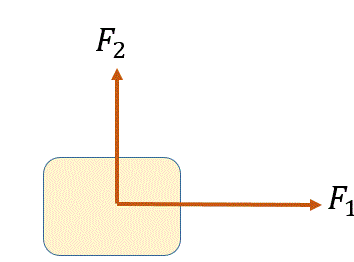
صندوق تم التأثير علية بقوتين \[F_1=50 N\] نحو الشرق \[F_2=30 N\] نحو الشمال فإن محصلة القوى المؤثرة على الصندوق تعادل
متجهين مقدار كل منهما هو طول المتجه واتجاه كل منهما موضح في الشكل أدناه أحد الإجابات التالية تعبر بشكل صحيح عن محصلة المتجهين

يتحرك أحمد نحو الغرب مسافة \[60\;m\] ثم غير اتجاهه وتحرك مسافة قدرها \[80\;m\] نحو الجنوب فإن محصلة الازاحتين تعادل

يتحرك ماجد نحو الشرق مسافة \[50\;m\] غير اتجاهه وتحرك نحو الجنوب مسافة \[40\;m\] أوجد محصلة الإزاحة

من خلال الشكل أدناه لدينا إزاحتين \[\vec A=3 m , \vec B=5 m\] ويصنع المتجه \[B\] مع المحور \[X\] الموجب زاوية قدرها \[\theta=53.1^\circ\] أوجد محصلة الإزاحة \[\vec R=\vec A +\vec B\] وحدد الزاوية بين المحصلة والمتجه \[\vec A\]

متجه قوة \[F=60 N\] ويصنع المتجه زاوية قدرها \[\theta=30^\circ\] جنوب الغرب فإن مركبتي القوة على المحاور المتعامدة تعادل

ثلاث متجهات كما في الشكل احد العبارات التالية صحيحة

ثلاث متجهات كما في الشكل احد العبارات التالية صحيحة

مثلث متجهات كما في الشكل قيم المتجهات موضحة على الشكل أدناه فان الزاوية \[\theta = ?\] تعادل

يتم تحليل متجه إلى مركبتين كما في الشكل أدناه فكانت قيم المركبات \[A_X=6 , A_Y=5\] فإن مقدار المتجه يعادل

أربع متجهات \[\vec A,\vec B,\vec C,\vec D\] موجودة على الشبكة أدناه أحد المتجهات عند تحليلها مركبتها الرأسية على المحور \[Y\] معدومة

اثرت قوتين على جسم مركبات كل قوة موضحه في الشكل أدناه باستخدام الشكل فإن محصلة القوتين واتجاه المحصلة تعادل

قوتين مقدار كل منهما \[50\;N\] أثرت على صندوق بطرق مختلفة رتب مقدار محصلة القوة الناتجة من الأصغر إلى الأكبر

انطلق طالب من المدرسة باتجاه الشرق وقطع مسافة قدرها \[120\;m\] ثم غير اتجاهه وانحرف بزاوية قدرها 40 درجة شمال الشرق وقطع مسافة قدرها \[90\;m\] حتى وصل إلى المنزل فإن الازاحة المقطوعة تعادل

مكعب خشبي كتلته \[30 kg\] وضع على مستوى أفقي خشن أثرت به قوة تميل فوق الأفق بزاوية قدرها 30 درجة ومقدارها 400 نيوتن فإن قيمة القوة المتعامدة تعادل

في الشكل أدناه جسم وضع على مستوى أفقي خشن أثرت علية قوة شد مقداها 20 نيوتن تميل فوق الأفق بزاوية 30 درجة فتحرك الجسم فإن محصلة القوى على المحور \[X\] تعادل

في الشكل أدناه جسم وزنه 26 نيوتن وضع على مستوى أفقي خشن أثرت علية قوة شد مقدارها 20 نيوتن تميل فوق الأفق بزاوية 30 درجة فإذا كانت قوة الإحتكاك الحركي 10 نيوتن فإن معامل الاحتكاك الحركي يعادل

ثلاث قوى متلاقية أثرت على جسم كما في الشكل أدناه فإن محصلة القوى على المحور الأفقي وعلى المحور الرأسي تعادل

جسم وضع على قمة مستوى مائل أملس يميل على الأفق بزاوية 20 درجة فإن التسارع الذي يتحرك به الجسم يعادل

📝 حل المسائل التالية (مقالي)
في الشكل أدناه جسم كتلته 2.65 كيلو جرام وضع على مستوى أفقي خشن أثرت علية قوة شد مقداها 20 نيوتن اتجاهها نحو اليمين تميل فوق الأفق بزاوية 30 درجة فتحرك الجسم فإذا كان معامل الاحتكاك الحركي 0.625
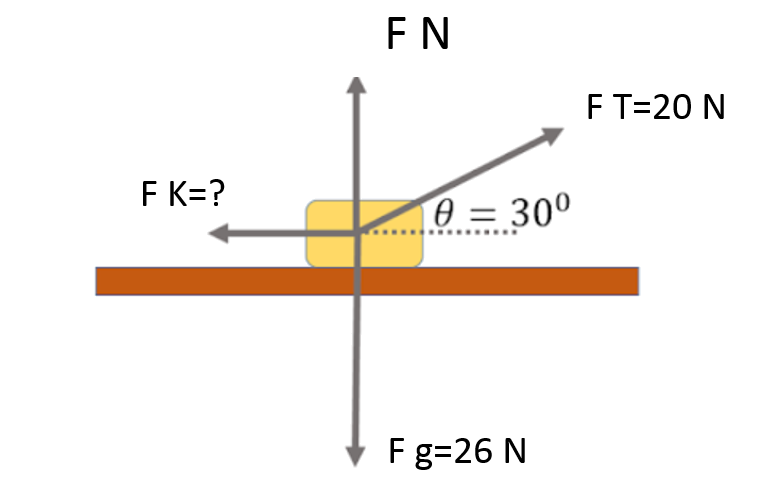
حدد على الشكل القوى المؤثرة على الجسم
\[.........................................\]
\[.........................................\]
\[.........................................\]احسب التسارع الذي يتحرك به الجسم
\[.........................................\;\;\;\;\;\;....................................\]
\[.........................................\;\;\;\;\;\;....................................\]
\[.........................................\;\;\;\;\;\;....................................\]
\[.........................................\;\;\;\;\;\;....................................\]🤖 اضغط هنا تظهر طريقة الحل
\[2\star\]في الشبكة المجاورة ثلاث متجهات أبعادها \[\vec A=5,\vec B=2,\vec C=3\] اتجاهها موضح على الشكل

حلل كل متجه إلى مركبتين
\[.....................................\;\;\;\;............................................\]
\[.....................................\;\;\;\;............................................\]
\[.....................................\;\;\;\;............................................\]احسب مقدار واتجاه \[\vec R=\vec A+\vec B+\vec C\]
\[.....................................\;\;\;\;............................................\]
\[.....................................\;\;\;\;............................................\]
\[.....................................\;\;\;\;............................................\]
\[.....................................\;\;\;\;............................................\]باستخدام المسطرة أوجد \[\vec R=\vec A+\vec B+\vec C\] بالرسم على الشبكة السابقة
🤖 اضغط هنا تظهر طريقة الحل
\[3\star\]ثلاث قوى متلاقية أثرت على جسم كما في الشكل أدناه أثرت على جسم فأصبح الجسم في حالة اتزان

حدد مقدار واتجاه القوة \[\vec F_2 = ?\]
\[.....................................\;\;\;\;............................................\]
\[.....................................\;\;\;\;............................................\]
\[.....................................\;\;\;\;............................................\]
\[.....................................\;\;\;\;............................................\]
\[.....................................\;\;\;\;............................................\]🤖 اضغط هنا تظهر طريقة الحل
📚 Vectors Question Bank 📚
Vector Quantities · Vector Addition · Vector Resolution
\[1 \star\]Which of the following physical quantities is a scalar quantity?
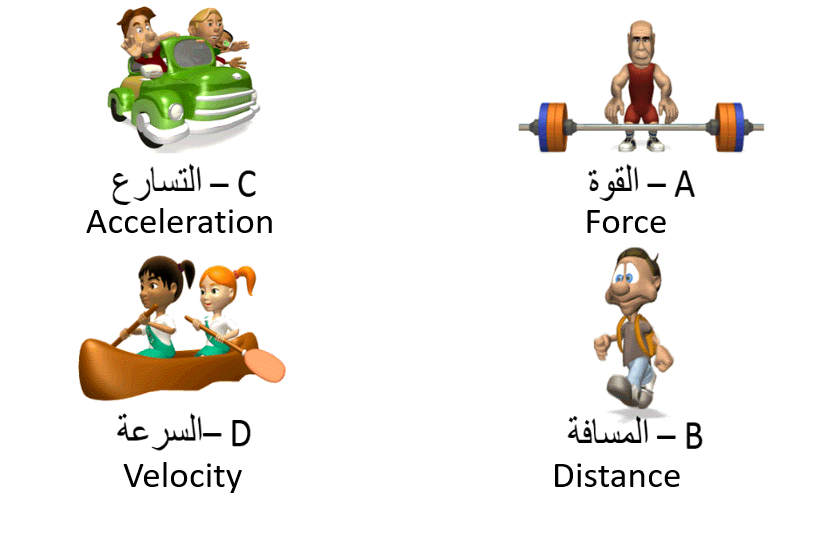
Force is considered a vector quantity and is determined by knowing:
In the grid below, a set of vectors with real magnitudes are shown. Which of the following statements is correct?
Four vectors \[\vec A,\vec B,\vec C,\vec D\] with magnitudes and directions shown below. Which of the following methods correctly shows the resultant vector \[\vec A+\vec B+\vec C+\vec D = ?\]
A box is acted upon by two forces \[F_1=50 N\] east and \[F_2=30 N\] north. The resultant force on the box is:
Two vectors, each with magnitude equal to its length and direction shown below. Which answer correctly represents the resultant of the two vectors?
Ahmed moves 60 m west, then changes direction and moves 80 m south. The resultant displacement is:
Majed moves 50 m east, then changes direction and moves 40 m south. The resultant displacement is:
From the figure below, we have two displacements \[\vec A=3 m , \vec B=5 m\] and vector B makes an angle \[\theta=53.1^\circ\] with the positive X-axis. Find the resultant displacement \[\vec R=\vec A +\vec B\] and the angle between the resultant and \[\vec A\].
A force vector \[F=60 N\] makes an angle \[\theta=30^\circ\] south of west. The components of the force on the perpendicular axes are:
Three vectors are shown in the figure. Which of the following statements is correct?
Three vectors are shown in the figure. Which of the following statements is correct?
In the vector triangle shown below with magnitudes labeled, the angle \[\theta = ?\] is:
A vector is resolved into two components as shown below. If the component values are \[A_X=6 , A_Y=5\], the magnitude of the vector is:
Four vectors \[\vec A,\vec B,\vec C,\vec D\] are shown on the grid below. Which vector has zero vertical component on the Y-axis when resolved?
Two forces act on a body with components shown in the figure below. The resultant force and its direction are:
Two forces, each of magnitude \[50\;N\], act on a box in different ways. Arrange the magnitudes of the resultant force from smallest to largest:
A student starts from school moving east for a distance of \[120\;m\], then changes direction and turns 40° north of east for a distance of \[90\;m\] until reaching home. The displacement is:
A wooden block of mass \[30 kg\] is placed on a rough horizontal surface. A force of 400 N is applied at an angle of 30° above the horizontal. The normal force is:
In the figure below, a body is placed on a rough horizontal surface. A tension force of 20 N is applied at an angle of 30° above the horizontal, causing the body to move. The resultant force on the X-axis is:
In the figure below, a body weighing 26 N is placed on a rough horizontal surface. A tension force of 20 N is applied at an angle of 30° above the horizontal. If the kinetic friction force is 10 N, the coefficient of kinetic friction is:
Three concurrent forces act on a body as shown below. The resultant force on the horizontal and vertical axes are:
A body is placed at the top of a smooth inclined plane making an angle of 20° with the horizontal. The acceleration of the body is:
📝 Solve the following problems (Essay)
In the figure below, a body of mass 2.65 kg is placed on a rough horizontal surface. A force of 20 N is applied to the right, inclined at 30° above the horizontal. The coefficient of kinetic friction is 0.625.
Identify all forces acting on the body in the diagram.
\[.........................................\]
\[.........................................\]
\[.........................................\]Calculate the acceleration of the body.
\[.........................................\;\;\;\;\;\;....................................\]
\[.........................................\;\;\;\;\;\;....................................\]
\[.........................................\;\;\;\;\;\;....................................\]
\[.........................................\;\;\;\;\;\;....................................\]🤖 Click here for the solution
\[2\star\]In the grid below, three vectors have magnitudes \[\vec A=5,\vec B=2,\vec C=3\] with directions shown.
Resolve each vector into its components.
\[.....................................\;\;\;\;............................................\]
\[.....................................\;\;\;\;............................................\]
\[.....................................\;\;\;\;............................................\]Calculate the magnitude and direction of \[\vec R=\vec A+\vec B+\vec C\]
\[.....................................\;\;\;\;............................................\]
\[.....................................\;\;\;\;............................................\]
\[.....................................\;\;\;\;............................................\]
\[.....................................\;\;\;\;............................................\]Using a ruler, draw \[\vec R=\vec A+\vec B+\vec C\] on the grid above.
🤖 Click here for the solution
\[3\star\]Three concurrent forces act on a body as shown below, and the body is in equilibrium.
Determine the magnitude and direction of \[\vec F_2 = ?\]
\[.....................................\;\;\;\;............................................\]
\[.....................................\;\;\;\;............................................\]
\[.....................................\;\;\;\;............................................\]
\[.....................................\;\;\;\;............................................\]
\[.....................................\;\;\;\;............................................\]🤖 Click here for the solution
📚 بنك الأسئلة - المتجهات 📚
الكميات المتجهة · جمع المتجهات · تحليل المتجهات

القوة تعتبر من الكميات الفيزيائية المتجهه وتتحدد بمعرفة

في الشبكة أدناه مجموعة من المتجهات أبعادها حقيقية أحد العبارات التالية صحيحة

أربع متجهات \[\vec A,\vec B,\vec C,\vec D\] مقاديرها واتجاهها موضحة في الشكل أدناه أي من الطرق التالية تبين محصلة المتجهات بالرسم \[\vec A+\vec B+\vec C+\vec D = ?\]

صندوق تم التأثير علية بقوتين \[F_1=50 N\] نحو الشرق \[F_2=30 N\] نحو الشمال فإن محصلة القوى المؤثرة على الصندوق تعادل

متجهين مقدار كل منهما هو طول المتجه واتجاه كل منهما موضح في الشكل أدناه أحد الإجابات التالية تعبر بشكل صحيح عن محصلة المتجهين

يتحرك أحمد نحو الغرب مسافة \[60\;m\] ثم غير اتجاهه وتحرك مسافة قدرها \[80\;m\] نحو الجنوب فإن محصلة الازاحتين تعادل

يتحرك ماجد نحو الشرق مسافة \[50\;m\] غير اتجاهه وتحرك نحو الجنوب مسافة \[40\;m\] أوجد محصلة الإزاحة
من خلال الشكل أدناه لدينا إزاحتين \[\vec A=3 m , \vec B=5 m\] ويصنع المتجه \[B\] مع المحور \[X\] الموجب زاوية قدرها \[\theta=53.1^\circ\] أوجد محصلة الإزاحة \[\vec R=\vec A +\vec B\] وحدد الزاوية بين المحصلة والمتجه \[\vec A\]

متجه قوة \[F=60 N\] ويصنع المتجه زاوية قدرها \[\theta=30^\circ\] جنوب الغرب فإن مركبتي القوة على المحاور المتعامدة تعادل

ثلاث متجهات كما في الشكل احد العبارات التالية صحيحة

ثلاث متجهات كما في الشكل احد العبارات التالية صحيحة


مثلث متجهات كما في الشكل قيم المتجهات موضحة على الشكل أدناه فان الزاوية \[\theta = ?\] تعادل

يتم تحليل متجه إلى مركبتين كما في الشكل أدناه فكانت قيم المركبات \[A_X=6 , A_Y=5\] فإن مقدار المتجه يعادل

أربع متجهات \[\vec A,\vec B,\vec C,\vec D\] موجودة على الشبكة أدناه أحد المتجهات عند تحليلها مركبتها الرأسية على المحور \[Y\] معدومة

اثرت قوتين على جسم مركبات كل قوة موضحه في الشكل أدناه باستخدام الشكل فإن محصلة القوتين واتجاه المحصلة تعادل

قوتين مقدار كل منهما \[50\;N\] أثرت على صندوق بطرق مختلفة رتب مقدار محصلة القوة الناتجة من الأصغر إلى الأكبر

انطلق طالب من المدرسة باتجاه الشرق وقطع مسافة قدرها \[120\;m\] ثم غير اتجاهه وانحرف بزاوية قدرها 40 درجة شمال الشرق وقطع مسافة قدرها \[90\;m\] حتى وصل إلى المنزل فإن الازاحة المقطوعة تعادل

مكعب خشبي كتلته \[30 kg\] وضع على مستوى أفقي خشن أثرت به قوة تميل فوق الأفق بزاوية قدرها 30 درجة ومقدارها 400 نيوتن فإن قيمة القوة المتعامدة تعادل

في الشكل أدناه جسم وضع على مستوى أفقي خشن أثرت علية قوة شد مقداها 20 نيوتن تميل فوق الأفق بزاوية 30 درجة فتحرك الجسم فإن محصلة القوى على المحور \[X\] تعادل

في الشكل أدناه جسم وزنه 26 نيوتن وضع على مستوى أفقي خشن أثرت علية قوة شد مقدارها 20 نيوتن تميل فوق الأفق بزاوية 30 درجة فإذا كانت قوة الإحتكاك الحركي 10 نيوتن فإن معامل الاحتكاك الحركي يعادل

ثلاث قوى متلاقية أثرت على جسم كما في الشكل أدناه فإن محصلة القوى على المحور الأفقي وعلى المحور الرأسي تعادل

جسم وضع على قمة مستوى مائل أملس يميل على الأفق بزاوية 20 درجة فإن التسارع الذي يتحرك به الجسم يعادل
📝 حل المسائل التالية (مقالي)
في الشكل أدناه جسم كتلته 2.65 كيلو جرام وضع على مستوى أفقي خشن أثرت علية قوة شد مقداها 20 نيوتن اتجاهها نحو اليمين تميل فوق الأفق بزاوية 30 درجة فتحرك الجسم فإذا كان معامل الاحتكاك الحركي 0.625
حدد على الشكل القوى المؤثرة على الجسم
\[.........................................\]
\[.........................................\]
احسب التسارع الذي يتحرك به الجسم
\[.........................................\;\;\;\;\;\;....................................\]
\[.........................................\;\;\;\;\;\;....................................\]
\[.........................................\;\;\;\;\;\;....................................\]

في الشبكة المجاورة ثلاث متجهات أبعادها \[\vec A=5,\vec B=2,\vec C=3\] اتجاهها موضح على الشكل
حلل كل متجه إلى مركبتين
\[.....................................\;\;\;\;............................................\]
\[.....................................\;\;\;\;............................................\]
احسب مقدار واتجاه \[\vec R=\vec A+\vec B+\vec C\]
\[.....................................\;\;\;\;............................................\]
\[.....................................\;\;\;\;............................................\]
\[.....................................\;\;\;\;............................................\]
باستخدام المسطرة أوجد \[\vec R=\vec A+\vec B+\vec C\] بالرسم على الشبكة السابقة

ثلاث قوى متلاقية أثرت على جسم كما في الشكل أدناه أثرت على جسم فأصبح الجسم في حالة اتزان
حدد مقدار واتجاه القوة \[\vec F_2 = ?\]
\[.....................................\;\;\;\;............................................\]
\[.....................................\;\;\;\;............................................\]
\[.....................................\;\;\;\;............................................\]
\[.....................................\;\;\;\;............................................\]

📚 Vectors Question Bank 📚
Vector Quantities · Vector Addition · Vector Resolution
Which of the following physical quantities is a scalar quantity?
Force is considered a vector quantity and is determined by knowing:
In the grid below, a set of vectors with real magnitudes are shown. Which of the following statements is correct?
Four vectors \[\vec A,\vec B,\vec C,\vec D\] with magnitudes and directions shown below. Which of the following methods correctly shows the resultant vector \[\vec A+\vec B+\vec C+\vec D = ?\]
A box is acted upon by two forces \[F_1=50 N\] east and \[F_2=30 N\] north. The resultant force on the box is:
Two vectors, each with magnitude equal to its length and direction shown below. Which answer correctly represents the resultant of the two vectors?
Ahmed moves 60 m west, then changes direction and moves 80 m south. The resultant displacement is:
Majed moves 50 m east, then changes direction and moves 40 m south. The resultant displacement is:
From the figure below, we have two displacements \[\vec A=3 m , \vec B=5 m\] and vector B makes an angle \[\theta=53.1^\circ\] with the positive X-axis. Find the resultant displacement \[\vec R=\vec A +\vec B\] and the angle between the resultant and \[\vec A\].
A force vector \[F=60 N\] makes an angle \[\theta=30^\circ\] south of west. The components of the force on the perpendicular axes are:
Three vectors are shown in the figure. Which of the following statements is correct?
Three vectors are shown in the figure. Which of the following statements is correct?
In the vector triangle shown below with magnitudes labeled, the angle \[\theta = ?\] is:
A vector is resolved into two components as shown below. If the component values are \[A_X=6 , A_Y=5\], the magnitude of the vector is:
Four vectors \[\vec A,\vec B,\vec C,\vec D\] are shown on the grid below. Which vector has zero vertical component on the Y-axis when resolved?
Two forces act on a body with components shown in the figure below. The resultant force and its direction are:
Two forces, each of magnitude \[50\;N\], act on a box in different ways. Arrange the magnitudes of the resultant force from smallest to largest:
A student starts from school moving east for a distance of \[120\;m\], then changes direction and turns 40° north of east for a distance of \[90\;m\] until reaching home. The displacement is:
A wooden block of mass \[30 kg\] is placed on a rough horizontal surface. A force of 400 N is applied at an angle of 30° above the horizontal. The normal force is:
In the figure below, a body is placed on a rough horizontal surface. A tension force of 20 N is applied at an angle of 30° above the horizontal, causing the body to move. The resultant force on the X-axis is:
In the figure below, a body weighing 26 N is placed on a rough horizontal surface. A tension force of 20 N is applied at an angle of 30° above the horizontal. If the kinetic friction force is 10 N, the coefficient of kinetic friction is:
Three concurrent forces act on a body as shown below. The resultant force on the horizontal and vertical axes are:
A body is placed at the top of a smooth inclined plane making an angle of 20° with the horizontal. The acceleration of the body is:
📝 Solve the following problems (Essay)
In the figure below, a body of mass 2.65 kg is placed on a rough horizontal surface. A force of 20 N is applied to the right, inclined at 30° above the horizontal. The coefficient of kinetic friction is 0.625.
Identify all forces acting on the body in the diagram.
\[.........................................\]
\[.........................................\]
Calculate the acceleration of the body.
\[.........................................\;\;\;\;\;\;....................................\]
\[.........................................\;\;\;\;\;\;....................................\]
\[.........................................\;\;\;\;\;\;....................................\]
In the grid below, three vectors have magnitudes \[\vec A=5,\vec B=2,\vec C=3\] with directions shown.
Resolve each vector into its components.
\[.....................................\;\;\;\;............................................\]
\[.....................................\;\;\;\;............................................\]
Calculate the magnitude and direction of \[\vec R=\vec A+\vec B+\vec C\]
\[.....................................\;\;\;\;............................................\]
\[.....................................\;\;\;\;............................................\]
\[.....................................\;\;\;\;............................................\]
Using a ruler, draw \[\vec R=\vec A+\vec B+\vec C\] on the grid above.
Three concurrent forces act on a body as shown below, and the body is in equilibrium.
Determine the magnitude and direction of \[\vec F_2 = ?\]
\[.....................................\;\;\;\;............................................\]
\[.....................................\;\;\;\;............................................\]
\[.....................................\;\;\;\;............................................\]
\[.....................................\;\;\;\;............................................\]
No comments:
Post a Comment