 Physics
📄 اطبع pdf
00971504825082
بنك الاسئلة (الشغل والطاقة الحركية )
Question bank of work and kinetic energy

📄 اطبع pdf
00971504825082
\[1 \star\]
ما مقدار الشغل المبذول عند تطبيق قوة مقدارها 10 نيوتن لتحريك صندوق بمقدار 4 أمتار بإتجاه القوة؟

اختر الإجابة الصحيحة
A\[ W=60\;\; J\]
B\[ W=40\;\; J\]
C\[ W=20\;\; J\]
D\[ W=80\;\; J\]
 اضغط هنا تظهر طريقة الحل
\[2 \star\]
ما مقدار الشغل المبذول عند تطبيق قوة مقدارها 60 نيوتن تميل بزاوية 35 درجة فوق الأفق لتحريك صندوق بمقدار 10 أمتار؟
اضغط هنا تظهر طريقة الحل
\[2 \star\]
ما مقدار الشغل المبذول عند تطبيق قوة مقدارها 60 نيوتن تميل بزاوية 35 درجة فوق الأفق لتحريك صندوق بمقدار 10 أمتار؟

اختر الإجابة الصحيحة
A\[ W=520.3\;\; J\]
B\[ W=312.8\;\; J\]
C\[ W=491.5\;\; J\]
D\[ W=615.6\;\; J\]
اضغط هنا تظهر طريقة الحل
\[3 \star\]
جسم كتلته \[3\;Kg\] وضع على مستوى مائل يميل على الأفق بزاوية \[𝜃=20^0\] كما في الشكل فتم انزلاق الجسم نحو الأسفل مسافة \[4\;m\] فإن شغل قوة الوزن تعادل

اختر الإجابة الصحيحة
A\[ W=110.5\;\; J\]
B\[ W=11.2\;\; J\]
C\[ W=40.2\;\; J\]
D\[ W=4.1\;\; J\]
اضغط هنا تظهر طريقة الحل
\[4 \star\]
مكعب خشبي وضع عند قاعدة مستوى مائل خشن يميل على الأفق بزاوية قدرها \[ 𝜃\] وتم سحب المكعب بقوة موازية للسطح المائل باتجاه قمة المستوى أحد القوى التالية شغلها معدوم

اختر الإجابة الصحيحة
A\[ W_{Fa}=0\]
B\[ W_{Fg}=0\]
C\[ W_{FN}=0\]
D\[ W_{Fk}=0\]
اضغط هنا تظهر طريقة الحل
\[5 \star\]
وضع صندوق كتلته \[10\;kg\] على سطح مستوى أفقي خشن وتم ربط الصندوق بحبل وتم سحبة بقوة ثابته مقدارها \[50\;N\] تميل فوق الأفق بزاوية \[𝜃=25^0\] من قبل طالبة فتم تحريك الصندوق مسافة \[d=8 m \] كما في الشكل أدناه فإذا كانت قوة الاحتكاك بين الصندوق والمستوى تعادل \[F_K=15\;N\] فإن الشغل الكلي المبذول على الصندوق تعادل

اختر الإجابة الصحيحة
A\[ W_{tot}=482.5\;\; J\]
B\[ W_{tot}=242.5\;\; J\]
C\[ W_{tot}=385.5\;\; J\]
D\[ W_{tot}=255.5\;\; J\]
اضغط هنا تظهر طريقة الحل
\[6 \star\]
أثرت قوة متغيرة على سيارة تتحرك على مستوى أفقي وتم رصد تغير القوة والازاحة وكتابتها بالجدول أدناه وعند رسم العلاقة بين القوة والازاحة فإن الشغل المبذول على الجسم يعادل


اختر الإجابة الصحيحة
A\[ W=20\;\; J\]
B\[ W=80\;\; J \]
C\[ W=40\;\; J \]
D\[ W=160\;\; J \]
اضغط هنا تظهر طريقة الحل
\[7 \star \star\]
الخط البياني أدناه يبين العلاقة بين القوة والازاحة لجسم متأثر بقوة متغيرة فإن الشغل المبذول من القوة يعادل

اختر الإجابة الصحيحة
A\[ W=9\;\; J\]
B\[ W=-6\;\; J \]
C\[ W=6\;\; J \]
D\[ W=3\;\; J \]
اضغط هنا تظهر طريقة الحل
\[8\star\]
أحد الخطوط البيانية لا يمكن أن تمثل العلاقة بين الطاقة الحركية لجسم والزمن

اختر الإجابة الصحيحة
Aالرسم البياني A
Bالرسم البياني B
Cالرسم البياني C
Dالرسم البياني D
اضغط هنا تظهر طريقة الحل
\[9 \star \star\]
أحد وحدات القياس التالية تعادل وحدة الطاقة جول \[J\]
اختر الإجابة الصحيحة
A\[ j=\frac {kg.m^2}{S^2}\]
B\[ j=\frac {kg.m^2}{S }\]
C\[ j=\frac {Kg.m} { s }\]
D\[ j=\frac {kg.m}{S^2} \]
اضغط هنا تظهر طريقة الحل
\[10 \star\]
سيارة طاقتها الحركية \[10\;J\] فإذا زادت سرعة السيارة إلى الضعف فإن طاقته الحركية تصبح

اختر الإجابة الصحيحة
A\[ KE=40 \;\;J\]
B\[ KE=80 \;\;J\]
C\[ KE=60 \;\;J \]
D\[ KE=20 \;\;J\]
اضغط هنا تظهر طريقة الحل
\[11 \star\]
سيارتين لهما نفس الكتلة وسرعة السيارة الأولى ضعف سرعة السيارة الثانية فإن النسبة بين الطاقة الحركية للسيارة الأولى إلى الطاقة الحركية للسيارة الثانية تعادل

اختر الإجابة الصحيحة
A\[\frac {KE_1}{KE_2}=2\]
B\[\frac {KE_1}{KE_2}=6\]
C\[\frac {KE_1}{KE_2}=4\]
D\[\frac {KE_1}{KE_2}=8\]
اضغط هنا تظهر طريقة الحل
\[12 \star\]
سيارة كتلتها \[1500\;Kg\] تتحرك بسرعة \[10\;m/s\] تغيرت سرعتها فأصبحت \[3m/s\] فإن التغير في الطاقة الحركية تعادل

اختر الإجابة الصحيحة
A\[∆KE=25600 \;\;J\]
B\[∆KE=-68250 \;\;J\]
C\[∆KE=-56430 \;\;J\]
D\[∆KE=-34670 \;\;J\]
اضغط هنا تظهر طريقة الحل
\[13 \star\star\]
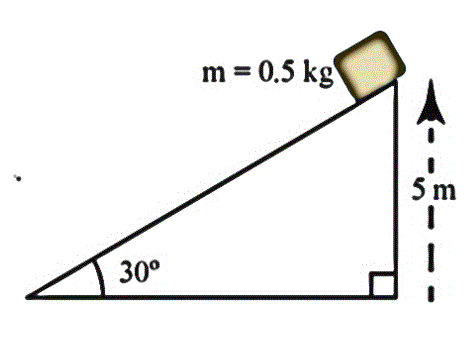
وضع جسم على قمة مستوى مائل أملس يميل على الأفق بزاوية \[𝜃=30^0\] ويرتفع عن سطح الأرض مسافة \[h=5 m\] كما في الشكل أدناه احسب سرعة الجسم عند نهاية المستوى المائل باستخدام نظرية الشغل وعلاقتها بالطاقة الحركية
اختر الإجابة الصحيحة
A\[𝑣𝑓=9.9\;\; 𝑚/𝑠\]
B\[𝑣𝑓=6.4\;\; 𝑚/𝑠\]
C\[𝑣𝑓=12.3\;\; 𝑚/𝑠\]
D\[𝑣𝑓=7.8\;\; 𝑚/𝑠\]
اضغط هنا تظهر طريقة الحل
\[14 \star\]
عربة كتلتها \[10\;kg\] تتحرك أفقيا بسرعة ابتدائية \[5\;m/s\] يتم تطبيق قوة \[30\;N\] على العربة بسحب المقبض الصلب الذي يميل بزاوية 60 درجة فوق الأفق. تستمر العربة في التحرك أفقيًا لمسافة 20 مترًا أخرى. بفرض عدم وجود احتكاك فإن سرعة العربة بعد قطع كامل المسافة

اختر الإجابة الصحيحة
A\[𝑣𝑓=14.3\;\; 𝑚/𝑠\]
B\[𝑣𝑓=6.8\;\; 𝑚/𝑠\]
C\[𝑣𝑓=11.4\;\; 𝑚/𝑠\]
D\[𝑣𝑓=9.2\;\; 𝑚/𝑠\]
اضغط هنا تظهر طريقة الحل
\[15 \star\]
جسم كتلته \[3\;kg\] أثرت علية قوة متغيرة الرسم البياني يبين كيف تتغير العجلة للجسم مع الإزاحة المقطوعة فإن الشغل المنجز على الجسم يعادل

اختر الإجابة الصحيحة
A\[W =300 \;\;J\]
B\[W =900 \;\;J\]
C\[W =1200 \;\;J\]
D\[W =1500 \;\;J\]
اضغط هنا تظهر طريقة الحل
\[16 \star \star \star\]
طالب كتلته 50 كيلو جرام. يستغرق 40 ثانية لتسلق درج بارتفاع 18 مترًا. فإن مقدار القدرة التي استهلكها

اختر الإجابة الصحيحة
A\[P=187.4 \;\;Watt\]
B\[P=115.9 \;\;Watt\]
C\[P=220.7 \;\;Watt\]
D\[P=330.1 \;\;Watt\]
اضغط هنا تظهر طريقة الحل
\[17\star\]
صندوق وزنه 40 نيوتن يتم رفعة بسرعة ثابتة مقدارها
\[3 m/s\] ما هي القدرة المطلوبة لإنجاز هذا العمل

اختر الإجابة الصحيحة
A\[P=43 \;\;Watt\]
B\[P=13.3 \;\;Watt\]
C\[P=120 \;\;Watt\]
D\[P=60 \;\;Watt\]
اضغط هنا تظهر طريقة الحل
\[18 \star\]
في تدريب رياضي على التسلق طالب وزنه 700 نيوتن تسلق حبل لمسافة 10 متر فاستهلك طاقة قدرها
\[2.5 hp \]فإن الزمن الذي اتم به هذا التسلق

اختر الإجابة الصحيحة
A\[t=3.75 \;\;S\]
B\[t=4.25 \;\;S\]
C\[t=2.5 \;\;S\]
D\[t=5.25 \;\;S\]
اضغط هنا تظهر طريقة الحل
\[19 \star \star \star\]
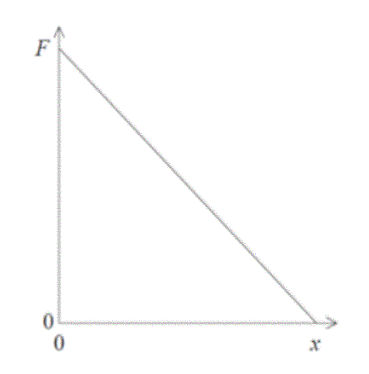
يوضح الرسم البياني العلاقة بين القوة والإزاحة لجسم أحد العبارات التالية تعبر عن التسارع وتغير الطاقة الحركية
اختر الإجابة الصحيحة
Aيقل التسارع - يقل التغير في الطاقة الحركية
Bيزداد التسارع - يقل التغير في الطاقة الحركية
Cيزداد التسارع - يزداد التغير في الطاقة الحركية
Dيقل التسارع - يزداد التغير في الطاقة الحركية
اضغط هنا تظهر طريقة الحل
📝 حل المسائل التالية
افترض أن صندوق كتلته \[m=20\;kg\] على حزام ناقل يتحرك بسرعة \[v=3\;\;m/s\]
 \[............................................\;\;\;\;............................................\]
\[............................................\;\;\;\;............................................\]
افترض أنك تدفع الصندوق بقوة ثابتة أفقية مقدارها \[F_a=100 \;\;N\] نحو اليمين عبر إزاحة قدرها \[d=2\;\;m\] وأن متوسط قوة الاحتكاك المعاكسة يبلغ \[F_K=15\;\;N\]. حدد القوى على الشكل واحسب الشغل الكلي الذي تم إنجازه على الصندوق
\[............................................\;\;\;\;............................................\]
\[............................................\;\;\;\;............................................\]
\[............................................\;\;\;\;............................................\]
\[............................................\;\;\;\;............................................\]
احسب سرعة الصندوق في نهاية الدفع، باستخدام مفهومي الشغل والطاقة
\[............................................\;\;\;\;............................................\]
\[............................................\;\;\;\;............................................\]
\[............................................\;\;\;\;............................................\]
اضغط هنا تظهر طريقة الحل
\[2\star\]
عربة كتلتها \[m=10\;kg\] تتحرك أفقيا بسرعة ابتدائية تبلغ \[v_i=5\;\;m/s\] يتم تطبيق قوة \[F_a=30\;\;N\] على العربة بسحب المقبض الصلب الذي يميل بزاوية 60 درجة فوق الأفق حتى أصبحت سرعتها \[v_f=8\;\;m/s\]

احسب الإزاحة المقطوعة عند وصولها إلى هذه السرعة، بفرض عدم وجود احتكاك.
\[............................................\;\;\;\;............................................\]
\[............................................\;\;\;\;............................................\]
\[............................................\;\;\;\;............................................\]
\[............................................\;\;\;\;............................................\]
\[............................................\;\;\;\;............................................\]
اضغط هنا تظهر طريقة الحل
\[1 \star\]
What is the work done when applying a force of 10 N to move a box 4 meters in the direction of the force?
Choose the correct answer
A\[ W=60\;\; J\]
B\[ W=40\;\; J\]
C\[ W=20\;\; J\]
D\[ W=80\;\; J\]
Click for AI solution
\[2 \star\]
What is the work done when applying a force of 60 N at an angle of 35° above the horizontal to move a box 10 meters?
Choose the correct answer
A\[ W=520.3\;\; J\]
B\[ W=312.8\;\; J\]
C\[ W=491.5\;\; J\]
D\[ W=615.6\;\; J\]
Click for AI solution
\[3 \star\]
An object of mass \[3\;Kg\] is placed on an inclined plane at an angle \[𝜃=20^0\] to the horizontal. The object slides down a distance of \[4\;m\]. What is the work done by the weight force?
Choose the correct answer
A\[ W=110.5\;\; J\]
B\[ W=11.2\;\; J\]
C\[ W=40.2\;\; J\]
D\[ W=4.1\;\; J\]
Click for AI solution
\[4 \star\]
A wooden cube is placed at the base of a rough inclined plane at an angle \[𝜃\] and pulled up the plane by a force parallel to the surface. Which of the following forces does zero work?
Choose the correct answer
A\[ W_{Fa}=0\]
B\[ W_{Fg}=0\]
C\[ W_{FN}=0\]
D\[ W_{Fk}=0\]
Click for AI solution
\[5 \star\]
A box of mass \[10\;kg\] is placed on a rough horizontal surface and pulled by a rope with a constant force of \[50\;N\] at an angle \[𝜃=25^0\] above the horizontal. The box moves a distance of \[d=8 m\]. If the friction force is \[F_K=15\;N\], what is the total work done on the box?
Choose the correct answer
A\[ W_{tot}=482.5\;\; J\]
B\[ W_{tot}=242.5\;\; J\]
C\[ W_{tot}=385.5\;\; J\]
D\[ W_{tot}=255.5\;\; J\]
Click for AI solution
\[6 \star\]
A variable force acts on a car moving on a horizontal surface. The force and displacement data are recorded in the table below. When plotting the force-displacement graph, the work done on the object is:
Choose the correct answer
A\[ W=20\;\; J\]
B\[ W=80\;\; J \]
C\[ W=40\;\; J \]
D\[ W=160\;\; J \]
Click for AI solution
\[7 \star \star\]
The graph below shows the force-displacement relationship for an object acted on by a variable force. The work done by the force is:
Choose the correct answer
A\[ W=9\;\; J\]
B\[ W=-6\;\; J \]
C\[ W=6\;\; J \]
D\[ W=3\;\; J \]
Click for AI solution
\[8\star\]
Which of the following graphs cannot represent the relationship between an object's kinetic energy and time?
Choose the correct answer
AGraph A
BGraph B
CGraph C
DGraph D
Click for AI solution
\[9 \star \star\]
Which of the following units is equivalent to the Joule \[J\] (unit of energy)?
Choose the correct answer
A\[ j=\frac {kg.m^2}{S^2}\]
B\[ j=\frac {kg.m^2}{S }\]
C\[ j=\frac {Kg.m} { s }\]
D\[ j=\frac {kg.m}{S^2} \]
Click for AI solution
\[10 \star\]
A car has kinetic energy \[10\;J\]. If its speed doubles, its kinetic energy becomes:
Choose the correct answer
A\[ KE=40 \;\;J\]
B\[ KE=80 \;\;J\]
C\[ KE=60 \;\;J \]
D\[ KE=20 \;\;J\]
Click for AI solution
\[11 \star\]
Two cars have the same mass, and the speed of the first car is twice that of the second. The ratio of the kinetic energy of the first car to that of the second is:
Choose the correct answer
A\[\frac {KE_1}{KE_2}=2\]
B\[\frac {KE_1}{KE_2}=6\]
C\[\frac {KE_1}{KE_2}=4\]
D\[\frac {KE_1}{KE_2}=8\]
Click for AI solution
\[12 \star\]
A car of mass \[1500\;Kg\] moving at \[10\;m/s\] changes its speed to \[3m/s\]. The change in kinetic energy is:
Choose the correct answer
A\[∆KE=25600 \;\;J\]
B\[∆KE=-68250 \;\;J\]
C\[∆KE=-56430 \;\;J\]
D\[∆KE=-34670 \;\;J\]
Click for AI solution
\[13 \star\star\]
An object is placed at the top of a smooth inclined plane at angle \[𝜃=30^0\] with height \[h=5 m\] above the ground. Calculate the speed at the bottom of the incline using the work-energy theorem.
Choose the correct answer
A\[𝑣𝑓=9.9\;\; 𝑚/𝑠\]
B\[𝑣𝑓=6.4\;\; 𝑚/𝑠\]
C\[𝑣𝑓=12.3\;\; 𝑚/𝑠\]
D\[𝑣𝑓=7.8\;\; 𝑚/𝑠\]
Click for AI solution
\[14 \star\]
A cart of mass \[10\;kg\] moving horizontally at initial speed \[5\;m/s\] has a force of \[30\;N\] applied by pulling a handle at 60° above the horizontal. The cart moves an additional 20 m. Assuming no friction, what is the final speed?
Choose the correct answer
A\[𝑣𝑓=14.3\;\; 𝑚/𝑠\]
B\[𝑣𝑓=6.8\;\; 𝑚/𝑠\]
C\[𝑣𝑓=11.4\;\; 𝑚/𝑠\]
D\[𝑣𝑓=9.2\;\; 𝑚/𝑠\]
Click for AI solution
\[15 \star\]
An object of mass \[3\;kg\] is acted on by a variable force. The graph shows how acceleration changes with displacement. The work done on the object is:
Choose the correct answer
A\[W =300 \;\;J\]
B\[W =900 \;\;J\]
C\[W =1200 \;\;J\]
D\[W =1500 \;\;J\]
Click for AI solution
\[16 \star \star \star\]
A student of mass 50 kg takes 40 seconds to climb stairs of height 18 m. The power consumed is:
Choose the correct answer
A\[P=187.4 \;\;Watt\]
B\[P=115.9 \;\;Watt\]
C\[P=220.7 \;\;Watt\]
D\[P=330.1 \;\;Watt\]
Click for AI solution
\[17\star\]
A box weighing 40 N is lifted at a constant speed of \[3 m/s\] What power is required?
Choose the correct answer
A\[P=43 \;\;Watt\]
B\[P=13.3 \;\;Watt\]
C\[P=120 \;\;Watt\]
D\[P=60 \;\;Watt\]
Click for AI solution
\[18 \star\]
In a climbing training exercise, a student weighing 700 N climbs a rope 10 m, consuming \[2.5 hp \]of power. The time taken to complete the climb is:
Choose the correct answer
A\[t=3.75 \;\;S\]
B\[t=4.25 \;\;S\]
C\[t=2.5 \;\;S\]
D\[t=5.25 \;\;S\]
Click for AI solution
\[19 \star \star \star\]
The graph shows the force-displacement relationship for an object. Which statement correctly describes the acceleration and change in kinetic energy?
Choose the correct answer
AAcceleration decreases - Change in KE decreases
BAcceleration increases - Change in KE decreases
CAcceleration increases - Change in KE increases
DAcceleration decreases - Change in KE increases
Click for AI solution
📝 Solve the following problems
Assume a box of mass \[m=20\;kg\] is on a conveyor belt moving at speed \[v=3\;\;m/s\]
\[............................................\;\;\;\;............................................\]
\[............................................\;\;\;\;............................................\]
Assume you push the box with a constant horizontal force \[F_a=100 \;\;N\] to the right over a displacement of \[d=2\;\;m\], and the average friction force is \[F_K=15\;\;N\]. Identify the forces on the diagram and calculate the total work done on the box.
\[............................................\;\;\;\;............................................\]
\[............................................\;\;\;\;............................................\]
\[............................................\;\;\;\;............................................\]
\[............................................\;\;\;\;............................................\]
Calculate the speed of the box at the end of the push using work and energy concepts.
\[............................................\;\;\;\;............................................\]
\[............................................\;\;\;\;............................................\]
\[............................................\;\;\;\;............................................\]
Click for AI solution
\[2\star\]
A cart of mass \[m=10\;kg\] moves horizontally with initial speed \[v_i=5\;\;m/s\]. A force of \[F_a=30\;\;N\] is applied by pulling the handle at 60° above the horizontal until the speed becomes \[v_f=8\;\;m/s\].
Calculate the displacement traveled when reaching this speed, assuming no friction.
\[............................................\;\;\;\;............................................\]
\[............................................\;\;\;\;............................................\]
\[............................................\;\;\;\;............................................\]
\[............................................\;\;\;\;............................................\]
\[............................................\;\;\;\;............................................\]
Click for AI solution
🧮 Calculator
🗑️
✏️ قلم
بنك الاسئلة (الشغل والطاقة الحركية )
|
📄 اطبع pdf
00971504825082
\[1 \star\]
ما مقدار الشغل المبذول عند تطبيق قوة مقدارها 10 نيوتن لتحريك صندوق بمقدار 4 أمتار بإتجاه القوة؟
اختر الإجابة الصحيحة
A\[ W=60\;\; J\]
B\[ W=40\;\; J\]
C\[ W=20\;\; J\]
D\[ W=80\;\; J\]
اضغط هنا تظهر طريقة الحل
\[2 \star\]
ما مقدار الشغل المبذول عند تطبيق قوة مقدارها 60 نيوتن تميل بزاوية 35 درجة فوق الأفق لتحريك صندوق بمقدار 10 أمتار؟
اختر الإجابة الصحيحة
A\[ W=520.3\;\; J\]
B\[ W=312.8\;\; J\]
C\[ W=491.5\;\; J\]
D\[ W=615.6\;\; J\]
اضغط هنا تظهر طريقة الحل
\[3 \star\]
جسم كتلته \[3\;Kg\] وضع على مستوى مائل يميل على الأفق بزاوية \[𝜃=20^0\] كما في الشكل فتم انزلاق الجسم نحو الأسفل مسافة \[4\;m\] فإن شغل قوة الوزن تعادل
اختر الإجابة الصحيحة
A\[ W=110.5\;\; J\]
B\[ W=11.2\;\; J\]
C\[ W=40.2\;\; J\]
D\[ W=4.1\;\; J\]
اضغط هنا تظهر طريقة الحل
\[4 \star\]
مكعب خشبي وضع عند قاعدة مستوى مائل خشن يميل على الأفق بزاوية قدرها \[ 𝜃\] وتم سحب المكعب بقوة موازية للسطح المائل باتجاه قمة المستوى أحد القوى التالية شغلها معدوم
اختر الإجابة الصحيحة
A\[ W_{Fa}=0\]
B\[ W_{Fg}=0\]
C\[ W_{FN}=0\]
D\[ W_{Fk}=0\]
اضغط هنا تظهر طريقة الحل
\[5 \star\]
وضع صندوق كتلته \[10\;kg\] على سطح مستوى أفقي خشن وتم ربط الصندوق بحبل وتم سحبة بقوة ثابته مقدارها \[50\;N\] تميل فوق الأفق بزاوية \[𝜃=25^0\] من قبل طالبة فتم تحريك الصندوق مسافة \[d=8 m \] كما في الشكل أدناه فإذا كانت قوة الاحتكاك بين الصندوق والمستوى تعادل \[F_K=15\;N\] فإن الشغل الكلي المبذول على الصندوق تعادل
اختر الإجابة الصحيحة
A\[ W_{tot}=482.5\;\; J\]
B\[ W_{tot}=242.5\;\; J\]
C\[ W_{tot}=385.5\;\; J\]
D\[ W_{tot}=255.5\;\; J\]
اضغط هنا تظهر طريقة الحل
\[6 \star\]
أثرت قوة متغيرة على سيارة تتحرك على مستوى أفقي وتم رصد تغير القوة والازاحة وكتابتها بالجدول أدناه وعند رسم العلاقة بين القوة والازاحة فإن الشغل المبذول على الجسم يعادل
اختر الإجابة الصحيحة
A\[ W=20\;\; J\]
B\[ W=80\;\; J \]
C\[ W=40\;\; J \]
D\[ W=160\;\; J \]
اضغط هنا تظهر طريقة الحل
\[7 \star \star\]
الخط البياني أدناه يبين العلاقة بين القوة والازاحة لجسم متأثر بقوة متغيرة فإن الشغل المبذول من القوة يعادل
اختر الإجابة الصحيحة
A\[ W=9\;\; J\]
B\[ W=-6\;\; J \]
C\[ W=6\;\; J \]
D\[ W=3\;\; J \]
اضغط هنا تظهر طريقة الحل
\[8\star\]
أحد الخطوط البيانية لا يمكن أن تمثل العلاقة بين الطاقة الحركية لجسم والزمن
اختر الإجابة الصحيحة
Aالرسم البياني A
Bالرسم البياني B
Cالرسم البياني C
Dالرسم البياني D
اضغط هنا تظهر طريقة الحل
\[9 \star \star\]
أحد وحدات القياس التالية تعادل وحدة الطاقة جول \[J\]
اختر الإجابة الصحيحة
A\[ j=\frac {kg.m^2}{S^2}\]
B\[ j=\frac {kg.m^2}{S }\]
C\[ j=\frac {Kg.m} { s }\]
D\[ j=\frac {kg.m}{S^2} \]
اضغط هنا تظهر طريقة الحل
\[10 \star\]
سيارة طاقتها الحركية \[10\;J\] فإذا زادت سرعة السيارة إلى الضعف فإن طاقته الحركية تصبح
اختر الإجابة الصحيحة
A\[ KE=40 \;\;J\]
B\[ KE=80 \;\;J\]
C\[ KE=60 \;\;J \]
D\[ KE=20 \;\;J\]
اضغط هنا تظهر طريقة الحل
\[11 \star\]
سيارتين لهما نفس الكتلة وسرعة السيارة الأولى ضعف سرعة السيارة الثانية فإن النسبة بين الطاقة الحركية للسيارة الأولى إلى الطاقة الحركية للسيارة الثانية تعادل
اختر الإجابة الصحيحة
A\[\frac {KE_1}{KE_2}=2\]
B\[\frac {KE_1}{KE_2}=6\]
C\[\frac {KE_1}{KE_2}=4\]
D\[\frac {KE_1}{KE_2}=8\]
اضغط هنا تظهر طريقة الحل
\[12 \star\]
سيارة كتلتها \[1500\;Kg\] تتحرك بسرعة \[10\;m/s\] تغيرت سرعتها فأصبحت \[3m/s\] فإن التغير في الطاقة الحركية تعادل
اختر الإجابة الصحيحة
A\[∆KE=25600 \;\;J\]
B\[∆KE=-68250 \;\;J\]
C\[∆KE=-56430 \;\;J\]
D\[∆KE=-34670 \;\;J\]
اضغط هنا تظهر طريقة الحل
\[13 \star\star\]
وضع جسم على قمة مستوى مائل أملس يميل على الأفق بزاوية \[𝜃=30^0\] ويرتفع عن سطح الأرض مسافة \[h=5 m\] كما في الشكل أدناه احسب سرعة الجسم عند نهاية المستوى المائل باستخدام نظرية الشغل وعلاقتها بالطاقة الحركية
اختر الإجابة الصحيحة
A\[𝑣𝑓=9.9\;\; 𝑚/𝑠\]
B\[𝑣𝑓=6.4\;\; 𝑚/𝑠\]
C\[𝑣𝑓=12.3\;\; 𝑚/𝑠\]
D\[𝑣𝑓=7.8\;\; 𝑚/𝑠\]
اضغط هنا تظهر طريقة الحل
\[14 \star\]
عربة كتلتها \[10\;kg\] تتحرك أفقيا بسرعة ابتدائية \[5\;m/s\] يتم تطبيق قوة \[30\;N\] على العربة بسحب المقبض الصلب الذي يميل بزاوية 60 درجة فوق الأفق. تستمر العربة في التحرك أفقيًا لمسافة 20 مترًا أخرى. بفرض عدم وجود احتكاك فإن سرعة العربة بعد قطع كامل المسافة
اختر الإجابة الصحيحة
A\[𝑣𝑓=14.3\;\; 𝑚/𝑠\]
B\[𝑣𝑓=6.8\;\; 𝑚/𝑠\]
C\[𝑣𝑓=11.4\;\; 𝑚/𝑠\]
D\[𝑣𝑓=9.2\;\; 𝑚/𝑠\]
اضغط هنا تظهر طريقة الحل
\[15 \star\]
جسم كتلته \[3\;kg\] أثرت علية قوة متغيرة الرسم البياني يبين كيف تتغير العجلة للجسم مع الإزاحة المقطوعة فإن الشغل المنجز على الجسم يعادل
اختر الإجابة الصحيحة
A\[W =300 \;\;J\]
B\[W =900 \;\;J\]
C\[W =1200 \;\;J\]
D\[W =1500 \;\;J\]
اضغط هنا تظهر طريقة الحل
\[16 \star \star \star\]
طالب كتلته 50 كيلو جرام. يستغرق 40 ثانية لتسلق درج بارتفاع 18 مترًا. فإن مقدار القدرة التي استهلكها
اختر الإجابة الصحيحة
A\[P=187.4 \;\;Watt\]
B\[P=115.9 \;\;Watt\]
C\[P=220.7 \;\;Watt\]
D\[P=330.1 \;\;Watt\]
اضغط هنا تظهر طريقة الحل
\[17\star\]
صندوق وزنه 40 نيوتن يتم رفعة بسرعة ثابتة مقدارها
\[3 m/s\] ما هي القدرة المطلوبة لإنجاز هذا العمل
اختر الإجابة الصحيحة
A\[P=43 \;\;Watt\]
B\[P=13.3 \;\;Watt\]
C\[P=120 \;\;Watt\]
D\[P=60 \;\;Watt\]
اضغط هنا تظهر طريقة الحل
\[18 \star\]
في تدريب رياضي على التسلق طالب وزنه 700 نيوتن تسلق حبل لمسافة 10 متر فاستهلك طاقة قدرها
\[2.5 hp \]فإن الزمن الذي اتم به هذا التسلق
اختر الإجابة الصحيحة
A\[t=3.75 \;\;S\]
B\[t=4.25 \;\;S\]
C\[t=2.5 \;\;S\]
D\[t=5.25 \;\;S\]
اضغط هنا تظهر طريقة الحل
\[19 \star \star \star\]
يوضح الرسم البياني العلاقة بين القوة والإزاحة لجسم أحد العبارات التالية تعبر عن التسارع وتغير الطاقة الحركية
اختر الإجابة الصحيحة
Aيقل التسارع - يقل التغير في الطاقة الحركية
Bيزداد التسارع - يقل التغير في الطاقة الحركية
Cيزداد التسارع - يزداد التغير في الطاقة الحركية
Dيقل التسارع - يزداد التغير في الطاقة الحركية
اضغط هنا تظهر طريقة الحل
📝 حل المسائل التالية
افترض أن صندوق كتلته \[m=20\;kg\] على حزام ناقل يتحرك بسرعة \[v=3\;\;m/s\]
\[............................................\;\;\;\;............................................\]
\[............................................\;\;\;\;............................................\]
افترض أنك تدفع الصندوق بقوة ثابتة أفقية مقدارها \[F_a=100 \;\;N\] نحو اليمين عبر إزاحة قدرها \[d=2\;\;m\] وأن متوسط قوة الاحتكاك المعاكسة يبلغ \[F_K=15\;\;N\]. حدد القوى على الشكل واحسب الشغل الكلي الذي تم إنجازه على الصندوق
\[............................................\;\;\;\;............................................\]
\[............................................\;\;\;\;............................................\]
\[............................................\;\;\;\;............................................\]
\[............................................\;\;\;\;............................................\]
احسب سرعة الصندوق في نهاية الدفع، باستخدام مفهومي الشغل والطاقة
\[............................................\;\;\;\;............................................\]
\[............................................\;\;\;\;............................................\]
\[............................................\;\;\;\;............................................\]
اضغط هنا تظهر طريقة الحل
\[2\star\]
عربة كتلتها \[m=10\;kg\] تتحرك أفقيا بسرعة ابتدائية تبلغ \[v_i=5\;\;m/s\] يتم تطبيق قوة \[F_a=30\;\;N\] على العربة بسحب المقبض الصلب الذي يميل بزاوية 60 درجة فوق الأفق حتى أصبحت سرعتها \[v_f=8\;\;m/s\]
احسب الإزاحة المقطوعة عند وصولها إلى هذه السرعة، بفرض عدم وجود احتكاك.
\[............................................\;\;\;\;............................................\]
\[............................................\;\;\;\;............................................\]
\[............................................\;\;\;\;............................................\]
\[............................................\;\;\;\;............................................\]
\[............................................\;\;\;\;............................................\]
اضغط هنا تظهر طريقة الحل
\[1 \star\]
What is the work done when applying a force of 10 N to move a box 4 meters in the direction of the force?
Choose the correct answer
A\[ W=60\;\; J\]
B\[ W=40\;\; J\]
C\[ W=20\;\; J\]
D\[ W=80\;\; J\]
Click for AI solution
\[2 \star\]
What is the work done when applying a force of 60 N at an angle of 35° above the horizontal to move a box 10 meters?
Choose the correct answer
A\[ W=520.3\;\; J\]
B\[ W=312.8\;\; J\]
C\[ W=491.5\;\; J\]
D\[ W=615.6\;\; J\]
Click for AI solution
\[3 \star\]
An object of mass \[3\;Kg\] is placed on an inclined plane at an angle \[𝜃=20^0\] to the horizontal. The object slides down a distance of \[4\;m\]. What is the work done by the weight force?
Choose the correct answer
A\[ W=110.5\;\; J\]
B\[ W=11.2\;\; J\]
C\[ W=40.2\;\; J\]
D\[ W=4.1\;\; J\]
Click for AI solution
\[4 \star\]
A wooden cube is placed at the base of a rough inclined plane at an angle \[𝜃\] and pulled up the plane by a force parallel to the surface. Which of the following forces does zero work?
Choose the correct answer
A\[ W_{Fa}=0\]
B\[ W_{Fg}=0\]
C\[ W_{FN}=0\]
D\[ W_{Fk}=0\]
Click for AI solution
\[5 \star\]
A box of mass \[10\;kg\] is placed on a rough horizontal surface and pulled by a rope with a constant force of \[50\;N\] at an angle \[𝜃=25^0\] above the horizontal. The box moves a distance of \[d=8 m\]. If the friction force is \[F_K=15\;N\], what is the total work done on the box?
Choose the correct answer
A\[ W_{tot}=482.5\;\; J\]
B\[ W_{tot}=242.5\;\; J\]
C\[ W_{tot}=385.5\;\; J\]
D\[ W_{tot}=255.5\;\; J\]
Click for AI solution
\[6 \star\]
A variable force acts on a car moving on a horizontal surface. The force and displacement data are recorded in the table below. When plotting the force-displacement graph, the work done on the object is:
Choose the correct answer
A\[ W=20\;\; J\]
B\[ W=80\;\; J \]
C\[ W=40\;\; J \]
D\[ W=160\;\; J \]
Click for AI solution
\[7 \star \star\]
The graph below shows the force-displacement relationship for an object acted on by a variable force. The work done by the force is:
Choose the correct answer
A\[ W=9\;\; J\]
B\[ W=-6\;\; J \]
C\[ W=6\;\; J \]
D\[ W=3\;\; J \]
Click for AI solution
\[8\star\]
Which of the following graphs cannot represent the relationship between an object's kinetic energy and time?
Choose the correct answer
AGraph A
BGraph B
CGraph C
DGraph D
Click for AI solution
\[9 \star \star\]
Which of the following units is equivalent to the Joule \[J\] (unit of energy)?
Choose the correct answer
A\[ j=\frac {kg.m^2}{S^2}\]
B\[ j=\frac {kg.m^2}{S }\]
C\[ j=\frac {Kg.m} { s }\]
D\[ j=\frac {kg.m}{S^2} \]
Click for AI solution
\[10 \star\]
A car has kinetic energy \[10\;J\]. If its speed doubles, its kinetic energy becomes:
Choose the correct answer
A\[ KE=40 \;\;J\]
B\[ KE=80 \;\;J\]
C\[ KE=60 \;\;J \]
D\[ KE=20 \;\;J\]
Click for AI solution
\[11 \star\]
Two cars have the same mass, and the speed of the first car is twice that of the second. The ratio of the kinetic energy of the first car to that of the second is:
Choose the correct answer
A\[\frac {KE_1}{KE_2}=2\]
B\[\frac {KE_1}{KE_2}=6\]
C\[\frac {KE_1}{KE_2}=4\]
D\[\frac {KE_1}{KE_2}=8\]
Click for AI solution
\[12 \star\]
A car of mass \[1500\;Kg\] moving at \[10\;m/s\] changes its speed to \[3m/s\]. The change in kinetic energy is:
Choose the correct answer
A\[∆KE=25600 \;\;J\]
B\[∆KE=-68250 \;\;J\]
C\[∆KE=-56430 \;\;J\]
D\[∆KE=-34670 \;\;J\]
Click for AI solution
\[13 \star\star\]
An object is placed at the top of a smooth inclined plane at angle \[𝜃=30^0\] with height \[h=5 m\] above the ground. Calculate the speed at the bottom of the incline using the work-energy theorem.
Choose the correct answer
A\[𝑣𝑓=9.9\;\; 𝑚/𝑠\]
B\[𝑣𝑓=6.4\;\; 𝑚/𝑠\]
C\[𝑣𝑓=12.3\;\; 𝑚/𝑠\]
D\[𝑣𝑓=7.8\;\; 𝑚/𝑠\]
Click for AI solution
\[14 \star\]
A cart of mass \[10\;kg\] moving horizontally at initial speed \[5\;m/s\] has a force of \[30\;N\] applied by pulling a handle at 60° above the horizontal. The cart moves an additional 20 m. Assuming no friction, what is the final speed?
Choose the correct answer
A\[𝑣𝑓=14.3\;\; 𝑚/𝑠\]
B\[𝑣𝑓=6.8\;\; 𝑚/𝑠\]
C\[𝑣𝑓=11.4\;\; 𝑚/𝑠\]
D\[𝑣𝑓=9.2\;\; 𝑚/𝑠\]
Click for AI solution
\[15 \star\]
An object of mass \[3\;kg\] is acted on by a variable force. The graph shows how acceleration changes with displacement. The work done on the object is:
Choose the correct answer
A\[W =300 \;\;J\]
B\[W =900 \;\;J\]
C\[W =1200 \;\;J\]
D\[W =1500 \;\;J\]
Click for AI solution
\[16 \star \star \star\]
A student of mass 50 kg takes 40 seconds to climb stairs of height 18 m. The power consumed is:
Choose the correct answer
A\[P=187.4 \;\;Watt\]
B\[P=115.9 \;\;Watt\]
C\[P=220.7 \;\;Watt\]
D\[P=330.1 \;\;Watt\]
Click for AI solution
\[17\star\]
A box weighing 40 N is lifted at a constant speed of \[3 m/s\] What power is required?
Choose the correct answer
A\[P=43 \;\;Watt\]
B\[P=13.3 \;\;Watt\]
C\[P=120 \;\;Watt\]
D\[P=60 \;\;Watt\]
Click for AI solution
\[18 \star\]
In a climbing training exercise, a student weighing 700 N climbs a rope 10 m, consuming \[2.5 hp \]of power. The time taken to complete the climb is:
Choose the correct answer
A\[t=3.75 \;\;S\]
B\[t=4.25 \;\;S\]
C\[t=2.5 \;\;S\]
D\[t=5.25 \;\;S\]
Click for AI solution
\[19 \star \star \star\]
The graph shows the force-displacement relationship for an object. Which statement correctly describes the acceleration and change in kinetic energy?
Choose the correct answer
AAcceleration decreases - Change in KE decreases
BAcceleration increases - Change in KE decreases
CAcceleration increases - Change in KE increases
DAcceleration decreases - Change in KE increases
Click for AI solution
📝 Solve the following problems
Assume a box of mass \[m=20\;kg\] is on a conveyor belt moving at speed \[v=3\;\;m/s\]
\[............................................\;\;\;\;............................................\]
\[............................................\;\;\;\;............................................\]
Assume you push the box with a constant horizontal force \[F_a=100 \;\;N\] to the right over a displacement of \[d=2\;\;m\], and the average friction force is \[F_K=15\;\;N\]. Identify the forces on the diagram and calculate the total work done on the box.
\[............................................\;\;\;\;............................................\]
\[............................................\;\;\;\;............................................\]
\[............................................\;\;\;\;............................................\]
\[............................................\;\;\;\;............................................\]
Calculate the speed of the box at the end of the push using work and energy concepts.
\[............................................\;\;\;\;............................................\]
\[............................................\;\;\;\;............................................\]
\[............................................\;\;\;\;............................................\]
Click for AI solution
\[2\star\]
A cart of mass \[m=10\;kg\] moves horizontally with initial speed \[v_i=5\;\;m/s\]. A force of \[F_a=30\;\;N\] is applied by pulling the handle at 60° above the horizontal until the speed becomes \[v_f=8\;\;m/s\].
Calculate the displacement traveled when reaching this speed, assuming no friction.
\[............................................\;\;\;\;............................................\]
\[............................................\;\;\;\;............................................\]
\[............................................\;\;\;\;............................................\]
\[............................................\;\;\;\;............................................\]
\[............................................\;\;\;\;............................................\]
Click for AI solution
🧮 Calculator
🗑️
✏️ قلم
00971504825082
اختر الإجابة الصحيحة
اضغط هنا تظهر طريقة الحل
اختر الإجابة الصحيحة
اضغط هنا تظهر طريقة الحل
اختر الإجابة الصحيحة
اضغط هنا تظهر طريقة الحل
اختر الإجابة الصحيحة
اضغط هنا تظهر طريقة الحل
اختر الإجابة الصحيحة
اضغط هنا تظهر طريقة الحل
اختر الإجابة الصحيحة
اضغط هنا تظهر طريقة الحل
اختر الإجابة الصحيحة
اضغط هنا تظهر طريقة الحل
اختر الإجابة الصحيحة
اضغط هنا تظهر طريقة الحل
اختر الإجابة الصحيحة
اضغط هنا تظهر طريقة الحل
اختر الإجابة الصحيحة
اضغط هنا تظهر طريقة الحل
اختر الإجابة الصحيحة
اضغط هنا تظهر طريقة الحل
اختر الإجابة الصحيحة
اضغط هنا تظهر طريقة الحل
اختر الإجابة الصحيحة
اضغط هنا تظهر طريقة الحل
اختر الإجابة الصحيحة
 اضغط هنا تظهر طريقة الحل
اختر الإجابة الصحيحة
اضغط هنا تظهر طريقة الحل
اختر الإجابة الصحيحة
 اضغط هنا تظهر طريقة الحل
اختر الإجابة الصحيحة
 اضغط هنا تظهر طريقة الحل
اختر الإجابة الصحيحة
اضغط هنا تظهر طريقة الحل
اختر الإجابة الصحيحة
اضغط هنا تظهر طريقة الحل
📝 حل المسائل التالية
افترض أن صندوق كتلته \[m=20\;kg\] على حزام ناقل يتحرك بسرعة \[v=3\;\;m/s\]
\[............................................\;\;\;\;............................................\]
افترض أنك تدفع الصندوق بقوة ثابتة أفقية مقدارها \[F_a=100 \;\;N\] نحو اليمين عبر إزاحة قدرها \[d=2\;\;m\] وأن متوسط قوة الاحتكاك المعاكسة يبلغ \[F_K=15\;\;N\]. حدد القوى على الشكل واحسب الشغل الكلي الذي تم إنجازه على الصندوق
\[............................................\;\;\;\;............................................\]
\[............................................\;\;\;\;............................................\]
\[............................................\;\;\;\;............................................\]
احسب سرعة الصندوق في نهاية الدفع، باستخدام مفهومي الشغل والطاقة
\[............................................\;\;\;\;............................................\]
\[............................................\;\;\;\;............................................\]
 اضغط هنا تظهر طريقة الحل
عربة كتلتها \[m=10\;kg\] تتحرك أفقيا بسرعة ابتدائية تبلغ \[v_i=5\;\;m/s\] يتم تطبيق قوة \[F_a=30\;\;N\] على العربة بسحب المقبض الصلب الذي يميل بزاوية 60 درجة فوق الأفق حتى أصبحت سرعتها \[v_f=8\;\;m/s\]
احسب الإزاحة المقطوعة عند وصولها إلى هذه السرعة، بفرض عدم وجود احتكاك.
\[............................................\;\;\;\;............................................\]
\[............................................\;\;\;\;............................................\]
\[............................................\;\;\;\;............................................\]
\[............................................\;\;\;\;............................................\]
 اضغط هنا تظهر طريقة الحل
Choose the correct answer
Click for AI solution
Choose the correct answer
Click for AI solution
Choose the correct answer
Click for AI solution
Choose the correct answer
Click for AI solution
Choose the correct answer
Click for AI solution
Choose the correct answer
Click for AI solution
Choose the correct answer
Click for AI solution
Choose the correct answer
Click for AI solution
Choose the correct answer
Click for AI solution
Choose the correct answer
Click for AI solution
Choose the correct answer
Click for AI solution
Choose the correct answer
Click for AI solution
Choose the correct answer
Click for AI solution
Choose the correct answer
Click for AI solution
Choose the correct answer
Click for AI solution
Choose the correct answer
Click for AI solution
Choose the correct answer
Click for AI solution
Choose the correct answer
Click for AI solution
Choose the correct answer
Click for AI solution
📝 Solve the following problems
Assume a box of mass \[m=20\;kg\] is on a conveyor belt moving at speed \[v=3\;\;m/s\]
\[............................................\;\;\;\;............................................\]
Assume you push the box with a constant horizontal force \[F_a=100 \;\;N\] to the right over a displacement of \[d=2\;\;m\], and the average friction force is \[F_K=15\;\;N\]. Identify the forces on the diagram and calculate the total work done on the box.
\[............................................\;\;\;\;............................................\]
\[............................................\;\;\;\;............................................\]
\[............................................\;\;\;\;............................................\]
Calculate the speed of the box at the end of the push using work and energy concepts.
\[............................................\;\;\;\;............................................\]
\[............................................\;\;\;\;............................................\]
Click for AI solution
A cart of mass \[m=10\;kg\] moves horizontally with initial speed \[v_i=5\;\;m/s\]. A force of \[F_a=30\;\;N\] is applied by pulling the handle at 60° above the horizontal until the speed becomes \[v_f=8\;\;m/s\].
Calculate the displacement traveled when reaching this speed, assuming no friction.
\[............................................\;\;\;\;............................................\]
\[............................................\;\;\;\;............................................\]
\[............................................\;\;\;\;............................................\]
\[............................................\;\;\;\;............................................\]
Click for AI solution
Walaa
ReplyDeleteشكرا جدا ... استفدت
ReplyDeleteجزاكم الله خير الجزاء
ReplyDeleteجزاكم الله خيرا
ReplyDeletethank you mr.
ReplyDeleteWelcome
Deleteاستاذ راغب احسن
ReplyDelete