 Physics
00971504825082
بنك الاسئلة المجالات المغناطيسية للتيار المستمر
|

📚 بنك الأسئلة - المجال المغناطيسي للتيار المستمر 📚
قانون أمبير · المجال حول سلك · الملفات الحلقية · الملفات اللولبية
\[1 \star\]سلك عمودي على الورقة تم حساب المجال المغناطيسي عند نقطة تبعد عن السلك
\[0.2\;m\]
فكانت قيمة المجال
\[4.0 × 10^{–6}\; T\] وكان اتجاهه يوازي الورقة نحو الأعلى فإن مقدار واتجاه التيار في السلك يساوي؟

 اضغط هنا تظهر طريقة الحل
\[2 \star\]
اضغط هنا تظهر طريقة الحل
\[2 \star\]مجال منتظم مقداره
\[ 2 × 10^{–4}\;T \]عمودي على الورقة للداخل وضع داخله سلك طويل يمر به تيار نحو الأعلى شدته
\[ 10 A \]
فإن المجال ينعدم عند نقطة تبعد عن السلك؟

أحد النقاط التالية من الممكن أن ينعدم عندها المجال المغناطيسي

سلك طويل يمر به التيار كما في الشكل فإن النسبة بين مجال النقطة \[a\] إلى مجال النقطة \[b\]

سلك عمودي على الورقة ويحمل تيارًا كهربائيًا يقترب الإلكترون من السلك من الشرق فإن اتجاه القوة المغناطيسية المؤثرة على الإلكترون

تتحرك شحنة سالبة بعيدًا عن سلك يمر به تيار مستمر اتجاهه محدد على الرسم فإن اتجاه القوة المغناطيسية المؤثرة على الشحنة السالبة

سلك موضوع بشكل يوازي الورقة و يمر به تيار شدته \[5 A\] وعلى بعد قدرة 0.3 متر قذف إلكترون بشكل يوازي الورقة نحو الأعلى وبسرعة مقدارها \[2 × 10^4 m/s\] فإن مقدار واتجاه القوة المؤثرة على الإلكترون تعادل

يوجد سلكان يحملان تيارات مختلفة المقدار ولكن بنفس الاتجاه \[ I_1 = 6 A\;,\; I_2 = 8 A \] اتجاه المجال عند النقطة \[A\] التي تقع في منتصف المسافة بين السلكين هو

أحد الأشكال التالية يعبر بشكل صحيح عن القوة المتبادلة بين تيارين

سلك طويل عمل جزء منه على شكل حلقة كما في الشكل ويمر به تيار فإن اتجاه المجال في مركز الحلقة

حلقة على شكل مربع طول ضلعها \[0.2 m\] ويمر بها تيار شدته \[3 A\] وضع سلك طوله 0.6 متر كما في الشكل ويمر به تيار شدته \[5 A\] ويبعد السلك عن الحلقة 0.3 متر فإن القوة التي تتأثر بها الحلقة واتجاهها يعادل

مجال مغناطيس منتظم شدته 1 × 10⁻⁵ T عمودي للداخل وضع داخله سلكان طويلان بشكل متوازي يمر بهما تياران الأول يمر به تيار (5A) والثاني يمر به تيار شدته \[2\;A\] ويبعد السلكين عن بعضهما مسافة 0.3 متر فإن القوة المغناطيسية المؤثرة على وحدة الأطوال للسلك 2

سلكان طويلان يمر بهما تياران تم حساب المجال المغناطيسي عند النقطة \[A\] 2 × 10⁻⁵T عمودي على الورقة نحو الداخل بالاعتماد على الشكل أدناه حدد اتجاه التيار في السلك وشدة التيار المار فيه

حلقتان دائريتان لهما نفس المركز يمر بهما تياران الحلقة الخارجية نصف قطرها 0.2 متر ويمر بها تيار شدته 4 أمبير والحلقة الداخلية نصف قطرها 0.15 متر ويمر بها تيار تم حساب المجال في المركز المشترك وجد أنه معدوم فإن مقدار واتجاه التيار في الملف الداخلي يعادل

سلك طوله 0.5 متر تم لفه على شكل حلقة دائرية ويمر به تيار شدته 2 أمبير فإن قيمة المجال المغناطيسي الناتج في مركز الحلقة يعادل

سلك طوله 0.4 متر تم لفه على شكل حلقة مربع ويمر به تيار شدته 2 أمبير فإن قيمة المجال المغناطيسي الناتج في مركز الحلقة يعادل

حلقة سلكية مربعة طول ضلعها \[20\;Cm\] ويمر بها تيار شدته \[I\] تم حساب المجال المغناطيسي الناتج من التيار المستمر في مركز الحلقة فكانت شدة المجال \[B= 0.4 mT\] نحو خارج الصفحة فإن مقدار واتجاه التيار المار في الحلقة يعادل

ملفان دائريان (هلمهولتز) عدد لفات كل ملف 80 لفة ويسري في كل لفة تيار شدته \[5\; A\] إذا كان نصف قطر الملف الواحد \[0.08\;m\] ويبعدان عن بعضهما مسافة قدرها \[0.16\;m\] فإن مقدار المجال المغناطيسي في (منتصف المسافة بينهما) تعادل

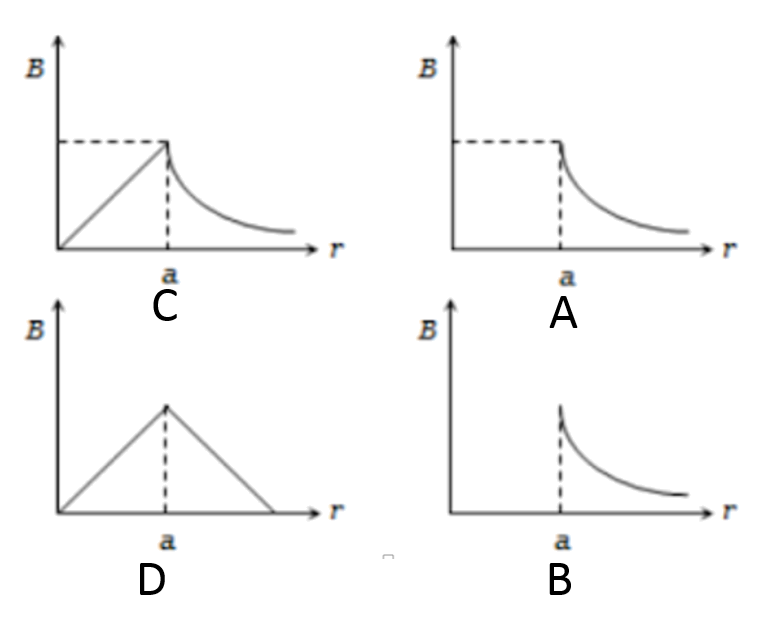
سلك موصل نصف قطره \[a\] ويمر به تيار ثابت فإن الشكل الصحيح المعبر عن المجال المغناطيسي من مركز السلك إلى خارج السلك والناتج عن مرور التيار في السلك هو
تم رسم العلاقة بين المجال الناتج من سلك يمر به تيار والبعد عن محور السلك كما في الشكل فإن قيمة المجال على بعد 12 mm من مركز السلك يعادل

سلكان متوازيان وضع كل منهما على رأس مثلث متساوي الأضلاع كما في الشكل ويمر بهما نفس التيار بشكل عمودي على مستوى الورقة نحو الداخل فإن اتجاه المجال الناتج عن السلكين عند رأس المثلث عند النقطة \[A\]

ملف لولبي مثالي هوائي ملفوف أبعاده وعدد لفاته موضحة كما في الشكل تم حساب المجال المغناطيسي عند نقطة تقع على محور الملف فكانت \[5 \times 10^{-3} T\] فإن شدة التيار المار في الحلقات تعادل \[\mu_0=4\pi\times10^{-7}\;\;H.m^{-1}\]

تم رسم العلاقة بين المجال الناتج من سلك يمر به تيار والبعد عن محور السلك كما في الشكل فإن قيمة المجال على بعد \[60 mm\] يعادل \[\mu_0=4\pi\times10^{-7}\;\;H.m^{-1}\]

حلقتان دائريتان لهما نفس المركز يمر بهما تياران الحلقة الخارجية نصف قطرها 0.4 متر ويمر بها تيار شدته 2 أمبير والحلقة الداخلية نصف قطرها 0.2 متر ويمر بها تيار \[i = ?\] تم حساب المجال المغناطيسي في المركز المشترك وجد أنه \[2.1 \times 10^{-6} T\] نحو الداخل فإن مقدار واتجاه التيار في الملف الداخلي يعادل

ملف لولبي مثالي وعدد لفاته 9 لفات وطول الملف يعادل \[0.2 m\] ويمر به تيار شدته \[i = 8 A\] كما في الشكل عند إغلاق المفتاح الملف هوائي النواة \[\mu_0 = 4\pi\times10^{-7} T.m/A\] فإن شدة المجال في محور الملف واتجاهه يعادل

أحد المخططات التالية يمثل المجال المغناطيسي الناتج عن مرور تيار مستمر في ملف دائري

ملفان لولبيان يبلغ نصف قطر وطول وعدد لفات الملفين \[r_A=2r_B\;,\; L_A=\frac{1}{2}L_B\;,\;N_A=\frac{1}{2}N_B\] يتدفق خلال الملفين نفس التيار فإن النسبة بين مقدار المجال المغناطيسي عند محور الملف \[A\] إلى مقدار المجال المغناطيسي عند محور الملف \[B\] يعادل

ملف حلقي مثالي عدد لفاته 30 لفة ويمر به تيار شدته \[4 A \] ويبلغ نصف قطر المغناطيس الحلقي \[0.2 m \] ونصف قطر كل حلقة من حلقاته تعادل \[0.05 m \] فإن أقل قيمة للمجال المغناطيسي داخل الملف الحلقي تعادل

حصل طالب على الرسم البياني التالي أثناء إجراء تجربة لمعرفة العلاقة بين المجال المغناطيسي والتيار المار في الملف اللولبي. فإن عدد لفات الملف في وحدة الطول تعادل

ملف لولبي يمر به تيار تم حساب المجال المغناطيسي عند نقطة في محور الملف فكانت شدة المجال \[B = 0.05 T\] تم مضاعفة شدة التيار وقربت الحلقات من بعضها البعض حتى قل طوله إلى النصف فإن شدة المجال المغناطيسي عند أي نقطة من محور الملف تعادل

سلك يمر به تيار تم حساب المجال المغناطيسي عند نقطة داخل السلك وتبعد عن مركز السلك 2 mm فكانت قيمة المجال \[B = 4 \times 10^{-4}T\] وعند نقطة خارج السلك تبعد عن مركز السلك 10 mm فكانت قيمة المجال \[B = 4 \times 10^{-4}T\] فإن نصف قطر السلك يعادل

ملفان لولبيان كل منهما هوائي النواة متحدان في المحور ويمر بهما تياران متعاكسان كما في الشكل أدناه طول كل منهما \[20\;cm\] وعدد لفات الملف الخارجي 9 لفات ويمر به تيار \[i_1=30 A\] والملف الداخلي عدد لفاته 10 لفات ويمر به تيار \[i_2=40 A\] فإن مقدار واتجاه المجال عند المحور المشترك يعادل

سلك نصف قطره \[R\] ويمر به تيار شدته \[I\] أحد المواقع التالية يكون عندها المجال المغناطيسي معدوم

ملفان لولبيان كل منهما هوائي النواة متحدان في المحور ويمر بهما تياران متعاكسان كما هو موضع في الشكل أدناه طول الملف الخارجي (12 Cm) وعدد لفاته 5 لفات ويمر به تيار \[i_1=30 A\] والملف الداخلي طوله (21.6 Cm) وعدد لفاته 9 لفات ويمر به تيار تم حساب مقدار المجال عند المحور المشترك فكان معدوم فإن مقدار التيار المار في الملف الداخلي يعادل

أوجد المجال المغناطيسي عند مركز سلك على شكل نصف دائرة كما الموضح في الشكل نصف قطره (10 Cm) إذا كان التيار في السلك (12 A)

📝 أجب عن الأسئلة التالية (مقالي)
سلك موصل نصف قطره \[R=5\;Cm\] يمر به تيار شدته \[i=1.5\;A\] بشكل منتظم ومعامل النفاذية المغناطيسية \[\mu_0=4\pi\times10^{-7}\;\;H.m^{-1}\] أحسب مقدار المجال المغناطيسي عند المواقع التالية:

في مركز السلك
\[.....................................\;\;\;\;............................................\]عند نقطة تبعد عن مركز السلك \(r=4\;cm\)
\[.....................................\;\;\;\;............................................\]عند نقطة تقع على محيط السلك
\[.....................................\;\;\;\;............................................\]عند نقطة تبعد عن مركز السلك \(r=10\;cm\)
\[.....................................\;\;\;\;............................................\] اضغط هنا تظهر طريقة الحل
\[2\star\]الشكل المجاور يبين ملف دائري يتكون من لفة واحدة، قطره \[d=4\;cm\] ويمر به تيار \[i_1=?\] يقع بجانبه وعلى بعد \[8\;cm\] من مركزه سلك نهائي الطول يمر به تيار \[i_2=?\] باتجاه الشمال إذا علمت أن المجال المغناطيسي في مركز الملف يساوي صفر

حدد اتجاه التيار في الملف الدائري الذي يحقق انعدام المجال المغناطيسي الكلي في مركز الملف
\[.....................................\;\;\;\;............................................\]احسب النسبة \[\frac{i_1}{i_2}\]
\[.....................................\;\;\;\;............................................\] اضغط هنا تظهر طريقة الحل
\[3\star\]سلكان طويلان مستقيمان ومتوازيان يبعدان عن بعضهما مسافة 20 سم. يمر في السلك الأول تيار مقداره \[5\;A\] وفي السلك الثاني تيار مقداره \[8\;A\] في الاتجاه المعاكس.

أوجد شدة المجال المغناطيسي الكلي عند نقطة تقع على بعد 10 سم من السلك الأول و 30 سم من السلك الثاني.
\[.....................................\;\;\;\;............................................\]احسب القوة المتبادلة بين السلكين لكل متر طولي
\[.....................................\;\;\;\;............................................\] اضغط هنا تظهر طريقة الحل
📚 Magnetic Field of Steady Current Question Bank 📚
Ampere's Law · Field around a wire · Solenoids · Toroids
\[1 \star\]A wire is perpendicular to the page. The magnetic field at a point 0.2 m from the wire was found to be 4.0 × 10⁻⁶ T directed upward parallel to the page. The magnitude and direction of the current in the wire is:
A uniform magnetic field of magnitude 2 × 10⁻⁴T is directed into the page. A long wire carrying 10 A upward is placed inside it. The magnetic field becomes zero at a point at distance from the wire:
At which of the following points can the magnetic field be zero?
A long wire carries current as shown. The ratio of the magnetic field at point \[a\] to that at point \[b\] is:
A wire is perpendicular to the page carrying current. An electron approaches the wire from the east. The direction of the magnetic force on the electron is:
A negative charge moves away from a wire carrying steady current as shown. The direction of the magnetic force on the negative charge is:
A wire is parallel to the page carrying 5 A. At a distance of 0.3 m, an electron is projected parallel to the page upward at 2 × 10^4 m/s. The magnitude and direction of the magnetic force on the electron is:
Two wires carry different currents in the same direction \[ I_1 = 6 A\;,\; I_2 = 8 A \]. The direction of the magnetic field at point \[A\] midway between the wires is:
Which of the following figures correctly represents the mutual force between two currents?
A long wire is bent into a loop as shown carrying current. The direction of the magnetic field at the center of the loop is:
A square loop of side 0.2 m carries 3 A. A wire of length 0.6 m carrying 5 A is placed 0.3 m from the loop as shown. The net force on the loop and its direction is:
A uniform magnetic field of 1 × 10⁻⁵ T is directed into the page. Two long parallel wires carry currents: 5 A and 2 A, separated by 0.3 m. The magnetic force per unit length on wire 2 is:
Two long wires carrying currents produce a magnetic field at point \[A\] of 2 × 10⁻⁵T into the page. Based on the figure, determine the direction and magnitude of the current in the wire:
Two concentric circular loops carry currents. The outer loop has radius 0.2 m and carries 4 A. The inner loop has radius 0.15 m and carries an unknown current. The magnetic field at the common center is zero. The magnitude and direction of the current in the inner loop is:
A wire of length 0.5 m is bent into a circular loop carrying 2 A. The magnetic field at the center of the loop is:
A wire of length 0.4 m is bent into a square loop carrying 2 A. The magnetic field at the center of the loop is:
A square loop of side 20 cm carries current I. The magnetic field at the center of the loop is 0.4 mT out of the page. The magnitude and direction of the current in the loop is:
Two Helmholtz coils each have 80 turns carrying 5 A. Each coil has radius 0.08 m and they are separated by 0.16 m. The magnetic field at the midpoint between them is:
A conducting wire of radius a carries steady current. Which graph correctly represents the magnetic field from the center to outside the wire?
The graph shows the relationship between the magnetic field produced by a current-carrying wire and the distance from the axis. The magnetic field at 12 mm from the center of the wire is:
Two parallel wires are placed at the vertices of an equilateral triangle as shown, carrying the same current perpendicular to the page into it. The direction of the magnetic field at vertex A is:
An ideal air-core solenoid with dimensions and turns as shown produces a magnetic field of \[5 \times 10^{-3} T\] at a point on its axis. The current in the solenoid is \[\mu_0=4\pi\times10^{-7}\;\;H.m^{-1}\]
The graph shows the relationship between the magnetic field produced by a current-carrying wire and distance from the axis. The magnetic field at 60 mm is \[\mu_0=4\pi\times10^{-7}\;\;H.m^{-1}\]
Two concentric circular loops carry currents. The outer loop has radius 0.4 m and carries 2 A. The inner loop has radius 0.2 m and carries current i. The magnetic field at the common center is \[2.1 \times 10^{-6} T\] into the page. The magnitude and direction of the current in the inner loop is:
An ideal solenoid has 9 turns, length 0.2 m, and carries 8 A as shown. When the switch is closed, the solenoid is air-core. The magnetic field on its axis and its direction is \[\mu_0 = 4\pi\times10^{-7} T.m/A\]
Which of the following graphs represents the magnetic field produced by steady current in a circular loop?
Two solenoids have radii, lengths, and turns given by \[r_A=2r_B\;,\; L_A=\frac{1}{2}L_B\;,\;N_A=\frac{1}{2}N_B\]. The same current flows through both. The ratio of the magnetic field at the axis of solenoid A to that at the axis of solenoid B is:
An ideal toroidal solenoid has 30 turns carrying 4 A. The toroid radius is 0.2 m and each loop has radius 0.05 m. The minimum magnetic field inside the toroid is:
A student obtained the following graph during an experiment to find the relationship between magnetic field and current in a solenoid. The number of turns per unit length of the solenoid is:
A solenoid carrying current produces a magnetic field of \[B = 0.05 T\] at a point on its axis. The current is doubled and the turns are brought closer so the length is halved. The new magnetic field at any point on the axis is:
A wire carrying current produces a magnetic field at a point inside the wire 2 mm from the center of \[B = 4 \times 10^{-4}T\], and at a point outside the wire 10 mm from the center of \[B = 4 \times 10^{-4}T\]. The radius of the wire is:
Two ideal air-core solenoids are coaxial and carry opposite currents as shown. Each has length 20 cm. The outer solenoid has 9 turns carrying 30 A, and the inner solenoid has 10 turns carrying 40 A. The magnitude and direction of the magnetic field at the common axis is:
A wire of radius R carries current I. At which position is the magnetic field zero?
Two ideal air-core solenoids are coaxial and carry opposite currents as shown. The outer solenoid has length 12 cm, 5 turns, and carries 30 A. The inner solenoid has length 21.6 cm, 9 turns, and carries unknown current. The magnetic field at the common axis is zero. The current in the inner solenoid is:
Find the magnetic field at the center of a semi-circular wire of radius 10 cm carrying 12 A as shown.
📝 Answer the following essay questions
A conducting wire of radius \[R=5\;cm\] carries a current \[i=1.5\;A\] uniformly. The magnetic permeability is \[\mu_0=4\pi\times10^{-7}\;\;H.m^{-1}\]. Calculate the magnetic field at the following positions:
At the center of the wire
\[.....................................\;\;\;\;............................................\]At a point \(r=4\;cm\) from the center
\[.....................................\;\;\;\;............................................\]At a point on the surface of the wire
\[.....................................\;\;\;\;............................................\]At a point \(r=10\;cm\) from the center
\[.....................................\;\;\;\;............................................\] Click here for the solution
\[2\star\]The figure shows a single-turn circular coil of diameter \[d=4\;cm\] carrying current \[i_1=?\]. Nearby, at a distance of \[8\;cm\] from its center, there is an infinitely long wire carrying current \[i_2=?\] toward the north. If the magnetic field at the center of the coil is zero:
Determine the direction of current in the circular coil that makes the total magnetic field zero at the center.
\[.....................................\;\;\;\;............................................\]Calculate the ratio \[\frac{i_1}{i_2}\]
\[.....................................\;\;\;\;............................................\] Click here for the solution
\[3\star\]Two long straight parallel wires are 20 cm apart. The first wire carries \[5\;A\] and the second carries \[8\;A\] in opposite directions.
Find the total magnetic field at a point 10 cm from the first wire and 30 cm from the second wire.
\[.....................................\;\;\;\;............................................\]Calculate the force between the two wires per meter of length.
\[.....................................\;\;\;\;............................................\] Click here for the solution
📚 بنك الأسئلة - المجال المغناطيسي للتيار المستمر 📚
قانون أمبير · المجال حول سلك · الملفات الحلقية · الملفات اللولبية
سلك عمودي على الورقة تم حساب المجال المغناطيسي عند نقطة تبعد عن السلك \[0.2\;m\] فكانت قيمة المجال \[4.0 × 10^{–6}\; T\] وكان اتجاهه يوازي الورقة نحو الأعلى فإن مقدار واتجاه التيار في السلك يساوي؟
 اضغط هنا تظهر طريقة الحل
مجال منتظم مقداره \[ 2 × 10^{–4}\;T \]عمودي على الورقة للداخل وضع داخله سلك طويل يمر به تيار نحو الأعلى شدته \[ 10 A \] فإن المجال ينعدم عند نقطة تبعد عن السلك؟
 اضغط هنا تظهر طريقة الحل
أحد النقاط التالية من الممكن أن ينعدم عندها المجال المغناطيسي
 اضغط هنا تظهر طريقة الحل
سلك طويل يمر به التيار كما في الشكل فإن النسبة بين مجال النقطة \[a\] إلى مجال النقطة \[b\]
اضغط هنا تظهر طريقة الحلسلك عمودي على الورقة ويحمل تيارًا كهربائيًا يقترب الإلكترون من السلك من الشرق فإن اتجاه القوة المغناطيسية المؤثرة على الإلكترون
 اضغط هنا تظهر طريقة الحل
تتحرك شحنة سالبة بعيدًا عن سلك يمر به تيار مستمر اتجاهه محدد على الرسم فإن اتجاه القوة المغناطيسية المؤثرة على الشحنة السالبة
 اضغط هنا تظهر طريقة الحل
سلك موضوع بشكل يوازي الورقة و يمر به تيار شدته \[5 A\] وعلى بعد قدرة 0.3 متر قذف إلكترون بشكل يوازي الورقة نحو الأعلى وبسرعة مقدارها \[2 × 10^4 m/s\] فإن مقدار واتجاه القوة المؤثرة على الإلكترون تعادل
 اضغط هنا تظهر طريقة الحل
يوجد سلكان يحملان تيارات مختلفة المقدار ولكن بنفس الاتجاه \[ I_1 = 6 A\;,\; I_2 = 8 A \] اتجاه المجال عند النقطة \[A\] التي تقع في منتصف المسافة بين السلكين هو
 اضغط هنا تظهر طريقة الحل
أحد الأشكال التالية يعبر بشكل صحيح عن القوة المتبادلة بين تيارين
 اضغط هنا تظهر طريقة الحل
سلك طويل عمل جزء منه على شكل حلقة كما في الشكل ويمر به تيار فإن اتجاه المجال في مركز الحلقة
 اضغط هنا تظهر طريقة الحل
حلقة على شكل مربع طول ضلعها \[0.2 m\] ويمر بها تيار شدته \[3 A\] وضع سلك طوله 0.6 متر كما في الشكل ويمر به تيار شدته \[5 A\] ويبعد السلك عن الحلقة 0.3 متر فإن القوة التي تتأثر بها الحلقة واتجاهها يعادل
 اضغط هنا تظهر طريقة الحل
مجال مغناطيس منتظم شدته 1 × 10⁻⁵ T عمودي للداخل وضع داخله سلكان طويلان بشكل متوازي يمر بهما تياران الأول يمر به تيار (5A) والثاني يمر به تيار شدته \[2\;A\] ويبعد السلكين عن بعضهما مسافة 0.3 متر فإن القوة المغناطيسية المؤثرة على وحدة الأطوال للسلك 2
 اضغط هنا تظهر طريقة الحل
سلكان طويلان يمر بهما تياران تم حساب المجال المغناطيسي عند النقطة \[A\] 2 × 10⁻⁵T عمودي على الورقة نحو الداخل بالاعتماد على الشكل أدناه حدد اتجاه التيار في السلك وشدة التيار المار فيه
 اضغط هنا تظهر طريقة الحل
حلقتان دائريتان لهما نفس المركز يمر بهما تياران الحلقة الخارجية نصف قطرها 0.2 متر ويمر بها تيار شدته 4 أمبير والحلقة الداخلية نصف قطرها 0.15 متر ويمر بها تيار تم حساب المجال في المركز المشترك وجد أنه معدوم فإن مقدار واتجاه التيار في الملف الداخلي يعادل
 اضغط هنا تظهر طريقة الحل
سلك طوله 0.5 متر تم لفه على شكل حلقة دائرية ويمر به تيار شدته 2 أمبير فإن قيمة المجال المغناطيسي الناتج في مركز الحلقة يعادل
اضغط هنا تظهر طريقة الحلسلك طوله 0.4 متر تم لفه على شكل حلقة مربع ويمر به تيار شدته 2 أمبير فإن قيمة المجال المغناطيسي الناتج في مركز الحلقة يعادل
 اضغط هنا تظهر طريقة الحل
حلقة سلكية مربعة طول ضلعها \[20\;Cm\] ويمر بها تيار شدته \[I\] تم حساب المجال المغناطيسي الناتج من التيار المستمر في مركز الحلقة فكانت شدة المجال \[B= 0.4 mT\] نحو خارج الصفحة فإن مقدار واتجاه التيار المار في الحلقة يعادل
 اضغط هنا تظهر طريقة الحل
ملفان دائريان (هلمهولتز) عدد لفات كل ملف 80 لفة ويسري في كل لفة تيار شدته \[5\; A\] إذا كان نصف قطر الملف الواحد \[0.08\;m\] ويبعدان عن بعضهما مسافة قدرها \[0.16\;m\] فإن مقدار المجال المغناطيسي في (منتصف المسافة بينهما) تعادل
 اضغط هنا تظهر طريقة الحل
سلك موصل نصف قطره \[a\] ويمر به تيار ثابت فإن الشكل الصحيح المعبر عن المجال المغناطيسي من مركز السلك إلى خارج السلك والناتج عن مرور التيار في السلك هو
 اضغط هنا تظهر طريقة الحل
تم رسم العلاقة بين المجال الناتج من سلك يمر به تيار والبعد عن محور السلك كما في الشكل فإن قيمة المجال على بعد 12 mm من مركز السلك يعادل
 اضغط هنا تظهر طريقة الحل
سلكان متوازيان وضع كل منهما على رأس مثلث متساوي الأضلاع كما في الشكل ويمر بهما نفس التيار بشكل عمودي على مستوى الورقة نحو الداخل فإن اتجاه المجال الناتج عن السلكين عند رأس المثلث عند النقطة \[A\]
 اضغط هنا تظهر طريقة الحل
ملف لولبي مثالي هوائي ملفوف أبعاده وعدد لفاته موضحة كما في الشكل تم حساب المجال المغناطيسي عند نقطة تقع على محور الملف فكانت \[5 \times 10^{-3} T\] فإن شدة التيار المار في الحلقات تعادل \[\mu_0=4\pi\times10^{-7}\;\;H.m^{-1}\]
 اضغط هنا تظهر طريقة الحل
تم رسم العلاقة بين المجال الناتج من سلك يمر به تيار والبعد عن محور السلك كما في الشكل فإن قيمة المجال على بعد \[60 mm\] يعادل \[\mu_0=4\pi\times10^{-7}\;\;H.m^{-1}\]
 اضغط هنا تظهر طريقة الحل
حلقتان دائريتان لهما نفس المركز يمر بهما تياران الحلقة الخارجية نصف قطرها 0.4 متر ويمر بها تيار شدته 2 أمبير والحلقة الداخلية نصف قطرها 0.2 متر ويمر بها تيار \[i = ?\] تم حساب المجال المغناطيسي في المركز المشترك وجد أنه \[2.1 \times 10^{-6} T\] نحو الداخل فإن مقدار واتجاه التيار في الملف الداخلي يعادل
 اضغط هنا تظهر طريقة الحل
ملف لولبي مثالي وعدد لفاته 9 لفات وطول الملف يعادل \[0.2 m\] ويمر به تيار شدته \[i = 8 A\] كما في الشكل عند إغلاق المفتاح الملف هوائي النواة \[\mu_0 = 4\pi\times10^{-7} T.m/A\] فإن شدة المجال في محور الملف واتجاهه يعادل
 اضغط هنا تظهر طريقة الحل
أحد المخططات التالية يمثل المجال المغناطيسي الناتج عن مرور تيار مستمر في ملف دائري
اضغط هنا تظهر طريقة الحلملفان لولبيان يبلغ نصف قطر وطول وعدد لفات الملفين \[r_A=2r_B\;,\; L_A=\frac{1}{2}L_B\;,\;N_A=\frac{1}{2}N_B\] يتدفق خلال الملفين نفس التيار فإن النسبة بين مقدار المجال المغناطيسي عند محور الملف \[A\] إلى مقدار المجال المغناطيسي عند محور الملف \[B\] يعادل
اضغط هنا تظهر طريقة الحلملف حلقي مثالي عدد لفاته 30 لفة ويمر به تيار شدته \[4 A \] ويبلغ نصف قطر المغناطيس الحلقي \[0.2 m \] ونصف قطر كل حلقة من حلقاته تعادل \[0.05 m \] فإن أقل قيمة للمجال المغناطيسي داخل الملف الحلقي تعادل
 اضغط هنا تظهر طريقة الحل
حصل طالب على الرسم البياني التالي أثناء إجراء تجربة لمعرفة العلاقة بين المجال المغناطيسي والتيار المار في الملف اللولبي. فإن عدد لفات الملف في وحدة الطول تعادل
اضغط هنا تظهر طريقة الحلملف لولبي يمر به تيار تم حساب المجال المغناطيسي عند نقطة في محور الملف فكانت شدة المجال \[B = 0.05 T\] تم مضاعفة شدة التيار وقربت الحلقات من بعضها البعض حتى قل طوله إلى النصف فإن شدة المجال المغناطيسي عند أي نقطة من محور الملف تعادل
اضغط هنا تظهر طريقة الحلسلك يمر به تيار تم حساب المجال المغناطيسي عند نقطة داخل السلك وتبعد عن مركز السلك 2 mm فكانت قيمة المجال \[B = 4 \times 10^{-4}T\] وعند نقطة خارج السلك تبعد عن مركز السلك 10 mm فكانت قيمة المجال \[B = 4 \times 10^{-4}T\] فإن نصف قطر السلك يعادل
 اضغط هنا تظهر طريقة الحل
ملفان لولبيان كل منهما هوائي النواة متحدان في المحور ويمر بهما تياران متعاكسان كما في الشكل أدناه طول كل منهما \[20\;cm\] وعدد لفات الملف الخارجي 9 لفات ويمر به تيار \[i_1=30 A\] والملف الداخلي عدد لفاته 10 لفات ويمر به تيار \[i_2=40 A\] فإن مقدار واتجاه المجال عند المحور المشترك يعادل
 اضغط هنا تظهر طريقة الحل
سلك نصف قطره \[R\] ويمر به تيار شدته \[I\] أحد المواقع التالية يكون عندها المجال المغناطيسي معدوم
اضغط هنا تظهر طريقة الحلملفان لولبيان كل منهما هوائي النواة متحدان في المحور ويمر بهما تياران متعاكسان كما هو موضع في الشكل أدناه طول الملف الخارجي (12 Cm) وعدد لفاته 5 لفات ويمر به تيار \[i_1=30 A\] والملف الداخلي طوله (21.6 Cm) وعدد لفاته 9 لفات ويمر به تيار تم حساب مقدار المجال عند المحور المشترك فكان معدوم فإن مقدار التيار المار في الملف الداخلي يعادل
 اضغط هنا تظهر طريقة الحل
أوجد المجال المغناطيسي عند مركز سلك على شكل نصف دائرة كما الموضح في الشكل نصف قطره (10 Cm) إذا كان التيار في السلك (12 A)
 اضغط هنا تظهر طريقة الحل
📝 أجب عن الأسئلة التالية (مقالي)
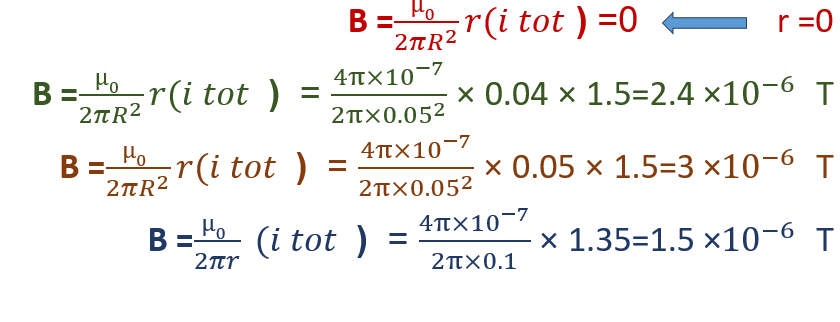
سلك موصل نصف قطره \[R=5\;Cm\] يمر به تيار شدته \[i=1.5\;A\] بشكل منتظم ومعامل النفاذية المغناطيسية \[\mu_0=4\pi\times10^{-7}\;\;H.m^{-1}\] أحسب مقدار المجال المغناطيسي عند المواقع التالية:
في مركز السلك
عند نقطة تبعد عن مركز السلك \(r=4\;cm\)
عند نقطة تقع على محيط السلك
عند نقطة تبعد عن مركز السلك \(r=10\;cm\)
 اضغط هنا تظهر طريقة الحل
الشكل المجاور يبين ملف دائري يتكون من لفة واحدة، قطره \[d=4\;cm\] ويمر به تيار \[i_1=?\] يقع بجانبه وعلى بعد \[8\;cm\] من مركزه سلك نهائي الطول يمر به تيار \[i_2=?\] باتجاه الشمال إذا علمت أن المجال المغناطيسي في مركز الملف يساوي صفر
حدد اتجاه التيار في الملف الدائري الذي يحقق انعدام المجال المغناطيسي الكلي في مركز الملف
احسب النسبة \[\frac{i_1}{i_2}\]
 اضغط هنا تظهر طريقة الحل
سلكان طويلان مستقيمان ومتوازيان يبعدان عن بعضهما مسافة 20 سم. يمر في السلك الأول تيار مقداره \[5\;A\] وفي السلك الثاني تيار مقداره \[8\;A\] في الاتجاه المعاكس.
أوجد شدة المجال المغناطيسي الكلي عند نقطة تقع على بعد 10 سم من السلك الأول و 30 سم من السلك الثاني.
احسب القوة المتبادلة بين السلكين لكل متر طولي
 اضغط هنا تظهر طريقة الحل
📚 Magnetic Field of Steady Current Question Bank 📚
Ampere's Law · Field around a wire · Solenoids · Toroids
A wire is perpendicular to the page. The magnetic field at a point 0.2 m from the wire was found to be 4.0 × 10⁻⁶ T directed upward parallel to the page. The magnitude and direction of the current in the wire is:
Click here for AI solutionA uniform magnetic field of magnitude 2 × 10⁻⁴T is directed into the page. A long wire carrying 10 A upward is placed inside it. The magnetic field becomes zero at a point at distance from the wire:
Click here for AI solutionAt which of the following points can the magnetic field be zero?
Click here for AI solutionA long wire carries current as shown. The ratio of the magnetic field at point \[a\] to that at point \[b\] is:
Click here for AI solutionA wire is perpendicular to the page carrying current. An electron approaches the wire from the east. The direction of the magnetic force on the electron is:
Click here for AI solutionA negative charge moves away from a wire carrying steady current as shown. The direction of the magnetic force on the negative charge is:
Click here for AI solutionA wire is parallel to the page carrying 5 A. At a distance of 0.3 m, an electron is projected parallel to the page upward at 2 × 10^4 m/s. The magnitude and direction of the magnetic force on the electron is:
Click here for AI solutionTwo wires carry different currents in the same direction \[ I_1 = 6 A\;,\; I_2 = 8 A \]. The direction of the magnetic field at point \[A\] midway between the wires is:
Click here for AI solutionWhich of the following figures correctly represents the mutual force between two currents?
Click here for AI solutionA long wire is bent into a loop as shown carrying current. The direction of the magnetic field at the center of the loop is:
Click here for AI solutionA square loop of side 0.2 m carries 3 A. A wire of length 0.6 m carrying 5 A is placed 0.3 m from the loop as shown. The net force on the loop and its direction is:
Click here for AI solutionA uniform magnetic field of 1 × 10⁻⁵ T is directed into the page. Two long parallel wires carry currents: 5 A and 2 A, separated by 0.3 m. The magnetic force per unit length on wire 2 is:
Click here for AI solutionTwo long wires carrying currents produce a magnetic field at point \[A\] of 2 × 10⁻⁵T into the page. Based on the figure, determine the direction and magnitude of the current in the wire:
Click here for AI solutionTwo concentric circular loops carry currents. The outer loop has radius 0.2 m and carries 4 A. The inner loop has radius 0.15 m and carries an unknown current. The magnetic field at the common center is zero. The magnitude and direction of the current in the inner loop is:
Click here for AI solutionA wire of length 0.5 m is bent into a circular loop carrying 2 A. The magnetic field at the center of the loop is:
Click here for AI solutionA wire of length 0.4 m is bent into a square loop carrying 2 A. The magnetic field at the center of the loop is:
Click here for AI solutionA square loop of side 20 cm carries current I. The magnetic field at the center of the loop is 0.4 mT out of the page. The magnitude and direction of the current in the loop is:
Click here for AI solutionTwo Helmholtz coils each have 80 turns carrying 5 A. Each coil has radius 0.08 m and they are separated by 0.16 m. The magnetic field at the midpoint between them is:
Click here for AI solutionA conducting wire of radius a carries steady current. Which graph correctly represents the magnetic field from the center to outside the wire?
Click here for AI solutionThe graph shows the relationship between the magnetic field produced by a current-carrying wire and the distance from the axis. The magnetic field at 12 mm from the center of the wire is:
Click here for AI solutionTwo parallel wires are placed at the vertices of an equilateral triangle as shown, carrying the same current perpendicular to the page into it. The direction of the magnetic field at vertex A is:
Click here for AI solutionAn ideal air-core solenoid with dimensions and turns as shown produces a magnetic field of \[5 \times 10^{-3} T\] at a point on its axis. The current in the solenoid is \[\mu_0=4\pi\times10^{-7}\;\;H.m^{-1}\]
Click here for AI solutionThe graph shows the relationship between the magnetic field produced by a current-carrying wire and distance from the axis. The magnetic field at 60 mm is \[\mu_0=4\pi\times10^{-7}\;\;H.m^{-1}\]
Click here for AI solutionTwo concentric circular loops carry currents. The outer loop has radius 0.4 m and carries 2 A. The inner loop has radius 0.2 m and carries current i. The magnetic field at the common center is \[2.1 \times 10^{-6} T\] into the page. The magnitude and direction of the current in the inner loop is:
Click here for AI solutionAn ideal solenoid has 9 turns, length 0.2 m, and carries 8 A as shown. When the switch is closed, the solenoid is air-core. The magnetic field on its axis and its direction is \[\mu_0 = 4\pi\times10^{-7} T.m/A\]
Click here for AI solutionWhich of the following graphs represents the magnetic field produced by steady current in a circular loop?
Click here for AI solutionTwo solenoids have radii, lengths, and turns given by \[r_A=2r_B\;,\; L_A=\frac{1}{2}L_B\;,\;N_A=\frac{1}{2}N_B\]. The same current flows through both. The ratio of the magnetic field at the axis of solenoid A to that at the axis of solenoid B is:
Click here for AI solutionAn ideal toroidal solenoid has 30 turns carrying 4 A. The toroid radius is 0.2 m and each loop has radius 0.05 m. The minimum magnetic field inside the toroid is:
Click here for AI solutionA student obtained the following graph during an experiment to find the relationship between magnetic field and current in a solenoid. The number of turns per unit length of the solenoid is:
Click here for AI solutionA solenoid carrying current produces a magnetic field of \[B = 0.05 T\] at a point on its axis. The current is doubled and the turns are brought closer so the length is halved. The new magnetic field at any point on the axis is:
Click here for AI solutionA wire carrying current produces a magnetic field at a point inside the wire 2 mm from the center of \[B = 4 \times 10^{-4}T\], and at a point outside the wire 10 mm from the center of \[B = 4 \times 10^{-4}T\]. The radius of the wire is:
Click here for AI solutionTwo ideal air-core solenoids are coaxial and carry opposite currents as shown. Each has length 20 cm. The outer solenoid has 9 turns carrying 30 A, and the inner solenoid has 10 turns carrying 40 A. The magnitude and direction of the magnetic field at the common axis is:
Click here for AI solutionA wire of radius R carries current I. At which position is the magnetic field zero?
Click here for AI solutionTwo ideal air-core solenoids are coaxial and carry opposite currents as shown. The outer solenoid has length 12 cm, 5 turns, and carries 30 A. The inner solenoid has length 21.6 cm, 9 turns, and carries unknown current. The magnetic field at the common axis is zero. The current in the inner solenoid is:
Click here for AI solutionFind the magnetic field at the center of a semi-circular wire of radius 10 cm carrying 12 A as shown.
Click here for AI solution📝 Answer the following essay questions
A conducting wire of radius \[R=5\;cm\] carries a current \[i=1.5\;A\] uniformly. The magnetic permeability is \[\mu_0=4\pi\times10^{-7}\;\;H.m^{-1}\]. Calculate the magnetic field at the following positions:
At the center of the wire
At a point \(r=4\;cm\) from the center
At a point on the surface of the wire
At a point \(r=10\;cm\) from the center
Click here for the solutionThe figure shows a single-turn circular coil of diameter \[d=4\;cm\] carrying current \[i_1=?\]. Nearby, at a distance of \[8\;cm\] from its center, there is an infinitely long wire carrying current \[i_2=?\] toward the north. If the magnetic field at the center of the coil is zero:
Determine the direction of current in the circular coil that makes the total magnetic field zero at the center.
Calculate the ratio \[\frac{i_1}{i_2}\]
Click here for the solutionTwo long straight parallel wires are 20 cm apart. The first wire carries \[5\;A\] and the second carries \[8\;A\] in opposite directions.
Find the total magnetic field at a point 10 cm from the first wire and 30 cm from the second wire.
Calculate the force between the two wires per meter of length.
Click here for the solution
No comments:
Post a Comment