 Physics
📄 اطبع pdf
00971504825082
الشغل
work

الشغل في الفيزياء
مفهوم الشغل - القوة المنتظمة والمتغيرة - أنواع الشغل
للاستفسار: 00971504825082
المعنى الشائع للشغل: هو بذل جهد جسدي أو فكري
وأنّ هذا المعنى يختلف عن المعنى الفيزيائي للشغل

المعنى الفيزيائي للشغل: وهو عبارة عن مقدار الطاقة اللازمة لتحريك جسم ذي كتلة مُعينة لمسافة مُعينة
فهو يتطلّب قوّة مؤثّرة وإزاحة
ولا يقتصر مفهوم الشُغل على تحريك الأجسام فقط فهو مفهوم عام ولكن يُعَبر عن انتقال الطاقة الى الجسم
قوة متغيرة
قوة منتظمة
القوة في هذه الحالة متغيرة المقدار أو الاتجاه أو كلاهما أثناء إزاحة الجسم
القوة في هذه الحالة ثابتة المقدار والاتجاه طوال فترة التأثير
\[W = \int F·ds\]
\[W = F·d·cosθ\]
الشغل الناتج عن قوة منتظمة
القوة منتظمة موازية لاتجاه الحركة

\[ W = F \cdot d \cdot \cos 0 \]
القوة منتظمة تصنع زاوية مع اتجاه الحركة

\[ W = \vec F \cdot \vec d = F \cdot d \cdot \cos(\theta) \]
\(\theta\) هي الزاوية بين اتّجاه القوّة المؤثّرة والإزاحة الناتجة
أنواع الشغل
الشغل الموجب
يحدث عندما تكون الزاوية بين القوة والإزاحة أقل من 90°
مثال: دفع صندوق في نفس اتجاه الدفع.
الشغل السالب
يحدث عندما تكون الزاوية بين القوة والإزاحة أكبر من 90°
مثال: قوة الاحتكاك التي تعارض الحركة.
الشغل المعدوم
يحدث عندما تكون الزاوية بين القوة والإزاحة 90°
مثال: حمل حقيبة والسير أفقيًا.
جدول التجارب
رقم التجربة
القوة (نيوتن)
الإزاحة (متر)
الزاوية (درجة)
الشغل (جول)
المساحة تحت المنحنى
نوع الشغل
الشغل إما أن يكون سالب أو يكون موجب أو يكون معدوم
في الصورة في الشكل أدناه يوجد ثلاث قوى تؤثر على الجسم المتحرك على مستوى مائل خشن
قوة الوزن وقوة الأحتكاك والقوة المتعامدة
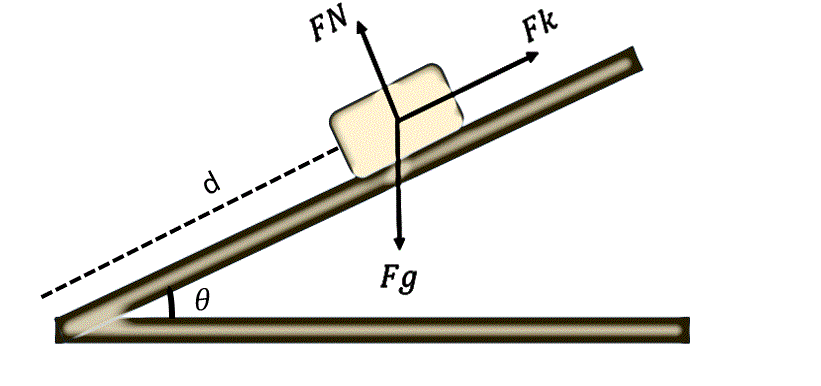
شغل قوة الوزن موجب لأن الزاوية بين قوة الوزن والإزاحة حادة

شغل قوة الاحتكاك سالب لأن الزاوية بين قوة الاحتكاك والإزاحة 180 درجة

شغل القوة المتعامدة معدوم لأن الزاوية بين القوة المتعامدة والإزاحة 90 درجة

\[1 \star \]
ما مقدار الشغل المبذول عند تطبيق قوة مقدارها 10 نيوتن لتحريك صندوق بمقدار 4 أمتار بإتجاه القوة؟
أختر الإجابة الصحيحة
A20 J
B60 J
C40 J
D80 J
 اضغط هنا تظهر طريقة الحل
الحل: الشغل = القوة × الإزاحة × جيب تمام الزاوية
\[W = 10 \times 4 \times \cos(0^\circ) = 10 \times 4 \times 1 = 40 \, J\]
الإجابة الصحيحة: C) 40 J
\[2 \star \]
ما مقدار الشغل المبذول عند تطبيق قوة مقدارها 60 نيوتن تميل بزاوية 35 درجة فوق الأفق لتحريك صندوق بمقدار 10 أمتار؟

أختر الإجابة الصحيحة
A520.3 J
B312.8 J
C615.6 J
D491.5 J
اضغط هنا تظهر طريقة الحل
الحل: \[W = 60 \times 10 \times \cos(35^\circ) = 600 \times 0.8192 = 491.5 \, J\]
الإجابة الصحيحة: D) 491.5 J
محصلة الشغل لمجموعة من القوى المنتظمة
القوى المتلاقية والحركة
القوى المتلاقية هي القوى التي تؤثر على جسم من نقاط مختلفة ولكنها تتلاقى في نقطة واحدة.
كيفية حساب الشغل للقوى المتلاقية
هناك طريقتين لإيجاد الشغل الكلي:
- الطريقة الأولى: نحسب شغل كل قوة على حدة ونجري الجمع الجبري
\[W_{net} = W_1 + W_2 + W_3 + ...\]
- الطريقة الثانية: نجد محصَّلة تلك القوى
\[W_{net} = F_{net} \cdot d \cdot \cos\theta\]
الشغل الناتج عن قوة غير منتظمة
الشغل الناتج عن قوة غير ثابتة لا يمكن استخدام العلاقة \(W = \vec F \cdot \vec d\)
يتم حساب الشغل من المساحة المحصورة تحت المنحنى (القوة - الإزاحة)
\[ W = \int_{X_1}^{X_2} F(x) \, dx \]
مثال تجريبي:
قوة متغيرة تعطى بالعلاقة \( F(x) = 2x + 3 \) نيوتن
احسب الشغل المبذول عند تحريك الجسم من \( x = 1 \) إلى \( x = 4 \) متر
الحل:
\[ W = \int_{1}^{4} (2x + 3) dx = [x^2 + 3x]_{1}^{4} = (16 + 12) - (1 + 3) = 24 \, J \]

محاكاة الشغل الناتج عن قوة غير منتظمة
الإزاحة: 0 م | القوة: 0 N | الشغل: 0 J
Work in Physics
Concept of Work - Constant and Variable Forces - Types of Work
For inquiries: 00971504825082
The common meaning of work: is physical or mental effort
This meaning differs from the physical meaning of work
Physical meaning of work: It is the amount of energy required to move an object of a certain mass over a certain distance
It requires a force and displacement
The concept of work is not limited to moving objects; it represents the transfer of energy to the object
Variable Force
Constant Force
Force magnitude or direction or both change during displacement
Force magnitude and direction are constant
\[W = \int F·ds\]
\[W = F·d·cosθ\]
Work Done by a Constant Force
Constant force parallel to the direction of motion
\[ W = F \cdot d \cdot \cos 0 \]
Constant force making an angle with the direction of motion
\[ W = \vec F \cdot \vec d = F \cdot d \cdot \cos(\theta) \]
\(\theta\) is the angle between the force direction and displacement
Types of Work
Positive Work
Occurs when the angle between force and displacement is less than 90°
Example: Pushing a box in the same direction as the push.
Negative Work
Occurs when the angle between force and displacement is greater than 90°
Example: Friction force opposing motion.
Zero Work
Occurs when the angle between force and displacement is 90°
Example: Carrying a bag while walking horizontally.
Experiments Table
Experiment
Force (N)
Displacement (m)
Angle (deg)
Work (J)
Area under curve
Work Type
Work can be positive, negative, or zero
Three forces act on an object moving on a rough inclined plane:
Weight force, friction force, and normal force
Work of weight is positive because the angle between weight and displacement is acute
Work of friction is negative because the angle between friction and displacement is 180°
Work of normal force is zero because the angle between normal force and displacement is 90°
\[1 \star \]
How much work is done when a force of 10 N is applied to move a box 4 meters in the direction of the force?
Choose the correct answer
A20 J
B60 J
C40 J
D80 J
Click here for solution
Solution: Work = Force × Displacement × Cosine of angle
\[W = 10 \times 4 \times \cos(0^\circ) = 10 \times 4 \times 1 = 40 \, J\]
Correct Answer: C) 40 J
\[2 \star \]
How much work is done when a force of 60 N is applied at an angle of 35° above the horizontal to move a box 10 meters?
Choose the correct answer
A520.3 J
B312.8 J
C615.6 J
D491.5 J
Click here for solution
Solution: \[W = 60 \times 10 \times \cos(35^\circ) = 600 \times 0.8192 = 491.5 \, J\]
Correct Answer: D) 491.5 J
Net Work for a Group of Constant Forces
Concurrent Forces and Motion
Concurrent forces are forces that act on an object from different points but meet at one point.
How to Calculate Work for Concurrent Forces
There are two methods to find the total work:
- Method 1: Calculate the work of each force separately and sum them
\[W_{net} = W_1 + W_2 + W_3 + ...\]
- Method 2: Find the resultant force
\[W_{net} = F_{net} \cdot d \cdot \cos\theta\]
Work Done by a Variable Force
The work done by a variable force cannot be calculated using \(W = \vec F \cdot \vec d\)
Work is calculated from the area under the curve (Force - Displacement)
\[ W = \int_{X_1}^{X_2} F(x) \, dx \]
Example:
Variable force \( F(x) = 2x + 3 \) Newtons
Calculate work from \( x = 1 \) to \( x = 4 \) meters
Solution:
\[ W = \int_{1}^{4} (2x + 3) dx = [x^2 + 3x]_{1}^{4} = (16 + 12) - (1 + 3) = 24 \, J \]
Simulation of Work Done by a Variable Force
Displacement: 0 m | Force: 0 N | Work: 0 J
⚡ اختبار الشغل - الفيزياء
مفهوم الشغل - القوة المنتظمة - الشغل الموجب والسالب والمعدوم - 20 سؤالاً
25:00
السؤال 1/20
التقدم: 0%
تم الإجابة: 0/20
الشغل
|
الشغل في الفيزياء
مفهوم الشغل - القوة المنتظمة والمتغيرة - أنواع الشغل
وأنّ هذا المعنى يختلف عن المعنى الفيزيائي للشغل
المعنى الفيزيائي للشغل: وهو عبارة عن مقدار الطاقة اللازمة لتحريك جسم ذي كتلة مُعينة لمسافة مُعينة
فهو يتطلّب قوّة مؤثّرة وإزاحة
ولا يقتصر مفهوم الشُغل على تحريك الأجسام فقط فهو مفهوم عام ولكن يُعَبر عن انتقال الطاقة الى الجسم
قوة متغيرة |
قوة منتظمة |
القوة في هذه الحالة متغيرة المقدار أو الاتجاه أو كلاهما أثناء إزاحة الجسم |
القوة في هذه الحالة ثابتة المقدار والاتجاه طوال فترة التأثير |
\[W = \int F·ds\] |
\[W = F·d·cosθ\] |
الشغل الناتج عن قوة منتظمة
القوة منتظمة تصنع زاوية مع اتجاه الحركة
\[ W = \vec F \cdot \vec d = F \cdot d \cdot \cos(\theta) \]
\(\theta\) هي الزاوية بين اتّجاه القوّة المؤثّرة والإزاحة الناتجة
أنواع الشغل
الشغل الموجب
يحدث عندما تكون الزاوية بين القوة والإزاحة أقل من 90°
مثال: دفع صندوق في نفس اتجاه الدفع.
الشغل السالب
يحدث عندما تكون الزاوية بين القوة والإزاحة أكبر من 90°
مثال: قوة الاحتكاك التي تعارض الحركة.
الشغل المعدوم
يحدث عندما تكون الزاوية بين القوة والإزاحة 90°
مثال: حمل حقيبة والسير أفقيًا.
جدول التجارب
| رقم التجربة | القوة (نيوتن) | الإزاحة (متر) | الزاوية (درجة) | الشغل (جول) | المساحة تحت المنحنى | نوع الشغل |
|---|
الشغل إما أن يكون سالب أو يكون موجب أو يكون معدوم
في الصورة في الشكل أدناه يوجد ثلاث قوى تؤثر على الجسم المتحرك على مستوى مائل خشن
قوة الوزن وقوة الأحتكاك والقوة المتعامدة
شغل قوة الوزن موجب لأن الزاوية بين قوة الوزن والإزاحة حادة
شغل قوة الاحتكاك سالب لأن الزاوية بين قوة الاحتكاك والإزاحة 180 درجة
شغل القوة المتعامدة معدوم لأن الزاوية بين القوة المتعامدة والإزاحة 90 درجة
\[1 \star \]
ما مقدار الشغل المبذول عند تطبيق قوة مقدارها 10 نيوتن لتحريك صندوق بمقدار 4 أمتار بإتجاه القوة؟
أختر الإجابة الصحيحة
اضغط هنا تظهر طريقة الحل
الحل: الشغل = القوة × الإزاحة × جيب تمام الزاوية
\[W = 10 \times 4 \times \cos(0^\circ) = 10 \times 4 \times 1 = 40 \, J\]
الإجابة الصحيحة: C) 40 J
\[2 \star \]
ما مقدار الشغل المبذول عند تطبيق قوة مقدارها 60 نيوتن تميل بزاوية 35 درجة فوق الأفق لتحريك صندوق بمقدار 10 أمتار؟
أختر الإجابة الصحيحة
اضغط هنا تظهر طريقة الحل
الحل: \[W = 60 \times 10 \times \cos(35^\circ) = 600 \times 0.8192 = 491.5 \, J\]
الإجابة الصحيحة: D) 491.5 J
محصلة الشغل لمجموعة من القوى المنتظمة
القوى المتلاقية والحركة
القوى المتلاقية هي القوى التي تؤثر على جسم من نقاط مختلفة ولكنها تتلاقى في نقطة واحدة.
كيفية حساب الشغل للقوى المتلاقية
هناك طريقتين لإيجاد الشغل الكلي:
- الطريقة الأولى: نحسب شغل كل قوة على حدة ونجري الجمع الجبري
\[W_{net} = W_1 + W_2 + W_3 + ...\] - الطريقة الثانية: نجد محصَّلة تلك القوى
\[W_{net} = F_{net} \cdot d \cdot \cos\theta\]
الشغل الناتج عن قوة غير منتظمة
الشغل الناتج عن قوة غير ثابتة لا يمكن استخدام العلاقة \(W = \vec F \cdot \vec d\)
يتم حساب الشغل من المساحة المحصورة تحت المنحنى (القوة - الإزاحة)
مثال تجريبي:
قوة متغيرة تعطى بالعلاقة \( F(x) = 2x + 3 \) نيوتن
احسب الشغل المبذول عند تحريك الجسم من \( x = 1 \) إلى \( x = 4 \) متر
الحل:
\[ W = \int_{1}^{4} (2x + 3) dx = [x^2 + 3x]_{1}^{4} = (16 + 12) - (1 + 3) = 24 \, J \]
محاكاة الشغل الناتج عن قوة غير منتظمة
الإزاحة: 0 م | القوة: 0 N | الشغل: 0 J
Work in Physics
Concept of Work - Constant and Variable Forces - Types of Work
This meaning differs from the physical meaning of work
Physical meaning of work: It is the amount of energy required to move an object of a certain mass over a certain distance
It requires a force and displacement
The concept of work is not limited to moving objects; it represents the transfer of energy to the object
Variable Force |
Constant Force |
Force magnitude or direction or both change during displacement |
Force magnitude and direction are constant |
\[W = \int F·ds\] |
\[W = F·d·cosθ\] |
Work Done by a Constant Force
Constant force making an angle with the direction of motion
\[ W = \vec F \cdot \vec d = F \cdot d \cdot \cos(\theta) \]
\(\theta\) is the angle between the force direction and displacement
Types of Work
Positive Work
Occurs when the angle between force and displacement is less than 90°
Example: Pushing a box in the same direction as the push.
Negative Work
Occurs when the angle between force and displacement is greater than 90°
Example: Friction force opposing motion.
Zero Work
Occurs when the angle between force and displacement is 90°
Example: Carrying a bag while walking horizontally.
Experiments Table
| Experiment | Force (N) | Displacement (m) | Angle (deg) | Work (J) | Area under curve | Work Type |
|---|
Work can be positive, negative, or zero
Three forces act on an object moving on a rough inclined plane:
Weight force, friction force, and normal force
Work of weight is positive because the angle between weight and displacement is acute
Work of friction is negative because the angle between friction and displacement is 180°
Work of normal force is zero because the angle between normal force and displacement is 90°
\[1 \star \]
How much work is done when a force of 10 N is applied to move a box 4 meters in the direction of the force?
Choose the correct answer
Click here for solution
Solution: Work = Force × Displacement × Cosine of angle
\[W = 10 \times 4 \times \cos(0^\circ) = 10 \times 4 \times 1 = 40 \, J\]
Correct Answer: C) 40 J
\[2 \star \]
How much work is done when a force of 60 N is applied at an angle of 35° above the horizontal to move a box 10 meters?
Choose the correct answer
Click here for solution
Solution: \[W = 60 \times 10 \times \cos(35^\circ) = 600 \times 0.8192 = 491.5 \, J\]
Correct Answer: D) 491.5 J
Net Work for a Group of Constant Forces
Concurrent Forces and Motion
Concurrent forces are forces that act on an object from different points but meet at one point.
How to Calculate Work for Concurrent Forces
There are two methods to find the total work:
- Method 1: Calculate the work of each force separately and sum them
\[W_{net} = W_1 + W_2 + W_3 + ...\] - Method 2: Find the resultant force
\[W_{net} = F_{net} \cdot d \cdot \cos\theta\]
Work Done by a Variable Force
The work done by a variable force cannot be calculated using \(W = \vec F \cdot \vec d\)
Work is calculated from the area under the curve (Force - Displacement)
Example:
Variable force \( F(x) = 2x + 3 \) Newtons
Calculate work from \( x = 1 \) to \( x = 4 \) meters
Solution:
\[ W = \int_{1}^{4} (2x + 3) dx = [x^2 + 3x]_{1}^{4} = (16 + 12) - (1 + 3) = 24 \, J \]
Simulation of Work Done by a Variable Force
Displacement: 0 m | Force: 0 N | Work: 0 J
⚡ اختبار الشغل - الفيزياء
مفهوم الشغل - القوة المنتظمة - الشغل الموجب والسالب والمعدوم - 20 سؤالاً
انه درس جميل
ReplyDeleteشكرا يا استاذ
ReplyDeleteشكرا استاذ
ReplyDelete