 Physics
00971504825082
التيار والمقاومةCurrent and Resistance |

التيار الكهربائيElectric Current
هو عبارة عن تدفق من الشحنات الكهربائية في موصل كهربائي والشحنة الكهربية قد تكون إما إلكترونات أو أيونات
طبقًا للنظام الدولي للوحدات تقاس شدة التيار الكهربي بـوحدة الأمبير
بينما يقاس التيار الكهربي بجهاز يدعى الأميتر
It is the flow of electric charges in an electrical conductor. The electric charge may be either electrons or ions.
According to the International System of Units, the electric current intensity is measured in Amperes.
Current is measured by a device called an ammeter.
في هذه المحاكاة أغلق الدائرة ولاحظ حركة الشحنات الكهربائية وكيفية فقدانها الطاقة في المقاوم In this simulation, close the circuit and observe the movement of electric charges and how they lose energy in the resistor.
في هذه المحاكاة تمثل حركة الإلكترونات في دائرة بسيطة من الجهد الأدنى إلى الأعلى مع العلم كلمة تيار كهربائي تعني حركة شحنات موجبة من الجهد الأعلى إلى الجهد الأدنى In this simulation, the movement of electrons in a simple circuit from lower potential to higher potential is shown, knowing that the term 'electric current' means the movement of positive charges from higher potential to lower potential.

كثافة التيار الكهربائيElectric Current Density
هو عبارة عن التيار المتدفق خلال وحدة المساحة في سلك موصل عند نقطة معينة
يرمز لكثافة التيار بالرمزIt is the current flowing through a unit area in a conducting wire at a given point.
Current density is denoted by the symbol j
وهو كمية متجهه اتجاهه باتجاه حركة الشحنات الموجبة (عكس حركة الالكترونات)
It is a vector quantity whose direction is the direction of positive charge movement (opposite to electron movement).
\[j=\frac{i}{A}\] وتقدر بوحدة قياسIt is measured in units of \[\frac{A}{m^2}\]
سرعة الانسياق وهي سرعة الالكترونات الموجهة في الدائرة الكهربائية
أي سلك موصل يحتوي على الكترونات تتحرك بشكل عشوائي وبسرعة عالية عند تطبيق فرق في الجهد بين طرفي السلك تصبح حركة الالكترونات سرعة عشوائية موجهه تدعى سرعة الانسياق وتكون السرعة بطيئة جدا من رتبة
Drift velocity is the average velocity of electrons in a conductor when an electric field is applied.
Any conductor contains electrons moving randomly at high speed. When a voltage is applied, their motion becomes a directed random motion called drift velocity, which is very slow, on the order of \[𝜗_d =10^{-4}\frac {m}{s}\]

لدينا موصل مساحة مقطعه\[(A)\]
وطبق علية مجال كهربائي تتحرك الالكترونات عكس المجال بسرعة انسياق
\[𝜗𝑑\]
وخلال فترة زمنية قدرها\[(d t)\] تقطع مسافة قدرها \[𝜗𝑑 . dt\] وبالتالي حجم الالكترونات التي تمر عبر المقطع تعادل
\[A. 𝜗𝑑 . dt\] فيكون عدد الالكترونات في هذا الحجم تعادل
\[n . A. 𝜗𝑑 . dt\]
(-e) وكل إلكترون مشحون بشحنة مقدارها
إذا الشحنة المتدفقة عبر هذه المساحة
\[dq = - e. n . A. 𝜗𝑑 . dt\]
(A) A conductor with cross-sectional area \[ A\] An electric field is applied, and electrons move opposite the field with drift velocity.\[(𝜗𝑑)\] During a time interval \[(dt)\] they travel a distance \[𝜗𝑑 . dt\]. Thus, the volume of electrons passing through the cross-section is \[A. 𝜗𝑑 . dt\]. The number of electrons in this volume is \[n . A. 𝜗𝑑 . dt\].
(-e) Each electron carries a charge -e.
So, the charge flowing through this area is \[dq = - e. n . A. 𝜗𝑑 . dt\]
فنحصل على شدة التيار
\[i =\frac{ dq }{ dt }= - e. n . A. 𝜗𝑑\]
Thus, the current intensity is
\[i =\frac{ dq }{ dt }= - e. n . A. 𝜗𝑑\]
وكثافة التيار
\[j = \frac{i}{A} = - e. n . 𝜗𝑑\]
And the current density is
\[j = \frac{i}{A} = - e. n . 𝜗𝑑\]

اختر الإجابة الصحيحةChoose the correct answer

قانون أومOhm's Law
في هذه المحاكاة درس العالم أوم العلاقة بين شدة التيار وفرق الجهد بين طرفي مقاوم أومي لذلك أختر قيمة لمقاومة أومية وقم بتغير فرق الجهد في كل مرة لاحظ ماذا يحدث لشدة التيار كرر التجربة مع مقاومة أخرى In this simulation, Ohm studied the relationship between current and potential difference across an ohmic resistor. Choose a resistance value and change the voltage each time. Observe what happens to the current. Repeat with another resistance.
تجربة قانون أوم أكمل بيانات الجدول التاليOhm's Law Experiment: Complete the following table
| رقم التجربةExp No. | فرق الجهد (فولت)Voltage (V) | شدة التيار (أمبير)Current (A) | المقاومة (أوم)Resistance (Ω) |
|---|---|---|---|
| 1 | |||
| 2 | |||
| 3 | |||
| 4 | |||
| 5 |
قانون أومOhm's Law
قانون أوم هو مبدأ أساسي في الكهرباء، أطلق عليه هذا الاسم نسبة إلى واضعه الفيزيائي الألماني "جورج سيمون أوم". وينص على أن فرق الجهد الكهربائي بين طرفي ناقل معدني يتناسب طرديا مع شدة التيار الكهربائي المار فيه. Ohm's Law is a fundamental principle in electricity, named after the German physicist Georg Simon Ohm. It states that the voltage across a conductor is directly proportional to the current flowing through it, provided the temperature remains constant.
يتم تعريف النسبة الثابتة بين فرق الجهد وشدة التيار بالمقاومة الكهربائية ويلاحظ أن المقاومة لناقل ما، هي قيمة ثابتة ولا تتغير بتغير فرق الجهد بين طرفيه، The constant ratio between voltage and current is defined as electrical resistance. Note that the resistance of a conductor is constant and does not change with the applied voltage.
يمكن التعبير عن المعادلة بصيغة التاليةThe equation can be expressed as follows
\[ V = I . R \]
قيم نفسكTest yourself
المقاومة النوعية والمقاومةResistivity and Resistance
المقاومة الكهربائية :وهي مدى ممانعة المادة لمرور التيار الكهربائي
عند تطبيق فرق جهد بين طرفي سلك \[∆V\] ويمر به تيار شدته \[i\] فإن ممانعة السلك لمرور التيار تعطى بالعلاقة حسب قانون أوم \[R=\frac {∆V}{i}\] وحدة قياس المقاومه الكهربائية هي أوم وهي تعادل \[𝝮=\frac{V}{A}\]
Electrical resistance: It is the measure of a material's opposition to the flow of electric current.
When a voltage \[∆V\] is applied across a wire carrying current \[i\], the resistance is given by Ohm's law: \[R=\frac {∆V}{i}\]. The unit of resistance is the ohm (Ω), where \[𝝮=\frac{V}{A}\]
توصف بعض الأجهزة من حيث مقدرتها على التوصيل وليس بمقدرتها على ممانعة التيار
\[G\] وهي تقدر بوجدة السيمنس \[G=\frac {i}{∆V}=\frac {1}{R}\;\;\;\;\;\;\;\;\;\;\;\;\;S=\frac {A}{V}=\frac {1}{𝝮}\]
Some devices are described by their ability to conduct, not by their ability to resist current.
\[G\] is conductance, measured in Siemens: \[G=\frac {i}{∆V}=\frac {1}{R}\;\;\;\;\;\;\;\;\;\;\;\;\;S=\frac {A}{V}=\frac {1}{𝝮}\]
أن ممانعة أي سلك لمرور التيار تعتمد على المادة المصنوع منها السلك والشكل الهندسي له ودرجة الحرارة
ولكل سلك مقاومة خاصة به تدعى المقاومة النوعية \[𝜌\] وهي عبارة عن النسبة بين شدة المجال الكهربائي إلى كثافة التيار
\[𝜌=\frac {E}{J}\;\;\;\;\;\;\;\;\;\;\;𝜌=\frac {\frac {V}{m}}{\frac {A}{m^2}}=\frac {V.m}{A}=𝝮.m\]
The opposition of any wire to current depends on the material, its geometry, and temperature.
Each wire has its own specific resistance called resistivity \[𝜌\], which is the ratio of the electric field intensity to the current density.
\[𝜌=\frac {E}{J}\;\;\;\;\;\;\;\;\;\;\;𝜌=\frac {\frac {V}{m}}{\frac {A}{m^2}}=\frac {V.m}{A}=𝝮.m\]
المقاومة النوعية ومعامل درجة الحرارة للمقاومة النوعية لبعض الموصلاتResistivity and Temperature Coefficient of Resistivity for Some Conductors
معامل درجة الحرارة عند الدرجة حرارة \[20^0c\] \[×10^{-3}\;\;K^{-1}\]Temperature coefficient at \[20^0c\] \[×10^{-3}\;\;K^{-1}\] |
المقاومة النوعية عند درجة حرارة \[20^0c\] \[×10^{-8}\;\;𝝮.m\]Resistivity at \[20^0c\] \[×10^{-8}\;\;𝝮.m\] |
اسم المادةMaterial |
3.8 | 1.6 | الفضةSilver |
3.9 | 1.72 | النحاسCopper |
3.4 | 2.44 | الذهبGold |
3.9 | 2.82 | الالمنيومAluminum |
2 | 3.9 | النحاس الأصفرBrass |
4.5 | 5.51 | التنجستنTungsten |
5 | 9.7 | الحديدIron |
نحن نعلم أن
\[E=\frac{∆V}{L}\;\;\;\;\;\;\;\;\;J=\frac{i}{A}\]
\[𝜌=\frac {E}{J}=\frac {\frac{∆V}{L}}{\frac{i}{A}}=\frac{∆V.A}{i.L}=\frac{iR.A}{i.L}=\frac{R.A}{L}\]
\[R= 𝜌.\frac{A}{L}\]
We know that
\[E=\frac{∆V}{L}\;\;\;\;\;\;\;\;\;J=\frac{i}{A}\]
\[𝜌=\frac {E}{J}=\frac {\frac{∆V}{L}}{\frac{i}{A}}=\frac{∆V.A}{i.L}=\frac{iR.A}{i.L}=\frac{R.A}{L}\]
\[R= 𝜌.\frac{A}{L}\]
العوامل المؤثرة على المقاومة الأوميةFactors Affecting Ohmic Resistance
في هذه المحاكاة نلاحظ قيمة المقاومة تتغير بتغير طول المقاوم ومساحة المقطع ونوع المادة المصنوع منها المقاوم In this simulation, we observe that the resistance value changes when we change the length, cross-sectional area, and material of the resistor.

اختر الإجابة الصحيحةChoose the correct answer

القوة الدافعة الكهربائيةElectromotive Force (EMF)
البطارية: تبذل شغلًا على الشحنات الكهربائية في الدائرة وتعطيها طاقة كهربائية وتدفعها في الدائرة لذلك تدعى القوة الدافعة الكهربائية. The battery does work on the electric charges in the circuit, giving them electrical energy and driving them through the circuit, hence it is called electromotive force.
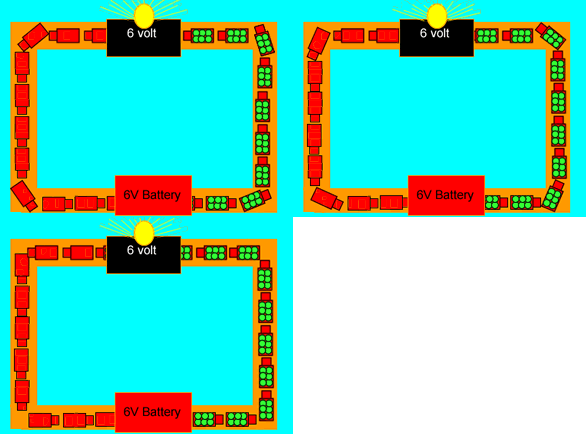
عند وصل البطارية في دائرة تحتوي على أسلاك موصلة يتكون مجال كهربائي يعمل على إعطاء طاقة للشحنات الخارجة منها التي تصطدم مع الشحنات الموجودة في الأسلاك الموصلة وتوجه حركتها وتدفعها في أجزاء الدائرة. When a battery is connected in a circuit containing conducting wires, an electric field is established that gives energy to the outgoing charges, which collide with charges in the wires, directing their motion and driving them through the circuit parts.
البطارية تبذل قوة على الشحنات f وتعطيها طاقة كهربائية e وتدفعها وتحركها في الدائرة m لذلك يرمز لفرق الجهد الناتج عن البطارية: The battery exerts a force on charges, gives them electrical energy, and drives them in the circuit, so the resulting voltage is denoted: \[V_{emf}\]
مثال 1) البطارية توفر فرق جهد ذا قيمة ثابتة بينما لا توفر تيارًا ثابتًا. ما هو السبب؟ Example 1) The battery provides a constant voltage but does not provide a constant current. What is the reason?


مثال 2) بطارية قابلة للشحن كتب عليها \[ 2500 mAh\] ما مقدار الشحنة التي توفرها؟ Example 2) A rechargeable battery is rated \[ 2500 mAh\]. How much charge does it provide?

قام أحد الطلاب بقياس فرق الجهد بين طرفي بطارية: - والدائرة مفتوحة - ومرة ثانية والدائرة مغلقة فكانت القياسات الموضحة بالشكل: A student measured the voltage across a battery terminals: - with open circuit - and again with closed circuit. The measurements are shown in the figure:

لتحديد السبب أجري التجربة التالية: هناك دائرتين إحداهما مغلقة والثانية مفتوحة. To determine the reason, the following experiment was conducted: There are two circuits, one closed and the other open.
قارن بين قراءة جهاز الفولتميتر لكلا الدائرتين. إن الدائرة المغلقة حدث بها ضياع في جهد المصدر. السبب في ذلك يوجد داخل البطارية مقاومة تدعى المقاومة الداخلية يرمز لها بالرمز (r) وتقدر بوحدة أوم (Ω). Compare the voltmeter reading for both circuits. In the closed circuit, there is a loss in the source voltage. The reason is that inside the battery there is a resistance called internal resistance denoted by (r) and measured in ohms (Ω).
قم بحساب قيمة المقاومة الداخلية للبطارية من خلال الجهد الذي فقد وقيمة التيار المار في الدائرة: r = Vr / I Calculate the internal resistance of the battery from the lost voltage and the current in the circuit: r = Vr / I

عند قياس فرق الجهد بين طرفي البطارية والدائرة مفتوحة يدعى القوة المحركة الدافعة (emf). لم تظهر قيمة المقاومة الداخلية إلا إذا مر تيار بها. أما عند القياس والدائرة مغلقة فهذا يدعى فرق الجهد وهو أصغر دائمًا من القوة المحركة الدافعة. When measuring the voltage across the battery terminals with an open circuit, it is called electromotive force (emf). The internal resistance value does not appear unless current flows through it. When measuring with a closed circuit, it is called terminal voltage, which is always less than the electromotive force.
\[5 \star \star\]فإن قيمة المقاومة الداخلية للبطارية تعادل A circuit is connected to a \[4 Ω\] resistor and a switch. A voltmeter connected across the circuit reads \[12V\] when the switch is open and \[10V\] when the switch is closed.
The internal resistance of the battery is:

 اضغط هنا تظهر طريقة الحلClick here to show the solution
التوصيل على التوالي يسير التيار الكهربائي في مسار واحد ويمر بجميع مكونات الدارة
التوصيل على التوالي يكون مقدار التيار المار في كل مكون من مكونات الدارة متساوياً والجهد للمصدر يتوزع على المقاومات وترتفع قيمة المقاومة المكافئة In series connection, the electric current flows in a single path and passes through all components.
In series, the current through each component is the same, and the source voltage is distributed across the resistors, while the equivalent resistance increases.
تجربة: دائرة المقاومات على التواليExperiment: Series Resistors Circuit
تعليمات:Instructions:
1. قم بإدخال قيم المقاومات (R1, R2, R3) في الحقول المخصصة1. Enter the resistor values (R1, R2, R3) in the designated fields.
2. أدخل قيمة الجهد الكلي (V_tot) أو التيار الكلي (I_tot)2. Enter the total voltage (V_tot) or total current (I_tot).
3. قم بحساب القيم الأخرى بناءً على قوانين دوائر التوالي3. Calculate the other values based on series circuit laws.
4. اضغط على زر "تصحيح الإجابات" للتحقق من صحة إجاباتك4. Click "Check Answers" to verify your answers.
| \[R_{eq}\]=?Ω | \[R_{3}\]= Ω | \[R_{2}\]= Ω | \[R_{1}\]= Ω |
| \[I_{tot}\]=A | \[I_{3}\]=A | \[I_{2}\]=A | \[I_{1}=\]A |
| \[V_{tot}\]=V | \[V_{3}\]=V | \[V_{2}\]=V | \[V_{1}\]=V |
| \[R_{eq} = \frac{V_{tot}}{I_{tot}}\] \[R_{eq}\] = ........ | \[R_{eq} = R_1 + R_2 + R_3\] \[R_{eq} \]= ........ | ماذا تستنتج في التيار المار في المقاوماتWhat do you conclude about the current through the resistors? | ماذا تستنتج في فرق الجهد بين طرفي كل مقاومWhat do you conclude about the voltage across each resistor? |

اختر الإجابة الصحيحةChoose the correct answer
اضغط هنا تظهر طريقة الحلClick here to show the solution

اختر الإجابة الصحيحةChoose the correct answer
اضغط هنا تظهر طريقة الحلClick here to show the solution
التوصيل على التوازي عندما يسير التيار الكهربائي بأكثر من مسار واحد ويمر بجميع مكونات الدارة
في حالة التوصيل على التوازي يتوزع التيار المار في مكونات الدارة كلا حسب مقاومتة والجهد للمصدر يعادل الجهد لكل فرع من أفرع التوازي In parallel connection, the electric current flows through multiple paths and passes through all components.
In parallel, the current distributes among components according to their resistance, and the source voltage equals the voltage across each branch.
تجربة: دائرة المقاومات على التوازيExperiment: Parallel Resistors Circuit
تعليمات:Instructions:
1. قم بإدخال قيم المقاومات (R1, R2, R3) في الحقول المخصصة1. Enter the resistor values (R1, R2, R3) in the designated fields.
2. أدخل قيمة الجهد الكلي (V_tot)2. Enter the total voltage (V_tot).
3. قم بحساب القيم الأخرى بناءً على قوانين دوائر التوازي3. Calculate the other values based on parallel circuit laws.
4. اضغط على زر "تصحيح الإجابات" للتحقق من صحة إجاباتك4. Click "Check Answers" to verify your answers.
| \[R_{eq}\]=? Ω | \[R_{3}\]= Ω | \[R_{2}\]= Ω | \[R_{1}\]= Ω |
| \[I_{tot}\]= A | \[I_{3}\]= A | \[I_{2}\]= A | \[I_{1}\]= A |
| \[V_{tot}\]= V | \[V_{3}\]= V | \[V_{2}\]= V | \[V_{1}\]= V |
| \[R_{eq} = \frac{V_{tot}}{I_{tot}}\] \[R_{eq} \]= ........ |
\[\frac{1}{R_{eq}} = \frac{1}{R_1} + \frac{1}{R_2} + \frac{1}{R_3}\] \[R_{eq}\] = ........ |
ماذا تستنتج في التيار المار في المقاوماتWhat do you conclude about the current through the resistors? |
ماذا تستنتج في فرق الجهد بين طرفي كل مقاومWhat do you conclude about the voltage across each resistor? |
 اضغط هنا تظهر طريقة الحلClick here to show the solution

 اضغط هنا تظهر طريقة الحلClick here to show the solution
 اضغط هنا تظهر طريقة الحلClick here to show the solution
 اضغط هنا تظهر طريقة الحلClick here to show the solution
الطاقة والقدرةEnergy and Power
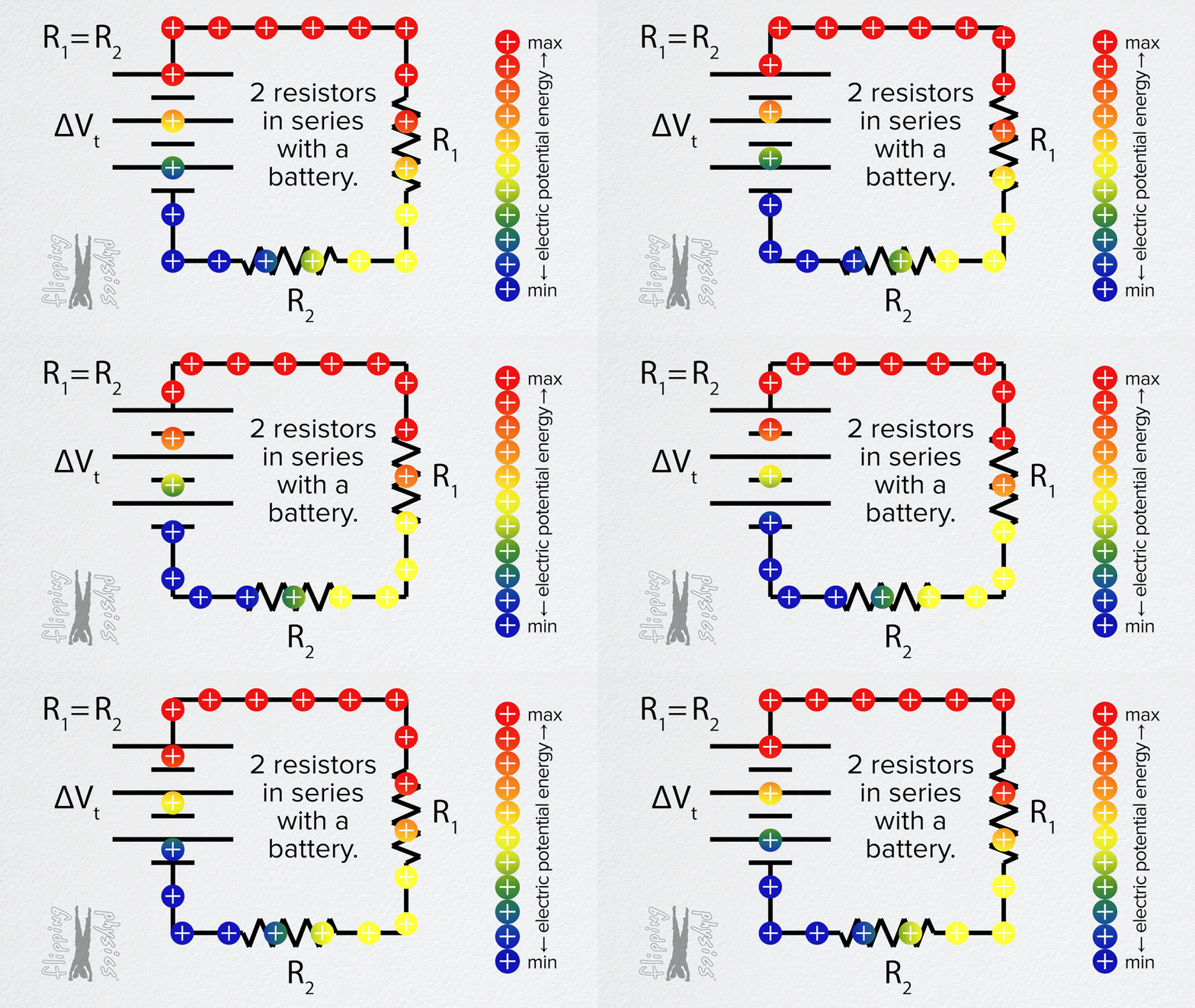
عند تطبيق فرق جهد في دائرة فإن القوة المحركة الكهربائية للبطارية تعمل على بذل شغل على الشحنات وتعطيها طاقة كهربائية
When a voltage is applied in a circuit, the battery's electromotive force does work on the charges and gives them electrical energy.
\[dU = dq . ∆𝑉\]
ونحن نعلم أنAnd we know that \[dq = I . dt\]
\[dU = I . dt .∆𝑉\]
\[\frac{𝑑𝑈}{dt}\] وهي معدل الطاقة المصروفة وتدعى القدرة ويرمز لها بالرمزis the rate of energy dissipation, called power, denoted by \[P\]
\[P = I . ∆𝑉\]
وتقدر بوحدة الوات في النظام الدوليIts unit is the watt in the SI system.
وحسب قانون أومAccording to Ohm's law \[R = \frac{∆𝑉}{I}\] يمكن كتابة القدرةpower can be written as \[𝑃= I^2. 𝑅\] \[𝑃= \frac{∆𝑉^2}{𝑅}\]

 اضغط هنا تظهر طريقة الحلClick here to show the solution
سطوع المصابيحBrightness of Lamps
عندما نتكلم عن سطوع المصابيح علينا أن نبحث عن القدرة كلما كانت قدرة المصباح أكبر كان سطوعه أكبر When we talk about the brightness of lamps, we need to consider power. The greater the power of the lamp, the greater its brightness.\[P = V.I = I^2.R =\frac{V^2}{R}\] \[P=\frac{W}{t}\]
هذه محاكاة عدة مصابيح متصلة ببعضها البعض قارن بين سطوع هذه المصابيح This is a simulation of several lamps connected together. Compare the brightness of these lamps.
هذه محاكاة لدائرة مركبة مع مصدر طاقة وأربعة مصابيح كهربائية متطابقة وثلاثة مفاتيح. افتح المفاتيح وأغلقها وقم بعمل تنبؤات حول كميات الجهد عبر المصابيح ، والتيارات عبر المصابيح ، وسطوع المصابيح (التي ترتبط بالطاقة التي يتبدد كل منها كحرارة وضوء). استخدم مربعات الاختيار لإظهار الفولتية والتيارات أو إخفائها. This is a simulation of a compound circuit with a power source, four identical electric lamps, and three switches. Open and close the switches and make predictions about the voltages across the lamps, the currents through the lamps, and the brightness of the lamps (which is related to the power each dissipates as heat and light). Use the checkboxes to show or hide voltages and currents.

اختر الإجابة الصحيحةChoose the correct answer
 اضغط هنا تظهر طريقة الحلClick here to show the solution

اختر الإجابة الصحيحةChoose the correct answer
 اضغط هنا تظهر طريقة الحلClick here to show the solution

اختر الإجابة الصحيحةChoose the correct answer
 اضغط هنا تظهر طريقة الحلClick here to show the solution

اختر الإجابة الصحيحةChoose the correct answer
 اضغط هنا تظهر طريقة الحلClick here to show the solution

تم بحمد الله شرح التيار الكهربائي والمقاومة وقانون أوم والمقاومة النوعية وتوصيل المقاومات على التوالي والتوازي والقدرة الكهربائية ومسائل متنوعة Praise be to Allah, we have covered Electric Current, Resistance, Ohm's Law, Resistivity, Series and Parallel Connections, Electric Power, and various problems.
من افضل المنصات اذا لم تكن الافضل
ReplyDeleteدرس ممتاز شكرا
ReplyDeleteافضل موقع تعليمي
ReplyDeleteشكراً على توضيح الدرس بطريقه مبتكره
ReplyDeleteدرس ممتاز
ReplyDelete