 Physics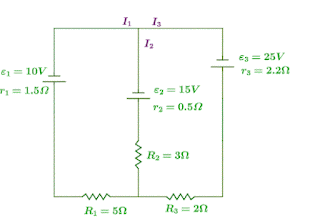
📄 اطبع pdf
00971504825082
قوانين كيرشوف
Kirchhoff's laws
⚡ قوانين كيرشوف وقنطرة وتستون
قانون التيار (KCL) - قانون الجهد (KVL) - قنطرة وتستون - أمثلة محلولة
📖 مقدمة
وضع العالم غوستاف كيرشوف قانونين أساسيين لتحليل الدوائر الكهربائية في القرن التاسع عشر، وهما حجر الزاوية في فهم سلوك التيار والجهد في الدوائر الإلكترونية.
أهمية القوانين:
- الهندسة الكهربائية
- هندسة الإلكترونيات
- أنظمة التحكم الآلي
- تصميم أنظمة الطاقة المتجددة
🔹 القانون الأول (قانون التيار - KCL)
النص: مجموع التيارات الداخلة إلى نقطة تفرع يساوي مجموع التيارات الخارجة منها
\[ \sum I_{in} = \sum I_{out} \]
📌 مثال تطبيقي:
إذا التقت أربع أسلاك في نقطة واحدة:
\[ I_1 + I_2 = I_3 + I_4 \]
🔹 طريقة حل المسائل:
- حدد جميع العقد في الدائرة
- ارسم اتجاهات التيار افتراضياً
- طبق KCL على كل عقدة
- حدد الحلقات المستقلة
- طبق KVL على كل حلقة
- حل نظام المعادلات الرياضي
🔹 القانون الثاني (قانون الجهد - KVL)
النص: مجموع الجهود في أي حلقة مغلقة يساوي صفراً
\[ \sum V = 0 \]
\[ V_{source} = V_1 + V_2 + V_3 + \cdots \]
📌 مثال تطبيقي:
في دائرة تحتوي على بطارية 12 فولت ومقاومتين:
\[ 12V - V_1 - V_2 = 0 \]
🔹 تطبيقات عملية:
- تصميم الدوائر الإلكترونية المعقدة
- تحليل أنظمة الطاقة الكهربائية
- أنظمة التحكم في السيارات الحديثة
- أنظمة التوزيع الكهربائي في المباني
- تحليل الأعطال في الشبكات الكهربائية
🧪 محاكاة قوانين كيرشوف
تعليمات الاستخدام:
- الأيقونة (1): تحديد التيارات الداخلة والخارجة عند الوصلة
- الأيقونة (2): تطبيق قانون الحلقات
- الأيقونة (3): إيجاد التيار وفرق الجهد في كل مقاوم
- المربع في الأعلى: تغيير قيم الدائرة
🔗 قنطرة وتستون (Wheatstone Bridge)
قنطرة وتستون هي دائرة كهربائية تُستخدم لقياس قيمة مقاومة مجهولة بدقة.
تحتوي القنطرة على أربع مقاومات وجهاز جلفانومتر، أحد هذه المقاومات متغيرة القيمة.
🔹 مبدأ العمل:
يتم تغيير قيمة المقاومة المتغيرة حتى نحصل على قراءة قدرها صفر في الجلفانومتر.
عندها نستطيع معرفة قيمة المقاومة المجهولة باستخدام معادلة التوازن.
🔹 معادلة التوازن:
\[ \frac{R_1}{R_2} = \frac{R_3}{R_x} \]
\[ R_x = \frac{R_2 \times R_3}{R_1} \]
🔹 العوامل المؤثرة:
- دقة المقاومات المعروفة
- استقرار مصدر الجهد
- حساسية الجلفانوميتر
- درجة الحرارة (تؤثر على قيم المقاومات)
🔹 التطبيقات العملية:
- قياس الإجهاد في المقاييس الانفعالية (Strain Gauges)
- كشف التغيرات في درجة الحرارة (مقاومات حرارية)
- أنظمة الإنذار بالأبواب والنوافذ
- قياس الضغط في المستشعرات الطبية
📌 مثال عملي:
في موازين الحمولة: عند وضع وزن على الميزان، يتغير شكل المقاييس الانفعالية مما يغير مقاومتها، ويُظهر التغير في قراءة الجلفانوميتر الوزن المطبق.
📝 مسائل محلولة على قوانين كيرشوف
اضغط على "عرض الحل" لكل مسألة لمشاهدة الخطوات التفصيلية
📌 المسألة الأولى (سهلة) - قانون كيرشوف الأول
المعطيات: في الدائرة الموضحة بالشكل، التيارات هي:
\( I_1 = 5A \) (داخل إلى العقدة)، \( I_2 = 3A \) (خارج من العقدة)، \( I_3 = 4A \) (خارج من العقدة).
المطلوب: أوجد قيمة \( I_4 \) واتجاهه باستخدام قانون كيرشوف الأول (KCL).
▸ الخطوة 1: كتابة قانون كيرشوف الأول
\[ \sum I_{in} = \sum I_{out} \]
\[ I_1 = I_2 + I_3 + I_4 \]
▸ الخطوة 2: التعويض بالقيم المعطاة
\[ 5 = 3 + 4 + I_4 \]
\[ 5 = 7 + I_4 \]
▸ الخطوة 3: إيجاد قيمة \( I_4 \)
\[ I_4 = 5 - 7 = -2A \]
▸ الخطوة 4: تحديد الاتجاه
الإشارة السالبة تعني أن الاتجاه الذي افترضناه كان خاطئاً،
إذن \( I_4 \) يكون داخل العقدة (اتجاه معاكس).
✅ الإجابة النهائية: \( I_4 = 2A \) للداخل
📌 المسألة الثانية (سهلة-متوسطة) - قانون كيرشوف الثاني
المعطيات: دائرة كهربائية تحتوي على بطارية جهدها \[ V = 24V \] ومقاومتان متصلتان على التوالي: \[ R_1 = 4\Omega \;\;\;\;\;\;\;\; R_2 = 8\Omega \].
المطلوب: أوجد جهد المقاومة \( R_2 \) باستخدام قانون كيرشوف الثاني (KVL).
▸ الخطوة 1: حساب المقاومة المكافئة (لأن الدائرة على التوالي)
\[ R_{eq} = R_1 + R_2 = 4 + 8 = 12\Omega \]
▸ الخطوة 2: حساب التيار الكلي باستخدام قانون أوم
\[ I = \frac{V}{R_{eq}} = \frac{24}{12} = 2A \]
▸ الخطوة 3: حساب جهد المقاومة \( R_2 \)
\[ V_2 = I \times R_2 = 2 \times 8 = 16V \]
▸ الخطوة 4: التحقق باستخدام KVL
\[ V - V_1 - V_2 = 24 - (2 \times 4) - 16 = 24 - 8 - 16 = 0 ✓ \]
✅ الإجابة النهائية: \( V_2 = 16V \)
📌 المسألة الثالثة (متوسطة)
المعطيات: دائرة كهربائية تحتوي على مقاومتين متصلتين على التوالي: \[ R_1 = 6\Omega \;\;\;\;\;\;\;\; R_2 = 12\Omega \]، ومصدر جهد \[ V = 18V \].
المطلوب: أوجد التيار المار في كل مقاومة وجهد كل مقاومة باستخدام قوانين كيرشوف.
▸ الخطوة 1: حساب المقاومة المكافئة
\[ R_{eq} = R_1 + R_2 = 6 + 12 = 18\Omega \]
▸ الخطوة 2: حساب التيار الكلي
\[ I = \frac{V}{R_{eq}} = \frac{18}{18} = 1A \]
في التوصيل على التوالي، التيار متساوٍ في جميع المقاومات: \( I_1 = I_2 = 1A \)
▸ الخطوة 3: حساب جهد كل مقاومة
\[ V_1 = I \times R_1 = 1 \times 6 = 6V \]
\[ V_2 = I \times R_2 = 1 \times 12 = 12V \]
▸ الخطوة 4: التحقق باستخدام KVL
\[ V - V_1 - V_2 = 18 - 6 - 12 = 0 ✓ \]
✅ الإجابات النهائية:
\( I_1 = I_2 = 1A \)
\( V_1 = 6V \)
\( V_2 = 12V \)
📌 المسألة الرابعة (متوسطة-صعبة) - دائرة مركبة
المعطيات: دائرة مركبة تحتوي على مقاومة \( 4\Omega \) على التوالي مع مجموعة متوازية من مقاومتين \( 6\Omega \) و \( 12\Omega \)، ومصدر جهد \( V = 48V \).
المطلوب: أوجد التيار الكلي والتيار المار في كل مقاومة من المجموعة المتوازية.
▸ الخطوة 1: حساب المقاومة المكافئة للمجموعة المتوازية
\[ \frac{1}{R_p} = \frac{1}{6} + \frac{1}{12} = \frac{2}{12} + \frac{1}{12} = \frac{3}{12} = \frac{1}{4} \]
\[ R_p = 4\Omega \]
▸ الخطوة 2: حساب المقاومة الكلية (توالي)
\[ R_{eq} = 4 + 4 = 8\Omega \]
▸ الخطوة 3: حساب التيار الكلي
\[ I = \frac{V}{R_{eq}} = \frac{48}{8} = 6A \]
▸ الخطوة 4: حساب جهد المجموعة المتوازية
\[ V_4 = I \times 4 = 6 \times 4 = 24V \]
جهد المجموعة المتوازية: \( V_p = 48 - 24 = 24V \)
▸ الخطوة 5: حساب التيارات في الفروع المتوازية
\[ I_6 = \frac{V_p}{6} = \frac{24}{6} = 4A \]
\[ I_{12} = \frac{V_p}{12} = \frac{24}{12} = 2A \]
▸ الخطوة 6: التحقق
\[ I = I_6 + I_{12} = 4 + 2 = 6A ✓ \]
✅ الإجابات النهائية:
التيار الكلي = 6A
تيار المقاومة 6Ω = 4A
تيار المقاومة 12Ω = 2A
📌 المسألة الخامسة (صعبة) - قنطرة وتستون
المعطيات: في قنطرة وتستون، المقاومات هي: \( R_1 = 10\Omega \), \( R_2 = 20\Omega \), \( R_3 = 15\Omega \).
المطلوب: أوجد قيمة المقاومة المجهولة \( R_x \) عند حالة التوازن (قراءة الجلفانومتر = صفر).
 ▸ الخطوة 1: كتابة معادلة التوازن لقنطرة وتستون
\[ \frac{R_1}{R_2} = \frac{R_3}{R_x} \]
(عند حالة التوازن، يكون التيار في الجلفانومتر = صفر)
▸ الخطوة 2: التعويض بالقيم المعطاة
\[ \frac{10}{20} = \frac{15}{R_x} \]
▸ الخطوة 3: حل المعادلة لإيجاد \( R_x \)
\[ 10 \times R_x = 20 \times 15 \]
\[ 10R_x = 300 \]
\[ R_x = \frac{300}{10} = 30\Omega \]
▸ الخطوة 4: التحقق
\[ \frac{10}{20} = \frac{15}{30} = 0.5 ✓ \]
✅ الإجابة النهائية: \( R_x = 30\Omega \)
⚡ Kirchhoff's Laws & Wheatstone Bridge
Current Law (KCL) - Voltage Law (KVL) - Wheatstone Bridge - Solved Examples
📖 Introduction
The scientist Gustav Kirchhoff established two fundamental laws for analyzing electrical circuits in the 19th century. These laws are the cornerstone of understanding current and voltage behavior in electronic circuits.
Importance:
- Electrical Engineering
- Electronics Engineering
- Automatic Control Systems
- Renewable Energy Systems Design
🔹 Kirchhoff's First Law (Current Law - KCL)
Statement: The sum of currents entering a junction equals the sum of currents leaving the junction
\[ \sum I_{in} = \sum I_{out} \]
📌 Example:
If four wires meet at one point:
\[ I_1 + I_2 = I_3 + I_4 \]
🔹 Problem-Solving Steps:
- Identify all nodes in the circuit
- Assume current directions
- Apply KCL at each node
- Identify independent loops
- Apply KVL on each loop
- Solve the system of equations
🔹 Kirchhoff's Second Law (Voltage Law - KVL)
Statement: The sum of voltages in any closed loop equals zero
\[ \sum V = 0 \]
\[ V_{source} = V_1 + V_2 + V_3 + \cdots \]
📌 Example:
In a circuit with a 12V battery and two resistors:
\[ 12V - V_1 - V_2 = 0 \]
🔹 Practical Applications:
- Complex electronic circuit design
- Power system analysis
- Modern automotive control systems
- Building electrical distribution
- Fault analysis in electrical networks
🧪 Kirchhoff's Laws Simulation
Instructions:
- Icon (1): Identify entering and leaving currents at junction
- Icon (2): Apply loop law
- Icon (3): Find current and voltage across each resistor
- Top box: Change circuit values
🔗 Wheatstone Bridge
Wheatstone Bridge is an electrical circuit used to measure an unknown resistance accurately.
It consists of four resistors and a galvanometer, with one variable resistor.
🔹 Principle of Operation:
The variable resistor is adjusted until the galvanometer reads zero.
At this point, the unknown resistance can be calculated using the balance equation.
🔹 Balance Equation:
\[ \frac{R_1}{R_2} = \frac{R_3}{R_x} \]
\[ R_x = \frac{R_2 \times R_3}{R_1} \]
🔹 Influencing Factors:
- Accuracy of known resistors
- Voltage source stability
- Galvanometer sensitivity
- Temperature (affects resistor values)
🔹 Practical Applications:
- Strain gauge measurement
- Temperature detection (thermal resistors)
- Door and window alarm systems
- Medical pressure sensors
📌 Practical Example:
In weighing scales: When weight is placed on the scale, the strain gauges change shape, altering their resistance. The change in the galvanometer reading indicates the applied weight.
📝 Solved Problems on Kirchhoff's Laws
Click "Show Solution" for each problem to see detailed steps
📌 Problem 1 (Easy) - Kirchhoff's Current Law
Given: In the circuit shown, the currents are:
\( I_1 = 5A \) (entering the node), \( I_2 = 3A \) (leaving the node), \( I_3 = 4A \) (leaving the node).
Required: Find \( I_4 \) and its direction using Kirchhoff's First Law (KCL).
▸ Step 1: Write Kirchhoff's First Law
\[ \sum I_{in} = \sum I_{out} \]
\[ I_1 = I_2 + I_3 + I_4 \]
▸ Step 2: Substitute the given values
\[ 5 = 3 + 4 + I_4 \]
\[ 5 = 7 + I_4 \]
▸ Step 3: Find \( I_4 \)
\[ I_4 = 5 - 7 = -2A \]
▸ Step 4: Determine direction
Negative sign means the assumed direction was wrong,
so \( I_4 \) is entering the node.
✅ Final Answer: \( I_4 = 2A \) entering
📌 Problem 2 (Easy-Medium) - Kirchhoff's Voltage Law
Given: A circuit with a 24V battery and two series resistors: \( R_1 = 4\Omega \) and \( R_2 = 8\Omega \).
Required: Find the voltage across \( R_2 \) using Kirchhoff's Second Law (KVL).
▸ Step 1: Calculate equivalent resistance (series)
\[ R_{eq} = R_1 + R_2 = 4 + 8 = 12\Omega \]
▸ Step 2: Calculate total current (Ohm's Law)
\[ I = \frac{V}{R_{eq}} = \frac{24}{12} = 2A \]
▸ Step 3: Calculate voltage across \( R_2 \)
\[ V_2 = I \times R_2 = 2 \times 8 = 16V \]
▸ Step 4: Verify using KVL
\[ V - V_1 - V_2 = 24 - 8 - 16 = 0 ✓ \]
✅ Final Answer: \( V_2 = 16V \)
📌 Problem 3 (Medium)
Given: A circuit with two series resistors: \( R_1 = 6\Omega \) and \( R_2 = 12\Omega \), and a voltage source \( V = 18V \).
Required: Find the current through each resistor and the voltage across each using Kirchhoff's Laws.
▸ Step 1: Calculate equivalent resistance
\[ R_{eq} = R_1 + R_2 = 6 + 12 = 18\Omega \]
▸ Step 2: Calculate total current
\[ I = \frac{V}{R_{eq}} = \frac{18}{18} = 1A \]
In series, current is the same through all resistors: \( I_1 = I_2 = 1A \)
▸ Step 3: Calculate voltage across each resistor
\[ V_1 = I \times R_1 = 1 \times 6 = 6V \]
\[ V_2 = I \times R_2 = 1 \times 12 = 12V \]
▸ Step 4: Verify using KVL
\[ V - V_1 - V_2 = 18 - 6 - 12 = 0 ✓ \]
✅ Final Answers:
\( I_1 = I_2 = 1A \)
\( V_1 = 6V \)
\( V_2 = 12V \)
📌 Problem 4 (Medium-Hard) - Combined Circuit
Given: A combined circuit with a \( 4\Omega \) resistor in series with a parallel combination of \( 6\Omega \) and \( 12\Omega \), connected to a \( V = 48V \) source.
Required: Find the total current and the current through each resistor in the parallel group.
▸ Step 1: Calculate equivalent resistance of parallel group
\[ \frac{1}{R_p} = \frac{1}{6} + \frac{1}{12} = \frac{2}{12} + \frac{1}{12} = \frac{3}{12} = \frac{1}{4} \]
\[ R_p = 4\Omega \]
▸ Step 2: Calculate total resistance (series)
\[ R_{eq} = 4 + 4 = 8\Omega \]
▸ Step 3: Calculate total current
\[ I = \frac{V}{R_{eq}} = \frac{48}{8} = 6A \]
▸ Step 4: Calculate voltage across parallel group
\[ V_4 = I \times 4 = 6 \times 4 = 24V \]
Voltage across parallel group: \( V_p = 48 - 24 = 24V \)
▸ Step 5: Calculate currents in parallel branches
\[ I_6 = \frac{V_p}{6} = \frac{24}{6} = 4A \]
\[ I_{12} = \frac{V_p}{12} = \frac{24}{12} = 2A \]
▸ Step 6: Verify
\[ I = I_6 + I_{12} = 4 + 2 = 6A ✓ \]
✅ Final Answers:
Total current = 6A
Current through 6Ω = 4A
Current through 12Ω = 2A
📌 Problem 5 (Hard) - Wheatstone Bridge
Given: In a Wheatstone bridge, the resistors are: \( R_1 = 10\Omega \), \( R_2 = 20\Omega \), \( R_3 = 15\Omega \).
Required: Find the unknown resistance \( R_x \) at balance condition (galvanometer reading = zero).
▸ Step 1: Write the balance equation for Wheatstone bridge
\[ \frac{R_1}{R_2} = \frac{R_3}{R_x} \]
(At balance condition, current through galvanometer = zero)
▸ Step 2: Substitute the given values
\[ \frac{10}{20} = \frac{15}{R_x} \]
▸ Step 3: Solve for \( R_x \)
\[ 10 \times R_x = 20 \times 15 \]
\[ 10R_x = 300 \]
\[ R_x = \frac{300}{10} = 30\Omega \]
▸ Step 4: Verify
\[ \frac{10}{20} = \frac{15}{30} = 0.5 ✓ \]
✅ Final Answer: \( R_x = 30\Omega \)
قوانين كيرشوف
|
⚡ قوانين كيرشوف وقنطرة وتستون
قانون التيار (KCL) - قانون الجهد (KVL) - قنطرة وتستون - أمثلة محلولة
📖 مقدمة
وضع العالم غوستاف كيرشوف قانونين أساسيين لتحليل الدوائر الكهربائية في القرن التاسع عشر، وهما حجر الزاوية في فهم سلوك التيار والجهد في الدوائر الإلكترونية.
أهمية القوانين:
- الهندسة الكهربائية
- هندسة الإلكترونيات
- أنظمة التحكم الآلي
- تصميم أنظمة الطاقة المتجددة
🔹 القانون الأول (قانون التيار - KCL)
النص: مجموع التيارات الداخلة إلى نقطة تفرع يساوي مجموع التيارات الخارجة منها
📌 مثال تطبيقي:
إذا التقت أربع أسلاك في نقطة واحدة: \[ I_1 + I_2 = I_3 + I_4 \]
🔹 طريقة حل المسائل:
- حدد جميع العقد في الدائرة
- ارسم اتجاهات التيار افتراضياً
- طبق KCL على كل عقدة
- حدد الحلقات المستقلة
- طبق KVL على كل حلقة
- حل نظام المعادلات الرياضي
🔹 القانون الثاني (قانون الجهد - KVL)
النص: مجموع الجهود في أي حلقة مغلقة يساوي صفراً
📌 مثال تطبيقي:
في دائرة تحتوي على بطارية 12 فولت ومقاومتين: \[ 12V - V_1 - V_2 = 0 \]
🔹 تطبيقات عملية:
- تصميم الدوائر الإلكترونية المعقدة
- تحليل أنظمة الطاقة الكهربائية
- أنظمة التحكم في السيارات الحديثة
- أنظمة التوزيع الكهربائي في المباني
- تحليل الأعطال في الشبكات الكهربائية
🧪 محاكاة قوانين كيرشوف
تعليمات الاستخدام:
- الأيقونة (1): تحديد التيارات الداخلة والخارجة عند الوصلة
- الأيقونة (2): تطبيق قانون الحلقات
- الأيقونة (3): إيجاد التيار وفرق الجهد في كل مقاوم
- المربع في الأعلى: تغيير قيم الدائرة
🔗 قنطرة وتستون (Wheatstone Bridge)
قنطرة وتستون هي دائرة كهربائية تُستخدم لقياس قيمة مقاومة مجهولة بدقة.
تحتوي القنطرة على أربع مقاومات وجهاز جلفانومتر، أحد هذه المقاومات متغيرة القيمة.
🔹 مبدأ العمل:
يتم تغيير قيمة المقاومة المتغيرة حتى نحصل على قراءة قدرها صفر في الجلفانومتر.
عندها نستطيع معرفة قيمة المقاومة المجهولة باستخدام معادلة التوازن.
🔹 معادلة التوازن:
🔹 العوامل المؤثرة:
- دقة المقاومات المعروفة
- استقرار مصدر الجهد
- حساسية الجلفانوميتر
- درجة الحرارة (تؤثر على قيم المقاومات)
🔹 التطبيقات العملية:
- قياس الإجهاد في المقاييس الانفعالية (Strain Gauges)
- كشف التغيرات في درجة الحرارة (مقاومات حرارية)
- أنظمة الإنذار بالأبواب والنوافذ
- قياس الضغط في المستشعرات الطبية
📌 مثال عملي:
في موازين الحمولة: عند وضع وزن على الميزان، يتغير شكل المقاييس الانفعالية مما يغير مقاومتها، ويُظهر التغير في قراءة الجلفانوميتر الوزن المطبق.
📝 مسائل محلولة على قوانين كيرشوف
اضغط على "عرض الحل" لكل مسألة لمشاهدة الخطوات التفصيلية
📌 المسألة الأولى (سهلة) - قانون كيرشوف الأول
المعطيات: في الدائرة الموضحة بالشكل، التيارات هي:
\( I_1 = 5A \) (داخل إلى العقدة)، \( I_2 = 3A \) (خارج من العقدة)، \( I_3 = 4A \) (خارج من العقدة).
المطلوب: أوجد قيمة \( I_4 \) واتجاهه باستخدام قانون كيرشوف الأول (KCL).
\[ \sum I_{in} = \sum I_{out} \]
\[ I_1 = I_2 + I_3 + I_4 \]
\[ 5 = 3 + 4 + I_4 \]
\[ 5 = 7 + I_4 \]
\[ I_4 = 5 - 7 = -2A \]
الإشارة السالبة تعني أن الاتجاه الذي افترضناه كان خاطئاً،
إذن \( I_4 \) يكون داخل العقدة (اتجاه معاكس).
📌 المسألة الثانية (سهلة-متوسطة) - قانون كيرشوف الثاني
المعطيات: دائرة كهربائية تحتوي على بطارية جهدها \[ V = 24V \] ومقاومتان متصلتان على التوالي: \[ R_1 = 4\Omega \;\;\;\;\;\;\;\; R_2 = 8\Omega \].
المطلوب: أوجد جهد المقاومة \( R_2 \) باستخدام قانون كيرشوف الثاني (KVL).
\[ R_{eq} = R_1 + R_2 = 4 + 8 = 12\Omega \]
\[ I = \frac{V}{R_{eq}} = \frac{24}{12} = 2A \]
\[ V_2 = I \times R_2 = 2 \times 8 = 16V \]
\[ V - V_1 - V_2 = 24 - (2 \times 4) - 16 = 24 - 8 - 16 = 0 ✓ \]
📌 المسألة الثالثة (متوسطة)
المعطيات: دائرة كهربائية تحتوي على مقاومتين متصلتين على التوالي: \[ R_1 = 6\Omega \;\;\;\;\;\;\;\; R_2 = 12\Omega \]، ومصدر جهد \[ V = 18V \].
المطلوب: أوجد التيار المار في كل مقاومة وجهد كل مقاومة باستخدام قوانين كيرشوف.
\[ R_{eq} = R_1 + R_2 = 6 + 12 = 18\Omega \]
\[ I = \frac{V}{R_{eq}} = \frac{18}{18} = 1A \]
في التوصيل على التوالي، التيار متساوٍ في جميع المقاومات: \( I_1 = I_2 = 1A \)
\[ V_1 = I \times R_1 = 1 \times 6 = 6V \]
\[ V_2 = I \times R_2 = 1 \times 12 = 12V \]
\[ V - V_1 - V_2 = 18 - 6 - 12 = 0 ✓ \]
\( I_1 = I_2 = 1A \)
\( V_1 = 6V \)
\( V_2 = 12V \)
📌 المسألة الرابعة (متوسطة-صعبة) - دائرة مركبة
المعطيات: دائرة مركبة تحتوي على مقاومة \( 4\Omega \) على التوالي مع مجموعة متوازية من مقاومتين \( 6\Omega \) و \( 12\Omega \)، ومصدر جهد \( V = 48V \).
المطلوب: أوجد التيار الكلي والتيار المار في كل مقاومة من المجموعة المتوازية.
\[ \frac{1}{R_p} = \frac{1}{6} + \frac{1}{12} = \frac{2}{12} + \frac{1}{12} = \frac{3}{12} = \frac{1}{4} \]
\[ R_p = 4\Omega \]
\[ R_{eq} = 4 + 4 = 8\Omega \]
\[ I = \frac{V}{R_{eq}} = \frac{48}{8} = 6A \]
\[ V_4 = I \times 4 = 6 \times 4 = 24V \]
جهد المجموعة المتوازية: \( V_p = 48 - 24 = 24V \)
\[ I_6 = \frac{V_p}{6} = \frac{24}{6} = 4A \]
\[ I_{12} = \frac{V_p}{12} = \frac{24}{12} = 2A \]
\[ I = I_6 + I_{12} = 4 + 2 = 6A ✓ \]
التيار الكلي = 6A
تيار المقاومة 6Ω = 4A
تيار المقاومة 12Ω = 2A
📌 المسألة الخامسة (صعبة) - قنطرة وتستون
المعطيات: في قنطرة وتستون، المقاومات هي: \( R_1 = 10\Omega \), \( R_2 = 20\Omega \), \( R_3 = 15\Omega \).
المطلوب: أوجد قيمة المقاومة المجهولة \( R_x \) عند حالة التوازن (قراءة الجلفانومتر = صفر).

\[ \frac{R_1}{R_2} = \frac{R_3}{R_x} \]
(عند حالة التوازن، يكون التيار في الجلفانومتر = صفر)
\[ \frac{10}{20} = \frac{15}{R_x} \]
\[ 10 \times R_x = 20 \times 15 \]
\[ 10R_x = 300 \]
\[ R_x = \frac{300}{10} = 30\Omega \]
\[ \frac{10}{20} = \frac{15}{30} = 0.5 ✓ \]
⚡ Kirchhoff's Laws & Wheatstone Bridge
Current Law (KCL) - Voltage Law (KVL) - Wheatstone Bridge - Solved Examples
📖 Introduction
The scientist Gustav Kirchhoff established two fundamental laws for analyzing electrical circuits in the 19th century. These laws are the cornerstone of understanding current and voltage behavior in electronic circuits.
Importance:
- Electrical Engineering
- Electronics Engineering
- Automatic Control Systems
- Renewable Energy Systems Design
🔹 Kirchhoff's First Law (Current Law - KCL)
Statement: The sum of currents entering a junction equals the sum of currents leaving the junction
📌 Example:
If four wires meet at one point: \[ I_1 + I_2 = I_3 + I_4 \]
🔹 Problem-Solving Steps:
- Identify all nodes in the circuit
- Assume current directions
- Apply KCL at each node
- Identify independent loops
- Apply KVL on each loop
- Solve the system of equations
🔹 Kirchhoff's Second Law (Voltage Law - KVL)
Statement: The sum of voltages in any closed loop equals zero
📌 Example:
In a circuit with a 12V battery and two resistors: \[ 12V - V_1 - V_2 = 0 \]
🔹 Practical Applications:
- Complex electronic circuit design
- Power system analysis
- Modern automotive control systems
- Building electrical distribution
- Fault analysis in electrical networks
🧪 Kirchhoff's Laws Simulation
Instructions:
- Icon (1): Identify entering and leaving currents at junction
- Icon (2): Apply loop law
- Icon (3): Find current and voltage across each resistor
- Top box: Change circuit values
🔗 Wheatstone Bridge
Wheatstone Bridge is an electrical circuit used to measure an unknown resistance accurately.
It consists of four resistors and a galvanometer, with one variable resistor.
🔹 Principle of Operation:
The variable resistor is adjusted until the galvanometer reads zero.
At this point, the unknown resistance can be calculated using the balance equation.
🔹 Balance Equation:
🔹 Influencing Factors:
- Accuracy of known resistors
- Voltage source stability
- Galvanometer sensitivity
- Temperature (affects resistor values)
🔹 Practical Applications:
- Strain gauge measurement
- Temperature detection (thermal resistors)
- Door and window alarm systems
- Medical pressure sensors
📌 Practical Example:
In weighing scales: When weight is placed on the scale, the strain gauges change shape, altering their resistance. The change in the galvanometer reading indicates the applied weight.
📝 Solved Problems on Kirchhoff's Laws
Click "Show Solution" for each problem to see detailed steps
📌 Problem 1 (Easy) - Kirchhoff's Current Law
Given: In the circuit shown, the currents are:
\( I_1 = 5A \) (entering the node), \( I_2 = 3A \) (leaving the node), \( I_3 = 4A \) (leaving the node).
Required: Find \( I_4 \) and its direction using Kirchhoff's First Law (KCL).
\[ \sum I_{in} = \sum I_{out} \]
\[ I_1 = I_2 + I_3 + I_4 \]
\[ 5 = 3 + 4 + I_4 \]
\[ 5 = 7 + I_4 \]
\[ I_4 = 5 - 7 = -2A \]
Negative sign means the assumed direction was wrong,
so \( I_4 \) is entering the node.
📌 Problem 2 (Easy-Medium) - Kirchhoff's Voltage Law
Given: A circuit with a 24V battery and two series resistors: \( R_1 = 4\Omega \) and \( R_2 = 8\Omega \).
Required: Find the voltage across \( R_2 \) using Kirchhoff's Second Law (KVL).
\[ R_{eq} = R_1 + R_2 = 4 + 8 = 12\Omega \]
\[ I = \frac{V}{R_{eq}} = \frac{24}{12} = 2A \]
\[ V_2 = I \times R_2 = 2 \times 8 = 16V \]
\[ V - V_1 - V_2 = 24 - 8 - 16 = 0 ✓ \]
📌 Problem 3 (Medium)
Given: A circuit with two series resistors: \( R_1 = 6\Omega \) and \( R_2 = 12\Omega \), and a voltage source \( V = 18V \).
Required: Find the current through each resistor and the voltage across each using Kirchhoff's Laws.
\[ R_{eq} = R_1 + R_2 = 6 + 12 = 18\Omega \]
\[ I = \frac{V}{R_{eq}} = \frac{18}{18} = 1A \]
In series, current is the same through all resistors: \( I_1 = I_2 = 1A \)
\[ V_1 = I \times R_1 = 1 \times 6 = 6V \]
\[ V_2 = I \times R_2 = 1 \times 12 = 12V \]
\[ V - V_1 - V_2 = 18 - 6 - 12 = 0 ✓ \]
\( I_1 = I_2 = 1A \)
\( V_1 = 6V \)
\( V_2 = 12V \)
📌 Problem 4 (Medium-Hard) - Combined Circuit
Given: A combined circuit with a \( 4\Omega \) resistor in series with a parallel combination of \( 6\Omega \) and \( 12\Omega \), connected to a \( V = 48V \) source.
Required: Find the total current and the current through each resistor in the parallel group.
\[ \frac{1}{R_p} = \frac{1}{6} + \frac{1}{12} = \frac{2}{12} + \frac{1}{12} = \frac{3}{12} = \frac{1}{4} \]
\[ R_p = 4\Omega \]
\[ R_{eq} = 4 + 4 = 8\Omega \]
\[ I = \frac{V}{R_{eq}} = \frac{48}{8} = 6A \]
\[ V_4 = I \times 4 = 6 \times 4 = 24V \]
Voltage across parallel group: \( V_p = 48 - 24 = 24V \)
\[ I_6 = \frac{V_p}{6} = \frac{24}{6} = 4A \]
\[ I_{12} = \frac{V_p}{12} = \frac{24}{12} = 2A \]
\[ I = I_6 + I_{12} = 4 + 2 = 6A ✓ \]
Total current = 6A
Current through 6Ω = 4A
Current through 12Ω = 2A
📌 Problem 5 (Hard) - Wheatstone Bridge
Given: In a Wheatstone bridge, the resistors are: \( R_1 = 10\Omega \), \( R_2 = 20\Omega \), \( R_3 = 15\Omega \).
Required: Find the unknown resistance \( R_x \) at balance condition (galvanometer reading = zero).
\[ \frac{R_1}{R_2} = \frac{R_3}{R_x} \]
(At balance condition, current through galvanometer = zero)
\[ \frac{10}{20} = \frac{15}{R_x} \]
\[ 10 \times R_x = 20 \times 15 \]
\[ 10R_x = 300 \]
\[ R_x = \frac{300}{10} = 30\Omega \]
\[ \frac{10}{20} = \frac{15}{30} = 0.5 ✓ \]
No comments:
Post a Comment