 Physics
بنك الاسئلة القوى الكهروستاتيكية |

\[1 \star\]
\[2 \star\]
\[3 \star\]
شحنتين لهما نفس المقدار كما في الشكل المسافة بينهما 0.2 m فإذا كانت القوة الكهربائية المتبادلة بينهما تعادل 0.4 N فإن مقدار كل من الشحنتين يعادل

أختر الإجابة الصحيحة
أ\[q=1.77 \times 10^{-6}\;\;C\]
ب\[q=1.33 \times 10^{-6}\;\;C\]
ج\[q=4.85 \times 10^{-6}\;\;C\]
د\[q=8.62 \times 10^{-6}\;\;C\]
الحل:
• قانون كولوم: \(F = k \frac{q_1 q_2}{r^2}\)، حيث \(q_1 = q_2 = q\)
• \(F = k \frac{q^2}{r^2} \Rightarrow q = r \sqrt{\frac{F}{k}}\)
• \(q = 0.2 \times \sqrt{\frac{0.4}{8.99 \times 10^9}}\)
• \(q = 0.2 \times \sqrt{4.45 \times 10^{-11}} = 0.2 \times 6.67 \times 10^{-6}\)
• \(q = 1.33 \times 10^{-6}\) C
الإجابة الصحيحة: ب) \(q = 1.33 \times 10^{-6}\;\;C\)
Two charges of equal magnitude are placed 0.2 m apart as shown. If the electric force between them is 0.4 N, what is the magnitude of each charge?
Choose the correct answer
A\[q=1.77 \times 10^{-6}\;\;C\]
B\[q=1.33 \times 10^{-6}\;\;C\]
C\[q=4.85 \times 10^{-6}\;\;C\]
D\[q=8.62 \times 10^{-6}\;\;C\]
Solution:
• Coulomb's law: \(F = k \frac{q_1 q_2}{r^2}\), where \(q_1 = q_2 = q\)
• \(F = k \frac{q^2}{r^2} \Rightarrow q = r \sqrt{\frac{F}{k}}\)
• \(q = 0.2 \times \sqrt{\frac{0.4}{8.99 \times 10^9}}\)
• \(q = 0.2 \times \sqrt{4.45 \times 10^{-11}} = 0.2 \times 6.67 \times 10^{-6}\)
• \(q = 1.33 \times 10^{-6}\) C
Correct answer: B) \(q = 1.33 \times 10^{-6}\;\;C\)
4
كشاف كهربائي مشحون بشحنة موجبة تم تقريب منه جسم لوحظ ان ورقتي الكشاف قد زاد انفراجهما فإن الجسم

أختر الإجابة الصحيحة
أالجسم غير مشحون
بالجسم مشحون بشحنة سالبة
جلا يمكن تحديد شحنة الجسم لعدم ملامسة الكشاف
دالجسم مشحون بشحنة موجبة
الحل:
• الكشاف مشحون بشحنة موجبة، ورقاته متباعدة.
• عند تقريب جسم مشحون، إذا زاد انفراج الورقتين فهذا يعني أن الجسم مشحون بنفس نوع شحنة الكشاف.
• لأن الشحنات المتشابهة تتنافر، فتزداد قوة التنافر بين الورقتين.
الإجابة الصحيحة: د) الجسم مشحون بشحنة موجبة
An electroscope is charged positively. A body is brought near it and the leaves diverge further. What is the body?
Choose the correct answer
AThe body is uncharged
BThe body is negatively charged
CThe charge cannot be determined because it did not touch the electroscope
DThe body is positively charged
Solution:
• The electroscope is positively charged, and its leaves are diverged.
• When a charged body is brought near, if the leaves diverge further, it means the body has the same type of charge as the electroscope.
• Because like charges repel, increasing the repulsion between the leaves.
Correct answer: D) The body is positively charged
5
أحد الموصلات التالية قد زادت كتلته مع العلم حدث التقريب في الصورة A,B حدث تلامس في الصورة C,D

أختر الإجابة الصحيحة
أ\[A\]
ب\[B\]
ج\[C\]
د\[D\]
الحل:
• في حالة التقريب (A و B): تحدث إعادة توزيع للشحنات فقط، ولا تنتقل شحنات بين الجسمين.
• في حالة التلامس (C و D): تنتقل الشحنات بين الجسمين، مما يؤدي إلى تغير في كتلة الموصل (اكتساب أو فقدان إلكترونات).
• بما أن الكتلة زادت، فهذا يعني أن الموصل اكتسب إلكترونات (شحنة سالبة).
• في الشكل D، الموصل الأيمن يكتسب إلكترونات من الموصل الأيسر.
الإجابة الصحيحة: د) D
Which of the following conductors increased in mass? Note: In figures A and B, the object was brought near; in figures C and D, contact occurred.
Choose the correct answer
A\[A\]
B\[B\]
C\[C\]
D\[D\]
Solution:
• In the case of induction (A and B): Only charge redistribution occurs, no charge transfer between the objects.
• In the case of contact (C and D): Charges are transferred between the objects, resulting in a change in the conductor's mass (gaining or losing electrons).
• Since the mass increased, the conductor gained electrons (negative charge).
• In figure D, the right conductor gains electrons from the left conductor.
Correct answer: D) D
\[6 \star\]
كشاف كهربائي متعادل تم تقريب منة موصل مشحون بشحنة موجبة لوحظ أن الكشاف قد انفرجت ورقتاه فإن

أختر الإجابة الصحيحة
أالمقبض تم شحنه بشحنة موجبة والورقتين بشحنة سالبة
بالمقبض تم شحنه بشحنة سالبة والورقتين بشحنة موجبة
جالمقبض والورقتين تم شحنهما بشحنة موجبة
دالمقبض والورقتين تم شحنهما بشحنة سالبة
الحل:
• عند تقريب موصل مشحون موجب من كشاف متعادل، تحدث ظاهرة الحث الكهروستاتيكي.
• الشحنة الموجبة للموصل تجذب الإلكترونات الحرة في الكشاف نحو المقبض (الجزء القريب).
• بالتالي، المقبض يكتسب شحنة سالبة (لأن الإلكترونات تتراكم فيه)، بينما الورقتين تصبحان موجبتين (لأنها فقدت إلكترونات).
• الورقتان الموجبتان تتنافران فتتباعدان.
الإجابة الصحيحة: ب) المقبض شحنته سالبة والورقتين موجبتين
A neutral electroscope has a positively charged conductor brought near it. The leaves diverge. What happens?
Choose the correct answer
AThe handle is positively charged and the leaves are negatively charged
BThe handle is negatively charged and the leaves are positively charged
CThe handle and leaves are both positively charged
DThe handle and leaves are both negatively charged
Solution:
• When a positively charged conductor is brought near a neutral electroscope, electrostatic induction occurs.
• The positive charge of the conductor attracts free electrons in the electroscope toward the handle (the near part).
• Therefore, the handle gains a negative charge (electrons accumulate there), while the leaves become positively charged (they lost electrons).
• The positively charged leaves repel each other and diverge.
Correct answer: B) The handle is negatively charged and the leaves are positively charged
\[7 \star\]
موصلان متشابهان متعادلان تم تقريب جسم مشحون بشحنة موجبة كما في الشكل من الموصلين و تم ابعاد الموصلين عن بعضهما البعض دون ابعاد الجسم المشحون فان شحنة الموصلين

أختر الإجابة الصحيحة
أ(موجب الشحنة B)( سالب الشحنة A)
ب(سالب الشحنة B) (سالب الشحنة A)
ج(سالب الشحنة B)( موجب الشحنة A)
د(موجب الشحنة B)( موجب الشحنة A)
الحل:
• الجسم الموجب يجذب الإلكترونات الحرة في الموصلين.
• الإلكترونات تنتقل من الموصل A إلى الموصل B (لأن A أقرب للجسم الموجب).
• الموصل A يصبح سالب الشحنة (لأنه فقد إلكترونات).
• الموصل B يصبح موجب الشحنة (لأنه اكتسب إلكترونات).
• عند إبعاد الموصلين عن بعضهما دون إبعاد الجسم، تبقى الشحنات كما هي.
الإجابة الصحيحة: ج) (موجب الشحنة A)( سالب الشحنة B)
Two identical neutral conductors are brought near a positively charged body as shown. The conductors are separated from each other without removing the charged body. What are the charges on the conductors?
Choose the correct answer
A(A negative) (B positive)
B(A negative) (B negative)
C(A positive) (B negative)
D(A positive) (B positive)
Solution:
• The positive body attracts free electrons in the conductors.
• Electrons move from conductor A to conductor B (because A is closer to the positive body).
• Conductor A becomes positively charged (it lost electrons).
• Conductor B becomes negatively charged (it gained electrons).
• When the conductors are separated without removing the body, the charges remain as they are.
Correct answer: C) (A positive) (B negative)
8
موصلان متشابهان متعادلان تم تقريب جسم مشحون بشحنة سالبة كما في الشكل من الموصلين ثم تم التوصيل بالأرض ومن بعدها قطع الاتصال بالأرض و تم ابعاد الموصلين عن بعضهما البعض دون ابعاد الجسم المشحون فان شحنة الموصلين

أختر الإجابة الصحيحة
أ(موجب الشحنة B)( متعادل A)
ب(سالب الشحنة B) (متعادل A)
ج(موجب الشحنة B)( موجب الشحنة A)
د(سالب الشحنة B)( موجب الشحنة A)
الحل:
• الجسم السالب يطرد الإلكترونات من الموصل A إلى الموصل B.
• عند توصيل A بالأرض، تنتقل الإلكترونات الزائدة من A إلى الأرض (لأن الأرض أكبر موصل).
• بعد قطع الاتصال بالأرض، يصبح A متعادل (فقد الشحنات الزائدة).
• B يظل موجب الشحنة لأنه اكتسب إلكترونات من A قبل التأريض.
الإجابة الصحيحة: أ) (متعادل A)( موجب الشحنة B)
Two identical neutral conductors are brought near a negatively charged body as shown. Then they are connected to ground, and the ground connection is removed. The conductors are separated from each other without removing the charged body. What are the charges on the conductors?
Choose the correct answer
A(A neutral) (B positive)
B(A neutral) (B negative)
C(A positive) (B positive)
D(A positive) (B negative)
Solution:
• The negative body repels electrons from conductor A to conductor B.
• When A is connected to ground, excess electrons flow from A to ground (since ground is a larger conductor).
• After disconnecting from ground, A becomes neutral (lost excess charges).
• B remains positively charged because it gained electrons from A before grounding.
Correct answer: A) (A neutral) (B positive)
\[9 \star\]
موصلان متشابهان متعادلان تم تقريب جسم مشحون بشحنة موجبة كما في الشكل من الموصلين ثم تم التوصيل بالأرض ومن بعدها قطع الاتصال بالأرض و ابعد الجسم المشحون و تم ابعاد الموصلين عن بعضهما البعض فان شحنة الموصلين

أختر الإجابة الصحيحة
أ(سالب الشحنة B) (سالب الشحنة A)
ب(سالب الشحنة B)( موجب الشحنة A)
ج(موجب الشحنة B)(متعادل A)
د(متعادل B)( موجب الشحنة A)
الحل:
• الجسم الموجب يجذب الإلكترونات من A إلى B (حيث A أقرب للجسم).
• عند توصيل B بالأرض، تنتقل الإلكترونات الزائدة من B إلى الأرض.
• بعد قطع الاتصال بالأرض، يصبح B متعادل (فقد الإلكترونات الزائدة).
• يظل A سالب الشحنة لأنه فقد إلكترونات لـ B قبل التأريض.
• عند إبعاد الجسم المشحون، تبقى الشحنات كما هي (A سالب، B متعادل).
الإجابة الصحيحة: ج) (متعادل B)( سالب الشحنة A)
Two identical neutral conductors are brought near a positively charged body as shown. Then they are connected to ground, and the ground connection is removed. The charged body is removed, and the conductors are separated. What are the charges on the conductors?
Choose the correct answer
A(A negative) (B neutral)
B(A positive) (B negative)
C(A neutral) (B positive)
D(A positive) (B neutral)
Solution:
• The positive body attracts electrons from A to B (since A is closer to the body).
• When B is connected to ground, excess electrons flow from B to ground.
• After disconnecting from ground, B becomes neutral (lost excess electrons).
• A remains negatively charged because it lost electrons to B before grounding.
• When the charged body is removed, the charges remain as they are (A negative, B neutral).
Correct answer: C) (A negative) (B neutral)
10
بأي عامل يتغير البعد بين شحنتين إذا زادت القوة المتبادلة بين شحنتين إلى ثلاث أضعاف مع بقاء باقي العوامل ثابته

أختر الإجابة الصحيحة
أ\[r_2=3r_1\]
ب\[r_2=9r_1\]
ج\[r_2=0.577r_1\]
د\[r_2=0.11r_1\]
الحل:
• قانون كولوم: \(F = k \frac{q_1 q_2}{r^2}\)
• \(F_2 = 3F_1\)
• \(3F_1 = k \frac{q_1 q_2}{r_2^2}\) و \(F_1 = k \frac{q_1 q_2}{r_1^2}\)
• بقسمة المعادلتين: \(\frac{3F_1}{F_1} = \frac{r_1^2}{r_2^2} \Rightarrow 3 = \frac{r_1^2}{r_2^2}\)
• \(r_2^2 = \frac{r_1^2}{3} \Rightarrow r_2 = \frac{r_1}{\sqrt{3}} = 0.577 r_1\)
الإجابة الصحيحة: ج) \(r_2 = 0.577 r_1\)
By what factor does the distance between two charges change if the force between them increases to three times its original value, with all other factors remaining constant?
Choose the correct answer
A\[r_2=3r_1\]
B\[r_2=9r_1\]
C\[r_2=0.577r_1\]
D\[r_2=0.11r_1\]
Solution:
• Coulomb's law: \(F = k \frac{q_1 q_2}{r^2}\)
• \(F_2 = 3F_1\)
• \(3F_1 = k \frac{q_1 q_2}{r_2^2}\) and \(F_1 = k \frac{q_1 q_2}{r_1^2}\)
• Dividing the equations: \(\frac{3F_1}{F_1} = \frac{r_1^2}{r_2^2} \Rightarrow 3 = \frac{r_1^2}{r_2^2}\)
• \(r_2^2 = \frac{r_1^2}{3} \Rightarrow r_2 = \frac{r_1}{\sqrt{3}} = 0.577 r_1\)
Correct answer: C) \(r_2 = 0.577 r_1\)
\[11 \star\]
موصل متعادل تم تقريب جسم مشحون بشحنة سالبة دون الملامسة وتم ملامسة الموصل بالأرض ثم قطع الاتصال بالأرض وأبعد الجسم المشحون السالب عن الموصل فإن الموصل

أختر الإجابة الصحيحة
أبقي متعادل
بشحن بشحنة موجبة
جحدث إعادة ترتيب شحنات فقط
دشحن بشحنة سالبة
الحل:
• الجسم السالب يطرد الإلكترونات من الموصل إلى الأرض.
• عند ملامسة الموصل للأرض، تنتقل الإلكترونات من الموصل إلى الأرض.
• بعد قطع الاتصال بالأرض، يصبح الموصل موجب الشحنة (لأنه فقد إلكترونات).
• عند إبعاد الجسم السالب، تبقى الشحنة الموجبة في الموصل.
الإجابة الصحيحة: ب) شحن بشحنة موجبة
A neutral conductor has a negatively charged body brought near it without touching. The conductor is connected to ground, then the ground connection is removed. The negatively charged body is moved away. What is the final charge of the conductor?
Choose the correct answer
AIt remains neutral
BIt becomes positively charged
COnly charge rearrangement occurred
DIt becomes negatively charged
Solution:
• The negative body repels electrons from the conductor to the ground.
• When the conductor is connected to ground, electrons flow from the conductor to ground.
• After disconnecting from ground, the conductor becomes positively charged (it lost electrons).
• When the negative body is removed, the positive charge remains on the conductor.
Correct answer: B) It becomes positively charged
12
جسم كروي تم ملامسة الكرة بجسم مشحون لوحظ أن الكرة عند موقع التلامس قد اكتسب شحنة مشابه للجسم المشحون وباقي الجسم بقي متعادل فإن الجسم الكروي يعتبر

أختر الإجابة الصحيحة
أكرة فلزية
بكرة جرفيت
جكرة نحاسية
دكرة زجاجية
الحل:
• في الموصلات (مثل الفلزات والجرافيت والنحاس)، تنتقل الشحنات بسهولة عبر الجسم بأكمله.
• في العوازل (مثل الزجاج)، تبقى الشحنات في مكان التلامس ولا تنتقل إلى باقي الجسم.
• بما أن الشحنة اكتسبت فقط في منطقة التلامس وباقي الجسم بقي متعادل، فهذا يعني أن الجسم عازل.
الإجابة الصحيحة: د) كرة زجاجية
A spherical object is touched by a charged body. The point of contact acquires a charge similar to that of the charged body, while the rest of the object remains neutral. What type of object is it?
Choose the correct answer
AA metal sphere
BA graphite sphere
CA copper sphere
DA glass sphere
Solution:
• In conductors (such as metals, graphite, and copper), charges move easily throughout the entire object.
• In insulators (such as glass), charges remain at the point of contact and do not spread to the rest of the object.
• Since the charge was only acquired at the contact area and the rest of the object remained neutral, the object is an insulator.
Correct answer: D) A glass sphere
13
بالاعتماد على الشكل إدناه فإن الشحنة \(q_2\) نوعها والقوة الكهربائية التي تتأثر بها

أختر الإجابة الصحيحة
أ\[F_{12}= 10\;\; N\;\; \longrightarrow \;\;\;\;\;\;\] q_2 شحنتها موجبة
ب\[F_{12}= 5\;\; N\;\; \longleftarrow\;\;\;\;\;\;\] q_2 شحنتها موجبة
ج\[F_{12}= 5\;\; N\;\; \longleftarrow\;\;\;\;\;\;\] q_2 شحنتها سالبة
د\[F_{12}= 10\;\; N\;\; \longrightarrow\;\;\;\;\;\;\] q_2 شحنتها سالبة
الحل:
• في الشكل، القوة المؤثرة على \(q_1\) من \(q_2\) هي 10 N نحو اليمين.
• حسب قانون نيوتن الثالث، القوة التي تؤثر بها \(q_1\) على \(q_2\) هي 10 N نحو اليسار.
• بما أن \(q_1\) موجبة وتجذب \(q_2\)، فإن \(q_2\) سالبة الشحنة.
الإجابة الصحيحة: د) \(F_{12}=10\;\;N\;\;\longrightarrow\) \(q_2\) سالبة
Based on the figure below, what is the sign of charge \(q_2\) and what is the electric force acting on it?
Choose the correct answer
A\[F_{12}= 10\;\; N\;\; \longrightarrow \;\;\;\;\;\;\] \(q_2\) is positive
B\[F_{12}= 5\;\; N\;\; \longleftarrow\;\;\;\;\;\;\] \(q_2\) is positive
C\[F_{12}= 5\;\; N\;\; \longleftarrow\;\;\;\;\;\;\] \(q_2\) is negative
D\[F_{12}= 10\;\; N\;\; \longrightarrow\;\;\;\;\;\;\] \(q_2\) is negative
Solution:
• In the figure, the force on \(q_1\) from \(q_2\) is 10 N to the right.
• According to Newton's third law, the force exerted by \(q_1\) on \(q_2\) is 10 N to the left.
• Since \(q_1\) is positive and attracts \(q_2\), \(q_2\) is negatively charged.
Correct answer: D) \(F_{12}=10\;\;N\;\;\longrightarrow\) \(q_2\) is negative
\[14 \star\]
جسم مجهول الشحنة تم ملامسة الجسم مجهول الشحنة للكشاف فانفرجت ورقتي الكشاف أبعد الجسم مجهول الشحنة وتم تقريب جسم موجب الشحنة من الكشاف دون الملامسة لوحظ أن ورقتي الكشاف قد قل انفراجهما هذا دليل على أن الجسم مجهول الشحنة

أختر الإجابة الصحيحة
أالجسم مشحون بشحنة موجبة
بالجسم مشحون بشحنة سالبة
جالجسم فقد الكترونات
دالجسم غير مشحون
الحل:
• عند ملامسة الجسم للكشاف، انفرجت الورقتان مما يعني أن الكشاف اكتسب شحنة.
• عند تقريب جسم موجب الشحنة من الكشاف، قل انفراج الورقتين.
• هذا يعني أن شحنة الكشاف سالبة (لأن الشحنة الموجبة جذبت الإلكترونات وقللت التنافر).
• بما أن الجسم نقل شحنته إلى الكشاف، فإن الجسم كان سالب الشحنة.
الإجابة الصحيحة: ب) الجسم مشحون بشحنة سالبة
A body of unknown charge touches an electroscope, causing its leaves to diverge. The body is removed, and a positively charged object is brought near the electroscope without touching. The leaves are observed to collapse slightly. This indicates that the unknown body was:
Choose the correct answer
AThe body was positively charged
BThe body was negatively charged
CThe body lost electrons
DThe body was uncharged
Solution:
• When the body touched the electroscope, the leaves diverged, meaning the electroscope gained charge.
• When a positively charged object was brought near, the leaves collapsed slightly.
• This means the electroscope was negatively charged (the positive charge attracted electrons and reduced repulsion).
• Since the body transferred its charge to the electroscope, the body was negatively charged.
Correct answer: B) The body was negatively charged
15
كشاف كهربائي قاعدتة متصلة بالأرض تم تقريب جسم مشحون بشحنة سالبة من الكشاف دون الملامسة أحد الاشكال التالية تبين ماذا يحدث للكشاف

أختر الإجابة الصحيحة
أA
بB
جC
دD
الحل:
• الكشاف متصل بالأرض، لذلك يمكن للإلكترونات أن تنتقل بين الكشاف والأرض.
• عند تقريب جسم سالب، يطرد الإلكترونات من الكشاف إلى الأرض.
• يبقى الكشاف بشحنة موجبة (فقد إلكترونات).
• الورقتان تصبحان موجبتين فتتباعدان (كما في الشكل C).
الإجابة الصحيحة: ج) C
An electroscope with its base connected to ground has a negatively charged body brought near it without touching. Which of the following figures correctly shows what happens to the electroscope?
Choose the correct answer
AA
BB
CC
DD
Solution:
• The electroscope is connected to ground, so electrons can move between the electroscope and ground.
• When a negative body is brought near, it repels electrons from the electroscope to ground.
• The electroscope remains positively charged (it lost electrons).
• The leaves become positively charged and diverge (as shown in figure C).
Correct answer: C) C
16
تم دلك قضيب من الزجاج بقطعة من الصوف فأصبح القضيب الزجاجي مشحون بشحنة موجبة فإن القضيب
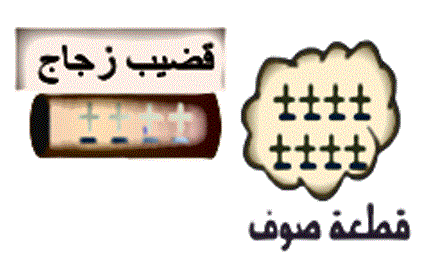
أختر الإجابة الصحيحة
أفقد بروتونات
بفقد إلكترونات
جاكتسب بروتونات
داكتسب إلكترونات
الحل:
• عند دلك الزجاج بالصوف، تنتقل الإلكترونات من الزجاج إلى الصوف.
• الزجاج يفقد إلكترونات، لذلك يصبح مشحوناً بشحنة موجبة.
• الصوف يكتسب إلكترونات، لذلك يصبح مشحوناً بشحنة سالبة.
الإجابة الصحيحة: ب) فقد إلكترونات
A glass rod is rubbed with a piece of wool and becomes positively charged. What happened to the rod?
Choose the correct answer
AIt lost protons
BIt lost electrons
CIt gained protons
DIt gained electrons
Solution:
• When glass is rubbed with wool, electrons transfer from the glass to the wool.
• The glass loses electrons, so it becomes positively charged.
• The wool gains electrons, so it becomes negatively charged.
Correct answer: B) It lost electrons
17
بأي عامل يتغير القوة الكهربائية بين شحنتين إذا زادت المسافة بين الشحنتين إلى الضعف مع بقاء باقي العوامل ثابته

أختر الإجابة الصحيحة
أ\[F_2=0.5 F_1\]
ب\[F_2=0.25 F_1\]
ج\[F_2=2 F_1\]
د\[F_2=2 F_1\]
الحل:
• قانون كولوم: \(F = k \frac{q_1 q_2}{r^2}\)
• \(r_2 = 2r_1\)
• \(F_2 = k \frac{q_1 q_2}{(2r_1)^2} = k \frac{q_1 q_2}{4r_1^2} = \frac{1}{4} F_1\)
الإجابة الصحيحة: ب) \(F_2 = 0.25 F_1\)
By what factor does the electric force between two charges change if the distance between them is doubled, with all other factors remaining constant?
Choose the correct answer
A\[F_2=0.5 F_1\]
B\[F_2=0.25 F_1\]
C\[F_2=2 F_1\]
D\[F_2=2 F_1\]
Solution:
• Coulomb's law: \(F = k \frac{q_1 q_2}{r^2}\)
• \(r_2 = 2r_1\)
• \(F_2 = k \frac{q_1 q_2}{(2r_1)^2} = k \frac{q_1 q_2}{4r_1^2} = \frac{1}{4} F_1\)
Correct answer: B) \(F_2 = 0.25 F_1\)
18
شحنتين مختلفتين في النوع مقدارها والابعاد موضحة أدناه \(q_1=2q\; C\;\;\;\;\; q_2=3q\; C\;\;\;\;\; r=0.1m\) فكانت القوة المتبادلة بين الشحنتين \(Fe=0.6 N\) فإن مقدار كل من الشحنتين تعادل

أختر الإجابة الصحيحة
أ\[q_1=2.22 \times 10^{-7}\;C\;\;\;\;\; q_2=3.33 \times 10^{-7}\;C\]
ب\[q_1=3.33 \times 10^{-7}\;C\;\;\;\;\; q_2=4.99 \times 10^{-7}\;C\]
ج\[q_1=6.66 \times 10^{-7}\;C\;\;\;\;\; q_2=3.33 \times 10^{-7}\;C\]
د\[q_1=1.11 \times 10^{-7}\;C\;\;\;\;\; q_2=1.66 \times 10^{-7}\;C\]
الحل:
• قانون كولوم: \(F = k \frac{q_1 q_2}{r^2} = k \frac{(2q)(3q)}{r^2} = k \frac{6q^2}{r^2}\)
• \(0.6 = 8.99 \times 10^9 \times \frac{6q^2}{(0.1)^2}\)
• \(0.6 = 8.99 \times 10^9 \times \frac{6q^2}{0.01} = 8.99 \times 10^9 \times 600 q^2\)
• \(q^2 = \frac{0.6}{8.99 \times 10^9 \times 600} = \frac{0.6}{5.394 \times 10^{12}} = 1.112 \times 10^{-13}\)
• \(q = 1.11 \times 10^{-7}\) C
• \(q_1 = 2q = 2.22 \times 10^{-7}\) C، \(q_2 = 3q = 3.33 \times 10^{-7}\) C
الإجابة الصحيحة: أ) \(q_1=2.22 \times 10^{-7}\;C\)، \(q_2=3.33 \times 10^{-7}\;C\)
Two charges of different types with magnitudes and distances as shown: \(q_1=2q\; C\;\;\;\;\; q_2=3q\; C\;\;\;\;\; r=0.1m\). The force between them is \(Fe=0.6 N\). What are the magnitudes of the charges?
Choose the correct answer
A\[q_1=2.22 \times 10^{-7}\;C\;\;\;\;\; q_2=3.33 \times 10^{-7}\;C\]
B\[q_1=3.33 \times 10^{-7}\;C\;\;\;\;\; q_2=4.99 \times 10^{-7}\;C\]
C\[q_1=6.66 \times 10^{-7}\;C\;\;\;\;\; q_2=3.33 \times 10^{-7}\;C\]
D\[q_1=1.11 \times 10^{-7}\;C\;\;\;\;\; q_2=1.66 \times 10^{-7}\;C\]
Solution:
• Coulomb's law: \(F = k \frac{q_1 q_2}{r^2} = k \frac{(2q)(3q)}{r^2} = k \frac{6q^2}{r^2}\)
• \(0.6 = 8.99 \times 10^9 \times \frac{6q^2}{(0.1)^2}\)
• \(0.6 = 8.99 \times 10^9 \times \frac{6q^2}{0.01} = 8.99 \times 10^9 \times 600 q^2\)
• \(q^2 = \frac{0.6}{8.99 \times 10^9 \times 600} = \frac{0.6}{5.394 \times 10^{12}} = 1.112 \times 10^{-13}\)
• \(q = 1.11 \times 10^{-7}\) C
• \(q_1 = 2q = 2.22 \times 10^{-7}\) C, \(q_2 = 3q = 3.33 \times 10^{-7}\) C
Correct answer: A) \(q_1=2.22 \times 10^{-7}\;C\), \(q_2=3.33 \times 10^{-7}\;C\)
19
كشاف كهربائي مشحون بشحنة سالبة تم تقريب جسم مشحون بشحنة سالبة من الكشاف دون الملامسة فإن ورقتي الكشاف

أختر الإجابة الصحيحة
ألا يتغير الانفراج للورقتين
بيقل الانفراج للورقتين
جيقل ثم يزداد الانفراج للورقتين
ديزداد الانفراج للورقتين
الحل:
• الكشاف مشحون سالباً، والورقتان سالبتان فتتباعدان.
• عند تقريب جسم سالب آخر، تزداد كمية الشحنة السالبة في الورقتين.
• تزداد قوة التنافر بين الورقتين، لذلك يزداد انفراجهما.
الإجابة الصحيحة: د) يزداد الانفراج للورقتين
A negatively charged electroscope has a negatively charged body brought near it without touching. What happens to the leaves?
Choose the correct answer
AThe divergence does not change
BThe divergence decreases
CThe divergence decreases then increases
DThe divergence increases
Solution:
• The electroscope is negatively charged, and the leaves are negative so they repel.
• When another negative body is brought near, the amount of negative charge on the leaves increases.
• The repulsive force between the leaves increases, so their divergence increases.
Correct answer: D) The divergence increases
20
يستخدم جهاز الترسيب الكهروستاتيكي في

أختر الإجابة الصحيحة
أطلاء السيارات
بطابعات الليزر
جتنقية انبعاث الغازات في المصانع
داستقبال الصواعق
الحل:
• جهاز الترسيب الكهروستاتيكي (Electrostatic Precipitator) يستخدم لإزالة الجسيمات الدقيقة من الغازات المنبعثة من المصانع.
• يعمل عن طريق شحن الجسيمات ثم جذبها بواسطة أقطاب كهربائية.
• يستخدم أيضاً في طلاء السيارات وطابعات الليزر، لكن استخدامه الأساسي هو تنقية الغازات.
الإجابة الصحيحة: ج) تنقية انبعاث الغازات في المصانع
The electrostatic precipitator is used in:
Choose the correct answer
ACar painting
BLaser printers
CPurifying industrial gas emissions
DLightning rods
Solution:
• The electrostatic precipitator is used to remove fine particles from industrial gas emissions.
• It works by charging the particles and then attracting them using electric electrodes.
• It is also used in car painting and laser printers, but its primary use is gas purification.
Correct answer: C) Purifying industrial gas emissions
\[21 \star\]
كاشف شحنات كهربائي مشحون بشحنة سالبة تم ملامسته بموصل لوحظ أن ورقتي الكشاف انطبقت ثم عاد الانفراج هذا دليل على أن الموصل

أختر الإجابة الصحيحة
أالموصل مشحون بشحنة سالبة
بالموصل مشحون بشحنة موجبة
جالموصل متعادل
دالموصل متغير الشحنة
الحل:
• الكشاف مشحون سالباً، والورقتان سالبتان.
• عند ملامسة موصل، إذا انطبقت الورقتان فهذا يعني أن الشحنة انتقلت من الكشاف إلى الموصل.
• ثم عاد الانفراج مما يعني أن الموصل أعطى الكشاف شحنة جديدة من نفس النوع (موجبة).
• هذا يحدث عندما يكون الموصل مشحوناً بشحنة موجبة أكبر من شحنة الكشاف.
الإجابة الصحيحة: ب) الموصل مشحون بشحنة موجبة
A negatively charged electroscope is touched by a conductor. The leaves first collapse and then diverge again. This indicates that the conductor is:
Choose the correct answer
AThe conductor is negatively charged
BThe conductor is positively charged
CThe conductor is neutral
DThe conductor has variable charge
Solution:
• The electroscope is negatively charged, and the leaves are negative.
• When a conductor touches it, if the leaves collapse, charge has transferred from the electroscope to the conductor.
• Then the leaves diverge again, meaning the conductor gave the electroscope a new charge of the same type (positive).
• This happens when the conductor is positively charged with a larger charge than the electroscope.
Correct answer: B) The conductor is positively charged
22
مكشاف كهربائي متعادل رتب بشكل صحيح خطوات شحن المكشاف الكهربائي دون الملامسة بشحنة سالبة

أختر الإجابة الصحيحة
أ\[B\;\;\Rightarrow\;\; D\;\;\Rightarrow\;\; C\;\;\Rightarrow A\;\;\;\;\;\; \]
ب\[D\;\;\Rightarrow\;\; B\;\;\Rightarrow\;\; C\;\;\Rightarrow A \;\;\;\;\;\;\]
ج\[C\;\;\Rightarrow\;\;B\;\;\Rightarrow\;\; A\;\;\Rightarrow D\;\;\;\;\;\; \]
د\[B\;\;\Rightarrow\;\; C\;\;\Rightarrow\;\; D\;\;\Rightarrow A\;\;\;\;\;\;\]
الحل:
• B: تقريب جسم سالب من الكشاف (دون ملامسة).
• D: ملامسة الكشاف بالأرض (تأريض).
• C: قطع الاتصال بالأرض.
• A: إبعاد الجسم السالب.
الإجابة الصحيحة: أ) B → D → C → A
A neutral electroscope. Arrange the correct steps for charging the electroscope by induction with a negative charge.
Choose the correct answer
A\[B\;\;\Rightarrow\;\; D\;\;\Rightarrow\;\; C\;\;\Rightarrow A\;\;\;\;\;\; \]
B\[D\;\;\Rightarrow\;\; B\;\;\Rightarrow\;\; C\;\;\Rightarrow A \;\;\;\;\;\;\]
C\[C\;\;\Rightarrow\;\;B\;\;\Rightarrow\;\; A\;\;\Rightarrow D\;\;\;\;\;\; \]
D\[B\;\;\Rightarrow\;\; C\;\;\Rightarrow\;\; D\;\;\Rightarrow A\;\;\;\;\;\;\]
Solution:
• B: Bring a negative body near the electroscope (without touching).
• D: Connect the electroscope to ground.
• C: Disconnect from ground.
• A: Remove the negative body.
Correct answer: A) B → D → C → A
1
شحنتين نفطيتين من نفس النوع مقدار الشحنة الأولى يعادل أربع أضعاف الثانية وضعت الشحنتين على مسافة من بغضهما قدرها \(r=0.4 m\) فتأثرت الشحنة الأولى بقوة نحو اليمين مقدارها
\(F_{21}=0.8 N\)

حدد مقدار واتجاه القوة المؤثرة على الشحنة الثانية
احسب مقدار كل من الشحنتين
الحل:
• القوة المؤثرة على الشحنة الثانية: \(F_{12} = 0.8 N\) نحو اليسار (حسب قانون نيوتن الثالث).
• \(F = k \frac{q_1 q_2}{r^2} = k \frac{(4q)(q)}{r^2} = k \frac{4q^2}{r^2}\)
• \(0.8 = 8.99 \times 10^9 \times \frac{4q^2}{(0.4)^2} = 8.99 \times 10^9 \times \frac{4q^2}{0.16}\)
• \(0.8 = 8.99 \times 10^9 \times 25q^2\)
• \(q^2 = \frac{0.8}{8.99 \times 10^9 \times 25} = \frac{0.8}{2.2475 \times 10^{11}} = 3.56 \times 10^{-12}\)
• \(q = \sqrt{3.56 \times 10^{-12}} = 1.89 \times 10^{-6}\) C
• \(q_1 = 4q = 7.56 \times 10^{-6}\) C
• \(q_2 = q = 1.89 \times 10^{-6}\) C
\(F_{12} = 0.8 N\) نحو اليسار، \(q_1 = 7.56 \times 10^{-6}\) C، \(q_2 = 1.89 \times 10^{-6}\) C
Two point charges of the same type, where the first charge is four times the second. They are placed 0.4 m apart. The first charge experiences a force of 0.8 N to the right.
Determine the magnitude and direction of the force on the second charge.
Calculate the magnitude of each charge.
Solution:
• The force on the second charge: \(F_{12} = 0.8 N\) to the left (Newton's third law).
• \(F = k \frac{q_1 q_2}{r^2} = k \frac{(4q)(q)}{r^2} = k \frac{4q^2}{r^2}\)
• \(0.8 = 8.99 \times 10^9 \times \frac{4q^2}{(0.4)^2} = 8.99 \times 10^9 \times \frac{4q^2}{0.16}\)
• \(0.8 = 8.99 \times 10^9 \times 25q^2\)
• \(q^2 = \frac{0.8}{8.99 \times 10^9 \times 25} = \frac{0.8}{2.2475 \times 10^{11}} = 3.56 \times 10^{-12}\)
• \(q = \sqrt{3.56 \times 10^{-12}} = 1.89 \times 10^{-6}\) C
• \(q_1 = 4q = 7.56 \times 10^{-6}\) C
• \(q_2 = q = 1.89 \times 10^{-6}\) C
\(F_{12} = 0.8 N\) to the left, \(q_1 = 7.56 \times 10^{-6}\) C, \(q_2 = 1.89 \times 10^{-6}\) C
2
شحنتين نفطيتين من نفس النوع مقدار الشحنة الأولى يعادل أربع أضعاف الثانية وضعت الشحنتين على مسافة من بغضهما قدرها \(r=0.4 m\) فتأثرت الشحنة الأولى بقوة نحو اليمين مقدارها \(F_{21}=0.8 N\)
احسب مقدار كل من الشحنتين
إذا زاد البعد بين الشحنتين إلى أربع أمثال كم تصبح القوة الكهربائية
الحل:
• من السؤال السابق: \(q_1 = 7.56 \times 10^{-6}\) C، \(q_2 = 1.89 \times 10^{-6}\) C
• \(r_2 = 4r_1 = 4 \times 0.4 = 1.6\) m
• \(F_2 = k \frac{q_1 q_2}{r_2^2} = 8.99 \times 10^9 \times \frac{(7.56 \times 10^{-6})(1.89 \times 10^{-6})}{(1.6)^2}\)
• \(F_2 = 8.99 \times 10^9 \times \frac{1.428 \times 10^{-11}}{2.56} = 8.99 \times 10^9 \times 5.58 \times 10^{-12}\)
• \(F_2 = 0.0502\) N
\(q_1 = 7.56 \times 10^{-6}\) C، \(q_2 = 1.89 \times 10^{-6}\) C، \(F_2 = 0.05\) N
Two point charges of the same type, where the first charge is four times the second. They are placed 0.4 m apart. The first charge experiences a force of 0.8 N to the right.
Calculate the magnitude of each charge.
If the distance between the charges is increased to four times its original value, what is the new electric force?
Solution:
• From the previous question: \(q_1 = 7.56 \times 10^{-6}\) C, \(q_2 = 1.89 \times 10^{-6}\) C
• \(r_2 = 4r_1 = 4 \times 0.4 = 1.6\) m
• \(F_2 = k \frac{q_1 q_2}{r_2^2} = 8.99 \times 10^9 \times \frac{(7.56 \times 10^{-6})(1.89 \times 10^{-6})}{(1.6)^2}\)
• \(F_2 = 8.99 \times 10^9 \times \frac{1.428 \times 10^{-11}}{2.56} = 8.99 \times 10^9 \times 5.58 \times 10^{-12}\)
• \(F_2 = 0.0502\) N
\(q_1 = 7.56 \times 10^{-6}\) C, \(q_2 = 1.89 \times 10^{-6}\) C, \(F_2 = 0.05\) N
شحنتين لهما نفس المقدار كما في الشكل المسافة بينهما 0.2 m فإذا كانت القوة الكهربائية المتبادلة بينهما تعادل 0.4 N فإن مقدار كل من الشحنتين يعادل
أختر الإجابة الصحيحة
Two charges of equal magnitude are placed 0.2 m apart as shown. If the electric force between them is 0.4 N, what is the magnitude of each charge?
Choose the correct answer
كشاف كهربائي مشحون بشحنة موجبة تم تقريب منه جسم لوحظ ان ورقتي الكشاف قد زاد انفراجهما فإن الجسم
أختر الإجابة الصحيحة
An electroscope is charged positively. A body is brought near it and the leaves diverge further. What is the body?
Choose the correct answer
أحد الموصلات التالية قد زادت كتلته مع العلم حدث التقريب في الصورة A,B حدث تلامس في الصورة C,D
أختر الإجابة الصحيحة
Which of the following conductors increased in mass? Note: In figures A and B, the object was brought near; in figures C and D, contact occurred.
Choose the correct answer
كشاف كهربائي متعادل تم تقريب منة موصل مشحون بشحنة موجبة لوحظ أن الكشاف قد انفرجت ورقتاه فإن
أختر الإجابة الصحيحة
A neutral electroscope has a positively charged conductor brought near it. The leaves diverge. What happens?
Choose the correct answer
موصلان متشابهان متعادلان تم تقريب جسم مشحون بشحنة موجبة كما في الشكل من الموصلين و تم ابعاد الموصلين عن بعضهما البعض دون ابعاد الجسم المشحون فان شحنة الموصلين
أختر الإجابة الصحيحة
Two identical neutral conductors are brought near a positively charged body as shown. The conductors are separated from each other without removing the charged body. What are the charges on the conductors?
Choose the correct answer
موصلان متشابهان متعادلان تم تقريب جسم مشحون بشحنة سالبة كما في الشكل من الموصلين ثم تم التوصيل بالأرض ومن بعدها قطع الاتصال بالأرض و تم ابعاد الموصلين عن بعضهما البعض دون ابعاد الجسم المشحون فان شحنة الموصلين
أختر الإجابة الصحيحة
Two identical neutral conductors are brought near a negatively charged body as shown. Then they are connected to ground, and the ground connection is removed. The conductors are separated from each other without removing the charged body. What are the charges on the conductors?
Choose the correct answer
موصلان متشابهان متعادلان تم تقريب جسم مشحون بشحنة موجبة كما في الشكل من الموصلين ثم تم التوصيل بالأرض ومن بعدها قطع الاتصال بالأرض و ابعد الجسم المشحون و تم ابعاد الموصلين عن بعضهما البعض فان شحنة الموصلين
أختر الإجابة الصحيحة
Two identical neutral conductors are brought near a positively charged body as shown. Then they are connected to ground, and the ground connection is removed. The charged body is removed, and the conductors are separated. What are the charges on the conductors?
Choose the correct answer
بأي عامل يتغير البعد بين شحنتين إذا زادت القوة المتبادلة بين شحنتين إلى ثلاث أضعاف مع بقاء باقي العوامل ثابته
أختر الإجابة الصحيحة
By what factor does the distance between two charges change if the force between them increases to three times its original value, with all other factors remaining constant?
Choose the correct answer
موصل متعادل تم تقريب جسم مشحون بشحنة سالبة دون الملامسة وتم ملامسة الموصل بالأرض ثم قطع الاتصال بالأرض وأبعد الجسم المشحون السالب عن الموصل فإن الموصل
أختر الإجابة الصحيحة
A neutral conductor has a negatively charged body brought near it without touching. The conductor is connected to ground, then the ground connection is removed. The negatively charged body is moved away. What is the final charge of the conductor?
Choose the correct answer
جسم كروي تم ملامسة الكرة بجسم مشحون لوحظ أن الكرة عند موقع التلامس قد اكتسب شحنة مشابه للجسم المشحون وباقي الجسم بقي متعادل فإن الجسم الكروي يعتبر
أختر الإجابة الصحيحة
A spherical object is touched by a charged body. The point of contact acquires a charge similar to that of the charged body, while the rest of the object remains neutral. What type of object is it?
Choose the correct answer
بالاعتماد على الشكل إدناه فإن الشحنة \(q_2\) نوعها والقوة الكهربائية التي تتأثر بها
أختر الإجابة الصحيحة
Based on the figure below, what is the sign of charge \(q_2\) and what is the electric force acting on it?
Choose the correct answer
جسم مجهول الشحنة تم ملامسة الجسم مجهول الشحنة للكشاف فانفرجت ورقتي الكشاف أبعد الجسم مجهول الشحنة وتم تقريب جسم موجب الشحنة من الكشاف دون الملامسة لوحظ أن ورقتي الكشاف قد قل انفراجهما هذا دليل على أن الجسم مجهول الشحنة
أختر الإجابة الصحيحة
A body of unknown charge touches an electroscope, causing its leaves to diverge. The body is removed, and a positively charged object is brought near the electroscope without touching. The leaves are observed to collapse slightly. This indicates that the unknown body was:
Choose the correct answer
كشاف كهربائي قاعدتة متصلة بالأرض تم تقريب جسم مشحون بشحنة سالبة من الكشاف دون الملامسة أحد الاشكال التالية تبين ماذا يحدث للكشاف
أختر الإجابة الصحيحة
An electroscope with its base connected to ground has a negatively charged body brought near it without touching. Which of the following figures correctly shows what happens to the electroscope?
Choose the correct answer
تم دلك قضيب من الزجاج بقطعة من الصوف فأصبح القضيب الزجاجي مشحون بشحنة موجبة فإن القضيب
أختر الإجابة الصحيحة
A glass rod is rubbed with a piece of wool and becomes positively charged. What happened to the rod?
Choose the correct answer
بأي عامل يتغير القوة الكهربائية بين شحنتين إذا زادت المسافة بين الشحنتين إلى الضعف مع بقاء باقي العوامل ثابته
أختر الإجابة الصحيحة
By what factor does the electric force between two charges change if the distance between them is doubled, with all other factors remaining constant?
Choose the correct answer
شحنتين مختلفتين في النوع مقدارها والابعاد موضحة أدناه \(q_1=2q\; C\;\;\;\;\; q_2=3q\; C\;\;\;\;\; r=0.1m\) فكانت القوة المتبادلة بين الشحنتين \(Fe=0.6 N\) فإن مقدار كل من الشحنتين تعادل
أختر الإجابة الصحيحة
Two charges of different types with magnitudes and distances as shown: \(q_1=2q\; C\;\;\;\;\; q_2=3q\; C\;\;\;\;\; r=0.1m\). The force between them is \(Fe=0.6 N\). What are the magnitudes of the charges?
Choose the correct answer
كشاف كهربائي مشحون بشحنة سالبة تم تقريب جسم مشحون بشحنة سالبة من الكشاف دون الملامسة فإن ورقتي الكشاف
أختر الإجابة الصحيحة
A negatively charged electroscope has a negatively charged body brought near it without touching. What happens to the leaves?
Choose the correct answer
يستخدم جهاز الترسيب الكهروستاتيكي في
أختر الإجابة الصحيحة
The electrostatic precipitator is used in:
Choose the correct answer
كاشف شحنات كهربائي مشحون بشحنة سالبة تم ملامسته بموصل لوحظ أن ورقتي الكشاف انطبقت ثم عاد الانفراج هذا دليل على أن الموصل
أختر الإجابة الصحيحة
A negatively charged electroscope is touched by a conductor. The leaves first collapse and then diverge again. This indicates that the conductor is:
Choose the correct answer
مكشاف كهربائي متعادل رتب بشكل صحيح خطوات شحن المكشاف الكهربائي دون الملامسة بشحنة سالبة
أختر الإجابة الصحيحة
A neutral electroscope. Arrange the correct steps for charging the electroscope by induction with a negative charge.
Choose the correct answer
شحنتين نفطيتين من نفس النوع مقدار الشحنة الأولى يعادل أربع أضعاف الثانية وضعت الشحنتين على مسافة من بغضهما قدرها \(r=0.4 m\) فتأثرت الشحنة الأولى بقوة نحو اليمين مقدارها
\(F_{21}=0.8 N\)
حدد مقدار واتجاه القوة المؤثرة على الشحنة الثانية
احسب مقدار كل من الشحنتين
Two point charges of the same type, where the first charge is four times the second. They are placed 0.4 m apart. The first charge experiences a force of 0.8 N to the right.
Determine the magnitude and direction of the force on the second charge.
Calculate the magnitude of each charge.
شحنتين نفطيتين من نفس النوع مقدار الشحنة الأولى يعادل أربع أضعاف الثانية وضعت الشحنتين على مسافة من بغضهما قدرها \(r=0.4 m\) فتأثرت الشحنة الأولى بقوة نحو اليمين مقدارها \(F_{21}=0.8 N\)
احسب مقدار كل من الشحنتين
إذا زاد البعد بين الشحنتين إلى أربع أمثال كم تصبح القوة الكهربائية
Two point charges of the same type, where the first charge is four times the second. They are placed 0.4 m apart. The first charge experiences a force of 0.8 N to the right.
Calculate the magnitude of each charge.
If the distance between the charges is increased to four times its original value, what is the new electric force?
No comments:
Post a Comment