 Physics
📄 اطبع pdf
00971504825082
دوائر التيار المتردد
⚡ دائرة مكثف وملف حثي (دائرة الاهتزاز)
الطاقة الكهربائية والمغناطيسية في دائرة الاهتزاز | دوائر التيار المتردد | المحولات
دائرة الاهتزاز هي دائرة كهربائية تحتوي على مكثف وملف حثي. عند شحن المكثف فإنه يكتسب طاقة كهربائية مختزنة بسبب المجال الكهربائي، وعند مرور تيار في الملف الحثي فإنه يختزن طاقة مغناطيسية بسبب المجال المغناطيسي. تتبادل هذه الطاقة بين المكثف والملف بشكل دوري.
كيف تعمل دائرة الاهتزاز؟
🔋 الطاقة في المكثف
عند شحن مكثف فإنه يكتسب طاقة كهربائية مختزنة بسبب المجال الكهربائي:
\[U_E = \frac{1}{2} \frac{q^2}{C}\]
🧲 الطاقة في الملف الحثي
ونتيجة مرور تيار في ملف حثي فإنه يختزن طاقة مغناطيسية بسبب المجال المغناطيسي:
\[P = \Delta V_{ind} \cdot i = L \frac{di}{dt} i\]
\[U_B = \int P \, dt = \int L \, i \, di = \frac{1}{2} L \, i^2\]
❓ السؤال: كيف تعمل دائرة الاهتزاز؟
💡 في دائرة الاهتزاز المثالية، تتحول الطاقة من طاقة كهربائية في المكثف إلى طاقة مغناطيسية في الملف والعكس، دون فقد في الطاقة. هذا ينتج اهتزازاً كهربائياً بتردد يعتمد على سعة المكثف \(C\) ومعامل الحث \(L\).


📝 امتحان قصير: دائرة مكثف وملف حثي (دائرة الاهتزاز)
عند شحن مكثف فإن المكثف يكتسب طاقة كهربائية مختزنة بسبب المجال الكهربائي. ونتيجة مرور تيار محث في ملف فإنه يختزن طاقة مغناطيسية بسبب المجال المغناطيسي.
السؤال 1: ما نوع الطاقة التي يختزنها المكثف عند شحنه؟
السؤال 2: ما الذي يسبب تخزين الطاقة في الملف الحثي؟
السؤال 3: ماذا تسمى الدائرة التي تحتوي على مكثف وملف حثي؟
السؤال 4: ما الذي يحدث للطاقة في دائرة الاهتزاز المثالية؟
السؤال 5: ما العامل الذي يحدد تردد الاهتزاز في الدائرة؟
السؤال 6: عندما تكون الطاقة في المكثف عند أقصى قيمة، ماذا تكون في الملف الحثي؟
السؤال 7: ما الذي يحدث إذا أضفنا مقاومة إلى دائرة الاهتزاز؟
السؤال 8: عندما يكون التيار في الدائرة عند قيمته العظمى، أين تتركز معظم الطاقة؟
السؤال 9: عندما يكون الجهد على المكثف عند قيمته العظمى، ماذا يكون التيار في الدائرة؟
السؤال 10: في أي تطبيق عملي تستخدم دوائر الاهتزاز؟
🔄 دوائر التيار المتردد
دوران ملف في مجال مغناطيسي يؤدي إلى تولد فرق جهد مستحث يعطى بالعلاقة:
\[\Delta V_{emf} = N \cdot A \cdot B \cdot \omega \sin(\omega t)\]
مولد (تيار متردد):
\[V_{max} = N \cdot A \cdot B \cdot \omega\]
\[\Delta V_{emf} = V_m \sin(\omega t)\]
وبالتالي ينتج تيار مستحث ولا يشترط أن يكون متفقاً في الطور مع فرق الجهد، وهو متغير القيمة كل لحظة والاتجاه كل نصف دورة:
\[I_t = I_m \sin(\omega t - \phi)\]
حيث \(\phi\) هي زاوية الطور بين الجهد والتيار، و\(I_m\) هي أعظم قيمة للتيار المتردد وتدعى سعة التيار المتردد.
🔌 دائرة تيار متردد تحتوي على مقاومة أومية
في هذه المحاكاة يتم وصل تيار متردد بمقاوم أومي ويتم مراقبة فرق الجهد والتيار المار في الدائرة. لاحظ أن مقياس التيار والجهد متغير القيمة كل لحظة. سوف يتم تمثيل الجهد والتيار على شكل متجهات.
📊 نتائج التجربة
حساب الممانعة
معادلة الجهد والتيار
فرق الطور بين التيار والجهد
\[R = \frac{V_{max}}{I_{max}}\]
\[R = \frac{V(t)}{I(t)}\]
معادلة الجهد:
\[V_R = V_m \sin(\omega t)\]
رسم الخط البياني لكل من الجهد والتيار بمرور الزمن
لا يوجد علاقة بين تغير التردد والمقاومة
\[I_t = I_m \sin(\omega t)\]
التيار والجهد متفقان في الطور
مثال 1
دائرة تيار متردد متصلة بمصدر قوة دافعة متغيرة مع الزمن معادلة جهد المصدر:
\[V(t) = 210 \sin(60\pi t)\]
تم وصل المصدر بمقاوم أومي مقداره \(R = 20 \, \Omega\). فإن معادلة التيار المتردد المعبرة عن هذه الدائرة هي:
اختر الإجابة الصحيحة:
A
\(I(t) = 10.5 \sin(60\pi t + \pi/2)\)
B
\(I(t) = 14.7 \sin(60\pi t - \pi/2)\)
C
\(I(t) = 10.5 \sin(60\pi t)\)
D
\(I(t) = 14.7 \sin(60\pi t + \pi/2)\)
📖 طريقة الحل:
من معادلة الجهد: \(V(t) = 210 \sin(60\pi t)\)، إذن \(V_m = 210\) فولت.
بما أن المقاومة أومية فقط، فإن الجهد والتيار في نفس الطور (\(\phi = 0\)).
سعة التيار: \(I_m = \frac{V_m}{R} = \frac{210}{20} = 10.5\) أمبير.
وبالتالي معادلة التيار: \(I(t) = 10.5 \sin(60\pi t)\)
✅ الإجابة الصحيحة: C
📝 امتحان قصير: دائرة تيار متردد مع مقاومة أومية
1. إذا كانت معادلة الجهد في دائرة تيار متردد مع مقاومة أومية هي \(v(t) = 100 \sin(314t)\)، فما هو تردد التيار؟
طريقة الحل:
معادلة الجهد: \(v(t) = V_m \sin(\omega t)\)
من المعادلة: \(\omega = 314 \, \text{rad/s}\)
التردد \(f = \omega / 2\pi = 314 / (2 \times 3.14) \approx 50\) هرتز
الإجابة الصحيحة: أ) 50 هرتز
2. في دائرة تيار متردد تحتوي على مقاومة أومية فقط، تكون زاوية الطور بين الجهد والتيار:
طريقة الحل:
في المقاومة الأومية، الجهد والتيار في نفس الطور (لا يوجد فرق طور)
الإجابة الصحيحة: ب) 0 درجة
3. كيف تؤثر زيادة التردد على قيمة المقاومة الأومية في دائرة تيار متردد؟
طريقة الحل:
المقاومة الأومية لا تعتمد على التردد في دائرة التيار المتردد
الإجابة الصحيحة: ج) تبقى ثابتة
4. إذا كانت معادلة التيار في دائرة تيار متردد مع مقاومة أومية هي \(i(t) = 5 \sin(120\pi t)\)، فما هو الجهد عند \(t = 1/240\) ث إذا كانت \(R = 10\Omega\)؟
طريقة الحل:
1. حساب التيار عند \(t = 1/240\) ثانية:
\(i(1/240) = 5 \sin(120\pi \times 1/240) = 5 \sin(\pi/2) = 5 \times 1 = 5A\)
2. حساب الجهد: \(v = i \times R = 5A \times 10\Omega = 50V\)
الإجابة الصحيحة: أ) 50V
5. أي من الإجابات التالية يمثل العلاقة الصحيحة بين الجهد والتيار مع الزمن في دائرة تيار متردد مع مقاومة أومية؟
طريقة الحل:
في المقاومة الأومية، الجهد والتيار في نفس الطور ولكن قد يكون لهما قيم مختلفة حسب قيمة المقاومة
الإجابة الصحيحة: د) الجهد والتيار في نفس الطور ولكن قد يكون لهما قيم مختلفة
6. إذا كانت معادلة الجهد \(v(t) = 150 \sin(377t + 30°)\) عبر مقاومة 15 أوم فما معادلة التيار؟
طريقة الحل:
1. حساب سعة التيار: \(I_m = V_m / R = 150 / 15 = 10A\)
2. في المقاومة الأومية، التيار والجهد في نفس الطور
3. معادلة التيار: \(i(t) = 10 \sin(377t + 30°)\)
الإجابة الصحيحة: أ) \(i(t) = 10 \sin(377t + 30°)\)
7. إذا كان الجهد والتيار في دائرة تيار متردد مع مقاومة أومية كما في الشكل أدناه، فما قيمة المقاومة إذا كانت سعة الجهد 200 فولت وسعة التيار 4 أمبير؟
طريقة الحل:
المقاومة = سعة الجهد / سعة التيار
\(R = V_m / I_m = 200V / 4A = 50\Omega\)
الإجابة الصحيحة: أ) 50Ω
🔌 المحولات الكهربائية
يستخدم المحول لرفع وخفض الجهد الكهربائي.
يتكون المحول من:
- ملف ابتدائي متصل بمصدر تيار متردد
- ملف ثانوي متصل بجهاز
- نواة من الحديد
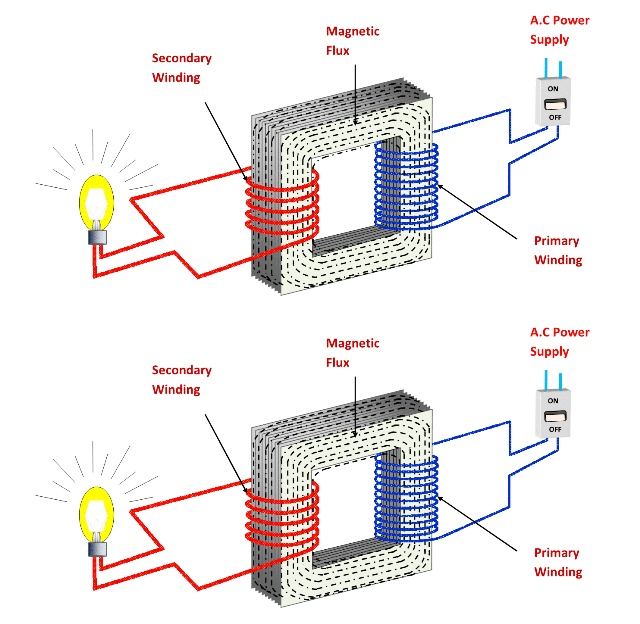
يعتمد في عمله على ظاهرة الحث المتبادل. نتيجة تغير التيار في الملف الابتدائي يتغير التدفق على الملف الثانوي ويتولد فرق جهد مستحث وتيار مستحث.
الملف الابتدائي والثانوي لهما نفس تغير التدفق بسبب وجود نواة الحديد:
\[V_{emf} = \frac{d\Phi_B}{dt}\]
فيكون فرق الجهد المستحث للملف الابتدائي والثانوي:
\[V_s = -N_s \frac{d\Phi_B}{dt}\]
\[V_p = -N_p \frac{d\Phi_B}{dt}\]
وبقسمة المعادلتين على بعضهما نحصل على:
\[\frac{N_S}{N_P} = \frac{V_S}{V_P}\]
إذا كان عدد لفات الملف الابتدائي أكبر من الثانوي فإن المحول خافض للجهد.
إذا كان عدد لفات الملف الابتدائي أصغر من الثانوي فإن المحول رافع للجهد.
عند وصل جهاز أو ما يسمى مقاوم في الملف الثانوي سيكون هناك قدرة في الملف الثانوي:
\[P_S = I_S \cdot V_S\]
وهذا التيار يولد مجال مغناطيسي في الملف الثانوي يعمل على توليد فرق جهد مستحث في الملف الابتدائي محافظا على الجهد الأصلي.
في المحولات المثالية:
\[P_S = P_P\]
\[I_S \cdot V_S = I_P \cdot V_P\]
\[\frac{I_S}{I_P} = \frac{V_P}{V_S} = \frac{N_P}{N_S}\]
من خلال العلاقة العكسية بين الجهد والتيار فإن المحول الرافع للجهد هو خافض للتيار والخافض للجهد هو رافع للتيار.
💡 معلومة مفيدة: محولات العزل هي محولات لا ترفع ولا تخفض الجهد ويكون عدد لفات الملف الابتدائي والثانوي متساوية، ويستخدم في عزل دائرة عن أخرى في الأجهزة المهمة حتى لا يحدث تداخل في التيارات.
يمكن حساب التيار في الملف الابتدائي من خلال العلاقة:
\[I_P = \left(\frac{N_S}{N_P}\right)^2 \cdot \frac{V_P}{R}\]
يمكن حساب المقاومة الفعالة في الملف الابتدائي من خلال العلاقة:
\[R_P = \left(\frac{N_P}{N_S}\right)^2 \cdot R\]
📝 امتحان قصير عن المحولات الكهربائية
1. ما هي الوظيفة الرئيسية للمحول الكهربائي؟
الإجابة الصحيحة هي: رفع أو خفض الجهد الكهربائي
المحول الكهربائي يستخدم لرفع أو خفض الجهد الكهربائي مع الحفاظ على الطاقة (إهمال الفقد).
2. إذا كان عدد لفات الملف الابتدائي \(N_P = 100\) لفة، و\(N_S = 200\) لفة، وكان جهد المصدر \(V_P = 110\) فولت، فما هو جهد الملف الثانوي؟
الإجابة الصحيحة هي: 220 فولت
طريقة الحل: باستخدام العلاقة \(V_S/V_P = N_S/N_P\)
\(V_S = V_P \times (N_S/N_P) = 110 \times (200/100) = 220\) فولت
3. إذا كان تيار الملف الابتدائي \(I_P = 5\) أمبير، وكانت نسبة التحويل \(N_P/N_S = 2:1\)، فما هو تيار الملف الثانوي \(I_S\)؟
الإجابة الصحيحة هي: 10 أمبير
طريقة الحل: باستخدام العلاقة \(I_S/I_P = N_P/N_S\)
\(I_S = I_P \times (N_P/N_S) = 5 \times (2/1) = 10\) أمبير
4. ما هي مكونات المحول الأساسية؟
الإجابة الصحيحة هي: ملف ابتدائي وملف ثانوي ونواة حديدية
يتكون المحول من ثلاث مكونات رئيسية: الملف الابتدائي المتصل بمصدر التيار المتردد، والملف الثانوي المتصل بالحمل، والنواة الحديدية التي توفر مسارًا للمجال المغناطيسي.
5. إذا كان جهد الملف الابتدائي 220 فولت وجهد الملف الثانوي 110 فولت، وكان تيار الحمل 4 أمبير، فما هو تيار الملف الابتدائي؟
الإجابة الصحيحة هي: 2 أمبير
طريقة الحل: باستخدام قانون حفظ الطاقة \(I_P \times V_P = I_S \times V_S\)
\(I_P = (I_S \times V_S)/V_P = (4 \times 110)/220 = 2\) أمبير
6. ما نوع التيار الكهربائي الذي يعمل عليه المحول؟
الإجابة الصحيحة هي: تيار متردد فقط
المحولات تعمل على التيار المتردد فقط لأنها تعتمد على التغير في المجال المغناطيسي الناتج عن التيار المتردد.
7. إذا كانت المقاومة في الملف الثانوي \(R = 50\) أوم، ونسبة التحويل \(N_P/N_S = 5:1\)، فما هي المقاومة الفعالة في الملف الابتدائي؟
الإجابة الصحيحة هي: 1250 أوم
طريقة الحل: باستخدام العلاقة \(R_P = (N_P/N_S)^2 \times R\)
\(R_P = (5/1)^2 \times 50 = 25 \times 50 = 1250\) أوم
8. ما هي العلاقة الصحيحة بين القدرة في الملف الابتدائي والثانوي في المحول المثالي؟
الإجابة الصحيحة هي: \(P_S = P_P\)
في المحول المثالي (بدون فقد)، القدرة في الملف الابتدائي تساوي القدرة في الملف الثانوي.
9. إذا كان تيار الملف الابتدائي \(I_P = 2\) أمبير، وكانت نسبة التحويل \(N_S/N_P = 1:4\)، فما هو تيار الملف الثانوي؟
الإجابة الصحيحة هي: 8 أمبير
طريقة الحل: باستخدام العلاقة \(I_S/I_P = N_P/N_S\)
\(I_S = I_P \times (N_P/N_S) = 2 \times (4/1) = 8\) أمبير
10. ما هي وظيفة النواة الحديدية في المحول؟
الإجابة الصحيحة هي: توفير مسار للمجال المغناطيسي
النواة الحديدية توفر مسارًا للمجال المغناطيسي وتزيد من كفاءة نقل الطاقة بين الملفين.
⚡ تم بحمد الله — صفحة شاملة عن دوائر الاهتزاز والتيار المتردد والمحولات ⚡
جميع المحتويات تفاعلية وتعليمية — استمتع بالتعلم!
⚡ Capacitor and Inductor Circuit (Oscillation Circuit)
Electrical and magnetic energy in an oscillation circuit | AC circuits | Transformers
An oscillation circuit is an electrical circuit containing a capacitor and an inductor. When the capacitor is charged, it gains electrical energy stored due to the electric field. When current flows through an inductor, it stores magnetic energy due to the magnetic field. This energy oscillates between the capacitor and the inductor periodically.
How Does an Oscillation Circuit Work?
🔋 Energy in the Capacitor
When a capacitor is charged, it gains electrical energy stored due to the electric field:
\[U_E = \frac{1}{2} \frac{q^2}{C}\]
🧲 Energy in the Inductor
When current flows through an inductor, it stores magnetic energy due to the magnetic field:
\[P = \Delta V_{ind} \cdot i = L \frac{di}{dt} i\]
\[U_B = \int P \, dt = \int L \, i \, di = \frac{1}{2} L \, i^2\]
❓ Question: How does an oscillation circuit work?
💡 In an ideal oscillation circuit, energy transforms from electrical energy in the capacitor to magnetic energy in the inductor and vice versa, without energy loss. This produces an electrical oscillation with a frequency depending on the capacitance \(C\) and inductance \(L\).
📝 Short Exam: Capacitor and Inductor Circuit (Oscillation Circuit)
When a capacitor is charged, it gains electrical energy stored due to the electric field. When current flows through an inductor, it stores magnetic energy due to the magnetic field.
Question 1: What type of energy does the capacitor store when charged?
Question 2: What causes energy storage in an inductor?
Question 3: What is the circuit called that contains a capacitor and an inductor?
Question 4: What happens to energy in an ideal oscillation circuit?
Question 5: What factor determines the oscillation frequency in the circuit?
Question 6: When the energy in the capacitor is at maximum, what is it in the inductor?
Question 7: What happens if we add resistance to the oscillation circuit?
Question 8: When the current in the circuit is at its maximum, where is most of the energy concentrated?
Question 9: When the voltage across the capacitor is at its maximum, what is the current in the circuit?
Question 10: In which practical application are oscillation circuits used?
🔄 Alternating Current Circuits
Rotating a coil in a magnetic field produces an induced voltage given by:
\[\Delta V_{emf} = N \cdot A \cdot B \cdot \omega \sin(\omega t)\]
AC Generator:
\[V_{max} = N \cdot A \cdot B \cdot \omega\]
\[\Delta V_{emf} = V_m \sin(\omega t)\]
This produces an induced current that is not necessarily in phase with the voltage, varying in value every moment and direction every half cycle:
\[I_t = I_m \sin(\omega t - \phi)\]
Where \(\phi\) is the phase angle between voltage and current, and \(I_m\) is the maximum value of the AC current called the amplitude.
🔌 AC Circuit with Ohmic Resistance
In this simulation, AC is connected to an ohmic resistor, and the voltage and current in the circuit are monitored. Note that the ammeter and voltmeter change value every moment. Voltage and current will be represented as vectors.
📊 Experiment Results
Impedance Calculation
Voltage and Current Equation
Phase Difference
\[R = \frac{V_{max}}{I_{max}}\]
\[R = \frac{V(t)}{I(t)}\]
Voltage equation:
\[V_R = V_m \sin(\omega t)\]
Graph of voltage and current over time
No relation between frequency change and resistance
\[I_t = I_m \sin(\omega t)\]
Current and voltage are in phase
Example 1
An AC circuit connected to a source with time-varying electromotive force. The source voltage equation is:
\[V(t) = 210 \sin(60\pi t)\]
The source is connected to an ohmic resistor of \(R = 20 \, \Omega\). The AC current equation for this circuit is:
Choose the correct answer:
A
\(I(t) = 10.5 \sin(60\pi t + \pi/2)\)
B
\(I(t) = 14.7 \sin(60\pi t - \pi/2)\)
C
\(I(t) = 10.5 \sin(60\pi t)\)
D
\(I(t) = 14.7 \sin(60\pi t + \pi/2)\)
📖 Solution:
From the voltage equation: \(V(t) = 210 \sin(60\pi t)\), so \(V_m = 210\) V.
Since the resistance is purely ohmic, voltage and current are in phase (\(\phi = 0\)).
Current amplitude: \(I_m = \frac{V_m}{R} = \frac{210}{20} = 10.5\) A.
Therefore, the current equation: \(I(t) = 10.5 \sin(60\pi t)\)
✅ Correct answer: C
📝 Short Exam: AC Circuit with Ohmic Resistance
1. If the voltage equation in an AC circuit with ohmic resistance is \(v(t) = 100 \sin(314t)\), what is the current frequency?
Solution:
Voltage equation: \(v(t) = V_m \sin(\omega t)\)
From the equation: \(\omega = 314 \, \text{rad/s}\)
Frequency \(f = \omega / 2\pi = 314 / (2 \times 3.14) \approx 50\) Hz
Correct answer: A) 50 Hz
2. In an AC circuit containing only ohmic resistance, the phase angle between voltage and current is:
Solution:
In ohmic resistance, voltage and current are in phase (no phase difference)
Correct answer: B) 0°
3. How does increasing frequency affect the ohmic resistance value in an AC circuit?
Solution:
Ohmic resistance does not depend on frequency in AC circuits
Correct answer: C) Remains constant
4. If the current equation in an AC circuit with ohmic resistance is \(i(t) = 5 \sin(120\pi t)\), what is the voltage at \(t = 1/240\) s if \(R = 10\Omega\)?
Solution:
1. Calculate current at \(t = 1/240\) s:
\(i(1/240) = 5 \sin(120\pi \times 1/240) = 5 \sin(\pi/2) = 5 \times 1 = 5A\)
2. Calculate voltage: \(v = i \times R = 5A \times 10\Omega = 50V\)
Correct answer: A) 50V
5. Which of the following represents the correct relationship between voltage and current over time in an AC circuit with ohmic resistance?
Solution:
In ohmic resistance, voltage and current are in phase but may have different values depending on resistance
Correct answer: D) Voltage and current are in phase but may have different values
6. If the voltage equation is \(v(t) = 150 \sin(377t + 30°)\) across a 15 Ω resistor, what is the current equation?
Solution:
1. Calculate current amplitude: \(I_m = V_m / R = 150 / 15 = 10A\)
2. In ohmic resistance, current and voltage are in phase
3. Current equation: \(i(t) = 10 \sin(377t + 30°)\)
Correct answer: A) \(i(t) = 10 \sin(377t + 30°)\)
7. If voltage and current in an AC circuit with ohmic resistance are as shown (two sinusoidal waves in phase but different amplitudes), what is the resistance value if voltage amplitude is 200 V and current amplitude is 4 A?
Solution:
Resistance = Voltage amplitude / Current amplitude
\(R = V_m / I_m = 200V / 4A = 50\Omega\)
Correct answer: A) 50Ω
🔌 Electrical Transformers
Transformers are used to step up and step down electrical voltage.
A transformer consists of:
- A primary coil connected to an AC source
- A secondary coil connected to a device
- An iron core
It works on the principle of mutual induction. As the current in the primary coil changes, the flux in the secondary coil changes, generating an induced voltage and induced current.
The primary and secondary coils have the same flux change due to the iron core:
\[V_{emf} = \frac{d\Phi_B}{dt}\]
Thus the induced voltage for primary and secondary coils is:
\[V_s = -N_s \frac{d\Phi_B}{dt}\]
\[V_p = -N_p \frac{d\Phi_B}{dt}\]
Dividing the two equations gives:
\[\frac{N_S}{N_P} = \frac{V_S}{V_P}\]
If the number of primary turns is greater than secondary, the transformer is a step-down.
If the number of primary turns is less than secondary, the transformer is a step-up.
When a device or resistance is connected to the secondary coil, there is power in the secondary coil:
\[P_S = I_S \cdot V_S\]
This current generates a magnetic field in the secondary coil that induces a voltage in the primary coil, maintaining the original voltage.
In ideal transformers:
\[P_S = P_P\]
\[I_S \cdot V_S = I_P \cdot V_P\]
\[\frac{I_S}{I_P} = \frac{V_P}{V_S} = \frac{N_P}{N_S}\]
Due to the inverse relationship between voltage and current, a step-up transformer is a step-down for current, and vice versa.
💡 Useful Information: Isolation transformers neither step up nor step down voltage; they have equal primary and secondary turns and are used to isolate one circuit from another in sensitive devices to prevent current interference.
The primary current can be calculated using:
\[I_P = \left(\frac{N_S}{N_P}\right)^2 \cdot \frac{V_P}{R}\]
The effective resistance in the primary can be calculated using:
\[R_P = \left(\frac{N_P}{N_S}\right)^2 \cdot R\]
📝 Short Exam: Electrical Transformers
1. What is the main function of an electrical transformer?
Correct answer: Step up or step down voltage
Transformers are used to step up or step down voltage while conserving energy (neglecting losses).
2. If primary turns \(N_P = 100\), \(N_S = 200\), and source voltage \(V_P = 110\) V, what is the secondary voltage?
Correct answer: 220 V
Solution: Using \(V_S/V_P = N_S/N_P\)
\(V_S = V_P \times (N_S/N_P) = 110 \times (200/100) = 220\) V
3. If primary current \(I_P = 5\) A, and turns ratio \(N_P/N_S = 2:1\), what is secondary current \(I_S\)?
Correct answer: 10 A
Solution: Using \(I_S/I_P = N_P/N_S\)
\(I_S = I_P \times (N_P/N_S) = 5 \times (2/1) = 10\) A
4. What are the basic components of a transformer?
Correct answer: Primary coil, secondary coil, and iron core
A transformer has three main components: the primary coil connected to an AC source, the secondary coil connected to the load, and the iron core providing a path for the magnetic field.
5. If primary voltage is 220 V and secondary voltage is 110 V, and load current is 4 A, what is the primary current?
Correct answer: 2 A
Solution: Using energy conservation \(I_P \times V_P = I_S \times V_S\)
\(I_P = (I_S \times V_S)/V_P = (4 \times 110)/220 = 2\) A
6. What type of electrical current does a transformer operate on?
Correct answer: AC only
Transformers operate on AC only because they depend on the changing magnetic field produced by AC.
7. If secondary resistance \(R = 50\) Ω, and turns ratio \(N_P/N_S = 5:1\), what is the effective primary resistance?
Correct answer: 1250 Ω
Solution: Using \(R_P = (N_P/N_S)^2 \times R\)
\(R_P = (5/1)^2 \times 50 = 25 \times 50 = 1250\) Ω
8. What is the correct relationship between primary and secondary power in an ideal transformer?
Correct answer: \(P_S = P_P\)
In an ideal transformer (no losses), primary power equals secondary power.
9. If primary current \(I_P = 2\) A, and turns ratio \(N_S/N_P = 1:4\), what is secondary current?
Correct answer: 8 A
Solution: Using \(I_S/I_P = N_P/N_S\)
\(I_S = I_P \times (N_P/N_S) = 2 \times (4/1) = 8\) A
10. What is the function of the iron core in a transformer?
Correct answer: Provide a path for the magnetic field
The iron core provides a path for the magnetic field and increases the efficiency of energy transfer between the coils.
⚡ Completed — Comprehensive page on oscillation circuits, AC, and transformers ⚡
All content is interactive and educational — enjoy learning!
دوائر التيار المتردد |
⚡ دائرة مكثف وملف حثي (دائرة الاهتزاز)
دائرة الاهتزاز هي دائرة كهربائية تحتوي على مكثف وملف حثي. عند شحن المكثف فإنه يكتسب طاقة كهربائية مختزنة بسبب المجال الكهربائي، وعند مرور تيار في الملف الحثي فإنه يختزن طاقة مغناطيسية بسبب المجال المغناطيسي. تتبادل هذه الطاقة بين المكثف والملف بشكل دوري.
كيف تعمل دائرة الاهتزاز؟
🔋 الطاقة في المكثف
عند شحن مكثف فإنه يكتسب طاقة كهربائية مختزنة بسبب المجال الكهربائي:
🧲 الطاقة في الملف الحثي
ونتيجة مرور تيار في ملف حثي فإنه يختزن طاقة مغناطيسية بسبب المجال المغناطيسي:
❓ السؤال: كيف تعمل دائرة الاهتزاز؟
📝 امتحان قصير: دائرة مكثف وملف حثي (دائرة الاهتزاز)
عند شحن مكثف فإن المكثف يكتسب طاقة كهربائية مختزنة بسبب المجال الكهربائي. ونتيجة مرور تيار محث في ملف فإنه يختزن طاقة مغناطيسية بسبب المجال المغناطيسي.
السؤال 1: ما نوع الطاقة التي يختزنها المكثف عند شحنه؟
السؤال 2: ما الذي يسبب تخزين الطاقة في الملف الحثي؟
السؤال 3: ماذا تسمى الدائرة التي تحتوي على مكثف وملف حثي؟
السؤال 4: ما الذي يحدث للطاقة في دائرة الاهتزاز المثالية؟
السؤال 5: ما العامل الذي يحدد تردد الاهتزاز في الدائرة؟
السؤال 6: عندما تكون الطاقة في المكثف عند أقصى قيمة، ماذا تكون في الملف الحثي؟
السؤال 7: ما الذي يحدث إذا أضفنا مقاومة إلى دائرة الاهتزاز؟
السؤال 8: عندما يكون التيار في الدائرة عند قيمته العظمى، أين تتركز معظم الطاقة؟
السؤال 9: عندما يكون الجهد على المكثف عند قيمته العظمى، ماذا يكون التيار في الدائرة؟
السؤال 10: في أي تطبيق عملي تستخدم دوائر الاهتزاز؟
🔄 دوائر التيار المتردد
دوران ملف في مجال مغناطيسي يؤدي إلى تولد فرق جهد مستحث يعطى بالعلاقة:
مولد (تيار متردد):
وبالتالي ينتج تيار مستحث ولا يشترط أن يكون متفقاً في الطور مع فرق الجهد، وهو متغير القيمة كل لحظة والاتجاه كل نصف دورة:
حيث \(\phi\) هي زاوية الطور بين الجهد والتيار، و\(I_m\) هي أعظم قيمة للتيار المتردد وتدعى سعة التيار المتردد.
🔌 دائرة تيار متردد تحتوي على مقاومة أومية
في هذه المحاكاة يتم وصل تيار متردد بمقاوم أومي ويتم مراقبة فرق الجهد والتيار المار في الدائرة. لاحظ أن مقياس التيار والجهد متغير القيمة كل لحظة. سوف يتم تمثيل الجهد والتيار على شكل متجهات.
📊 نتائج التجربة
| حساب الممانعة | معادلة الجهد والتيار | فرق الطور بين التيار والجهد |
|---|---|---|
| \[R = \frac{V_{max}}{I_{max}}\] \[R = \frac{V(t)}{I(t)}\] |
معادلة الجهد: \[V_R = V_m \sin(\omega t)\] |
رسم الخط البياني لكل من الجهد والتيار بمرور الزمن |
| لا يوجد علاقة بين تغير التردد والمقاومة | \[I_t = I_m \sin(\omega t)\] | التيار والجهد متفقان في الطور |
دائرة تيار متردد متصلة بمصدر قوة دافعة متغيرة مع الزمن معادلة جهد المصدر:
تم وصل المصدر بمقاوم أومي مقداره \(R = 20 \, \Omega\). فإن معادلة التيار المتردد المعبرة عن هذه الدائرة هي:
اختر الإجابة الصحيحة:
من معادلة الجهد: \(V(t) = 210 \sin(60\pi t)\)، إذن \(V_m = 210\) فولت.
بما أن المقاومة أومية فقط، فإن الجهد والتيار في نفس الطور (\(\phi = 0\)).
سعة التيار: \(I_m = \frac{V_m}{R} = \frac{210}{20} = 10.5\) أمبير.
وبالتالي معادلة التيار: \(I(t) = 10.5 \sin(60\pi t)\)
📝 امتحان قصير: دائرة تيار متردد مع مقاومة أومية
1. إذا كانت معادلة الجهد في دائرة تيار متردد مع مقاومة أومية هي \(v(t) = 100 \sin(314t)\)، فما هو تردد التيار؟
طريقة الحل:
معادلة الجهد: \(v(t) = V_m \sin(\omega t)\)
من المعادلة: \(\omega = 314 \, \text{rad/s}\)
التردد \(f = \omega / 2\pi = 314 / (2 \times 3.14) \approx 50\) هرتز
الإجابة الصحيحة: أ) 50 هرتز
2. في دائرة تيار متردد تحتوي على مقاومة أومية فقط، تكون زاوية الطور بين الجهد والتيار:
طريقة الحل:
في المقاومة الأومية، الجهد والتيار في نفس الطور (لا يوجد فرق طور)
الإجابة الصحيحة: ب) 0 درجة
3. كيف تؤثر زيادة التردد على قيمة المقاومة الأومية في دائرة تيار متردد؟
طريقة الحل:
المقاومة الأومية لا تعتمد على التردد في دائرة التيار المتردد
الإجابة الصحيحة: ج) تبقى ثابتة
4. إذا كانت معادلة التيار في دائرة تيار متردد مع مقاومة أومية هي \(i(t) = 5 \sin(120\pi t)\)، فما هو الجهد عند \(t = 1/240\) ث إذا كانت \(R = 10\Omega\)؟
طريقة الحل:
1. حساب التيار عند \(t = 1/240\) ثانية:
\(i(1/240) = 5 \sin(120\pi \times 1/240) = 5 \sin(\pi/2) = 5 \times 1 = 5A\)
2. حساب الجهد: \(v = i \times R = 5A \times 10\Omega = 50V\)
الإجابة الصحيحة: أ) 50V
5. أي من الإجابات التالية يمثل العلاقة الصحيحة بين الجهد والتيار مع الزمن في دائرة تيار متردد مع مقاومة أومية؟
طريقة الحل:
في المقاومة الأومية، الجهد والتيار في نفس الطور ولكن قد يكون لهما قيم مختلفة حسب قيمة المقاومة
الإجابة الصحيحة: د) الجهد والتيار في نفس الطور ولكن قد يكون لهما قيم مختلفة
6. إذا كانت معادلة الجهد \(v(t) = 150 \sin(377t + 30°)\) عبر مقاومة 15 أوم فما معادلة التيار؟
طريقة الحل:
1. حساب سعة التيار: \(I_m = V_m / R = 150 / 15 = 10A\)
2. في المقاومة الأومية، التيار والجهد في نفس الطور
3. معادلة التيار: \(i(t) = 10 \sin(377t + 30°)\)
الإجابة الصحيحة: أ) \(i(t) = 10 \sin(377t + 30°)\)
7. إذا كان الجهد والتيار في دائرة تيار متردد مع مقاومة أومية كما في الشكل أدناه، فما قيمة المقاومة إذا كانت سعة الجهد 200 فولت وسعة التيار 4 أمبير؟
طريقة الحل:
المقاومة = سعة الجهد / سعة التيار
\(R = V_m / I_m = 200V / 4A = 50\Omega\)
الإجابة الصحيحة: أ) 50Ω
🔌 المحولات الكهربائية
يستخدم المحول لرفع وخفض الجهد الكهربائي.
يتكون المحول من:
- ملف ابتدائي متصل بمصدر تيار متردد
- ملف ثانوي متصل بجهاز
- نواة من الحديد
يعتمد في عمله على ظاهرة الحث المتبادل. نتيجة تغير التيار في الملف الابتدائي يتغير التدفق على الملف الثانوي ويتولد فرق جهد مستحث وتيار مستحث.
الملف الابتدائي والثانوي لهما نفس تغير التدفق بسبب وجود نواة الحديد:
فيكون فرق الجهد المستحث للملف الابتدائي والثانوي:
وبقسمة المعادلتين على بعضهما نحصل على:
إذا كان عدد لفات الملف الابتدائي أكبر من الثانوي فإن المحول خافض للجهد.
إذا كان عدد لفات الملف الابتدائي أصغر من الثانوي فإن المحول رافع للجهد.
عند وصل جهاز أو ما يسمى مقاوم في الملف الثانوي سيكون هناك قدرة في الملف الثانوي:
وهذا التيار يولد مجال مغناطيسي في الملف الثانوي يعمل على توليد فرق جهد مستحث في الملف الابتدائي محافظا على الجهد الأصلي.
في المحولات المثالية:
من خلال العلاقة العكسية بين الجهد والتيار فإن المحول الرافع للجهد هو خافض للتيار والخافض للجهد هو رافع للتيار.
يمكن حساب التيار في الملف الابتدائي من خلال العلاقة:
يمكن حساب المقاومة الفعالة في الملف الابتدائي من خلال العلاقة:
📝 امتحان قصير عن المحولات الكهربائية
1. ما هي الوظيفة الرئيسية للمحول الكهربائي؟
المحول الكهربائي يستخدم لرفع أو خفض الجهد الكهربائي مع الحفاظ على الطاقة (إهمال الفقد).
2. إذا كان عدد لفات الملف الابتدائي \(N_P = 100\) لفة، و\(N_S = 200\) لفة، وكان جهد المصدر \(V_P = 110\) فولت، فما هو جهد الملف الثانوي؟
طريقة الحل: باستخدام العلاقة \(V_S/V_P = N_S/N_P\)
\(V_S = V_P \times (N_S/N_P) = 110 \times (200/100) = 220\) فولت
3. إذا كان تيار الملف الابتدائي \(I_P = 5\) أمبير، وكانت نسبة التحويل \(N_P/N_S = 2:1\)، فما هو تيار الملف الثانوي \(I_S\)؟
طريقة الحل: باستخدام العلاقة \(I_S/I_P = N_P/N_S\)
\(I_S = I_P \times (N_P/N_S) = 5 \times (2/1) = 10\) أمبير
4. ما هي مكونات المحول الأساسية؟
يتكون المحول من ثلاث مكونات رئيسية: الملف الابتدائي المتصل بمصدر التيار المتردد، والملف الثانوي المتصل بالحمل، والنواة الحديدية التي توفر مسارًا للمجال المغناطيسي.
5. إذا كان جهد الملف الابتدائي 220 فولت وجهد الملف الثانوي 110 فولت، وكان تيار الحمل 4 أمبير، فما هو تيار الملف الابتدائي؟
طريقة الحل: باستخدام قانون حفظ الطاقة \(I_P \times V_P = I_S \times V_S\)
\(I_P = (I_S \times V_S)/V_P = (4 \times 110)/220 = 2\) أمبير
6. ما نوع التيار الكهربائي الذي يعمل عليه المحول؟
المحولات تعمل على التيار المتردد فقط لأنها تعتمد على التغير في المجال المغناطيسي الناتج عن التيار المتردد.
7. إذا كانت المقاومة في الملف الثانوي \(R = 50\) أوم، ونسبة التحويل \(N_P/N_S = 5:1\)، فما هي المقاومة الفعالة في الملف الابتدائي؟
طريقة الحل: باستخدام العلاقة \(R_P = (N_P/N_S)^2 \times R\)
\(R_P = (5/1)^2 \times 50 = 25 \times 50 = 1250\) أوم
8. ما هي العلاقة الصحيحة بين القدرة في الملف الابتدائي والثانوي في المحول المثالي؟
في المحول المثالي (بدون فقد)، القدرة في الملف الابتدائي تساوي القدرة في الملف الثانوي.
9. إذا كان تيار الملف الابتدائي \(I_P = 2\) أمبير، وكانت نسبة التحويل \(N_S/N_P = 1:4\)، فما هو تيار الملف الثانوي؟
طريقة الحل: باستخدام العلاقة \(I_S/I_P = N_P/N_S\)
\(I_S = I_P \times (N_P/N_S) = 2 \times (4/1) = 8\) أمبير
10. ما هي وظيفة النواة الحديدية في المحول؟
النواة الحديدية توفر مسارًا للمجال المغناطيسي وتزيد من كفاءة نقل الطاقة بين الملفين.
⚡ تم بحمد الله — صفحة شاملة عن دوائر الاهتزاز والتيار المتردد والمحولات ⚡
جميع المحتويات تفاعلية وتعليمية — استمتع بالتعلم!
⚡ Capacitor and Inductor Circuit (Oscillation Circuit)
An oscillation circuit is an electrical circuit containing a capacitor and an inductor. When the capacitor is charged, it gains electrical energy stored due to the electric field. When current flows through an inductor, it stores magnetic energy due to the magnetic field. This energy oscillates between the capacitor and the inductor periodically.
How Does an Oscillation Circuit Work?
🔋 Energy in the Capacitor
When a capacitor is charged, it gains electrical energy stored due to the electric field:
🧲 Energy in the Inductor
When current flows through an inductor, it stores magnetic energy due to the magnetic field:
❓ Question: How does an oscillation circuit work?
📝 Short Exam: Capacitor and Inductor Circuit (Oscillation Circuit)
When a capacitor is charged, it gains electrical energy stored due to the electric field. When current flows through an inductor, it stores magnetic energy due to the magnetic field.
Question 1: What type of energy does the capacitor store when charged?
Question 2: What causes energy storage in an inductor?
Question 3: What is the circuit called that contains a capacitor and an inductor?
Question 4: What happens to energy in an ideal oscillation circuit?
Question 5: What factor determines the oscillation frequency in the circuit?
Question 6: When the energy in the capacitor is at maximum, what is it in the inductor?
Question 7: What happens if we add resistance to the oscillation circuit?
Question 8: When the current in the circuit is at its maximum, where is most of the energy concentrated?
Question 9: When the voltage across the capacitor is at its maximum, what is the current in the circuit?
Question 10: In which practical application are oscillation circuits used?
🔄 Alternating Current Circuits
Rotating a coil in a magnetic field produces an induced voltage given by:
AC Generator:
This produces an induced current that is not necessarily in phase with the voltage, varying in value every moment and direction every half cycle:
Where \(\phi\) is the phase angle between voltage and current, and \(I_m\) is the maximum value of the AC current called the amplitude.
🔌 AC Circuit with Ohmic Resistance
In this simulation, AC is connected to an ohmic resistor, and the voltage and current in the circuit are monitored. Note that the ammeter and voltmeter change value every moment. Voltage and current will be represented as vectors.
📊 Experiment Results
| Impedance Calculation | Voltage and Current Equation | Phase Difference |
|---|---|---|
| \[R = \frac{V_{max}}{I_{max}}\] \[R = \frac{V(t)}{I(t)}\] |
Voltage equation: \[V_R = V_m \sin(\omega t)\] |
Graph of voltage and current over time |
| No relation between frequency change and resistance | \[I_t = I_m \sin(\omega t)\] | Current and voltage are in phase |
An AC circuit connected to a source with time-varying electromotive force. The source voltage equation is:
The source is connected to an ohmic resistor of \(R = 20 \, \Omega\). The AC current equation for this circuit is:
Choose the correct answer:
From the voltage equation: \(V(t) = 210 \sin(60\pi t)\), so \(V_m = 210\) V.
Since the resistance is purely ohmic, voltage and current are in phase (\(\phi = 0\)).
Current amplitude: \(I_m = \frac{V_m}{R} = \frac{210}{20} = 10.5\) A.
Therefore, the current equation: \(I(t) = 10.5 \sin(60\pi t)\)
📝 Short Exam: AC Circuit with Ohmic Resistance
1. If the voltage equation in an AC circuit with ohmic resistance is \(v(t) = 100 \sin(314t)\), what is the current frequency?
Solution:
Voltage equation: \(v(t) = V_m \sin(\omega t)\)
From the equation: \(\omega = 314 \, \text{rad/s}\)
Frequency \(f = \omega / 2\pi = 314 / (2 \times 3.14) \approx 50\) Hz
Correct answer: A) 50 Hz
2. In an AC circuit containing only ohmic resistance, the phase angle between voltage and current is:
Solution:
In ohmic resistance, voltage and current are in phase (no phase difference)
Correct answer: B) 0°
3. How does increasing frequency affect the ohmic resistance value in an AC circuit?
Solution:
Ohmic resistance does not depend on frequency in AC circuits
Correct answer: C) Remains constant
4. If the current equation in an AC circuit with ohmic resistance is \(i(t) = 5 \sin(120\pi t)\), what is the voltage at \(t = 1/240\) s if \(R = 10\Omega\)?
Solution:
1. Calculate current at \(t = 1/240\) s:
\(i(1/240) = 5 \sin(120\pi \times 1/240) = 5 \sin(\pi/2) = 5 \times 1 = 5A\)
2. Calculate voltage: \(v = i \times R = 5A \times 10\Omega = 50V\)
Correct answer: A) 50V
5. Which of the following represents the correct relationship between voltage and current over time in an AC circuit with ohmic resistance?
Solution:
In ohmic resistance, voltage and current are in phase but may have different values depending on resistance
Correct answer: D) Voltage and current are in phase but may have different values
6. If the voltage equation is \(v(t) = 150 \sin(377t + 30°)\) across a 15 Ω resistor, what is the current equation?
Solution:
1. Calculate current amplitude: \(I_m = V_m / R = 150 / 15 = 10A\)
2. In ohmic resistance, current and voltage are in phase
3. Current equation: \(i(t) = 10 \sin(377t + 30°)\)
Correct answer: A) \(i(t) = 10 \sin(377t + 30°)\)
7. If voltage and current in an AC circuit with ohmic resistance are as shown (two sinusoidal waves in phase but different amplitudes), what is the resistance value if voltage amplitude is 200 V and current amplitude is 4 A?
Solution:
Resistance = Voltage amplitude / Current amplitude
\(R = V_m / I_m = 200V / 4A = 50\Omega\)
Correct answer: A) 50Ω
🔌 Electrical Transformers
Transformers are used to step up and step down electrical voltage.
A transformer consists of:
- A primary coil connected to an AC source
- A secondary coil connected to a device
- An iron core
It works on the principle of mutual induction. As the current in the primary coil changes, the flux in the secondary coil changes, generating an induced voltage and induced current.
The primary and secondary coils have the same flux change due to the iron core:
Thus the induced voltage for primary and secondary coils is:
Dividing the two equations gives:
If the number of primary turns is greater than secondary, the transformer is a step-down.
If the number of primary turns is less than secondary, the transformer is a step-up.
When a device or resistance is connected to the secondary coil, there is power in the secondary coil:
This current generates a magnetic field in the secondary coil that induces a voltage in the primary coil, maintaining the original voltage.
In ideal transformers:
Due to the inverse relationship between voltage and current, a step-up transformer is a step-down for current, and vice versa.
The primary current can be calculated using:
The effective resistance in the primary can be calculated using:
📝 Short Exam: Electrical Transformers
1. What is the main function of an electrical transformer?
Transformers are used to step up or step down voltage while conserving energy (neglecting losses).
2. If primary turns \(N_P = 100\), \(N_S = 200\), and source voltage \(V_P = 110\) V, what is the secondary voltage?
Solution: Using \(V_S/V_P = N_S/N_P\)
\(V_S = V_P \times (N_S/N_P) = 110 \times (200/100) = 220\) V
3. If primary current \(I_P = 5\) A, and turns ratio \(N_P/N_S = 2:1\), what is secondary current \(I_S\)?
Solution: Using \(I_S/I_P = N_P/N_S\)
\(I_S = I_P \times (N_P/N_S) = 5 \times (2/1) = 10\) A
4. What are the basic components of a transformer?
A transformer has three main components: the primary coil connected to an AC source, the secondary coil connected to the load, and the iron core providing a path for the magnetic field.
5. If primary voltage is 220 V and secondary voltage is 110 V, and load current is 4 A, what is the primary current?
Solution: Using energy conservation \(I_P \times V_P = I_S \times V_S\)
\(I_P = (I_S \times V_S)/V_P = (4 \times 110)/220 = 2\) A
6. What type of electrical current does a transformer operate on?
Transformers operate on AC only because they depend on the changing magnetic field produced by AC.
7. If secondary resistance \(R = 50\) Ω, and turns ratio \(N_P/N_S = 5:1\), what is the effective primary resistance?
Solution: Using \(R_P = (N_P/N_S)^2 \times R\)
\(R_P = (5/1)^2 \times 50 = 25 \times 50 = 1250\) Ω
8. What is the correct relationship between primary and secondary power in an ideal transformer?
In an ideal transformer (no losses), primary power equals secondary power.
9. If primary current \(I_P = 2\) A, and turns ratio \(N_S/N_P = 1:4\), what is secondary current?
Solution: Using \(I_S/I_P = N_P/N_S\)
\(I_S = I_P \times (N_P/N_S) = 2 \times (4/1) = 8\) A
10. What is the function of the iron core in a transformer?
The iron core provides a path for the magnetic field and increases the efficiency of energy transfer between the coils.
⚡ Completed — Comprehensive page on oscillation circuits, AC, and transformers ⚡
All content is interactive and educational — enjoy learning!
No comments:
Post a Comment