Search

 
📄 اطبع pdf
00971504825082

اختبار تجريبي الأجسام الجاسئة والحركة الدائرية والحركة الدورانية
Practice Test: Rigid Bodies, Circular Motion, and Rotational Motion

رَبِّ أَوْزِعْنِي أَنْ أَشْكُرَ نِعْمَتَكَ الَّتِي أَنْعَمْتَ عَلَيَّ وَعَلَى وَالِدَيَّ وَأَنْ أَعْمَلَ صَالِحًا تَرْضَاهُ وَأَصْلِحْ لِي فِي ذُرِّيَّتِي إِنِّي تُبْتُ إِلَيْكَ وَإِنِّي مِنَ الْمُسْلِمِينَ My Lord, enable me to be grateful for Your favor which You have bestowed upon me and upon my parents and to do righteousness of which You approve. And make my offspring righteous. Indeed, I have repented to You, and indeed, I am of the Muslims.

رَبَّنَا هَبْ لَنَا مِنْ أَزْوَاجِنَا وَذُرِّيَّاتِنَا قُرَّةَ أَعْيُنٍ وَاجْعَلْنَا لِلْمُتَّقِينَ إِمَامًا Our Lord, grant us from among our wives and offspring comfort to our eyes and make us an example for the righteous.

رَبِّ هَبْ لِي حُكْمًا وَأَلْحِقْنِي بِالصَّالِحِينَ واجْعَل لِّي لِسَانَ صِدْقٍ فِي الآخِرِينَ وَاجْعَلْنِي مِن وَرَثَةِ جَنَّةِ النَّعِيمِ My Lord, grant me wisdom and join me with the righteous. And make for me a reputation of truth among the later generations. And make me among the inheritors of the Garden of Pleasure.

smile
\[1 \star\]

في أي حالة يكون مركز الثقل مختلفًا عن مركز الكتلة In which case is the center of gravity different from the center of mass?

أختر الإجابة الصحيحةChoose the correct answer


A
للأجسام الصغيرة على سطح الأرضFor small objects on Earth's surface
B
للأجسام ذات الكثافة المتغيرةFor objects with variable density
C
عندما يكون مجال الجاذبية غير منتظمWhen the gravitational field is non-uniform
D
للأجسام غير المتماثلةFor asymmetrical objects
📌 الخطوة 1: مركز الكتلة هو النقطة التي تتوزع حولها كتلة الجسم بشكل متوازن. Center of mass is the point where the mass of the body is balanced.
📌 الخطوة 2: مركز الثقل هو النقطة التي تؤثر فيها قوة الجاذبية على الجسم. Center of gravity is the point where the force of gravity acts on the body.
📌 الخطوة 3: عندما يكون مجال الجاذبية منتظماً، يتطابق مركز الكتلة مع مركز الثقل. In a uniform gravitational field, the center of mass coincides with the center of gravity.
📌 الخطوة 4: عندما يكون مجال الجاذبية غير منتظم، يختلف مركز الثقل عن مركز الكتلة. In a non-uniform gravitational field, the center of gravity differs from the center of mass.
✅ الإجابة الصحيحة هي: C ✅ Correct answer: C

\[2 \star\]

ما الذي يحدث لمركز كتلة جسم عند إزالة جزء منه What happens to the center of mass of a body when a part of it is removed?

أختر الإجابة الصحيحةChoose the correct answer


A
يتحرك نحو الجزء المزالMoves toward the removed part
B
يتحرك بعيدًا عن الجزء المزالMoves away from the removed part
C
يبقى في نفس المكانStays in the same place
D
يعتمد على شكل الجزء المزالDepends on the shape of the removed part
📌 الخطوة 1: مركز الكتلة هو المتوسط المرجح لمواضع جميع أجزاء الجسم. Center of mass is the weighted average of all parts' positions.
📌 الخطوة 2: عند إزالة جزء من الجسم، يقل وزن ذلك الجزء من المتوسط. When a part is removed, its contribution to the weighted average is removed.
📌 الخطوة 3: ينتقل مركز الكتلة نحو الأجزاء المتبقية (بعيدًا عن الجزء المزال). The center of mass shifts toward the remaining parts (away from the removed part).
✅ الإجابة الصحيحة هي: B ✅ Correct answer: B

\[3 \star\]

كرة كتلتها \(m_1=0.5\;kg\;\;\; X=0.8\;m\;\;\; Y=0.4\;m\) كرة ثانية كتلتها \(m_2=0.3\;kg\;\;\; X=-0.4\;m\;\;\; Y=-0.4\;m\) فإن مركز الكتلة المشترك لهما يقع عند الموقع A ball of mass \(m_1=0.5\;kg\) at \((0.8,\;0.4)\) and a second ball of mass \(m_2=0.3\;kg\) at \((-0.4,\;-0.4)\). The center of mass is at:

أختر الإجابة الصحيحةChoose the correct answer


A
\[(0.35\;m\;\;\;,\;\;\;-0.2\;m)\]
B
\[(0.35\;m\;\;\;,\;\;\;0.1\;m)\]
C
\[(0.15\;m\;\;\;,\;\;\;-0.1\;m)\]
D
\[(0.25\;m\;\;\;,\;\;\;0.2\;m)\]
📌 الخطوة 1: مركز الكتلة: \(X_{cm} = \frac{m_1x_1 + m_2x_2}{m_1 + m_2}\) Center of mass: \(X_{cm} = \frac{m_1x_1 + m_2x_2}{m_1 + m_2}\)
📌 الخطوة 2: \(X_{cm} = \frac{0.5(0.8) + 0.3(-0.4)}{0.5 + 0.3} = \frac{0.4 - 0.12}{0.8} = \frac{0.28}{0.8} = 0.35\;m\) \(X_{cm} = \frac{0.5(0.8) + 0.3(-0.4)}{0.5 + 0.3} = \frac{0.4 - 0.12}{0.8} = \frac{0.28}{0.8} = 0.35\;m\)
📌 الخطوة 3: \(Y_{cm} = \frac{0.5(0.4) + 0.3(-0.4)}{0.8} = \frac{0.2 - 0.12}{0.8} = \frac{0.08}{0.8} = 0.1\;m\) \(Y_{cm} = \frac{0.5(0.4) + 0.3(-0.4)}{0.8} = \frac{0.2 - 0.12}{0.8} = \frac{0.08}{0.8} = 0.1\;m\)
✅ الإجابة الصحيحة هي: B \((0.35,\;0.1)\) ✅ Correct answer: B \((0.35,\;0.1)\)

\[4 \star\]

لماذا يقع مركز الكتلة دائمًا على الخط الواصل بين الجسمين؟ Why does the center of mass always lie on the line connecting two bodies?

أختر الإجابة الصحيحةChoose the correct answer


A
لأن القوى المؤثرة تكون في هذا الاتجاه فقطForces only act in that direction
B
لأن أي موقع آخر سيكون غير متوازنAny other position would be unbalanced
C
لأن هذا هو المكان الوحيد الذي يتوازن فيه النظامThis is the only position where the system is balanced
D
جميع ما سبقAll of the above
📌 الخطوة 1: مركز الكتلة هو المتوسط المرجح لمواقع الأجسام في النظام. Center of mass is the weighted average of the positions of bodies.
📌 الخطوة 2: بالنسبة لجسمين، يقع مركز الكتلة على الخط المستقيم الواصل بينهما. For two bodies, the center of mass lies on the straight line connecting them.
📌 الخطوة 3: هذا الموقع هو الوحيد الذي يحقق التوازن لكل من الكتلة والقوى المؤثرة. This is the only position that balances both mass distribution and forces.
✅ الإجابة الصحيحة هي: D (جميع ما سبق) ✅ Correct answer: D (All of the above)

\[5 \star\]

أي من الإحداثيات القطبية التالية تمثل النقطة الديكارتية
\((-2\;\;\;,\;\;\;2)\)
Which polar coordinates represent the Cartesian point \((-2,\;2)\)?

أختر الإجابة الصحيحةChoose the correct answer


A
\[(2\;\;, \frac{\pi}{4})\]
B
\[(2\sqrt{2}\;\;, \frac{\pi}{4})\]
C
\[(2\sqrt{2}\;\;, \frac{3\pi}{4})\]
D
\[(2\;\;, \frac{3\pi}{4})\]
📌 الخطوة 1: التحويل من الديكارتية إلى القطبية: \(r = \sqrt{x^2 + y^2}\)، \(\theta = \tan^{-1}(\frac{y}{x})\) Conversion from Cartesian to polar: \(r = \sqrt{x^2 + y^2}\), \(\theta = \tan^{-1}(\frac{y}{x})\)
📌 الخطوة 2: \(r = \sqrt{(-2)^2 + (2)^2} = \sqrt{4 + 4} = \sqrt{8} = 2\sqrt{2}\) \(r = \sqrt{(-2)^2 + (2)^2} = \sqrt{4 + 4} = \sqrt{8} = 2\sqrt{2}\)
📌 الخطوة 3: الزاوية: النقطة في الربع الثاني، \(\theta = \pi - \tan^{-1}(\frac{2}{2}) = \pi - \frac{\pi}{4} = \frac{3\pi}{4}\) Angle: point in quadrant II, \(\theta = \pi - \tan^{-1}(\frac{2}{2}) = \pi - \frac{\pi}{4} = \frac{3\pi}{4}\)
✅ الإجابة الصحيحة هي: C \((2\sqrt{2}, \frac{3\pi}{4})\) ✅ Correct answer: C \((2\sqrt{2}, \frac{3\pi}{4})\)

\[6 \star\]

إذا كانت الإحداثيات القطبية للنقطة ما هي \((2\;\;\;,\;\;\;\frac{\pi}{3})\) فما هي إحداثياتها الديكارتية If the polar coordinates of a point are \((2,\frac{\pi}{3})\), what are its Cartesian coordinates?

أختر الإجابة الصحيحةChoose the correct answer


A
\[(1\;\;,\;\;\sqrt{3})\]
B
\[(\sqrt{2}\;\;,\;\;2)\]
C
\[(2\;\;,\;\;\sqrt{2})\]
D
\[(\sqrt{3}\;\;,\;\;1)\]
📌 الخطوة 1: التحويل من القطبية إلى الديكارتية: \(x = r\cos\theta\)، \(y = r\sin\theta\) Conversion from polar to Cartesian: \(x = r\cos\theta\), \(y = r\sin\theta\)
📌 الخطوة 2: \(x = 2\cos(\frac{\pi}{3}) = 2 \times \frac{1}{2} = 1\) \(x = 2\cos(\frac{\pi}{3}) = 2 \times \frac{1}{2} = 1\)
📌 الخطوة 3: \(y = 2\sin(\frac{\pi}{3}) = 2 \times \frac{\sqrt{3}}{2} = \sqrt{3}\) \(y = 2\sin(\frac{\pi}{3}) = 2 \times \frac{\sqrt{3}}{2} = \sqrt{3}\)
✅ الإجابة الصحيحة هي: A \((1,\sqrt{3})\) ✅ Correct answer: A \((1,\sqrt{3})\)

\[7 \star\star\]

يتحرك جسم حركة دائرية منتظمة بحيث يعمل ثلاث دورات ونصف عكس عقارب الساعة كل 2 ثانية فان سرعته الزاوية بوحدة
\(\frac{rad}{s}\)
An object moves in uniform circular motion, completing 3.5 revolutions counterclockwise every 2 seconds. Its angular speed in \(rad/s\) is:

أختر الإجابة الصحيحةChoose the correct answer


A
\[W = 4\pi\;\;rad/s\]
B
\[W = 7\pi\;\;rad/s\]
C
\[W = 6\pi\;\;rad/s\]
D
\[W = 3.5\pi\;\;rad/s\]
📌 الخطوة 1: السرعة الزاوية: \(\omega = \frac{\Delta\theta}{\Delta t}\) Angular speed: \(\omega = \frac{\Delta\theta}{\Delta t}\)
📌 الخطوة 2: الزاوية المقطوعة: \(3.5\) دورة = \(3.5 \times 2\pi = 7\pi\) راديان Angle covered: \(3.5\) revolutions = \(3.5 \times 2\pi = 7\pi\) radians
📌 الخطوة 3: \(\omega = \frac{7\pi}{2} = 3.5\pi\;rad/s\) \(\omega = \frac{7\pi}{2} = 3.5\pi\;rad/s\)
✅ الإجابة الصحيحة هي: D \(3.5\pi\;rad/s\) ✅ Correct answer: D \(3.5\pi\;rad/s\)

\[8 \star\]

أحد الإجابات التالية تعادل السرعة الزاوية لعقرب الدقائق Which of the following is the angular speed of the minute hand?

أختر الإجابة الصحيحةChoose the correct answer


A
\[W = -\frac{\pi}{3600}\;\;rad/s\]
B
\[W = -\frac{\pi}{60}\;\;rad/s\]
C
\[W = -\frac{\pi}{1800}\;\;rad/s\]
D
\[W = -\frac{\pi}{12}\;\;rad/s\]
📌 الخطوة 1: عقرب الدقائق يكمل دورة كاملة (\(2\pi\) راديان) في 60 دقيقة = 3600 ثانية. Minute hand completes one revolution (\(2\pi\) rad) in 60 minutes = 3600 seconds.
📌 الخطوة 2: \(\omega = \frac{2\pi}{3600} = \frac{\pi}{1800}\;rad/s\) \(\omega = \frac{2\pi}{3600} = \frac{\pi}{1800}\;rad/s\)
📌 الخطوة 3: الإشارة سالبة لأن الحركة في اتجاه عقارب الساعة (اختياري). Negative sign indicates clockwise motion (optional).
✅ الإجابة الصحيحة هي: C \(-\frac{\pi}{1800}\;rad/s\) ✅ Correct answer: C \(-\frac{\pi}{1800}\;rad/s\)

\[9 \star\star\]

يتحرك قمر صناعي في مسار دائري منتظم حول الأرض نصف قطر المسار الدائري \(8500\;Km\) حيث كان زمنه الدوري \(2\;day\) سرعته الخطية تساوي A satellite moves in a uniform circular orbit around Earth with radius \(8500\;km\) and period \(2\;days\). Its linear speed is:

أختر الإجابة الصحيحةChoose the correct answer


A
\[v = 210\;\;m/s\]
B
\[v = 512\;\;m/s\]
C
\[v = 518\;\;m/s\]
D
\[v = 309\;\;m/s\]
📌 الخطوة 1: السرعة الخطية: \(v = \frac{2\pi r}{T}\) Linear speed: \(v = \frac{2\pi r}{T}\)
📌 الخطوة 2: \(r = 8500\;km = 8.5 \times 10^6\;m\)، \(T = 2\;days = 2 \times 24 \times 3600 = 172800\;s\) \(r = 8500\;km = 8.5 \times 10^6\;m\)، \(T = 2\;days = 172800\;s\)
📌 الخطوة 3: \(v = \frac{2\pi \times 8.5 \times 10^6}{172800} \approx 309\;m/s\) \(v = \frac{2\pi \times 8.5 \times 10^6}{172800} \approx 309\;m/s\)
✅ الإجابة الصحيحة هي: D \(309\;m/s\) ✅ Correct answer: D \(309\;m/s\)

\[10 \star\]

في الحركة الدائرية المنتظمة أحد الأشكال التالية تعبر عن اتجاه السرعة الخطية والتسارع المركزي لجسم يتحرك حركة دائرية منتظمة عكس عقارب الساعة In uniform circular motion, which figure shows the direction of linear velocity and centripetal acceleration for counterclockwise motion?
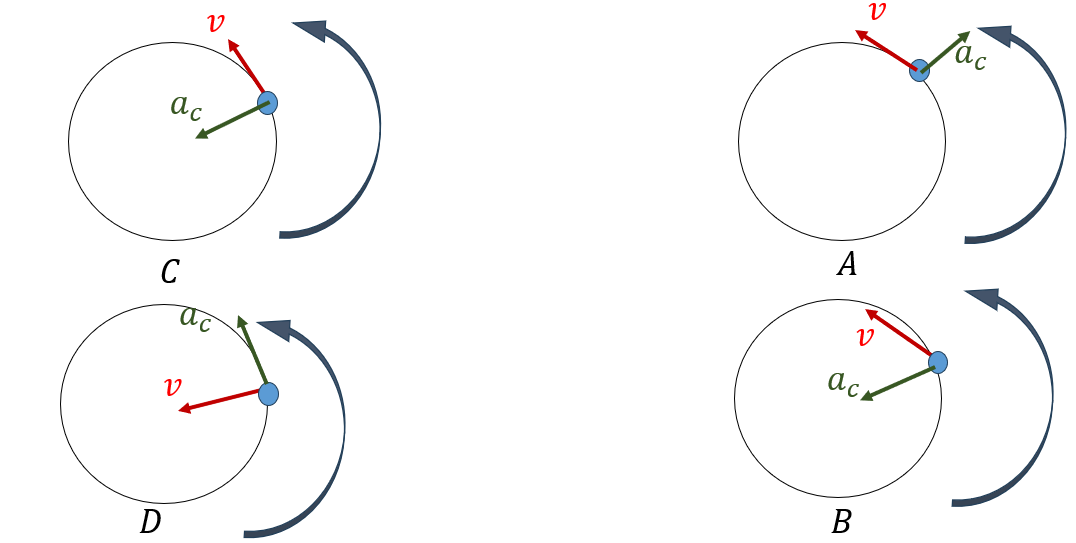
أختر الإجابة الصحيحةChoose the correct answer


A
الشكل AFigure A
B
الشكل BFigure B
C
الشكل CFigure C
D
الشكل DFigure D
📌 الخطوة 1: في الحركة الدائرية المنتظمة عكس عقارب الساعة، تكون السرعة الخطية مماسية للمسار. In counterclockwise uniform circular motion, velocity is tangential to the path.
📌 الخطوة 2: التسارع المركزي (الجذب المركزي) يكون نحو مركز المسار الدائري. Centripetal acceleration is directed toward the center of the circular path.
📌 الخطوة 3: الشكل C يظهر السرعة الخطية مماسية (عكس عقارب الساعة) والتسارع نحو المركز. Figure C correctly shows tangential velocity (counterclockwise) and acceleration toward the center.
✅ الإجابة الصحيحة هي: C (الشكل C) ✅ Correct answer: C (Figure C)

\[11 \star\]

أحد المخططات التالية يمثل العلاقة بين اتجاهات السرعة الخطية ومتجهة الموقع وعجلة الجذب المركزية والقوة المركزية لجسم يتحرك حركة دائرية منتظمة Which diagram correctly shows the relationship between linear velocity, position vector, centripetal acceleration, and centripetal force for uniform circular motion?

أختر الإجابة الصحيحةChoose the correct answer


A
A
B
B
C
C
D
D
📌 الخطوة 1: متجه الموقع (\(\vec{r}\)) يشير من المركز إلى الجسم. Position vector (\(\vec{r}\)) points from center to object.
📌 الخطوة 2: السرعة الخطية (\(\vec{v}\)) مماسية للمسار (عمودية على \(\vec{r}\)). Linear velocity (\(\vec{v}\)) is tangential (perpendicular to \(\vec{r}\)).
📌 الخطوة 3: العجلة المركزية (\(\vec{a}_c\)) والقوة المركزية (\(\vec{F}_c\)) تتجهان نحو المركز (عكس اتجاه \(\vec{r}\)). Centripetal acceleration (\(\vec{a}_c\)) and force (\(\vec{F}_c\)) point toward the center (opposite to \(\vec{r}\)).
📌 الخطوة 4: الشكل C يظهر هذه العلاقات بشكل صحيح. Figure C correctly shows these relationships.
✅ الإجابة الصحيحة هي: C ✅ Correct answer: C

\[12 \star\star\]

جسم يتحرك في مسار دائري نصف قطره 5 متر. إذا كان التسارع الكلي للجسم \(a_{tot}=13\;m/s^2\) والتسارع الخطي \(a_t=5\;m/s^2\)، فما مقدار سرعة الجسم؟ An object moves in a circular path of radius 5 m. If the total acceleration is \(a_{tot}=13\;m/s^2\) and tangential acceleration is \(a_t=5\;m/s^2\), what is the object's speed?

أختر الإجابة الصحيحةChoose the correct answer


A
\[v = 7.75\;\;m/s\]
B
\[v = 9.35\;\;m/s\]
C
\[v = 10.25\;\;m/s\]
D
\[v = 4.15\;\;m/s\]
📌 الخطوة 1: التسارع الكلي: \(a_{tot}^2 = a_c^2 + a_t^2\) حيث \(a_c\) هو التسارع المركزي. Total acceleration: \(a_{tot}^2 = a_c^2 + a_t^2\) where \(a_c\) is centripetal acceleration.
📌 الخطوة 2: \(a_c = \sqrt{a_{tot}^2 - a_t^2} = \sqrt{13^2 - 5^2} = \sqrt{169 - 25} = \sqrt{144} = 12\;m/s^2\) \(a_c = \sqrt{a_{tot}^2 - a_t^2} = \sqrt{13^2 - 5^2} = \sqrt{169 - 25} = \sqrt{144} = 12\;m/s^2\)
📌 الخطوة 3: \(a_c = \frac{v^2}{r}\) → \(v = \sqrt{a_c \times r} = \sqrt{12 \times 5} = \sqrt{60} \approx 7.75\;m/s\) \(a_c = \frac{v^2}{r}\) → \(v = \sqrt{a_c \times r} = \sqrt{12 \times 5} = \sqrt{60} \approx 7.75\;m/s\)
✅ الإجابة الصحيحة هي: A \(7.75\;m/s\) ✅ Correct answer: A \(7.75\;m/s\)

\[13 \star\]

جسم يتحرك في مسار دائري نصف قطره 2 متر بسرعة خطية متغيرة حسب العلاقة \(v = 3t + 2\) (حيث الزمن بالثواني) احسب التسارع الكلي للجسم عند
\(t = 2\;s\)
An object moves in a circular path of radius 2 m with speed \(v = 3t + 2\) (t in seconds). Calculate the total acceleration at \(t = 2\;s\).

أختر الإجابة الصحيحةChoose the correct answer


A
\[a_{total} = 18.32\;\;m/s^2\]
B
\[a_{total} = 15.23\;\;m/s^2\]
C
\[a_{total} = 32.14\;\;m/s^2\]
D
\[a_{total} = 28.45\;\;m/s^2\]
📌 الخطوة 1: السرعة عند \(t=2\): \(v = 3(2) + 2 = 8\;m/s\) Speed at \(t=2\): \(v = 3(2) + 2 = 8\;m/s\)
📌 الخطوة 2: التسارع الخطي (التماسي): \(a_t = \frac{dv}{dt} = 3\;m/s^2\) Tangential acceleration: \(a_t = \frac{dv}{dt} = 3\;m/s^2\)
📌 الخطوة 3: التسارع المركزي: \(a_c = \frac{v^2}{r} = \frac{8^2}{2} = 32\;m/s^2\) Centripetal acceleration: \(a_c = \frac{v^2}{r} = \frac{8^2}{2} = 32\;m/s^2\)
📌 الخطوة 4: التسارع الكلي: \(a_{total} = \sqrt{a_c^2 + a_t^2} = \sqrt{32^2 + 3^2} = \sqrt{1024 + 9} = \sqrt{1033} \approx 32.14\;m/s^2\) Total acceleration: \(a_{total} = \sqrt{a_c^2 + a_t^2} = \sqrt{32^2 + 3^2} = \sqrt{1024 + 9} = \sqrt{1033} \approx 32.14\;m/s^2\)
✅ الإجابة الصحيحة هي: C \(32.14\;m/s^2\) ✅ Correct answer: C \(32.14\;m/s^2\)

\[14 \star\]

ربط حجر في خيط طوله
0.6 m
وادير في وضع أفقي فكان زمنه الدوري
0.4 s
فإن عجلته المركزية تساوي؟
A stone is tied to a string of length 0.6 m and swung horizontally with a period of 0.4 s. What is its centripetal acceleration?

أختر الإجابة الصحيحةChoose the correct answer


A
\[a_c = 15\pi\;\;m/s^2\]
B
\[a_c = 40\pi\;\;m/s^2\]
C
\[a_c = 40\pi^2\;\;m/s^2\]
D
\[a_c = 15\pi^2\;\;m/s^2\]
📌 الخطوة 1: السرعة الزاوية: \(\omega = \frac{2\pi}{T} = \frac{2\pi}{0.4} = 5\pi\;rad/s\) Angular speed: \(\omega = \frac{2\pi}{T} = \frac{2\pi}{0.4} = 5\pi\;rad/s\)
📌 الخطوة 2: التسارع المركزي: \(a_c = \omega^2 r = (5\pi)^2 \times 0.6 = 25\pi^2 \times 0.6 = 15\pi^2\;m/s^2\) Centripetal acceleration: \(a_c = \omega^2 r = (5\pi)^2 \times 0.6 = 25\pi^2 \times 0.6 = 15\pi^2\;m/s^2\)
✅ الإجابة الصحيحة هي: D \(15\pi^2\;m/s^2\) ✅ Correct answer: D \(15\pi^2\;m/s^2\)

\[15 \star\]

تم ربط دلو بحبل طوله
0.4 m
وتم تدويره بشكل أفقي وبسرعة مماسية قدرها \(v=2\;m/s\) فإن الزمن الدوري للحركة يعادل
A bucket is tied to a rope of length 0.4 m and swung horizontally with tangential speed \(v=2\;m/s\). The period of motion is:

أختر الإجابة الصحيحةChoose the correct answer


A
\[T = 5\;\;s\]
B
\[T = 4.12\;\;s\]
C
\[T = 1.26\;\;s\]
D
\[T = 3.56\;\;s\]
📌 الخطوة 1: العلاقة بين السرعة الخطية والزمن الدوري: \(v = \frac{2\pi r}{T}\) Relation between linear speed and period: \(v = \frac{2\pi r}{T}\)
📌 الخطوة 2: \(T = \frac{2\pi r}{v} = \frac{2\pi \times 0.4}{2} = 0.4\pi \approx 1.26\;s\) \(T = \frac{2\pi r}{v} = \frac{2\pi \times 0.4}{2} = 0.4\pi \approx 1.26\;s\)
✅ الإجابة الصحيحة هي: C \(1.26\;s\) ✅ Correct answer: C \(1.26\;s\)

\[16 \star\star\]

في لعبة العربة الأفعوانية وبفرض عدم وجود احتكاك بين العربة والسكة يشعر اللاعب بانعدام الوزن الظاهري عند الوصول إلى قمة المسار الدائري. فإذا كان نصف المسار الدائري يعادل \(r=6\;m\) فإن السرعة الخطية عند القمة تعادل In a roller coaster ride, assuming no friction, the rider feels weightless at the top of the circular loop. If the radius is \(r=6\;m\), what is the linear speed at the top?
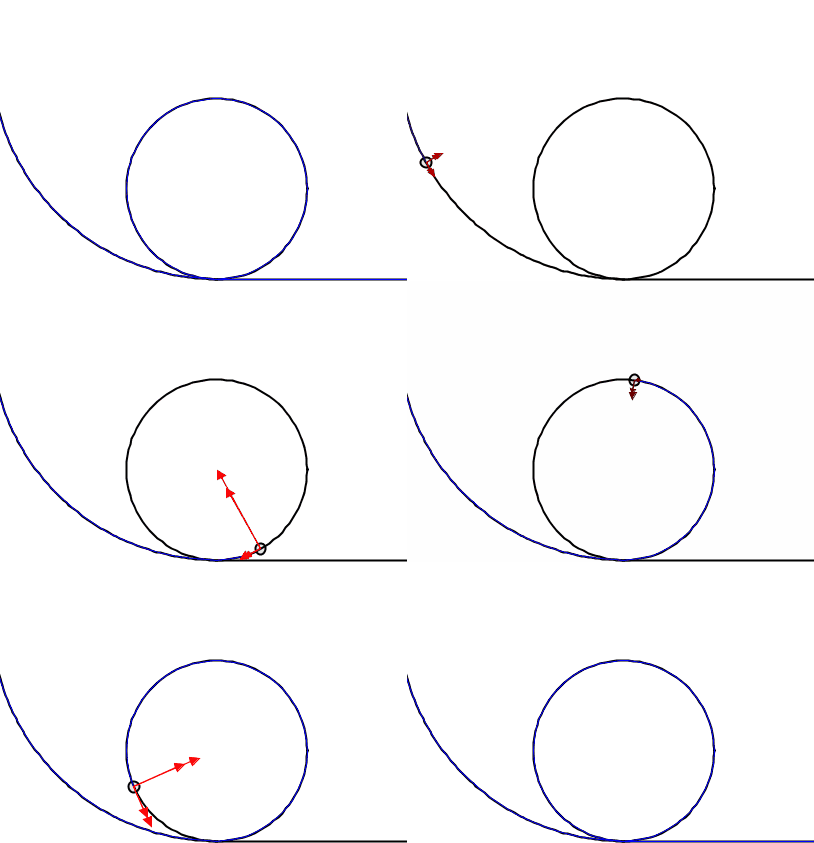
أختر الإجابة الصحيحةChoose the correct answer


A
\[v = 12.5\;\;m/s\]
B
\[v = 4.53\;\;m/s\]
C
\[v = 7.66\;\;m/s\]
D
\[v = 10.3\;\;m/s\]
📌 الخطوة 1: عند القمة، انعدام الوزن الظاهري يعني أن القوة العمودية \(N = 0\) At the top, weightlessness means normal force \(N = 0\)
📌 الخطوة 2: معادلة الحركة عند القمة: \(mg - N = \frac{mv^2}{r}\) → \(mg = \frac{mv^2}{r}\) Equation at top: \(mg - N = \frac{mv^2}{r}\) → \(mg = \frac{mv^2}{r}\)
📌 الخطوة 3: \(v = \sqrt{gr} = \sqrt{9.81 \times 6} = \sqrt{58.86} \approx 7.66\;m/s\) \(v = \sqrt{gr} = \sqrt{9.81 \times 6} = \sqrt{58.86} \approx 7.66\;m/s\)
✅ الإجابة الصحيحة هي: C \(7.66\;m/s\) ✅ Correct answer: C \(7.66\;m/s\)

\[17 \star\star\]

أحد الإجابات التالية تعادل السرعة الزاوية لعقرب الساعات Which of the following is the angular speed of the hour hand?

أختر الإجابة الصحيحةChoose the correct answer


A
\[W = -0.104\;\;rad/s\]
B
\[W = 1.45 \times 10^{-4}\;\;rad/s\]
C
\[W = 0.104\;\;rad/s\]
D
\[W = -1.74 \times 10^{-3}\;\;rad/s\]
📌 الخطوة 1: عقرب الساعات يكمل دورة كاملة (\(2\pi\) راديان) في 12 ساعة = 43200 ثانية. Hour hand completes one revolution (\(2\pi\) rad) in 12 hours = 43200 seconds.
📌 الخطوة 2: \(\omega = \frac{2\pi}{43200} = \frac{\pi}{21600} \approx 1.45 \times 10^{-4}\;rad/s\) \(\omega = \frac{2\pi}{43200} = \frac{\pi}{21600} \approx 1.45 \times 10^{-4}\;rad/s\)
✅ الإجابة الصحيحة هي: B \(1.45 \times 10^{-4}\;rad/s\) ✅ Correct answer: B \(1.45 \times 10^{-4}\;rad/s\)

\[18 \star\]

يتحرك جسم حركة دائرية منتظمة بحيث يعمل ثلاث دورات ونصف عكس عقارب الساعة كل 2 ثانية فان سرعته الزاوية بوحدة
\(\frac{rad}{s}\)
An object moves in uniform circular motion, completing 3.5 revolutions counterclockwise every 2 seconds. Its angular speed in \(rad/s\) is:

أختر الإجابة الصحيحةChoose the correct answer


A
\[W = 3.5\pi\;\;rad/s\]
B
\[W = 4\pi\;\;rad/s\]
C
\[W = 7\pi\;\;rad/s\]
D
\[W = 6\pi\;\;rad/s\]
📌 الخطوة 1: السرعة الزاوية: \(\omega = \frac{\Delta\theta}{\Delta t}\) Angular speed: \(\omega = \frac{\Delta\theta}{\Delta t}\)
📌 الخطوة 2: الزاوية المقطوعة: \(3.5\) دورة = \(3.5 \times 2\pi = 7\pi\) راديان Angle covered: \(3.5\) revolutions = \(3.5 \times 2\pi = 7\pi\) radians
📌 الخطوة 3: \(\omega = \frac{7\pi}{2} = 3.5\pi\;rad/s\) \(\omega = \frac{7\pi}{2} = 3.5\pi\;rad/s\)
✅ الإجابة الصحيحة هي: A \(3.5\pi\;rad/s\) ✅ Correct answer: A \(3.5\pi\;rad/s\)

\[19 \star\]

جسم يتحرك حركة دائرية معادلة الإزاحة الزاوية متغيرة بمرور الزمن \(\theta = 0.5t^2 + 2t + 4\) فإن السرعة الزاوية للجسم في الثانية الخامسة تعادل An object moves in circular motion with angular displacement \(\theta = 0.5t^2 + 2t + 4\). The angular speed at \(t=5\;s\) is:

أختر الإجابة الصحيحةChoose the correct answer


A
\[W = 5\;\;rad/s\]
B
\[W = 6.7\;\;rad/s\]
C
\[W = 7\;\;rad/s\]
D
\[W = 26.5\;\;rad/s\]
📌 الخطوة 1: السرعة الزاوية هي مشتقة الإزاحة الزاوية بالنسبة للزمن: \(\omega = \frac{d\theta}{dt}\) Angular speed is the derivative of angular displacement: \(\omega = \frac{d\theta}{dt}\)
📌 الخطوة 2: \(\omega = \frac{d}{dt}(0.5t^2 + 2t + 4) = t + 2\) \(\omega = \frac{d}{dt}(0.5t^2 + 2t + 4) = t + 2\)
📌 الخطوة 3: عند \(t=5\): \(\omega = 5 + 2 = 7\;rad/s\) At \(t=5\): \(\omega = 5 + 2 = 7\;rad/s\)
✅ الإجابة الصحيحة هي: C \(7\;rad/s\) ✅ Correct answer: C \(7\;rad/s\)

\[20 \star\]

منعطف في مضمار سباق نصف قطره 100 متر ويميل بزاوية 15 درجة فوق المستوى الأفقي. ما السرعة المثلى لاجتياز المنعطف بدون احتكاك؟ A race track curve has radius 100 m and is banked at 15° above horizontal. What is the optimum speed to navigate the curve without friction?

أختر الإجابة الصحيحةChoose the correct answer


A
\[v = 18.31\;\;m/s\]
B
\[v = 23.14\;\;m/s\]
C
\[v = 16.22\;\;m/s\]
D
\[v = 13.44\;\;m/s\]
📌 الخطوة 1: السرعة المثلى بدون احتكاك: \(v = \sqrt{g r \tan\theta}\) Optimum speed without friction: \(v = \sqrt{g r \tan\theta}\)
📌 الخطوة 2: \(v = \sqrt{9.81 \times 100 \times \tan(15^\circ)} = \sqrt{981 \times 0.2679} = \sqrt{262.8} \approx 16.22\;m/s\) \(v = \sqrt{9.81 \times 100 \times \tan(15^\circ)} = \sqrt{981 \times 0.2679} = \sqrt{262.8} \approx 16.22\;m/s\)
✅ الإجابة الصحيحة هي: C \(16.22\;m/s\) ✅ Correct answer: C \(16.22\;m/s\)

\[21 \star\]

مضمار سباق به منعطف نصف قطره 50 متر ويميل بزاوية 30 درجة فوق المستوى الأفقي. إذا كان السطح مغطى بالجليد معامل الاحتكاك \(\mu \approx 0.05\) السرعة المثلى لاجتياز المنعطف A race track curve has radius 50 m and is banked at 30° with friction coefficient \(\mu = 0.05\). What is the optimum speed with friction?

أختر الإجابة الصحيحةChoose the correct answer


A
\[v = 18.31\;\;m/s\]
B
\[v = 23.14\;\;m/s\]
C
\[v = 16.22\;\;m/s\]
D
\[v = 17.8\;\;m/s\]
📌 الخطوة 1: السرعة المثلى مع الاحتكاك: \(v = \sqrt{g r \frac{\tan\theta + \mu}{1 - \mu\tan\theta}}\) Optimum speed with friction: \(v = \sqrt{g r \frac{\tan\theta + \mu}{1 - \mu\tan\theta}}\)
📌 الخطوة 2: \(\tan(30^\circ) = 0.577\) \(\tan(30^\circ) = 0.577\)
📌 الخطوة 3: \(v = \sqrt{9.81 \times 50 \times \frac{0.577 + 0.05}{1 - 0.05 \times 0.577}} = \sqrt{490.5 \times \frac{0.627}{0.971}} = \sqrt{490.5 \times 0.646} = \sqrt{316.9} \approx 17.8\;m/s\) \(v = \sqrt{9.81 \times 50 \times \frac{0.577 + 0.05}{1 - 0.05 \times 0.577}} = \sqrt{490.5 \times \frac{0.627}{0.971}} = \sqrt{490.5 \times 0.646} = \sqrt{316.9} \approx 17.8\;m/s\)
✅ الإجابة الصحيحة هي: D \(17.8\;m/s\) ✅ Correct answer: D \(17.8\;m/s\)

\[22 \star\]

جسم كروي صلب كتلته ونصف قطره \(m\;(kg)\;,\;r\;(m)\) يبدأ الحركة من السكون من ارتفاع \(h\;(m)\) فوق قاعدة مستوى مائل ويتدحرج لأسفل دون انزلاق تحت تأثير الجاذبية. العلاقة المعبرة عن السرعة الخطية لمركز كتلة الجسم الكروي عندما يغادر المستوى المائل ويتدحرج على سطح أفقي هي \(I = \frac{2}{5}mr^2\) A solid sphere of mass \(m\) and radius \(r\) starts from rest at height \(h\) on an inclined plane and rolls down without slipping. The expression for linear speed when it reaches horizontal ground is \(I = \frac{2}{5}mr^2\)

أختر الإجابة الصحيحةChoose the correct answer


A
\[v = \sqrt{\frac{10gh}{7}}\]
B
\[v = \sqrt{2gh}\]
C
\[v = \sqrt{gh}\]
D
\[v = \sqrt{\frac{5gh}{7}}\]
📌 الخطوة 1: باستخدام قانون حفظ الطاقة: \(mgh = \frac{1}{2}mv^2 + \frac{1}{2}I\omega^2\) Using conservation of energy: \(mgh = \frac{1}{2}mv^2 + \frac{1}{2}I\omega^2\)
📌 الخطوة 2: \(I = \frac{2}{5}mr^2\)، \(\omega = \frac{v}{r}\) (دون انزلاق) \(I = \frac{2}{5}mr^2\)، \(\omega = \frac{v}{r}\) (no slipping)
📌 الخطوة 3: \(mgh = \frac{1}{2}mv^2 + \frac{1}{2}(\frac{2}{5}mr^2)(\frac{v^2}{r^2}) = \frac{1}{2}mv^2 + \frac{1}{5}mv^2 = \frac{7}{10}mv^2\) \(mgh = \frac{1}{2}mv^2 + \frac{1}{2}(\frac{2}{5}mr^2)(\frac{v^2}{r^2}) = \frac{1}{2}mv^2 + \frac{1}{5}mv^2 = \frac{7}{10}mv^2\)
📌 الخطوة 4: \(v^2 = \frac{10gh}{7}\) → \(v = \sqrt{\frac{10gh}{7}}\) \(v^2 = \frac{10gh}{7}\) → \(v = \sqrt{\frac{10gh}{7}}\)
✅ الإجابة الصحيحة هي: A \(\sqrt{\frac{10gh}{7}}\) ✅ Correct answer: A \(\sqrt{\frac{10gh}{7}}\)

\[23 \star\star\]

أحد وحدات القياس التالية لا يمكن استخدامها لقياس عزم الدوران وتعادل Which of the following units cannot be used to measure torque?

أختر الإجابة الصحيحةChoose the correct answer


A
\[N\cdot m\]
B
\[\frac{kg\cdot m^2}{s^2}\]
C
\[J\]
D
\[ft\cdot lb\]
📌 الخطوة 1: عزم الدوران: \(\tau = rF\sin\theta\) Torque: \(\tau = rF\sin\theta\)
📌 الخطوة 2: وحدة عزم الدوران في النظام الدولي هي \(N\cdot m\) أو \(\frac{kg\cdot m^2}{s^2}\) SI unit of torque is \(N\cdot m\) or \(\frac{kg\cdot m^2}{s^2}\)
📌 الخطوة 3: الجول (J) هو وحدة الطاقة، وعزم الدوران على الرغم من أنه نفس الأبعاد، إلا أنه ليس طاقة بل كمية متجهة. Joule (J) is a unit of energy. Although torque has the same dimensions, it is a vector quantity, not energy.
✅ الإجابة الصحيحة هي: C (J) ✅ Correct answer: C (J)

\[24 \star\star\]

أربع قوى متساوية كما في الشكل أثرت على قرص نصف قطره \(10\;cm\) قابل للدوران عند المحور أكبر عزم دوران للقوة. Four equal forces act on a disk of radius \(10\;cm\) as shown. Which force produces the greatest torque?

أختر الإجابة الصحيحةChoose the correct answer


A
\[\tau_1\]
B
\[\tau_2\]
C
\[\tau_3\]
D
\[\tau_4\]
📌 الخطوة 1: عزم الدوران: \(\tau = rF\sin\theta\) حيث \(\theta\) هي الزاوية بين متجه الموقع والقوة. Torque: \(\tau = rF\sin\theta\) where \(\theta\) is the angle between position vector and force.
📌 الخطوة 2: جميع القوى متساوية (\(F\)) ونصف القطر متساوي (\(r\)). All forces are equal (\(F\)) and radius is equal (\(r\)).
📌 الخطوة 3: أكبر عزم يكون عندما \(\sin\theta = 1\) أي \(\theta = 90^\circ\). القوة \(\tau_2\) هي الوحيدة التي تؤثر عمودياً على نصف القطر. Maximum torque when \(\sin\theta = 1\) (\(\theta = 90^\circ\)). Force \(\tau_2\) is the only one perpendicular to the radius.
✅ الإجابة الصحيحة هي: B (\(\tau_2\)) ✅ Correct answer: B (\(\tau_2\))

\[25 \star\]

قرص كتلته \(m=5\;kg\) ونصف قطره \(R=0.3\;m\) مثبت في محور أفقي عديم الاحتكاك ولف حبل عدة مرات حول القرص ثم ربط في قالب كتلته \(M=40\;kg\) كما في الشكل أدناه وبفرض عدم انزلاق الحبل فإن عجلة القالب تعادل. A disk of mass \(m=5\;kg\) and radius \(R=0.3\;m\) is mounted on a frictionless horizontal axis. A rope is wrapped around the disk and attached to a mass \(M=40\;kg\). Assuming no slipping, the acceleration of the mass is:

أختر الإجابة الصحيحةChoose the correct answer


A
\[a = -10.7\;m/s^2\]
B
\[a = -5.6\;m/s^2\]
C
\[a = -3.4\;m/s^2\]
D
\[a = -9.2\;m/s^2\]
📌 الخطوة 1: معادلات الحركة: للقالب \(Mg - T = Ma\)، للقرص \(\tau = I\alpha\) حيث \(\tau = TR\) و \(\alpha = \frac{a}{R}\) Equations: for mass \(Mg - T = Ma\), for disk \(\tau = I\alpha\) with \(\tau = TR\) and \(\alpha = \frac{a}{R}\)
📌 الخطوة 2: \(I = \frac{1}{2}mR^2 = \frac{1}{2}(5)(0.3)^2 = 0.225\;kg\cdot m^2\) \(I = \frac{1}{2}mR^2 = \frac{1}{2}(5)(0.3)^2 = 0.225\;kg\cdot m^2\)
📌 الخطوة 3: \(TR = I\alpha\) → \(T = \frac{Ia}{R^2} = \frac{0.225a}{0.09} = 2.5a\) \(TR = I\alpha\) → \(T = \frac{Ia}{R^2} = \frac{0.225a}{0.09} = 2.5a\)
📌 الخطوة 4: \(40(9.81) - 2.5a = 40a\) → \(392.4 = 42.5a\) → \(a \approx 9.23\;m/s^2\) (للأسفل \(a = -9.23\;m/s^2\)) \(40(9.81) - 2.5a = 40a\) → \(392.4 = 42.5a\) → \(a \approx 9.23\;m/s^2\) (downward \(a = -9.23\;m/s^2\))
✅ الإجابة الصحيحة هي: D \(-9.2\;m/s^2\) ✅ Correct answer: D \(-9.2\;m/s^2\)

\[26 \star\]

تبذل قوة متغيرة مع الزمن على جسم في نقطة يكون متجه الموقع الخاص بها بالنسبة إلى النقطة المحورية هو \(r = 3\hat{X} + 4\hat{Y}\) (بالأمتار) على المحورين إذا كانت القوة المؤثرة \(F = 2t\hat{X} - 3t^2\hat{Y}\) حيث \(t\) هو الزمن بالثواني، احسب عزم الدوران الذي أوجدته القوة حول هذه النقطة المحورية عند الزمن \(t = 2s\). A time-varying force acts on a point with position vector \(r = 3\hat{i} + 4\hat{j}\) (m). If the force is \(F = 2t\hat{i} - 3t^2\hat{j}\) (t in seconds), calculate the torque about the pivot at \(t = 2s\).

أختر الإجابة الصحيحةChoose the correct answer


A
\[\tau = -20\;\;N\cdot m\]
B
\[\tau = -52\;\;N\cdot m\]
C
\[\tau = -36\;\;N\cdot m\]
D
\[\tau = -16\;\;N\cdot m\]
📌 الخطوة 1: عزم الدوران: \(\tau = r \times F\) (الضرب الاتجاهي) Torque: \(\tau = r \times F\) (cross product)
📌 الخطوة 2: عند \(t=2s\): \(F = 2(2)\hat{i} - 3(2)^2\hat{j} = 4\hat{i} - 12\hat{j}\) At \(t=2s\): \(F = 2(2)\hat{i} - 3(2)^2\hat{j} = 4\hat{i} - 12\hat{j}\)
📌 الخطوة 3: \(\tau = (3\hat{i} + 4\hat{j}) \times (4\hat{i} - 12\hat{j}) = 3(-12)(\hat{i} \times \hat{j}) + 4(4)(\hat{j} \times \hat{i}) = -36\hat{k} + 16(-\hat{k}) = -52\hat{k}\;N\cdot m\) \(\tau = (3\hat{i} + 4\hat{j}) \times (4\hat{i} - 12\hat{j}) = 3(-12)(\hat{i} \times \hat{j}) + 4(4)(\hat{j} \times \hat{i}) = -36\hat{k} + 16(-\hat{k}) = -52\hat{k}\;N\cdot m\)
✅ الإجابة الصحيحة هي: B \(-52\;N\cdot m\) ✅ Correct answer: B \(-52\;N\cdot m\)

أجب عن الأسئلة التاليةAnswer the following questions

\[1 \star\]

هناك ثلاث كتل نقطية \(m_1=10\;kg\), \(m_2=5\;kg\), \(m_3=2\;kg\) مركز كتلتها عند الموقع \(m_1(1,0)\), \(m_2(0,1)\), \(m_3(2,1)\) كما هو موضح في الشكل أدناه Three point masses \(m_1=10\;kg\), \(m_2=5\;kg\), \(m_3=2\;kg\) are located at \(m_1(1,0)\), \(m_2(0,1)\), \(m_3(2,1)\) as shown below

احسب مركز الكتلة للنظامCalculate the center of mass of the system

\[.........................................\;\;\;\;\;\;....................................\]

\[........................................\;\;\;\;\;\;....................................\]

\[.........................................\;\;\;\;\;\;....................................\]

\[........................................\;\;\;\;\;\;....................................\]

\[.........................................\;\;\;\;\;\;....................................\]

\[........................................\;\;\;\;\;\;....................................\]

📌 الخطوة 1: \(X_{cm} = \frac{m_1x_1 + m_2x_2 + m_3x_3}{m_1 + m_2 + m_3}\) \(X_{cm} = \frac{m_1x_1 + m_2x_2 + m_3x_3}{m_1 + m_2 + m_3}\)
📌 الخطوة 2: \(X_{cm} = \frac{10(1) + 5(0) + 2(2)}{10+5+2} = \frac{10 + 0 + 4}{17} = \frac{14}{17} \approx 0.824\;m\) \(X_{cm} = \frac{10(1) + 5(0) + 2(2)}{10+5+2} = \frac{10 + 0 + 4}{17} = \frac{14}{17} \approx 0.824\;m\)
📌 الخطوة 3: \(Y_{cm} = \frac{10(0) + 5(1) + 2(1)}{17} = \frac{0 + 5 + 2}{17} = \frac{7}{17} \approx 0.412\;m\) \(Y_{cm} = \frac{10(0) + 5(1) + 2(1)}{17} = \frac{0 + 5 + 2}{17} = \frac{7}{17} \approx 0.412\;m\)
✅ مركز الكتلة عند \((0.824,\;0.412)\;m\) ✅ Center of mass at \((0.824,\;0.412)\;m\)

إذا كانت الفترة المدارية للمريخ حول الشمس 687 يوم أرضي، فما هي الزاوية التي يقطعها المريخ خلال 45 يوم أرضي؟ If the orbital period of Mars is 687 Earth days, what angle does Mars cover in 45 Earth days?

\[.........................................\;\;\;\;\;\;....................................\]

\[........................................\;\;\;\;\;\;....................................\]

\[.........................................\;\;\;\;\;\;....................................\]

\[........................................\;\;\;\;\;\;....................................\]

📌 الخطوة 1: السرعة الزاوية للمريخ: \(\omega = \frac{2\pi}{T} = \frac{2\pi}{687}\;rad/day\) Angular speed of Mars: \(\omega = \frac{2\pi}{T} = \frac{2\pi}{687}\;rad/day\)
📌 الخطوة 2: الزاوية المقطوعة: \(\theta = \omega t = \frac{2\pi}{687} \times 45 = \frac{90\pi}{687} = \frac{30\pi}{229} \approx 0.412\;rad\) Angle covered: \(\theta = \omega t = \frac{2\pi}{687} \times 45 = \frac{90\pi}{687} = \frac{30\pi}{229} \approx 0.412\;rad\)
📌 الخطوة 3: \(0.412\;rad \times \frac{180}{\pi} \approx 23.6^\circ\) \(0.412\;rad \times \frac{180}{\pi} \approx 23.6^\circ\)
✅ الزاوية ≈ \(23.6^\circ\) ✅ Angle ≈ \(23.6^\circ\)

\[2 \star\]

سيارة نصف قطر إطاراتها \(r=0.25\;m\) بدأت حركتها من السكون وبعد زمن قدره \(t=25\;s\) أصبحت سرعتها \(v=25\;m/s\) احسب السرعة الزاوية عند تلك اللحظة A car with tire radius \(r=0.25\;m\) starts from rest and reaches \(v=25\;m/s\) after \(t=25\;s\). Calculate the angular speed at that moment.

احسب السرعة الزاوية عند تلك اللحظةCalculate the angular speed at that moment

\[.........................................\;\;\;\;\;\;....................................\]

\[........................................\;\;\;\;\;\;....................................\]

جسب قواعد المتجهات لماذا لا تنطبق العلاقة بين مقدار السرعة الخطية والسرعة الزاوية على متجهات السرعة الزاوية والخطية According to vector rules, why doesn't the relationship between linear speed and angular speed apply to the vectors?

\[.........................................\;\;\;\;\;\;....................................\]

\[........................................\;\;\;\;\;\;....................................\]

احسب التسارع الحطي والزاوي عند تلك اللحظةCalculate the tangential and angular acceleration at that moment

\[.........................................\;\;\;\;\;\;....................................\]

\[........................................\;\;\;\;\;\;....................................\]

\[.........................................\;\;\;\;\;\;....................................\]

\[........................................\;\;\;\;\;\;....................................\]

📌 الخطوة 1: السرعة الزاوية: \(\omega = \frac{v}{r} = \frac{25}{0.25} = 100\;rad/s\) Angular speed: \(\omega = \frac{v}{r} = \frac{25}{0.25} = 100\;rad/s\)
📌 الخطوة 2: لماذا لا تنطبق على المتجهات؟ لأن السرعة الخطية هي \(\vec{v} = \vec{\omega} \times \vec{r}\) (ضرب اتجاهي)، وليس مجرد ضرب كميات قياسية. اتجاه \(\vec{v}\) عمودي على كل من \(\vec{\omega}\) و \(\vec{r}\). Why not for vectors? Because \(\vec{v} = \vec{\omega} \times \vec{r}\) (cross product). The direction of \(\vec{v}\) is perpendicular to both \(\vec{\omega}\) and \(\vec{r}\).
📌 الخطوة 3: التسارع الخطي: \(a_t = \frac{v - v_0}{t} = \frac{25 - 0}{25} = 1\;m/s^2\) Tangential acceleration: \(a_t = \frac{v - v_0}{t} = \frac{25 - 0}{25} = 1\;m/s^2\)
📌 الخطوة 4: التسارع الزاوي: \(\alpha = \frac{a_t}{r} = \frac{1}{0.25} = 4\;rad/s^2\) Angular acceleration: \(\alpha = \frac{a_t}{r} = \frac{1}{0.25} = 4\;rad/s^2\)
✅ \(\omega = 100\;rad/s\), \(\alpha = 4\;rad/s^2\) ✅ \(\omega = 100\;rad/s\), \(\alpha = 4\;rad/s^2\)

محرك يحتوي على تروس ترس كبير نصف قطره 0.3 متر يلامس ترس أصغر نصف قطره 0.2 متر. الترسان لا ينزلقان فوق بعضهما أثناء الدوران. إذا كان الترس الكبير يدور 50 دورة في الثانية، A gear system: large gear radius 0.3 m, small gear radius 0.2 m. The gears do not slip. If the large gear rotates at 50 rev/s,

احسب السرعة الزاوية للترس الصغيرCalculate the angular speed of the small gear

\[.........................................\;\;\;\;\;\;....................................\]

\[........................................\;\;\;\;\;\;....................................\]

إذا زاد الترس الكبير سرعته من 50 إلى 60 دورة/ث خلال 2 ثانية، احسب العجلة الزاوية لكل من الترس الكبير والترس الصغير If the large gear's speed increases from 50 to 60 rev/s in 2 seconds, calculate the angular acceleration of both gears.

\[.........................................\;\;\;\;\;\;....................................\]

\[........................................\;\;\;\;\;\;....................................\]

\[.........................................\;\;\;\;\;\;....................................\]

\[........................................\;\;\;\;\;\;....................................\]

📌 الخطوة 1: السرعة الزاوية للترس الكبير: \(\omega_1 = 50 \times 2\pi = 100\pi\;rad/s\) Angular speed of large gear: \(\omega_1 = 50 \times 2\pi = 100\pi\;rad/s\)
📌 الخطوة 2: لأن الترسان متصلان، السرعة الخطية عند نقطة التلامس متساوية: \(v_1 = v_2\) → \(r_1\omega_1 = r_2\omega_2\) Connected gears: \(v_1 = v_2\) → \(r_1\omega_1 = r_2\omega_2\)
📌 الخطوة 3: \(\omega_2 = \frac{r_1}{r_2}\omega_1 = \frac{0.3}{0.2} \times 100\pi = 1.5 \times 100\pi = 150\pi\;rad/s\) \(\omega_2 = \frac{r_1}{r_2}\omega_1 = \frac{0.3}{0.2} \times 100\pi = 1.5 \times 100\pi = 150\pi\;rad/s\)
📌 الخطوة 4: التسارع الزاوي للترس الكبير: \(\alpha_1 = \frac{(60-50) \times 2\pi}{2} = \frac{20\pi}{2} = 10\pi\;rad/s^2\) Angular acceleration of large gear: \(\alpha_1 = \frac{(60-50) \times 2\pi}{2} = \frac{20\pi}{2} = 10\pi\;rad/s^2\)
📌 الخطوة 5: \(\alpha_2 = \frac{r_1}{r_2}\alpha_1 = \frac{0.3}{0.2} \times 10\pi = 15\pi\;rad/s^2\) \(\alpha_2 = \frac{r_1}{r_2}\alpha_1 = \frac{0.3}{0.2} \times 10\pi = 15\pi\;rad/s^2\)
✅ \(\omega_2 = 150\pi\;rad/s\), \(\alpha_1 = 10\pi\;rad/s^2\), \(\alpha_2 = 15\pi\;rad/s^2\) ✅ \(\omega_2 = 150\pi\;rad/s\), \(\alpha_1 = 10\pi\;rad/s^2\), \(\alpha_2 = 15\pi\;rad/s^2\)

\[3 \star\]

كتلة مقدارها 1.5 كجم مربوطة بطرف حبل يدور في مسار دائري رأسي بسرعة ثابتة 5 م/ث. نصف قطر الدائرة 2 متر. A mass of 1.5 kg is tied to a rope and moves in a vertical circular path at constant speed 5 m/s. Radius is 2 m.

a) ما مقدار الشد في الحبل عندما تكون الكتلة عند أعلى نقطة في المسار؟ a) What is the tension at the top of the path?

\[.........................................\;\;\;\;\;\;....................................\]

\[........................................\;\;\;\;\;\;....................................\]

b) ما مقدار الشد في الحبل عندما تكون الكتلة عند أسفل نقطة في المسار؟ b) What is the tension at the bottom?

\[.........................................\;\;\;\;\;\;....................................\]

\[........................................\;\;\;\;\;\;....................................\]

c) ما هي الزاوية التي يصنعها الحبل مع الاتجاه الرأسي عندما يكون الشد مساوياً لوزن الكتلة؟ c) What is the angle between the rope and the vertical when tension equals the weight?

\[.........................................\;\;\;\;\;\;....................................\]

\[........................................\;\;\;\;\;\;....................................\]

📌 a) عند القمة: \(T_{top} + mg = \frac{mv^2}{r}\) → \(T_{top} = \frac{mv^2}{r} - mg = \frac{1.5(25)}{2} - 1.5(9.81) = 18.75 - 14.715 = 4.035\;N\) At top: \(T_{top} + mg = \frac{mv^2}{r}\) → \(T_{top} = \frac{1.5(25)}{2} - 1.5(9.81) = 18.75 - 14.715 = 4.035\;N\)
📌 b) عند القاع: \(T_{bottom} - mg = \frac{mv^2}{r}\) → \(T_{bottom} = \frac{mv^2}{r} + mg = 18.75 + 14.715 = 33.465\;N\) At bottom: \(T_{bottom} - mg = \frac{mv^2}{r}\) → \(T_{bottom} = \frac{mv^2}{r} + mg = 18.75 + 14.715 = 33.465\;N\)
📌 c) عندما \(T = mg\): \(mg - mg\cos\theta = \frac{mv^2}{r}\) → \(mg(1 - \cos\theta) = \frac{mv^2}{r}\) → \(\cos\theta = 1 - \frac{v^2}{gr} = 1 - \frac{25}{9.81 \times 2} = 1 - 1.274 = -0.274\) → \(\theta = \cos^{-1}(-0.274) \approx 105.9^\circ\) When \(T = mg\): \(mg - mg\cos\theta = \frac{mv^2}{r}\) → \(mg(1 - \cos\theta) = \frac{mv^2}{r}\) → \(\cos\theta = 1 - \frac{v^2}{gr} = 1 - \frac{25}{9.81 \times 2} = 1 - 1.274 = -0.274\) → \(\theta = \cos^{-1}(-0.274) \approx 105.9^\circ\)
✅ \(T_{top} = 4.04\;N\), \(T_{bottom} = 33.47\;N\), \(\theta \approx 105.9^\circ\) ✅ \(T_{top} = 4.04\;N\), \(T_{bottom} = 33.47\;N\), \(\theta \approx 105.9^\circ\)

سيارة نصف قطر إطاراتها \(r=0.25\;m\) تتحرك دون انزلاق بسرعة ثابتة مقدارها \(v=23\;m/s\) لمدة زمنية قدرها \(t=3\;min\) شاهد السائق مطب فطبق نظام الفرملة فتباطأت بشكل منتظم حتى توقفت بعد زمن قدره \(t=25\;s\) احسب عدد الدورات التي دارها الإطار خلال كامل الفترة تعادل A car with tire radius \(r=0.25\;m\) moves without slipping at constant speed \(v=23\;m/s\) for \(t=3\;min\). The driver brakes uniformly and stops after \(t=25\;s\). Calculate the total number of revolutions of the tire.

\[........................................................................................\]

\[........................................................................................\]

\[........................................................................................\]

\[........................................................................................\]

📌 الخطوة 1: المسافة الكلية = مسافة السرعة الثابتة + مسافة التباطؤ Total distance = constant speed distance + braking distance
📌 الخطوة 2: \(d_1 = v \times t_1 = 23 \times (3 \times 60) = 23 \times 180 = 4140\;m\) \(d_1 = v \times t_1 = 23 \times 180 = 4140\;m\)
📌 الخطوة 3: أثناء التباطؤ: \(v_f = 0\), \(v_i = 23\), \(t_2 = 25\) → \(a = \frac{0-23}{25} = -0.92\;m/s^2\) During braking: \(a = \frac{0-23}{25} = -0.92\;m/s^2\)
📌 الخطوة 4: \(d_2 = v_i t + \frac{1}{2}at^2 = 23(25) + \frac{1}{2}(-0.92)(625) = 575 - 287.5 = 287.5\;m\) \(d_2 = 23(25) + \frac{1}{2}(-0.92)(625) = 575 - 287.5 = 287.5\;m\)
📌 الخطوة 5: المسافة الكلية = \(4140 + 287.5 = 4427.5\;m\) Total distance = \(4140 + 287.5 = 4427.5\;m\)
📌 الخطوة 6: عدد الدورات: \(N = \frac{d}{2\pi r} = \frac{4427.5}{2\pi(0.25)} = \frac{4427.5}{1.5708} \approx 2818.5\) دورة Revolutions: \(N = \frac{4427.5}{2\pi(0.25)} \approx 2818.5\) rev
✅ عدد الدورات ≈ \(2819\) دورة ✅ Number of revolutions ≈ \(2819\) rev

\[4 \star\]

اسطوانة متجانسة صلبة كتلتها \(m=1.5\;kg\) تتدحرج على سطح أفقي حول محورها دون انزلاق بطاقة قدرها \(K=8.5\;J\) فإن السرعة الخطية لمركز كتلتها تعادل \(I = \frac{1}{2}mR^2\) A solid uniform cylinder of mass \(m=1.5\;kg\) rolls on a horizontal surface without slipping with kinetic energy \(K=8.5\;J\). The linear speed of the center of mass is (\(I = \frac{1}{2}mR^2\))

\[........................................................................................\]

\[........................................................................................\]

\[........................................................................................\]

\[........................................................................................\]

📌 الخطوة 1: الطاقة الحركية للجسم المتدحرج: \(K = \frac{1}{2}mv^2 + \frac{1}{2}I\omega^2\) Kinetic energy of rolling object: \(K = \frac{1}{2}mv^2 + \frac{1}{2}I\omega^2\)
📌 الخطوة 2: للأسطوانة: \(I = \frac{1}{2}mR^2\)، \(\omega = \frac{v}{R}\) For cylinder: \(I = \frac{1}{2}mR^2\), \(\omega = \frac{v}{R}\)
📌 الخطوة 3: \(K = \frac{1}{2}mv^2 + \frac{1}{2}(\frac{1}{2}mR^2)(\frac{v^2}{R^2}) = \frac{1}{2}mv^2 + \frac{1}{4}mv^2 = \frac{3}{4}mv^2\) \(K = \frac{1}{2}mv^2 + \frac{1}{2}(\frac{1}{2}mR^2)(\frac{v^2}{R^2}) = \frac{1}{2}mv^2 + \frac{1}{4}mv^2 = \frac{3}{4}mv^2\)
📌 الخطوة 4: \(8.5 = \frac{3}{4}(1.5)v^2 = 1.125v^2\) → \(v^2 = \frac{8.5}{1.125} = 7.556\) → \(v \approx 2.75\;m/s\) \(8.5 = \frac{3}{4}(1.5)v^2 = 1.125v^2\) → \(v^2 = \frac{8.5}{1.125} = 7.556\) → \(v \approx 2.75\;m/s\)
✅ \(v \approx 2.75\;m/s\) ✅ \(v \approx 2.75\;m/s\)

أسطوانة مصمتة وضعت على قمة مستوى مائل يرتفع عن سطح الأرض \(h=3.5\;m\) لتبدأ حركتها بالتدحرج دون انزلاق تحت تأثير الجاذبية من السكون علما بأن عزم القصور الذاتي للأسطوانة \(I = \frac{1}{2}mr^2\) A solid cylinder is placed at the top of an incline of height \(h=3.5\;m\). It rolls down without slipping from rest. Moment of inertia \(I = \frac{1}{2}mr^2\)

أحسب السرعة الخطية لمركز الكتلة عندما تغادر المستوى المائل لتتدحرج على سطح أفقي Calculate the linear speed of the center of mass when it reaches the horizontal surface

\[........................................................................................\]

\[........................................................................................\]

\[........................................................................................\]

\[........................................................................................\]

تم تغير الأسطوانة بأسطوانة كتلتها ضعف الأسطوانة السابقة ولها نصف قطر الضعف كم تكون سرعة الأسطوانة لحظة وصولها للسطح الأفقي If the cylinder is replaced by one with double the mass and double the radius, what is its speed at the bottom?

\[........................................................................................\]

\[........................................................................................\]

📌 الخطوة 1: باستخدام حفظ الطاقة: \(mgh = \frac{1}{2}mv^2 + \frac{1}{2}I\omega^2\) Using conservation of energy: \(mgh = \frac{1}{2}mv^2 + \frac{1}{2}I\omega^2\)
📌 الخطوة 2: للأسطوانة: \(I = \frac{1}{2}mR^2\)، \(\omega = \frac{v}{R}\) For cylinder: \(I = \frac{1}{2}mR^2\), \(\omega = \frac{v}{R}\)
📌 الخطوة 3: \(mgh = \frac{1}{2}mv^2 + \frac{1}{4}mv^2 = \frac{3}{4}mv^2\) → \(v = \sqrt{\frac{4gh}{3}}\) \(mgh = \frac{1}{2}mv^2 + \frac{1}{4}mv^2 = \frac{3}{4}mv^2\) → \(v = \sqrt{\frac{4gh}{3}}\)
📌 الخطوة 4: \(v = \sqrt{\frac{4 \times 9.81 \times 3.5}{3}} = \sqrt{\frac{137.34}{3}} = \sqrt{45.78} \approx 6.77\;m/s\) \(v = \sqrt{\frac{4 \times 9.81 \times 3.5}{3}} = \sqrt{\frac{137.34}{3}} = \sqrt{45.78} \approx 6.77\;m/s\)
📌 الخطوة 5: عند مضاعفة الكتلة ونصف القطر، يبقى \(v = \sqrt{\frac{4gh}{3}}\) لأن \(m\) و \(R\) لا يظهران في المعادلة النهائية. Doubling mass and radius: \(v\) remains the same because \(m\) and \(R\) cancel out.
✅ \(v \approx 6.77\;m/s\) (نفس القيمة في الحالتين) ✅ \(v \approx 6.77\;m/s\) (same in both cases)

اكتب تعليقا واذا كان هناك خطأ اكتبه وحدد مكانه Write a comment, and if there is mistake, write and specify its location

No comments:

Post a Comment

🧮 Calculator
🗑️
✏️ قلم