 Physics
قانون أمبير للمجال المغناطيسي
|

We have a loop carrying current, and we want to calculate the magnetic field at a point on the axis of the loop. ليكن لدينا حلقة يمر بها تيار والمطلوب حساب المجال عند نقطة تقع على محور الحلقة.
We take a small part of the loop and calculate the field produced by it, then integrate over the entire loop. نأخذ جزء صغير من الحلقة ونحسب المجال الناتج عنها ونجري التكامل على كامل الحلقة.
From your previous experience, find the value of the field. Note that the angle between \(d\vec L\) and \(\hat r\) is \(90^\circ\). من خلال خبراتك السابقة أوجد قيمة المجال. لاحظ الزاوية بين \(d\vec L\) و \(\hat r\) هي \(90^\circ\).
According to Biot-Savart:حسب بيو-سافار:
The point is affected by a field with two components:النقطة متأثرة بمجال له مركبتين:
Due to the symmetry of the loop, if we take the opposite part, the vertical components cancel out.من خلال تناظر الحلقة لو أخذ جزء مقابل من الحلقة لكان لها مجال له مركبتين، ومن خلال تساوي وتعاكس المركبة الرأسية \(BY\) تلغى.

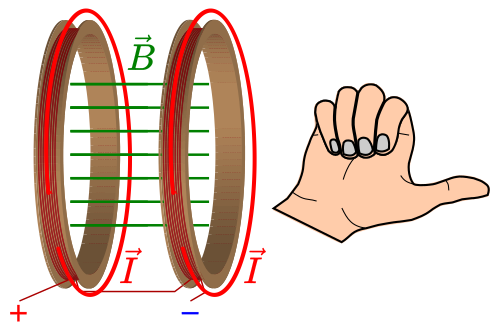
The magnetic field produced by a single loop is not uniform — it varies with position. However, many scientific and practical applications require a uniform magnetic field. إن المجال المغناطيسي الناتج عن حلقة واحدة ليس منتظماً — بل يتغير مع الموقع. ومع ذلك، تتطلب العديد من التطبيقات العلمية والعملية مجالاً مغناطيسياً منتظماً.
I discovered that in the region between two identical coaxial coils, the magnetic field becomes uniform. The closer the coils are brought together, the larger the region of uniformity. اكتشفت أن في المنطقة بين ملفين متطابقين ومحوريين، يصبح المجال المغناطيسي منتظماً. وكلما قربنا الملفين من بعضهما، اتسعت منطقة الانتظام.
The optimal separation for maximum uniformity is when the distance between the coils equals their radius (\(d = R\)). This configuration is now known as Helmholtz coils. المسافة المثلى للحصول على أقصى انتظام هي عندما تكون المسافة بين الملفين مساوية لنصف قطرهما (\(d = R\)). يُعرف هذا التكوين الآن باسم ملفات هلمهولتز.
If we bring the loops even closer and increase the number of loops, we get a wider uniform field. This is known as a solenoid. إذا قمنا بتقريب الحلقات أكثر وزدنا عدد الحلقات، سنحصل على مجال منتظم أوسع. وهذا ما يُعرف بالملف اللولبي.
 🖱️
In this simulation, when a charged particle is launched at a constant speed and perpendicular to a uniform field, the particle will follow a circular path. Launch the particle at the center of a Helmholtz coil, perpendicular to the field, and observe the circular trajectory. This confirms the uniform field at the center of the Helmholtz coil. And do not forget to make the angle between the field and the.في هذه المحاكاة عند قذف جسيم مشحون بسرعة ثابتة وبشكل عمودي على مجال منتظم سوف يتخذ الجسيم مسار دائري إقذف جسيم في مركز ملف هليمهولتز وبشكل عمودي وراقب المسار الدائري هذا يؤكد المجال المنتظم في مركز هلمهولتز ولاتنسى أن تجعل الزاوية بين المجال واالسرعة 90 درجة من خلال جعل زاوية القذف 0.0
بإتجاه محور
🖱️
In this simulation, when a charged particle is launched at a constant speed and perpendicular to a uniform field, the particle will follow a circular path. Launch the particle at the center of a Helmholtz coil, perpendicular to the field, and observe the circular trajectory. This confirms the uniform field at the center of the Helmholtz coil. And do not forget to make the angle between the field and the.في هذه المحاكاة عند قذف جسيم مشحون بسرعة ثابتة وبشكل عمودي على مجال منتظم سوف يتخذ الجسيم مسار دائري إقذف جسيم في مركز ملف هليمهولتز وبشكل عمودي وراقب المسار الدائري هذا يؤكد المجال المنتظم في مركز هلمهولتز ولاتنسى أن تجعل الزاوية بين المجال واالسرعة 90 درجة من خلال جعل زاوية القذف 0.0
بإتجاه محور

Choose the correct answer: اختر الإجابة الصحيحة:
 Click here to show solution
اضغط هنا تظهر طريقة الحل
Click here to show solution
اضغط هنا تظهر طريقة الحل

Choose the correct answer: اختر الإجابة الصحيحة:
Click here to show solution
اضغط هنا تظهر طريقة الحل
Useful Information: Calculating the Magnetic Field of a Solenoid Using Ampere's Law معلومات مفيدة: حساب مقدار المجال المغناطيسي لملف لولبي باستخدام قانون أمبير
We have an ideal solenoid carrying a direct current. Using the right-hand rule, we determine the direction of the field. To calculate the field, we choose a closed surface, preferably a rectangle or square for convenience. ليكن لدينا ملف لولبي مثالي ويمر به تيار مستمر. من خلال قاعدة القبضة نحدد اتجاه المجال. ولحساب المجال نختار سطح مغلق، الأفضل أن يكون على شكل مربع أو مستطيل للسهولة.
Applying Ampere's law:بتطبيق قانون أمبير:
There are four surfaces to consider:يوجد أربع أسطح أمامك:

Apply the following simulation to derive the value of the field for a solenoid. (Every 5 turns have a length of 1 mm. The current is the sum of the enclosed currents - multiply the number of turns by the current intensity used.) طبق المحاكاة التالية لاستنتاج قيمة المجال لملف لولبي. (كل خمس لفات طولها 1 ميلي متر، التيار هو مجموع التيارات المحصورة - أضرب عدد اللفات بشدة التيار المستخدمة.)
Useful Information: Calculating the Magnetic Field of a Toroid معلومات مفيدة: حساب مقدار المجال المغناطيسي لملف حلقي
When the solenoid is bent until its ends meet, it is called a toroid. The toroid is considered ideal (no field outside the toroid - the field is only between the turns). عند ثني الملف اللولبي حتى يلتقي طرفاه يُدعى ملفاً حلقيّاً. إن الملف الحلقي يعتبر مثالياً (لا يوجد مجال خارج الملف، المجال فقط بين الحلقات).
Applying Ampere's law to calculate the field inside the toroid, we choose a loop of radius \(r\): بتطبيق قانون أمبير لحساب المجال داخل الملف نختار حلقة نصف قطرها \(r\):
🧲 اختبار المجال المغناطيسي
حلقات دائرية - ملفات هلمهولتز - الملف اللولبي - 15 سؤالاً
http://subaru.univ-lemans.fr/AccesLibre/UM/Pedago/physique/02/electri/toremagne.html
No comments:
Post a Comment